Embroidery used to have a reputation as something your great-grandmother did while sitting near a window with excellent posture and a cup of tea that never got cold. Today, it is all over Facebook, Pinterest, Instagram, Etsy, denim jackets, sneakers, tote bags, wedding gifts, wall art, and occasionally the sleeve of someone who swore they were “just trying one tiny flower.” Famous last words.
The Facebook page Embroidery-Pics became a viral favorite by doing something beautifully simple: collecting and sharing cool embroidery projects from makers around the world. Bored Panda reported that the page had reached around 1 million followers, proof that a needle, thread, and imagination can compete surprisingly well with dance challenges, celebrity gossip, and videos of raccoons stealing cat food.
Why does embroidery content perform so well online? Because it delivers a satisfying combination of patience, detail, color, texture, and “Wait, that is thread?” surprise. A great embroidered piece can look like a painting, a tiny sculpture, a comic strip, a family keepsake, or a wearable joke. It is slow art made for fast scrolling, and that contrast is exactly what makes it irresistible.
Why Embroidery Is Having Such a Big Online Moment
Embroidery is not new. Far from it. Textile historians trace decorative stitching back thousands of years, and American museums preserve samplers, garments, household linens, and embroidered artworks that show how needlework has carried skill, memory, identity, education, and personal style across generations. What has changed is visibility. A project that once might have been admired by a few family members can now travel across the internet in minutes.
Social media also rewards crafts that are visual at every stage. A blank hoop becomes a sketch. A sketch becomes a few awkward first stitches. Then come color blocks, texture, shadows, and finally a finished object that looks almost impossible. Viewers love the transformation. Makers love the encouragement. Beginners love knowing that even the most jaw-dropping embroidery project began with one stitch that probably looked a little suspicious.
What Makes a Cool Embroidery Project Go Viral?
Not every hoop becomes internet famous, but the projects that do usually share a few qualities. First, they have a strong visual hook. Maybe it is a realistic pet portrait, a 3D flower, a tiny food design, or a landscape that looks like it was painted with floss. Second, they show skill without feeling cold or mechanical. The best embroidery still feels human. You can sense the maker’s decisions in every thread.
Third, viral embroidery often has personality. A perfect rose is lovely, but a rose stitched onto a thrifted denim jacket? Better. A mountain landscape is beautiful, but a mountain landscape inside a three-inch hoop? Now we are leaning closer to the screen. A cat portrait is cute, but a cat portrait with the exact expression of a disappointed landlord? That is shareable art.
30 Of The Best Cool Embroidery Project Ideas Worth Admiring
The following list is inspired by the kinds of creative embroidery projects that make pages like Embroidery-Pics so popular. These are the designs people pause for, save, share, and secretly imagine making before remembering they still have an unfinished scarf from 2019.
1. Thread-Painted Animal Portraits
Realistic pet portraits are among the most impressive hand embroidery projects. With careful shading, directional stitches, and layered colors, artists can recreate fur, whiskers, eyes, and tiny expressions. A good stitched dog portrait can look so alive you half expect it to bark at the mail carrier.
2. 3D Floral Hoops
Raised petals, woven roses, padded satin stitches, and stumpwork techniques can turn a flat hoop into a garden. These pieces are popular because they combine softness and structure, making the flowers look as if they are growing right out of the fabric.
3. Miniature Landscape Embroidery
Mountains, forests, sunsets, deserts, and oceans all work beautifully in thread. The magic comes from blending floss colors the way painters blend pigment. Tiny trees, stitched clouds, and little French-knot flowers can make a hoop feel like a window.
4. Embroidered Denim Jackets
Denim is the unofficial playground of modern embroidery. Florals on the back panel, bees on pockets, vines crawling down sleeves, and names stitched above collars all turn basic jackets into wearable art. It is customization with attitude.
5. Sashiko-Inspired Visible Mending
Visible mending proves that repair can be beautiful. Sashiko-style running stitches, geometric patterns, and contrasting thread can strengthen worn fabric while making jeans, shirts, and bags look intentionally designed instead of accidentally destroyed.
6. Embroidered Food Miniatures
Pizza slices, sushi rolls, strawberries, croissants, cupcakes, ramen bowls, and tiny burgers are surprisingly delightful in thread. Food embroidery works because it is playful, colorful, and just silly enough to make people smile.
7. Botanical Study Hoops
These projects resemble pages from a vintage plant guide. Makers stitch leaves, roots, buds, mushrooms, herbs, and wildflowers with careful labels and natural colors. The result feels part science, part cottagecore, and part “I suddenly need a greenhouse.”
8. Pop Culture Cross-Stitch
Cross-stitch is often grid-based, making it perfect for pixel art, quotes, game references, movie lines, and nostalgic characters. It has the charming energy of an 8-bit video game meeting a sewing basket.
9. Portraits With Embroidered Hair
One trend that always earns attention is portrait embroidery where the face is drawn or lightly stitched, but the hair is made from flowing thread. The texture gives movement, drama, and volume. Basically, shampoo-commercial energy, but handmade.
10. Beaded Insect Embroidery
Butterflies, beetles, bees, moths, and dragonflies become stunning when artists add beads, sequins, metallic thread, or dimensional wings. These projects show how embroidery can cross into jewelry and sculpture.
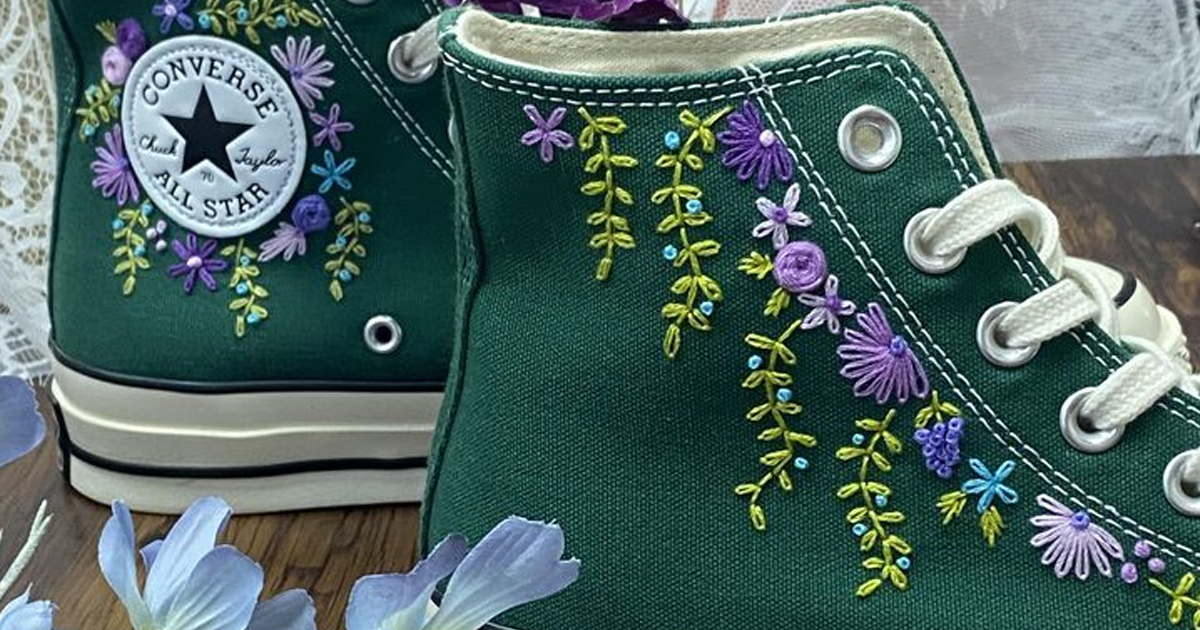
11. Embroidered Sneakers
Canvas shoes offer a small but exciting surface for stitching. Tiny daisies, flames, stars, initials, vines, or cartoon-style icons can make plain sneakers look custom without requiring a full closet makeover.
12. Minimalist Line-Art Embroidery
Not every great design needs forty colors. Single-line faces, hands, plants, and abstract figures can look elegant and modern. These projects are ideal for beginners because the concept is simple but still stylish.
13. Blackwork Patterns
Blackwork uses repeated geometric stitches to create dramatic texture and contrast. It can look historical, gothic, mathematical, or surprisingly contemporary depending on the design. It is proof that one color can still bring the drama.
14. Ribbon Embroidery Roses
Ribbon embroidery creates lush petals and soft curves that regular floss cannot always achieve. Roses, peonies, lavender, and leaves look especially charming with this technique, which has a romantic, heirloom feel.
15. Embroidered Family Portraits
Simple stitched portraits of couples, families, grandparents, children, or pets make meaningful gifts. They do not need photorealistic detail; the charm often comes from recognizable clothing, hair, posture, and little personal touches.
16. Embroidery On Knitwear
Sweaters, cardigans, hats, and mittens can be decorated with flowers, stars, fruit, names, or tiny animals. Embroidery on knitting has become popular because it refreshes old garments and adds cozy personality.
17. Ocean-Inspired Hoops
Waves, coral, shells, jellyfish, whales, and tide pools translate beautifully into thread. Beads can mimic bubbles, metallic thread can suggest water, and layered blues can make the fabric feel deep and cool.
18. Funny Quote Embroidery
Traditional floral borders paired with sarcastic sayings are a modern classic. The contrast between delicate stitching and spicy wording is internet gold. Grandma’s technique, millennial exhaustion, perfect match.
19. Embroidered Maps
Maps stitched onto fabric can mark hometowns, travel routes, wedding locations, hiking trails, or meaningful places. Historic embroidered map samplers also show that geography and needlework have been friends for a long time.
20. Needle-Painted Birds
Bird embroidery is all about color transitions and feather direction. Cardinals, hummingbirds, owls, parrots, and robins can look incredibly lifelike when stitch length and thread shades are handled carefully.
21. Mushroom And Forest Floor Designs
Mushrooms, moss, acorns, ferns, beetles, and tiny woodland details have become favorites among nature-loving stitchers. These projects feel like a fairy tale paused at ground level.
22. Embroidered Book Covers
Fabric book sleeves and journal covers become extra special with stitched names, flowers, moons, quotes, or tiny library motifs. It is a practical project that also says, “Yes, my notebook has better accessories than I do.”
23. Punch Needle Wall Art
Punch needle embroidery creates looped texture that looks plush and graphic. It is especially effective for bold shapes, abstract designs, rugs, pillows, and wall hangings.
24. Whitework Embroidery
White thread on white fabric sounds subtle, but it can be breathtaking. Texture, shadow, pulled stitches, and raised surfaces create elegance without relying on color. It is quiet luxury, but with a needle.
25. Embroidered Patches
Patches are beginner-friendly, giftable, and practical. Makers can stitch patches for backpacks, jackets, hats, uniforms, or craft fairs. They are small enough to finish before motivation wanders off.
26. Stitched Wedding Details
Wedding embroidery can appear on veils, handkerchiefs, ring pillows, bouquet ribbons, jackets, and keepsake hoops. Names, dates, vows, and flowers become heirlooms when stitched by hand.
27. Architectural Embroidery
Houses, storefronts, cabins, city skylines, churches, and landmarks make beautiful embroidery subjects. Clean lines, window details, and layered textures can turn a building into a sentimental keepsake.
28. Embroidered Houseplants
Monstera leaves, pothos vines, succulents, cacti, and hanging plants are modern favorites. They are cheerful, recognizable, and much harder to kill than actual houseplants.
29. Mixed-Media Embroidery
Some artists combine embroidery with watercolor, acrylic paint, fabric scraps, lace, paper, beads, or found objects. These projects stand out because they break the “rules” in clever ways while still keeping thread at the center.
30. Heirloom-Style Samplers With A Modern Twist
Traditional samplers once helped stitchers practice alphabets, borders, numbers, and motifs. Modern versions might include family names, personal jokes, birth dates, favorite places, or symbolic objects. They connect old-school technique with present-day storytelling.
Why People Love Sharing Embroidery Online
Embroidery has a rare ability to make people admire effort. In an online world full of instant filters and one-click effects, a stitched artwork announces that someone sat down, threaded a needle, and committed to the tiny chaos of making something by hand. That kind of patience feels almost rebellious.
There is also a strong community element. Experienced stitchers share tips about hoops, floss, fabric tension, stabilizers, needles, stitches, and color choices. Beginners post their first wobbly flowers and receive encouragement instead of judgment. Online craft communities are not always perfect, but at their best, they turn learning into a group activity.
Pages that curate embroidery projects succeed because they offer inspiration without demanding that everyone become an expert. Some followers stitch every week. Others simply enjoy looking at beautiful work. Both groups matter. Admiration is part of how handmade art stays alive.
How Beginners Can Start Their Own Cool Embroidery Project
The easiest way to begin is with a simple kit. A good beginner embroidery kit usually includes fabric, a hoop, thread, a needle, instructions, and a printed or transferable design. That removes the most intimidating part: standing in front of hundreds of thread colors and wondering why there are twelve reds that all look exactly the same until you buy the wrong one.
Start with basic stitches such as backstitch, running stitch, satin stitch, stem stitch, chain stitch, lazy daisy, and French knots. These stitches can create outlines, petals, lettering, dots, stems, leaves, and small details. Once you understand them, you can complete a surprising number of projects without needing advanced techniques.
Choose fabric that is easy to handle, such as cotton or linen, and keep it tight in the hoop. Use shorter thread lengths to avoid tangles. Separate embroidery floss strands when the pattern asks you to. Most importantly, do not panic if your first stitches look uneven. Embroidery is forgiving. Fabric does not yell. Thread may knot itself into a tiny emotional crisis, but that is normal.
What Cool Embroidery Projects Teach Us About Creativity
The best embroidery projects remind us that creativity does not always need expensive tools or a dramatic studio with perfect lighting. Sometimes it needs a hoop, a needle, thread, fabric, and a willingness to try. The materials are humble, but the results can be extraordinary.
Embroidery also teaches patience in a way that feels productive. You cannot rush a detailed portrait or a field of French knots. You build it slowly, stitch by stitch. That pace is part of the reward. Many people find sewing and embroidery calming because the repeated motions create focus, and the visible progress gives the brain something satisfying to hold onto.
Another lesson is that small details matter. A single highlight in an eye can make an animal portrait feel alive. One darker shade under a petal can add depth. A slightly curved line can turn a flat stem into something graceful. Embroidery trains you to notice.
Experience Section: What It Feels Like To Fall Down The Embroidery Rabbit Hole
Anyone who has spent time looking at cool embroidery projects online knows the experience. You open Facebook for one quick scroll. You see a hoop with a tiny fox sleeping under stitched flowers. You tap. Suddenly the algorithm realizes you enjoy thread-based emotional damage, and now your feed is full of embroidered bees, denim jackets, mushroom patches, pet portraits, and a woman turning a plain tote bag into a botanical masterpiece. Twenty minutes disappear. Your coffee is cold. You are now convinced you need fourteen shades of green.
The funny thing about embroidery inspiration is that it feels both impressive and possible. A hyperrealistic bird might look far beyond beginner level, but a small leaf? That seems doable. A floral monogram? Maybe. A patch for a backpack? Definitely. This is how the hobby sneaks in. It does not kick down the door. It politely offers you a needle and says, “Just try one stitch.”
My favorite part of watching embroidery communities online is the honesty of the process. Finished pieces are gorgeous, but progress photos are even better. You see the pencil sketch, the first uneven outline, the color test, the messy back of the hoop, the moment when the design looks questionable, and then the final reveal where everything suddenly makes sense. That middle stage is comforting because every creative project has an awkward teenager phase. Embroidery simply documents it in thread.
There is also something deeply personal about stitched art. A printed poster can be beautiful, but an embroidered portrait, name, flower, or date carries time inside it. You can tell someone made decisions, fixed mistakes, changed colors, and kept going. That effort gives the object emotional weight. It is why embroidered gifts often feel more meaningful than store-bought decorations. They say, “I thought about you for hours, and occasionally stabbed fabric in your honor.” Romantic, practical, and slightly dramatic.
For beginners, the best experience is usually starting small. A tiny flower on a pocket, a moon on a tote bag, initials on a handkerchief, or a simple hoop with three colors can teach more than a giant ambitious masterpiece that causes despair by step two. Confidence grows through finished projects. The first one does not have to be perfect. In fact, it probably should not be. Imperfection gives it personality, and personality is often what makes handmade work memorable.
Embroidery also changes how you look at ordinary things. A plain shirt becomes a blank canvas. A stain becomes a possible flower. A hole in jeans becomes a design opportunity. A boring tote bag becomes a future garden. Once you start thinking like a stitcher, the world fills with surfaces waiting for tiny decorations. This is charming, but dangerous. Hide your family’s napkins.
The success of a Facebook page dedicated to embroidery makes perfect sense in this context. People are not only looking at pretty pictures; they are looking at evidence of care. In a fast, noisy digital space, embroidered projects feel slow, tactile, and sincere. They remind viewers that beauty can be built patiently, one small stitch at a time. That is why these projects keep being shared, saved, and celebrated. They are not just cool crafts. They are tiny arguments in favor of paying attention.
Conclusion
The Facebook page that gained a massive following by sharing embroidery projects proves that handmade art still has serious power online. Whether it is a realistic pet portrait, a 3D floral hoop, a repaired pair of jeans, or a sarcastic quote surrounded by delicate roses, embroidery continues to evolve without losing its charm. It connects history with humor, patience with personality, and old techniques with modern creativity.
The 30 cool embroidery project ideas above show why people cannot stop scrolling, saving, and sharing stitched art. Embroidery is accessible enough for beginners, deep enough for experts, and expressive enough for anyone with a story to tell. All you need is fabric, thread, a needle, and the courage to begin. A hoop helps too. So does good lighting. And maybe snacks. Definitely snacks.