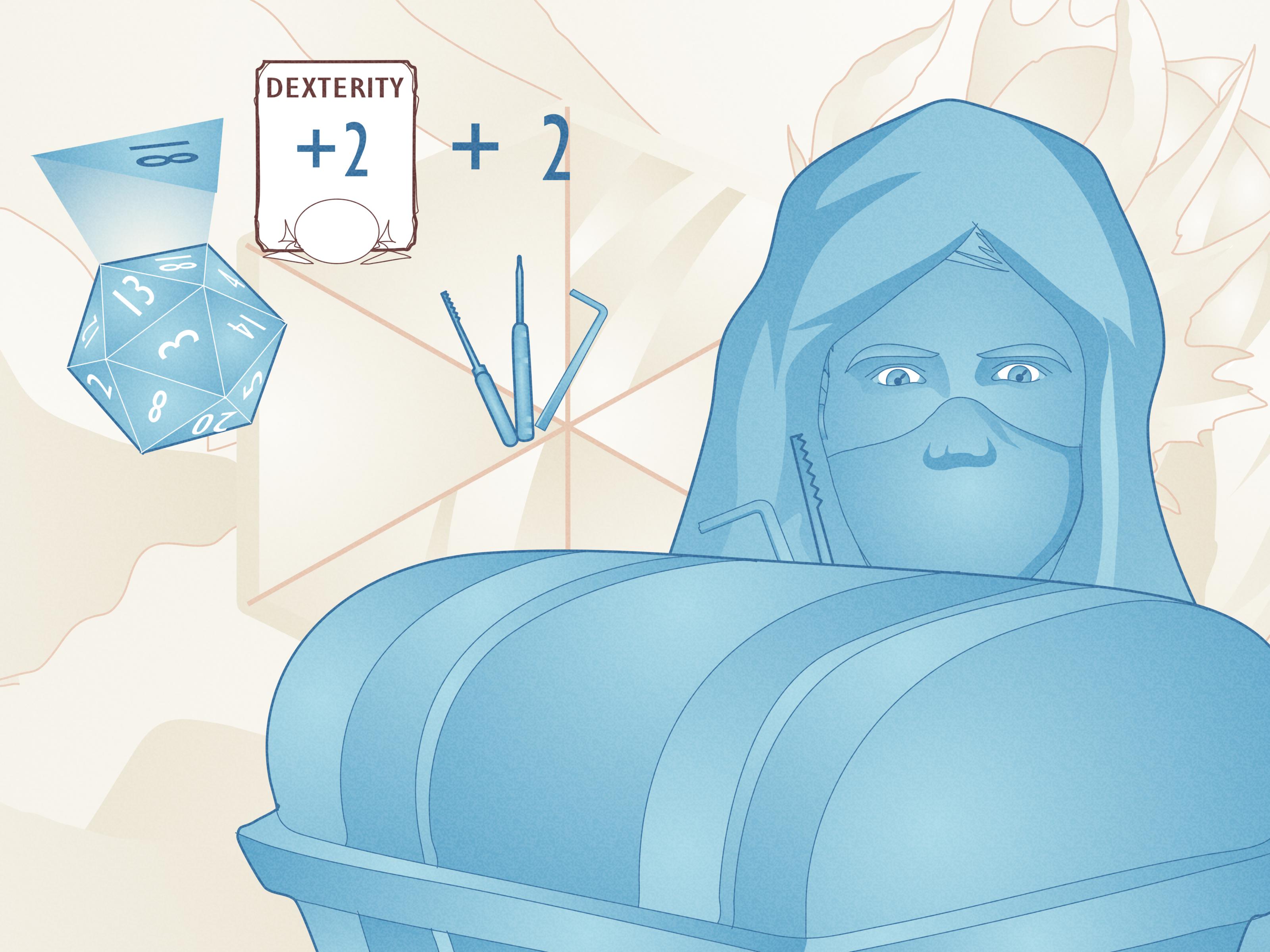
Thieves’ tools in D&D 5e are the tiny, suspiciously useful kit that turns a locked door from “the campaign stops here” into “give me twelve seconds and don’t breathe so loudly.” They are not just a rogue fashion accessory, though every rogue does seem legally required to own a set, jingle them dramatically, and say, “I’ve got this,” before rolling a natural 2.
Mechanically, thieves’ tools are a tool set used for opening locks, disarming mechanical traps, examining tricky devices, and giving clever players a way to solve problems without immediately setting the furniture on fire. They matter because D&D 5e treats locks and traps as challenges that often require both the right equipment and the right proficiency. The tools do not replace creative thinking, but they give that thinking a rules-supported handle.
This guide explains the attributes of thieves’ tools, how they work in both 2014-style and 2024-style D&D 5e play, what rolls to make, how to calculate modifiers and success chances, and how Dungeon Masters can make them fun without turning every chest into a tax audit with hinges.
What Are Thieves’ Tools in D&D 5e?
Thieves’ tools are a specialized tool kit used by adventurers to interact with locks and traps. The classic set includes items such as a small file, lock picks, a small mirror on a metal handle, narrow-bladed scissors, and pliers. In plain adventuring language, this is the “please do not explode the treasure chest” kit.
In the 2014 rules, thieves’ tools are described broadly: proficiency with them lets a character add their proficiency bonus to ability checks made to disarm traps or open locks. Tool use is not permanently tied to one ability score, so the Dungeon Master can call for Dexterity, Intelligence, Wisdom, or another ability depending on the situation.
In the 2024 revision, the presentation is more standardized. Thieves’ tools are associated with Dexterity, and their listed uses include picking a lock or disarming a trap, commonly with a DC 15 example. This does not mean every lock in the multiverse politely has DC 15 printed on the bottom. It means the rules now give DMs a clearer default.
Thieves’ Tools Attributes
Here are the most important attributes players and DMs usually need at the table:
| Attribute | Typical 5e Value or Rule | Why It Matters |
|---|---|---|
| Item Type | Tool | Used with tool proficiency, not weapon or armor proficiency. |
| Cost | Usually 25 gp | Important for starting gear, shopping, and replacement kits. |
| Weight | Usually 1 lb. | Light enough to carry unless your inventory is already a traveling junk drawer. |
| Common Ability | Dexterity | Most lockpicking and delicate trap work depends on careful hands. |
| Main Uses | Open locks, disarm traps | The two classic reasons adventurers keep them handy. |
| Proficiency Benefit | Add proficiency bonus when applicable | This is the big mechanical reward for being trained. |
Who Gets Proficiency with Thieves’ Tools?
Rogues are the obvious answer, but they are not the only answer. Depending on the rule set, background, class, feat, or character-building option used at your table, several characters can start with or gain thieves’ tools proficiency. Criminal-style backgrounds commonly fit the theme, and some DMs also allow training during downtime.
The important distinction is this: owning thieves’ tools and being proficient with thieves’ tools are not the same thing. A fighter can buy the kit. A rogue who is proficient gets to use the kit with training. The fighter is holding tiny metal instruments and optimism. The rogue is holding tiny metal instruments and a resume.
How Do Thieves’ Tools Rolls Work?
The basic calculation is simple:
d20 + relevant ability modifier + proficiency bonus if proficient + other bonuses or penalties = total check result
If the total equals or beats the Difficulty Class, the character succeeds. If it does not, the character fails, makes no progress, or succeeds with a complication if the DM prefers a more cinematic ruling.
Example: Picking a Simple Lock
A level 1 rogue has Dexterity 16, giving a +3 Dexterity modifier. Their proficiency bonus is +2. If they are proficient with thieves’ tools, their check is:
d20 + 3 + 2 = d20 + 5
Against a DC 15 lock, the rogue needs a 10 or higher on the d20. That means 11 successful results out of 20, or a 55% chance. Congratulations: the rogue is competent, but the dice goblin still has legal custody of the evening.
Example: A Skilled Higher-Level Rogue
Now imagine a level 5 rogue with Dexterity 18 and expertise applied to thieves’ tools under a rules setup that allows it. Dexterity gives +4, proficiency bonus is +3, and expertise doubles that proficiency bonus to +6.
d20 + 4 + 6 = d20 + 10
Against a DC 20 lock, the rogue needs a 10 or higher again, so the chance is still 55%. Against DC 15, the rogue needs only a 5 or higher, giving an 80% chance. That is when the rogue starts looking at locks the way a chef looks at onions.
Common DCs for Thieves’ Tools Checks
D&D 5e commonly uses these broad Difficulty Classes:
| Difficulty | DC | Thieves’ Tools Example |
|---|---|---|
| Very Easy | 5 | A rusty latch with barely any real security. |
| Easy | 10 | A cheap lock on a common storage box. |
| Medium | 15 | A standard lock or simple trap mechanism. |
| Hard | 20 | A quality lock, noble’s cabinet, or well-made dungeon trap. |
| Very Hard | 25 | A masterwork lock or complex trap under pressure. |
| Nearly Impossible | 30 | A legendary vault mechanism designed by someone with trust issues. |
Not every locked door needs a roll. If there is no meaningful pressure, no consequence for failure, and the character is trained, the DM can simply say the character succeeds after a few moments. Rolling is best when the result matters: guards are coming, the trap may trigger, the room is filling with water, or the barbarian is whispering “I can solve this” while holding an axe.
2014 Rules vs. 2024 Rules: What Changed?
The biggest practical difference is clarity. The 2014 version gives DMs more open-ended flexibility. A check might be “Dexterity using thieves’ tools,” but the rules also support the idea that tools are not tied to one ability. For example, the DM might call for Intelligence using thieves’ tools to understand an unfamiliar locking mechanism, or Wisdom using thieves’ tools to work by touch in total darkness.
The 2024 version makes tools easier to run quickly. Thieves’ tools are tied to Dexterity, and the listed Utilize actions provide direct examples such as picking a lock or disarming a trap at DC 15. The 2024 rules also make the relationship between skills and tools more explicit: when a tool and a relevant skill both apply, and the character has the right proficiencies, advantage may come into play depending on the check structure.
For most tables, the experience is similar: roll a d20, add Dexterity, add proficiency if trained, and see whether the rogue becomes the hero or the chest becomes a surprise porcupine.
Do You Need Thieves’ Tools to Pick a Lock?
Usually, yes. A tool helps a character do something they could not reasonably do barehanded. In fantasy terms, picking a lock without thieves’ tools is like trying to write calligraphy with a sausage: brave, memorable, and probably not what the rules intended.
That said, the DM has final authority. A character might improvise with a hairpin, wire, dagger tip, or other object if the scene supports it. The DM may allow the attempt with disadvantage, a higher DC, or limited effectiveness. However, thieves’ tools are the normal game object for the job, and proficiency represents actual training.
Can Non-Rogues Use Thieves’ Tools?
Absolutely. Nothing says only rogues are allowed to touch the kit while ominous flute music plays. A bard with the right background, an artificer with tool expertise, a ranger trained as a scout, or even a wizard with a suspicious past can use thieves’ tools if they have them. If they are proficient, they add proficiency. If not, the DM may still allow a raw ability check when appropriate.
This is good party design. When the rogue is absent, unconscious, polymorphed into a goat, or emotionally unavailable after failing three checks in a row, someone else might still save the expedition.
Thieves’ Tools and Skills: Sleight of Hand, Investigation, and Perception
Thieves’ tools do not exist in a vacuum. They often work alongside skills:
- Perception may notice a suspicious wire, seam, needle hole, pressure plate, or unusual keyhole.
- Investigation may help understand how a trap or mechanism works.
- Sleight of Hand may apply when the task depends on delicate manual control.
- Arcana may matter if the trap is magical rather than mechanical.
A clean trap sequence might look like this: first, a Wisdom (Perception) check notices something strange. Second, an Intelligence (Investigation) check identifies the mechanism. Third, a Dexterity check using thieves’ tools disables the device. That sounds like a lot, so DMs should use the full sequence only when the trap is important. For a simple chest trap, one good check may be enough.
Calculating Success Chance
To estimate success chance, use this method:
- Find the DC.
- Find the character’s total modifier.
- Subtract the modifier from the DC to find the minimum d20 roll needed.
- Count successful numbers on the d20.
- Multiply by 5% for each successful number.
Example Probability Table
| DC | Modifier | Needed Roll | Success Chance |
|---|---|---|---|
| 15 | +5 | 10+ | 55% |
| 15 | +8 | 7+ | 70% |
| 20 | +5 | 15+ | 30% |
| 20 | +10 | 10+ | 55% |
| 25 | +10 | 15+ | 30% |
Advantage changes the math dramatically. If a character has a 55% chance normally, advantage raises that chance to about 80%. That is why advantage on tool checks feels so powerful. It does not merely add a number; it gives the player two chances to dodge the cruel little cube of fate.
What Happens When You Fail?
Failure should depend on the situation. A failed thieves’ tools check does not always mean the tools break, the trap explodes, and the rogue must retire to open a bakery. Possible outcomes include:
- The lock remains closed.
- The attempt takes longer than expected.
- The trap triggers.
- The mechanism jams.
- The party makes noise and attracts attention.
- The character learns something useful but does not solve the problem yet.
Good failure keeps the game moving. “Nothing happens, try again” can become dull unless there is time pressure. A better ruling might be: “You can open it, but it will take ten minutes,” or “You fail quietly, but now you know the lock is beyond normal craftsmanship.”
Creative Uses for Thieves’ Tools
Thieves’ tools are not only for locked doors. Within a fantasy adventure, they can support all kinds of careful mechanical interaction. A character might use them to open a trapped coffer, remove a tiny gear, inspect a hidden needle mechanism, disable a tripwire housing, recover evidence from a lock, or sabotage a dungeon device in a non-destructive way.
They can also help with social and exploration scenes. A rogue might examine a noble’s locked writing desk during a masquerade, open shackles without waking the guard, or identify whether a lock was recently tampered with. The important limit is that thieves’ tools are a game abstraction, not a real-world instruction manual. Keep their use safely in the realm of fantasy problem-solving.
Tips for Players
Describe Your Approach
Do not just say, “I roll thieves’ tools.” Say what your character is trying to do. Are you working slowly and quietly? Checking for traps first? Trying to open the lock quickly before patrols return? The description helps the DM choose the ability, DC, consequences, and whether advantage or disadvantage applies.
Ask About the Environment
A lock in a dry noble’s study is different from a lock under seawater, in magical darkness, during combat, or while a gelatinous cube is making direct eye contact. Conditions matter.
Bring Backup Plans
Thieves’ tools are excellent, but they are not a universal key. Knock spells, brute force, bargaining, secret passwords, alternate entrances, and bribing the goblin intern are all valid solutions. A clever party treats thieves’ tools as one option, not the entire strategy.
Tips for Dungeon Masters
Use Locks and Traps with Purpose
A lock should protect something meaningful, create tension, reveal worldbuilding, or offer a choice. If every broom closet has a DC 25 lock, players will stop feeling challenged and start wondering whether the janitor is secretly Vecna.
Vary the Consequences
Not every failed roll should trigger damage. Some failures cost time, resources, stealth, or information. This keeps thieves’ tools scenes interesting and avoids making every trap feel like a disguised hit point tax.
Reward Proficiency
If a player invested in thieves’ tools, let that choice matter. Include locks, traps, mechanisms, hidden compartments, and investigation opportunities where their training shines. Character choices feel better when the world notices them.
Table Experiences: What Actually Makes Thieves’ Tools Fun
In actual play, thieves’ tools work best when they create suspense without freezing the session. The most memorable scenes are rarely “I rolled a 17, the door opens.” They are the moments when the rogue is crouched beside a chest while the paladin distracts guards with a fake religious debate, the wizard is counting seconds on a spell duration, and the barbarian is whispering tactical advice that consists entirely of “hit it.”
One useful experience from many tables is that players enjoy knowing the stakes before rolling. A DM might say, “You can try to open it quickly, but a failure makes noise,” or “You can take your time and avoid the noise risk, but the patrol may get closer.” This turns a simple check into a decision. The player is not merely rolling; they are choosing a style of risk.
Another lesson is that locks should match the story. A goblin supply chest might be DC 10 or 15 because it is practical, not luxurious. A duke’s private coffer might be DC 20 because it was made by a skilled locksmith. A vault in an ancient lich-temple might be DC 25 or higher, and it probably has a second problem waiting behind the first problem, because liches are famously not chill about visitors.
It also helps to separate discovery from disarming when the trap matters. If players never get a chance to notice traps, thieves’ tools feel like punishment insurance. If they can investigate, plan, and then use the tools, the scene becomes interactive. The party can brace a shield, use mage hand, examine old bloodstains, pour water to reveal seams, or send the familiar to scout. The thieves’ tools check becomes the final delicate move after smart play, not the only move.
At the same time, avoid overcomplicating minor obstacles. If the rogue is proficient, not under pressure, and dealing with an ordinary lock, automatic success after a short time can be better than rolling. This keeps the game moving and makes proficiency feel professional. Dice should appear when the question is dramatic, not when the party wants to open a pantry.
For players, the best habit is to treat thieves’ tools as a storytelling prompt. Mention that your character checks the frame, listens for movement inside the mechanism, uses the mirror to inspect the underside of the latch, or pauses when something feels wrong. These descriptions do not need to become real-world technical detail; they simply give the DM hooks for advantage, clues, or interesting consequences.
For DMs, the best habit is to let failure change the situation instead of ending it. Maybe the lock opens, but the attempt leaves scratches. Maybe the trap is disabled, but the poison vial is cracked and must be handled carefully. Maybe the character cannot open the vault, but they identify the maker’s mark and learn where the matching key might be. This style keeps the adventure alive even when the die rolls badly.
In short, thieves’ tools are fun when they support tension, choices, and character identity. They let the expert feel like an expert, give the party quiet alternatives to loud violence, and make dungeons feel like places built by paranoid people with budgets. That is exactly the kind of problem adventurers deserve.
Conclusion
Thieves’ tools in D&D 5e are small, light, affordable, and wildly important when the adventure includes locks, traps, vaults, hidden compartments, or any door the DM describes with suspicious enthusiasm. The core calculation is easy: roll a d20, add the relevant ability modifier, add proficiency if trained, apply other bonuses or advantage when appropriate, and compare the total to the DC.
The real magic, however, is not the math. It is the way thieves’ tools create quiet tension. They give the rogue a spotlight, reward careful planning, and offer a solution that does not involve kicking down every door like a tax-collecting minotaur. Used well, thieves’ tools are not just equipment. They are an invitation to play smarter, sneakier, and funnier.