A sparkling swimming pool can look perfectly innocent while quietly plotting against your eyes, pool liner, heater, and weekend plans. Clear water is not necessarily balanced water, and cloudy water is not always fixed by tossing in another scoop of chlorine. The only dependable way to know what your pool needs is to test it.
Regular pool water testing reveals whether the sanitizer is working, the pH is comfortable, and the water is balanced enough to protect pool surfaces and equipment. It also prevents the classic pool-maintenance mistake: adding chemicals based on a hunch, then adding more chemicals to repair the first hunch.
This guide explains how to test pool water with strips, liquid reagent kits, and digital testers. It also covers the most important readings, proper sampling techniques, common testing errors, and practical lessons that experienced pool owners learn after a few summers of chemistry experiments.
Why Testing Pool Water Matters
Pool water is constantly changing. Sunlight breaks down chlorine, swimmers introduce oils and organic material, rain dilutes chemicals, and evaporation leaves minerals behind. Even topping off the pool with tap or well water can alter pH, alkalinity, hardness, or metal levels.
Testing gives you information before you add anything. That matters because too little sanitizer can allow germs and algae to multiply, while excessive chemical treatment can irritate swimmers and damage equipment. Poorly balanced water may also corrode metal components, etch plaster, fade liners, produce scale, or turn a clear pool into something resembling vegetable soup.
The CDC recommends maintaining pool water at a pH of 7.0 to 7.8. It also recommends at least 1 part per million, or ppm, of free chlorine in pools without cyanuric acid and at least 2 ppm when cyanuric acid or stabilized chlorine is used. Product labels, equipment instructions, and local health requirements may specify narrower operating ranges.
What Should You Test in Pool Water?
A basic testing routine should cover sanitizer and pH. A more complete water analysis also includes total alkalinity, calcium hardness, and cyanuric acid. Saltwater pools need a salt reading, while pools with recurring stains or algae may occasionally require tests for metals or phosphates.
Free and Total Chlorine
Free chlorine is the portion available to sanitize the water. Total chlorine includes both free chlorine and combined chlorine. Combined chlorine, commonly associated with chloramines, is calculated by subtracting free chlorine from total chlorine.
A noticeable difference between total and free chlorine can indicate that chlorine has reacted with contaminants. Ironically, the harsh “chlorine smell” around a pool may signal a chloramine problem rather than an abundance of clean, active sanitizer.
pH
The pH reading describes how acidic or basic the water is. Low pH can make the water corrosive and uncomfortable. High pH can reduce chlorine efficiency and encourage cloudy water or scale formation.
Many residential pool systems are managed within a range of approximately 7.2 to 7.8, though the correct target should follow the sanitizer label and equipment manufacturer’s recommendations. The pH scale is logarithmic, so a small numerical change represents a meaningful chemical shift. Your pool is not being dramatic; the math really is.
Total Alkalinity
Total alkalinity measures the water’s ability to resist sudden pH changes. Think of it as the pool’s shock absorber. When alkalinity is too low, pH may bounce around. When it is excessive, lowering pH can become frustratingly difficult.
A commonly recommended residential range is about 80 to 120 ppm, although the ideal level depends partly on the sanitizer, pool surface, and overall water balance.
Calcium Hardness
Calcium hardness measures dissolved calcium in the water. Insufficient calcium can contribute to aggressive water that attacks plaster or grout. Excessive calcium, especially when combined with high pH and warm water, can encourage scale.
Many pool guides use a broad working range of roughly 200 to 400 ppm, but the preferred target varies among plaster, fiberglass, and vinyl-lined pools. Water temperature, alkalinity, pH, and dissolved solids also affect whether the water is corrosive or scale-forming.
Cyanuric Acid
Cyanuric acid, or CYA, protects chlorine from rapid destruction by ultraviolet sunlight. It is helpful in outdoor pools, but more is not always better. High CYA can reduce the speed at which chlorine disinfects the water, meaning the chlorine reading must be considered alongside the stabilizer level.
Many residential outdoor systems use approximately 30 to 50 ppm of CYA, but sanitizer products and salt-chlorine-generator manuals may call for different targets. Indoor pools generally do not need sunlight protection.
Salt, Metals, and Phosphates
A saltwater chlorine generator needs enough dissolved salt to operate, but the correct concentration is model-specific. Use the generator’s manual rather than a universal internet number.
Iron and copper tests are useful when water develops colored stains, unusual tinting, or discoloration after chlorination. Phosphate testing may help when algae repeatedly returns despite otherwise appropriate sanitation, but phosphate results should not replace routine chlorine, pH, filtration, and brushing practices.
Choosing a Pool Water Testing Method
Pool Test Strips
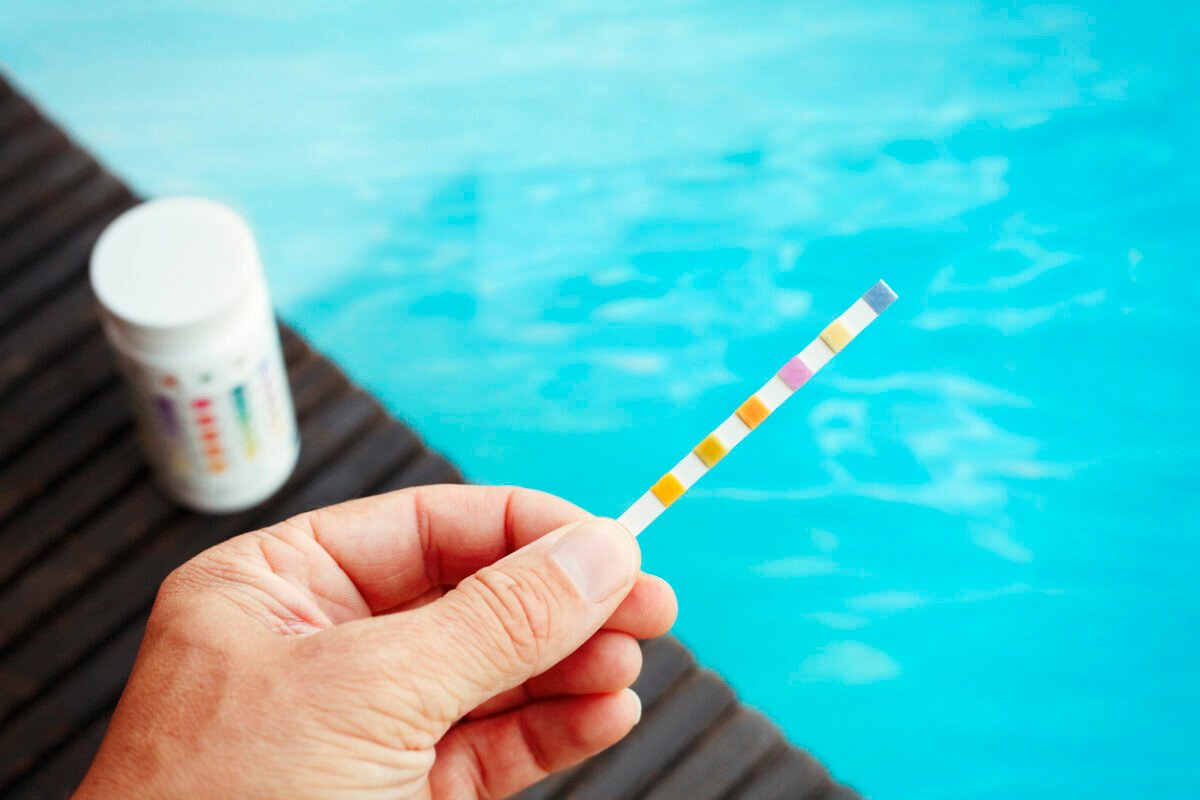
Test strips are quick, inexpensive, and easy to use. A multi-parameter strip can check chlorine, pH, alkalinity, hardness, and stabilizer within seconds. They are especially useful for frequent screening and for pool owners who would rather not perform a miniature chemistry lab before breakfast.
The trade-off is precision. Colors can be difficult to distinguish, moisture can damage unused strips, and results may be affected by improper timing. Strips are excellent for spotting trends, but an unexpected result should often be confirmed with a good liquid kit or professional test.
Liquid Reagent Test Kits
Liquid kits generally provide more precise readings than basic strips. Depending on the kit, you may add drops to a measured sample, compare a developed color with a standard, or count drops until the sample reaches a specified endpoint.
These kits require a little more patience, but they are well suited to homeowners who adjust their own water chemistry. Accurate sample volume, vertical dropper bottles, fresh reagents, correct mixing, and careful counting are essential.
Digital Testers and Photometers
Digital devices can reduce the guesswork involved in matching colors. Some test only pH or salt, while advanced photometers analyze several parameters with reagent tablets or disks.
Digital does not mean maintenance-free. Sensors may need calibration, testing chambers must remain clean, and reagents still expire. A poorly calibrated meter can deliver an incorrect result with impressive numerical confidencethe pool-care equivalent of being wrong in a business suit.
Modern photometers may measure free chlorine, total chlorine, pH, alkalinity, calcium hardness, cyanuric acid, and additional parameters.
How to Test Pool Water Correctly
Step 1: Circulate the Water
Run the circulation system long enough for the pool water to mix. Avoid testing immediately after chemicals have been poured into one location. A concentrated pocket near a return jet or chemical feeder will not represent the entire pool.
Step 2: Inspect the Testing Supplies
Confirm that reagents and strips have not expired or suffered heat and moisture damage. Keep testing products tightly closed and stored indoors in a cool, dry place. Do not leave the kit beside the equipment pad all summer, where it can be slowly baked into a colorful box of misinformation.
Step 3: Collect a Representative Sample
Move away from return jets, skimmers, steps, corners, chemical feeders, and obvious dead zones. Collect water from the middle portion of the pool, approximately elbow-deep or about 18 inches below the surface. For pools with shallow and deep ends, the area near the transition between them is often a practical sampling location.
Use a clean plastic testing cell or sample container. Rinse it with pool water before filling it to the line required by the test. Test the sample promptly because sanitizer readings can change while water sits in the container.
Step 4: Use the Selected Testing Method
For test strips: Remove one strip without touching the testing pads. Close the container immediately. Dip the strip exactly as directed, remove it, and hold it in the position specified by the manufacturer. Wait the required development time, then compare each pad with the chart under neutral white light or indirect daylight.
For a liquid kit: Fill the test cell to the correct line. Add the specified reagents in the proper order. Hold dropper bottles vertically so the drops remain consistent. Cap and invert, swirl, or mix according to the instructions. For a titration test, count each drop until the instructed color change occurs.
For a digital tester: Calibrate the device when required, rinse the probe or chamber, and follow the manufacturer’s testing sequence. Never assume that calibration performed months ago is still perfect.
Step 5: Record the Results
Write the readings in a notebook, spreadsheet, or pool-care app. Include the date, weather, water temperature, chemicals added, and unusual events such as heavy rain or a large pool party.
A testing history makes trends visible. For example, steadily rising CYA may point to repeated use of stabilized chlorine tablets, while recurring pH increases may be associated with aeration, new plaster, or the operation of a saltwater chlorine generator.
Step 6: Confirm Suspicious Readings
When a result looks wildly different from the previous test, repeat it before treating the pool. Use a fresh sample, verify the instructions, and confirm the result with another method when possible.
A professional pool-store analysis can be helpful when opening a pool, investigating stains, correcting severe imbalance, or comparing your home kit with another instrument. Bring a fresh sample in a clean plastic bottle and have it tested promptly.
How Often Should Pool Water Be Tested?
For a typical residential pool, test free chlorine and pH at least two or three times per week. Daily checks may be appropriate during very hot weather, heavy use, algae treatment, equipment problems, or periods of rapid chlorine loss.
Test alkalinity weekly until the pool becomes predictable, then continue at regular intervals. Calcium hardness and CYA usually change more slowly, but they should be checked after substantial water replacement, major rainfall, opening the pool, or changing sanitizer products.
Test again after a large pool party, a storm, visible algae, unexpected cloudiness, a major chemical addition, or a prolonged pump shutdown. Frequent testing is cheaper than rescuing a green pool, and it involves considerably less brushing while questioning your life choices.
Common Pool Testing Mistakes
Sampling From the Wrong Location
Water collected beside a return jet, floating chlorinator, step, or skimmer may produce a distorted result. Use a consistent central location and depth.
Reading a Test Too Early or Too Late
Color reactions are time-sensitive. Set a timer when necessary instead of relying on your internal clock, especially if your internal clock is also supervising children and grilling hamburgers.
Touching Test Pads or Reagent Tips
Wet fingers, sunscreen, dirt, and chemical residue can contaminate a strip. Reagent tips should not touch the sample container or other surfaces.
Using Old Testing Products
Heat, sunlight, moisture, freezing temperatures, and age can degrade testing supplies. Replace questionable reagents rather than adjusting thousands of gallons of water based on a bottle that has lived through three presidential administrations.
Correcting Everything at Once
Do not dump several balancing products into the pool simultaneously. Confirm the pool volume, calculate doses carefully, add products separately, allow adequate circulation, and retest according to label instructions.
Never mix pool chemicals together. Keep products dry, use separate measuring tools, add chemicals only as directed, and store incompatible products apart. Pool chemicals can produce fires, dangerous gases, or serious injuries when mishandled.
Practical Pool Water Testing Experiences
The most useful lesson from repeated pool testing is that one isolated number rarely tells the complete story. A homeowner may see low free chlorine and immediately add more sanitizer. However, if the pH is high, the CYA is excessive, or the pump has not circulated properly, that chlorine may not solve the real problem. Experienced pool owners learn to read the results as a group rather than treating every measurement like an unrelated emergency.
Another common experience involves test strips that appear to disagree with themselves. One reading looks normal, the next looks suspicious, and the third seems to have been designed by an abstract artist. This often happens because the bottle was left open, the pads were touched, or the colors were read after the approved time window. Repeating the test carefullyand confirming it with a liquid kitusually provides a more believable answer.
Heavy rain offers another practical lesson. After a storm, a pool can look clean while its sanitizer level has dropped and its pH or alkalinity has shifted. Rain also carries dust, pollen, leaves, and other contaminants into the water. Testing after significant rainfall is therefore more useful than waiting for cloudiness or algae to announce the problem with a full theatrical performance.
Pool parties create a similar pattern. A dozen swimmers can consume sanitizer much faster than a quiet afternoon with one person floating peacefully and pretending not to hear the phone. Sunscreen, sweat, cosmetics, and organic material increase chlorine demand. Testing before the gathering helps establish safe water, while testing afterward reveals whether the pool needs additional sanitation or filtration.
New pool owners also discover that chasing pH can become expensive. They lower it, test too soon, add more acid, and later find that the pH dropped farther than intended. The better approach is to confirm alkalinity, use accurately calculated doses, keep the pump running, and allow the water to mix before retesting. Small, measured corrections are usually easier to control than one heroic chemical pour.
Saltwater pools provide another surprise: they are still chlorine pools. The salt cell produces chlorine from dissolved salt, but the owner must continue testing chlorine, pH, alkalinity, hardness, stabilizer, and salt. In fact, pH may require close attention in some saltwater systems. The presence of a digital control panel does not mean the water has agreed to manage itself.
Finally, experienced owners learn the value of keeping records. Memory tends to report that “the pool was fine last week,” while a written log may show that chlorine has declined for four consecutive tests. That trend can reveal a dirty filter, increased sunlight, depleted stabilizer, algae growth, or a malfunctioning feeder before the water visibly deteriorates.
The practical goal is not to achieve one perfect set of numbers and preserve it forever. Pool water changes every day. Successful maintenance comes from testing consistently, recognizing trends, making modest corrections, and confirming the result. Once that routine becomes familiar, pool chemistry stops feeling like wizardry and starts feeling like ordinary preventive maintenancewith slightly more goggles.
Final Thoughts
Learning how to test pool water is one of the most valuable skills a pool owner can develop. Collect the sample correctly, follow the testing instructions exactly, record the results, and investigate unusual readings before reaching for another chemical container.
Test strips are convenient for routine checks, liquid kits offer greater precision, and digital instruments reduce color-matching guesswork. Whichever method you choose, consistency matters more than owning the fanciest equipment. A few careful minutes of testing can protect swimmers, preserve pool surfaces, reduce chemical waste, and keep your backyard oasis from becoming a very expensive biology project.
Note: Recommended operating ranges can vary according to pool construction, sanitizer type, water temperature, equipment specifications, product labels, and local regulations. Always follow the instructions supplied with your testing kit, chemicals, and pool equipment.