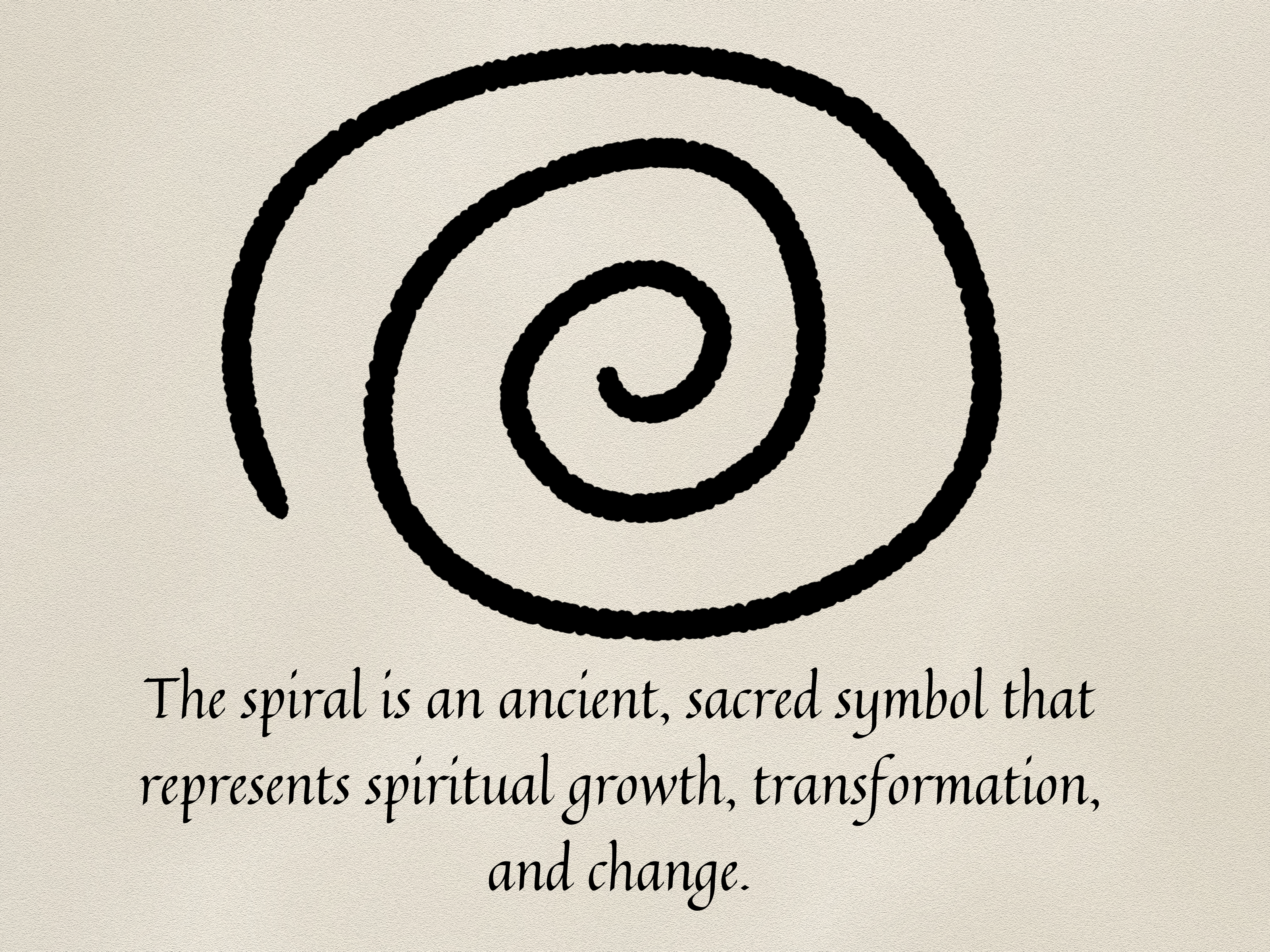
The spiral is one of those symbols that seems to show up everywhere once you start noticing it. It curls through seashells, sunflowers, storm systems, ancient carvings, sacred paths, textiles, jewelry, and modern art. It appears in places separated by oceans and centuries, which is why people keep returning to the same question: what does the spiral actually mean?
The short answer is that the spiral usually points to movement with meaning. Unlike a straight line, it does not rush from point A to point B like a caffeine-fueled intern on deadline. It turns, circles, deepens, and expands. Spiritually, that makes it a powerful symbol for growth, transformation, return, rebirth, memory, and the strange but beautiful fact that human life rarely unfolds in a neat sequence.
Still, it is worth saying upfront that the spiral is not a universal code with one fixed message stamped on it forever. Different cultures have used spiral forms in different ways. In some Indigenous North American traditions, spiral imagery can relate to migration, emergence, sacred landscapes, or time. In labyrinth practice, spiral-like paths often symbolize an inward journey and a changed return. In ancient and later European art, the spiral can suggest infinity, continuity, or the union of opposite forces. In modern art, it may stand for entropy, resurrection, memory, or ecological awareness. The symbol keeps recurring because it is flexible enough to hold many truths at once.
What the Spiral Spiritually Means
Growth That Is Not Linear
One of the most common spiritual readings of the spiral is personal growth. Not glow-up growth in the social media sense, but actual soul-level growth: learning, losing, remembering, beginning again, and somehow becoming wiser with each round. A spiral returns to familiar territory, yet never in exactly the same place. That makes it a useful image for healing, faith, grief, and maturity. You revisit old questions, but from a new level of awareness.
That idea resonates because it feels true. Most people do not “solve” life once and move on in a straight line. We circle back to love, identity, purpose, fear, family, and mortality over and over again. The spiral says that repetition is not failure. It may be development.
Life, Death, and Rebirth
The spiral also carries strong associations with cycles. In spiritual language, it often suggests birth, death, renewal, seasonal return, and the unfolding of sacred time. A spiral seems to move outward endlessly while remaining anchored to a center, which makes it a natural symbol for both continuity and change. That is one reason spiral imagery appears so often in discussions of eternity, fate, regeneration, and the ongoing motion of the cosmos.
This does not mean every culture used the symbol in exactly the same theological way. It does mean the shape itself lends powerfully to ideas of recurrence: endings that are also beginnings, departures that are also homecomings, and time that behaves more like a tide than a ruler.
The Journey Inward and the Return Outward
Many spiritual interpretations of the spiral focus on movement toward the center. The center can represent truth, God, the self, memory, source, silence, or revelation. The outward motion can then symbolize return to the world with insight, healing, or responsibility. In that sense, the spiral is both mystical and practical. It is not merely about escape. It is about transformation that eventually has to walk back into ordinary life, answer emails, and still carry meaning.
This inward-then-outward pattern helps explain why the spiral appears so often in meditation, pilgrimage, prayer, and reflective art. It mirrors the human rhythm of retreat and return.
Why the Spiral Feels Sacred in the First Place
Part of the spiral’s power comes from nature. People have long noticed spiral forms in shells, plants, weather patterns, and the larger visual drama of the universe. Even when ancient communities did not describe these patterns in modern mathematical language, they clearly recognized that the world itself moves in recurring, curling, expanding forms. Nature made the spiral feel old before religion or philosophy gave it a formal interpretation.
There is also a nice reality check here. Modern pop spirituality often claims that every spiral in nature proves one specific sacred formula, usually while dramatically pointing at a nautilus shell. Real life is more interesting. The nautilus does form a logarithmic spiral, but it is not a perfect cheat sheet for every “golden ratio” claim on the internet. Even so, spiral growth in shells and plants remains genuinely fascinating. Spirals in flowers and seed heads reflect real growth patterns and efficient packing. In other words, the symbol feels mystical partly because the natural world really does keep sketching versions of it.
That bridge between wonder and observation matters. The spiral sits comfortably between science and spirituality because it can be admired as a pattern, a metaphor, and a sacred sign all at once.
Cultural Symbolism of the Spiral Across Traditions
Indigenous North American Meanings
In the American Southwest, spiral imagery appears in rock markings, and its meaning is often connected to place, time, migration, and spiritual knowledge. Some interpretations recorded by the National Park Service describe the spiral as a migration symbol, though even within Native communities that meaning can vary. One interpretation begins in the center and moves outward; another understands the center as the final goal. That difference is important because it reminds us not to flatten living traditions into one tidy sentence for the convenience of a caption.
Other contexts add more layers. Spiral petroglyphs in relation to sunlight and landscape have been understood as solar calendars in some locations. At Mesa Verde, a boxy spiral has been associated with the sipapu, the emergence place tied to origin stories in Pueblo traditions. Elsewhere, government and tribal interpretation emphasizes that rock markings are not merely decorative “art” but communications embedded in land, story, and belief. Their deepest meanings may be guarded, local, or partially lost to outsiders.
The spiral also appears in Native historical recording. The Lone Dog Winter Count, for example, arranges pictographic history from the center of a hide outward in a counterclockwise spiral. Here the shape is not just pretty design. It is memory organized in motion. Contemporary Native artists have also used spiral structures to express Indigenous concepts of time and continuity between generations. In this context, the spiral can suggest history as living recurrence rather than a simple colonial timeline with a beginning, middle, and official ending.
Celtic and Ancient European Associations
Spiral imagery is also deeply associated with ancient Europe, especially megalithic and later Celtic visual culture. Triple spirals are among the most recognizable forms in this tradition, and many viewers connect them with triplicity: life-death-rebirth, land-sea-sky, maiden-mother-crone, or other threefold patterns. Some of these interpretations are ancient in spirit, while others are later spiritual readings layered onto older art. The honest answer is that not every ancient maker left us a labeled instruction manual.
What we can say is that spiral forms were important. Museum scholarship on Bronze Age jewelry notes how compelling the spiral was as a visual motif and suggests that its outward unfurling evokes infinity while its inward turn suggests a fixed center. That is a remarkable pairing: expansion and stability in a single image. It is not hard to see why later spiritual traditions found the symbol irresistible.
The famous triple spiral at Newgrange in Ireland is often interpreted through ideas of sacred time, seasonal return, and the threshold between death and renewal. Because the site is also known for astronomical alignment, modern readers frequently connect the design with solar or cosmic cycles. Whether one reads it archaeologically, spiritually, or poetically, the message many people take from it is clear enough: existence moves in patterns larger than a single human lifetime.
Labyrinths, Prayer, and the Sacred Path
Spiral-like pathways also shape the spiritual meaning of labyrinths. A labyrinth is not a maze. That distinction matters. A maze is a puzzle with dead ends. A labyrinth is a single path that leads inward and then back out again. In modern contemplative practice, labyrinth walking is often described as a path of prayer, a walking meditation, and a meeting place between mind, body, and spirit.
The symbolism is wonderfully human. On the way in, many people release worry, grief, or mental noise. At the center, they pause, listen, or simply breathe. On the way back out, they return to daily life carrying whatever insight they found. This is why labyrinth practice has spread beyond strictly religious settings into hospitals, parks, schools, memorial spaces, and retreat centers. The spiral path gives physical form to something people already know inwardly: clarity often requires turning, slowing, and surrendering the fantasy that transformation should be efficient.
Andean and Indigenous Latin American Cosmologies
The spiral also appears in Indigenous understandings of movement, relationship, and the cosmos in the Americas beyond the United States. In Smithsonian Folklife writing on Kichwa-Otavaleño traditions in Ecuador, spiral dancing is described as representing the motion of celestial bodies and people’s relationship with Pachamama, understood not merely as “Mother Earth” but more fully as a kind of mother spacetime or mother cosmos. That phrase is striking because it captures something the spiral does so well: it joins space and time, body and sky, movement and belonging.
Seen this way, the spiral is not just an abstract religious symbol. It is a choreography of relationship. It tells people where they stand in a living universe.
Modern Art and the Continuing Life of the Spiral
The spiral did not retire after antiquity and go live quietly in a museum gift shop. Modern artists still reach for it when they want to talk about time, ecology, memory, and mortality. Robert Smithson’s Spiral Jetty, for example, draws on the spiral as a form charged with ancient resonance while also linking it to industrial landscapes, entropy, and environmental awareness. Meanwhile, Japanese artist Motoi Yamamoto has used vortex-like spiral forms to evoke memory, life, death, and resurrection. These works show that the spiral remains spiritually alive precisely because it can hold contradiction. It can be ancient and contemporary, personal and planetary, sacred and unsettling.
The Deeper Symbolic Logic of the Spiral
So why does this symbol keep surviving cultural change? Because it solves a spiritual problem that many other symbols do not. The spiral holds paradox without collapsing. It suggests movement, but not chaos. It suggests return, but not stagnation. It suggests a center, but not rigid stillness. It lets people imagine that life can move forward while circling back; that grief can deepen love; that memory can hurt and heal; that spiritual development can be repetitive without being pointless.
It also helps people picture sacred time differently. In many spiritual traditions, time is not merely a straight march toward extinction. It can be seasonal, ritual, ancestral, or regenerative. The spiral gives that intuition a shape. It says that time may widen as it turns, and that the past is not always behind us. Sometimes it is under us, within us, or waiting at the next bend.
Clockwise, Counterclockwise, and Other Interpretive Cautions
People often ask whether clockwise spirals mean one thing and counterclockwise spirals mean another. Sometimes they do. In certain artistic or esoteric interpretations, clockwise motion may be linked with growth, generation, or positive energy, while counterclockwise motion can suggest dissolution, descent, or entropy. Modern commentary on Spiral Jetty even leans into that contrast. But there is no universal rulebook here. Direction matters in some contexts and not in others. Cultural setting always comes first.
That caution is part of responsible symbolism. It is easy to turn the spiral into a trendy all-purpose logo for “good vibes and cosmic snacks.” It is harder, and more meaningful, to admit that symbols gather power from specific peoples, places, rituals, and histories. The spiral becomes richer when we resist oversimplifying it.
Experiences Related to the Spiral’s Spiritual Meaning & Cultural Symbolism
People who work with spiral symbolism often describe the experience less as receiving a neat answer and more as entering a process. Someone may walk a labyrinth while carrying grief and notice that the path feels strangely familiar: one moment close to the center, the next moment apparently far away again, then unexpectedly near once more. That can feel frustrating at first, but it often becomes the lesson. Healing does not move in a straight line. The path bends, doubles back, and still moves somewhere real.
Others encounter the spiral during periods of transition. A person starting over after a divorce, a career change, a move, or a spiritual crisis may be drawn to spiral imagery because it offers a kinder map than the usual success story. Instead of demanding constant upward momentum, it allows for revisiting old identities without being trapped by them. You may feel like you are back in the same emotional territory, but the spiral quietly insists that you are not exactly where you were. You have changed, even if the scenery looks familiar.
Artists and writers often speak of the spiral as a creative experience. Ideas do not always arrive in tidy outlines. They circle. They echo. They revisit a memory from childhood, connect it to a conversation from yesterday, and suddenly produce something new. The spiral becomes a picture of imagination itself: recursive, layered, and slightly allergic to orderly filing systems. That is part of why spiral imagery appears so often in works about memory, ancestry, and transformation.
There is also a bodily side to the symbol. Dancing in circles that turn into spirals, tracing a spiral with a finger, walking a winding path, or simply staring at spiral forms in nature can create a sense of grounding and expansion at the same time. Many people report feeling drawn inward, quieter, and more attentive. The mind stops trying to win a race it was never going to enjoy anyway. The spiral slows perception. It invites contemplation instead of conquest.
For some, the experience is explicitly religious. The center of the spiral may feel like a meeting place with God, Spirit, ancestors, or a deeper self. For others, it is less theological and more existential. The spiral becomes a way to tolerate mystery. It reassures them that uncertainty is not emptiness, and that not knowing can still be meaningful. Even without a formal creed, the symbol gives shape to trust.
People also use spiral imagery during remembrance. A memorial garden path, a spiral notebook kept during recovery, a tattoo chosen after loss, or a ritual walk performed on an anniversary can all turn the symbol into lived practice. In those moments, the spiral is not decoration. It is structure for emotion. It holds sorrow without freezing it. It suggests that love continues to move, even when life has been broken open.
That may be the spiral’s most enduring experiential gift: it helps people imagine that return is possible without pretending nothing has changed. You can go back to your life, but not as the same person. You can re-enter the world carrying memory, pain, insight, joy, and responsibility all at once. The spiral makes room for that complexity. It says that transformation may be gradual, repetitive, and even messy, but it is still transformation. Spiritually speaking, that is often exactly what people need to hear.
Conclusion
The spiral’s spiritual meaning endures because it speaks to something both ancient and immediate. It tells the truth about how people actually live: in cycles, in seasons, in returns, in grief, in growth, and in repeated attempts to move closer to what matters. Across cultures, the spiral has symbolized migration, emergence, sacred time, memory, infinity, cosmic relationship, prayer, and rebirth. Its exact meanings change, but its emotional logic remains uncannily consistent.
If the circle suggests wholeness and the line suggests progress, the spiral suggests the real human story: becoming. It is the shape of learning through return, of going inward without disappearing, and of stepping back into the world with a little more depth than before. No wonder it keeps showing up. The spiral is not just a design. It is a philosophy in motion.