Fast food has always loved a good costume change. Give a burger a new bun, a dessert a splashy name, and a drink a tropical foam hat, and suddenly lunch feels like an event instead of a stop between errands. That is exactly the energy behind Burger King’s SpongeBob-themed menu, a playful promotion built around one of animation’s most recognizable franchises. It is bright, nostalgic, family-friendly, and just self-aware enough to know that adults are absolutely going to order a cartoon meal “for the kids” while secretly planning to keep the pie for themselves.
In this campaign, Burger King leaned hard into Bikini Bottom. The chain rolled out a limited-time menu inspired by SpongeBob SquarePants and tied it to the theatrical release of The SpongeBob Movie: Search for SquarePants. That gave the promotion a built-in audience: families heading to the movies, Gen Z fans who grew up on SpongeBob reruns, and millennials who now feel a strange emotional connection to anything involving Krabby Patties, pineapple houses, and Patrick-level chaos. In other words, the menu was designed to do more than sell food. It was built to create a moment.
Why Burger King and SpongeBob Make Sense Together
On paper, Burger King and SpongeBob sound like an odd little crossover. One is a global burger chain with flame-grilled branding. The other is an underwater cartoon universe powered by absurdity, jellyfishing, and the world’s most dramatic fry cook. But from a marketing perspective, this collaboration is surprisingly logical.
SpongeBob is one of those rare entertainment brands that spans generations. Kids know the characters. Adults know the jokes. Parents know the theme song whether they want to or not. Burger King, meanwhile, has been working to make its menu and promotions feel more culturally alive, more social-media-ready, and more capable of turning a simple meal into something people want to photograph before they eat. When those two worlds collide, you get a campaign that feels made for the internet.
The strategy is simple: take familiar Burger King formats, dress them in SpongeBob personality, and let the visuals do the heavy lifting. A square yellow bun is not subtle. A pineapple-themed box is definitely not subtle. That is the point. This menu was never trying to be quiet. It was trying to swim into your feed, wave both arms, and yell, “I’m ready!”
What’s on the Burger King SpongeBob Menu?
The Burger King SpongeBob menu centers on a small but memorable lineup of character-inspired items. Instead of flooding the menu with too many choices, Burger King kept the collection focused and visually distinct, which is usually the smarter move for limited-time offers. The result feels more curated than cluttered.
SpongeBob’s Krabby Whopper
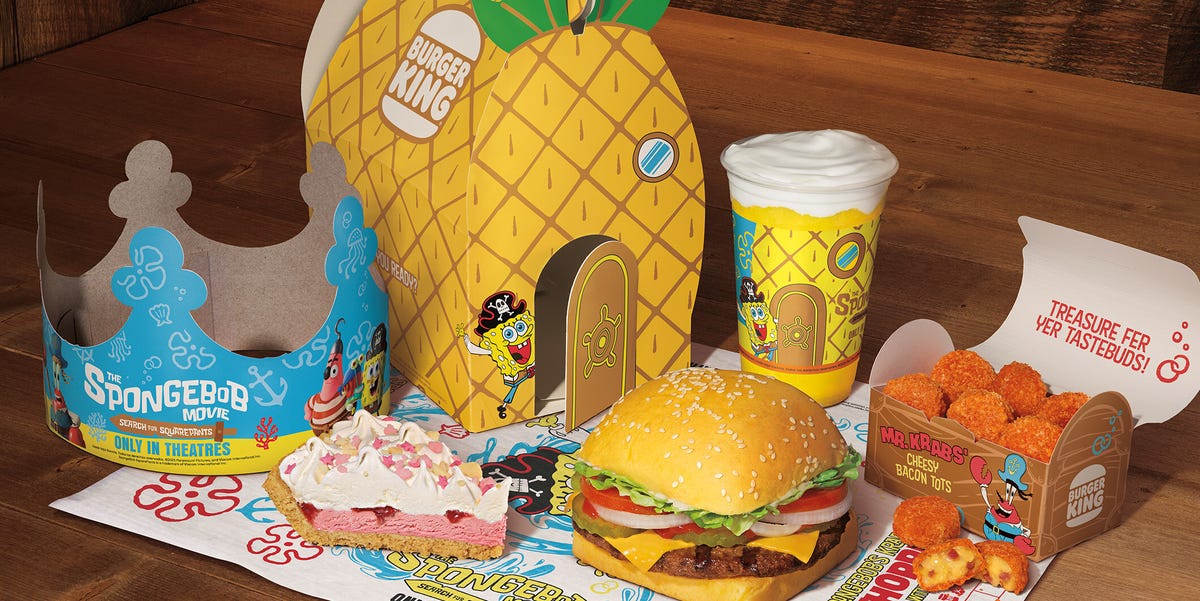
The headline item is SpongeBob’s Krabby Whopper, a twist on Burger King’s most famous sandwich. The defining detail is the square yellow bun, which instantly signals the SpongeBob connection before the first bite even happens. Underneath that playful exterior, the sandwich still leans on recognizable Whopper DNA: a flame-grilled beef patty, cheese, lettuce, tomato, pickles, onions, mayo, and ketchup. That balance matters. Burger King did not reinvent the entire sandwich. It kept the core familiar and let the themed presentation create the novelty.
That is probably why the burger works as the centerpiece of the campaign. It feels special without becoming unrecognizable. Fans get the cartoon wink, while everyday Burger King customers still get a burger they understand. It is costume-party energy with a practical streak.
Mr. Krabs’ Cheesy Bacon Tots
Then there are Mr. Krabs’ Cheesy Bacon Tots, which might be the most fitting character match on the menu. Mr. Krabs is obsessed with money, so giving him coin-shaped tots is the kind of visual pun that practically writes itself. These crispy bites combine potato, cheese, and bacon into a side that feels more indulgent than standard fries and more snackable for groups. They also help the menu avoid becoming just another burger-and-dessert combo.
From a menu engineering perspective, the tots are smart. They give Burger King a side item with strong shareability, strong photo appeal, and an easy connection to the character. They are also exactly the kind of thing that gets ordered “to try” and then mysteriously disappears from the bag before anyone gets home.
Patrick’s Star-berry Shortcake Pie
Patrick’s Star-berry Shortcake Pie is the dessert entry, and yes, the pun is doing some heavy lifting here. Still, it works. The pie reportedly layers strawberry and vanilla-style creamy filling with a cookie crumb crust, shortcake-style crumbles, and star-shaped sprinkles. That makes it the most overtly whimsical item on the menu, which is perfect for Patrick. If SpongeBob is the face of cheerful chaos, Patrick is the patron saint of pink, goofy dessert logic.
For Burger King, the dessert also broadens the menu’s appeal. Not every guest wants a themed burger, but a limited-time pie with a cartoon tie-in is the kind of impulse add-on that can boost check size without much resistance. It is sweet, silly, and built for people who think they are “just getting one thing” before adding two more at the counter.
Pirate’s Frozen Pineapple Float
The drink, Pirate’s Frozen Pineapple Float, rounds out the lineup with something cold, tropical, and distinctly on-theme. Pineapple is a natural choice because SpongeBob’s house is one of the most iconic homes in television history. Give the drink a frozen texture and a tropical-flavored foam topping, and suddenly it becomes more than just a beverage. It becomes part prop, part treat, part social content.
That kind of drink matters in a limited-time promotion. A burger may anchor the meal, but a visually interesting beverage helps complete the “experience” part of the campaign. It also gives customers a reason to bundle. If the burger gets attention, the drink helps finish the story.
The Bundle, the Box, and the Bigger Marketing Play
Burger King did not stop with individual items. The chain also packaged the promotion into a Bikini Bottom Bundle, which brought the themed foods together in a pineapple-shaped Under the Sea box. There was also a special-edition King Jr. Meal with collectible toys and themed crown elements for younger fans. That was a smart move for two reasons.
First, bundles simplify the purchase decision. When a themed launch happens, many guests do not want to study the menu like they are taking an exam. They want the easiest version of “give me the whole thing.” A bundle solves that. Second, packaging matters more than ever in fast food promotions. The box is not just a container. It is part of the product. It travels to the car, to the kitchen table, and most importantly, to the camera roll.
This is where the Burger King SpongeBob menu becomes bigger than food. It turns into branded entertainment. The meal is designed to be seen, shared, and talked about. That is why themed quick-service launches keep happening across the industry. A limited-time menu can create urgency, social buzz, and cross-generational curiosity in ways a permanent menu board rarely can.
How the Menu Taps Into Nostalgia Without Feeling Lazy
Nostalgia marketing can be powerful, but it can also feel cheap when brands rely only on recognition and forget to make the product interesting. Burger King mostly avoided that trap here. The SpongeBob menu did not just slap a cartoon face on generic packaging and call it a day. It translated character traits and visual motifs into the actual items.
The square yellow bun mirrors SpongeBob himself. The coin-like tots fit Mr. Krabs. The pineapple drink nods to SpongeBob’s home. The pink, sprinkle-topped pie gives Patrick his own spotlight. These are small details, but they matter because they show the collaboration had a point of view. It was not random. It was themed with intent.
That is why the menu likely resonated with adults as much as kids. People who grew up watching SpongeBob are now old enough to spend their own money on novelty food without asking permission, which is dangerous for their wallets and wonderful for fast-food marketing teams. A campaign like this works when it invites people to revisit something familiar while still giving them something new to talk about.
What This Says About Burger King’s Current Brand Strategy
In recent years, Burger King has looked for ways to sharpen its identity in a crowded quick-service field. The chain still has the Whopper, still leans on flame-grilled differentiation, and still has global name recognition. But in a fast-food landscape packed with viral drops, celebrity meals, seasonal items, and rewards-app incentives, legacy alone does not guarantee buzz.
The SpongeBob-themed menu fits into a broader pattern: meet customers where culture is already moving, then turn the visit into an event. This kind of promotion gives Burger King multiple wins at once. It creates fresh menu conversation, drives app engagement through rewards and exclusives, and helps the brand feel more current without abandoning its core products.
It also shows how quick-service restaurants increasingly behave like entertainment brands. They do not just release items anymore. They build mini worlds around them. There are collectible elements, special packaging, limited-time urgency, app hooks, and movie tie-ins. The modern fast-food launch is part lunch, part merch drop, part social campaign. Burger King clearly understood that with this promotion.
Will the SpongeBob Menu Actually Matter Beyond the Hype?
That is the fair question. The internet gets excited about limited-time fast food every week. Some items blow up online and disappear quietly. Others turn into cult favorites. A themed menu does not automatically become a meaningful business win just because people post the bun on TikTok.
Still, this launch had a few advantages. It arrived with strong built-in recognition, a movie tie-in, family appeal, and items that were simple enough to execute at scale while still looking different from standard menu fare. Industry coverage after the launch also suggested the promotion gave Burger King a meaningful traffic boost, which is exactly what chains want from these short-run campaigns. In plain English: the menu was not just cute, it was useful. That tends to be the sweet spot.
Even if the SpongeBob menu was never meant to last forever, it likely succeeded at what it was built to do: get people talking, get people through the door, and remind customers that Burger King can still have fun with its menu. In the quick-service world, that is not a small thing.
500 More Words on the Experience of a SpongeBob-Themed Fast-Food Launch
The most interesting part of a promotion like this is not only the food. It is the feeling around the food. A SpongeBob-themed Burger King menu turns an ordinary fast-food stop into a tiny event, and that matters more than people sometimes admit. Normally, grabbing a burger is a practical decision. You are hungry, you are busy, and you need lunch to stop acting like a hostile coworker. But when a themed menu arrives, the same trip suddenly has a little ceremony attached to it.
For families, the experience is obvious. Kids recognize SpongeBob instantly, so the meal becomes entertainment before the bag is even opened. The packaging helps, the toys help, and the character names on the menu help. Parents are not just buying calories; they are buying a short burst of excitement, a manageable treat, and maybe ten peaceful minutes in the back seat while everyone inspects a crown and argues over whose toy is better. That is not nothing. In a crowded family schedule, convenience plus delight is a strong combo.
For older fans, the experience lands differently. It is less about toys and more about nostalgia with a side of irony. A lot of adults know perfectly well they are ordering a cartoon-inspired burger, and that is exactly why they enjoy it. There is something fun about participating in a brand collaboration that does not take itself too seriously. The square yellow bun is silly in the best way. It invites people to laugh a little, take a photo, and enjoy the absurdity of being emotionally invested in a fast-food item inspired by a sponge who works at a fictional restaurant.
There is also a social experience built into these launches. Themed menus give friend groups, couples, siblings, and coworkers a reason to do a casual taste test. Which item is best? Is the pineapple float refreshing or just aggressively tropical? Are the cheesy tots actually worth it? Does the burger taste different, or does the bun simply make your brain think it does? These are not world-changing questions, but they are fun ones, and fun travels fast online. A limited-time menu becomes a conversation starter because it offers a shared reference point that feels low stakes and immediately understandable.
Then there is the collector mindset. Some people are drawn to the box, the toys, the crown, or the whole temporary weirdness of it all. Limited-time food culture now overlaps with fandom culture more than ever. Customers are not always just buying the meal; they are buying proof that they were there for the moment. That is why themed packaging can feel almost as important as the food itself. The experience becomes part edible, part collectible, part memory.
And finally, there is the simple emotional effect of surprise. Fast food can become repetitive. The same menus, same signage, same routines. A promotion like Burger King’s SpongeBob-themed menu cuts through that sameness. It adds color, humor, and a little sense of play. No one is pretending a Krabby Whopper will solve life’s problems. But for one lunch, one movie night, or one random drive-thru run after a long day, it can make the experience feel less mechanical and more memorable. Honestly, in a world full of boring errands, that is a pretty decent superpower.
Final Take
Burger King’s SpongeBob-themed menu is the kind of fast-food promotion that understands the modern assignment. It gives customers recognizable characters, visually strong menu items, and enough novelty to spark social conversation without making the food feel completely detached from the brand. The Krabby Whopper carries the campaign, the cheesy bacon tots add playful indulgence, the pie leans into dessert nostalgia, and the pineapple float ties the whole undersea idea together.
More importantly, the promotion shows how fast food now competes on experience as much as appetite. People want something shareable, limited, and culturally recognizable. Burger King delivered exactly that with this SpongeBob collaboration. Whether guests showed up for the movie tie-in, the childhood memories, the collectible packaging, or just the chance to eat a yellow square bun and tell their friends about it later, the campaign did what strong limited-time launches are supposed to do: make the brand feel lively, relevant, and impossible to ignore.