Every electronics hobbyist has a secret little spark goblin living somewhere behind the logic analyzer. It whispers things like, “What would happen if we made that arc just a little longer?” and “Surely one more transformer won’t hurt.” For decades, the traditional answer to that itch was to raid an old CRT television, harvest the flyback transformer, and hope the dust inside did not contain the ghosts of obsolete video games. But now the maker world has a more modern temptation: the printable flyback transformer.
The phrase sounds almost impossible at first. A flyback transformer is the sort of component we associate with epoxy, ferrite cores, miles of hair-thin magnet wire, mysterious insulation systems, and factory machinery that looks like it belongs in a sci-fi cleanroom. A 3D printer, on the other hand, usually makes dragon figurines, brackets, cable clips, and replacement knobs for appliances that companies definitely wanted you to throw away. Put the two together and you get a project that feels half engineering experiment, half lightning-themed dare.
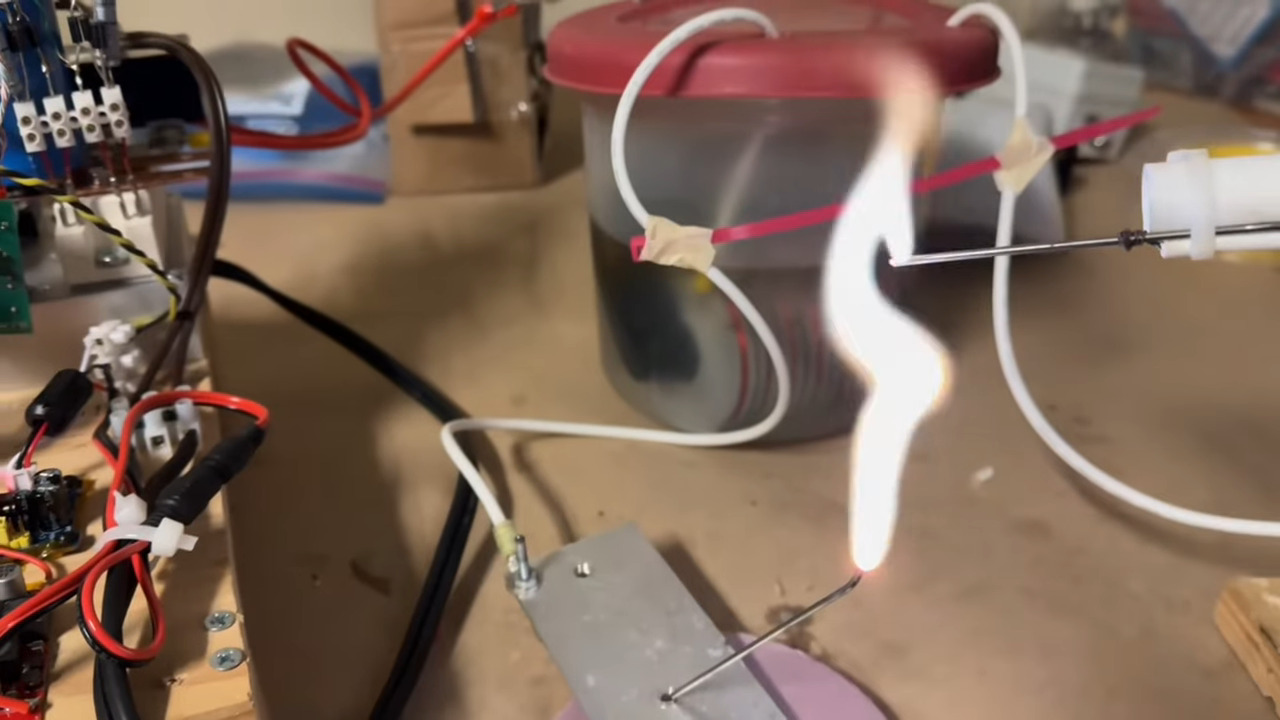
The headline project that inspired this discussion came from the high-voltage maker community: a large 3D-printed flyback transformer built with printed coil forms, a commercially sourced split ferrite core, a serious amount of secondary winding, and oil immersion to reduce arcing. It is not a toy, not a beginner project, and absolutely not something to poke with a screwdriver while saying, “Is it on?” But it is a fascinating example of how additive manufacturing can push hobby electronics into territory that used to require specialty parts or a very generous junk pile.
What Is a Flyback Transformer, Really?
A flyback transformer is not quite a normal transformer wearing a dramatic cape, although that is a fair first impression. In a conventional transformer, power is transferred from primary to secondary windings continuously through the changing magnetic field. In a flyback topology, the device behaves more like a coupled inductor. Energy is stored in the magnetic field during one part of the switching cycle and released to the secondary during another part. The gap in the ferrite core is important because much of the stored energy lives in that non-magnetic gap rather than in the core material itself.
This is why flyback transformers are so common in isolated power supplies, compact converters, CRT displays, neon drivers, ionizers, and experimental high-voltage rigs. They can step voltage up, provide isolation, and support multiple outputs in a relatively small package. In practical power electronics, they are loved because they can be cost-effective and compact. In high-voltage hobby land, they are loved because they can make arcs that look like the special effects department got a raise.
Why Make a Printable Flyback Transformer?
Let’s admit the obvious: you can buy flyback transformers. You can pull them from old equipment. You can order compact high-voltage modules online for less than the price of lunch, although whether those modules contain trustworthy insulation is another question entirely. So why print one?
The answer is control. A printed flyback transformer lets the builder design a custom bobbin, create winding sections, adjust spacing, manage insulation geometry, and scale the form factor beyond what is easily available in common off-the-shelf parts. For a large experimental transformer, the physical structure matters as much as the circuit. The winding path, the distance between layers, the separation between high-potential nodes, and the mechanical stability of the coil all determine whether the device produces a glorious purple arc or quietly becomes a smoky lesson in humility.
In the showcased large printable design, the secondary coil form used multiple snap-together printed discs, reinforced with epoxy. The secondary reportedly used about a kilometer of fine 30-gauge magnet wire, while the primary used a much smaller number of turns made from thick wire with high-voltage silicone insulation. That contrast is the flyback story in miniature: many turns on the secondary for high voltage, few turns on the primary for high current magnetic excitation, and a ferrite core to keep the invisible magnetic traffic moving in the right neighborhood.
The Magic Is Not Just the 3D Print
Calling the project “printable” is catchy, but it is worth being precise. The entire transformer is not 3D printed. The core is still ferrite. The windings are still copper. The insulation still matters. The driver electronics still need real engineering. The printed parts are the scaffold, the geometry, the bobbin, and the physical architecture that allows the windings to exist in an organized, repeatable shape.
That distinction matters because plastic is not magic. A 3D print can create clever spacing and support structures, but layer lines, voids, moisture, carbonized tracking paths, and heat can all turn a nice-looking part into a failure point. In high-voltage work, surfaces matter. Creepage, clearance, contamination, humidity, and sharp edges all matter. A tiny burr that looks harmless at five volts can become a neon sign for failure at thousands of volts.
Why the Bobbin Design Is So Important
The bobbin is not just a spool. In a high-voltage flyback transformer, it is part of the insulation strategy. A good form keeps winding layers where they belong, helps maintain spacing, reduces mechanical movement, and prevents turns from collapsing into one another. Sectioned bobbins can also reduce the voltage difference between adjacent turns or layers by spreading the secondary winding across compartments.
This is one reason 3D printing is attractive. You can print complex forms that would be inconvenient to machine or assemble by hand. Snap-together discs, internal walls, winding channels, and customized core openings are all within reach. The downside is that printed parts must be treated as experimental, not certified insulation systems. Industrial transformer insulation is tested as a complete system, often considering thermal aging, material compatibility, partial discharge, and real operating stress. Your desktop printer does not automatically grant that blessing, no matter how confidently the slicer estimates print time.
Ferrite Cores, Air Gaps, and the Energy Storage Problem
A flyback transformer needs a suitable magnetic core. Ferrite is commonly used because it performs well at switching frequencies where laminated iron would become hot, lossy, and grumpy. The air gap is central to flyback behavior because it prevents the core from saturating too easily and allows the transformer to store energy between switching intervals.
Core saturation is the villain hiding behind many failed flyback experiments. When a core saturates, inductance drops, current rises quickly, switching devices suffer, and the circuit may enter the exciting but financially unpleasant region known as “parts replacement.” Proper flyback design considers peak current, switching frequency, duty cycle, turns ratio, leakage inductance, winding resistance, core area, and temperature rise. In other words, it is less “wrap wire until bored” and more “the math goblin demands tribute.”
The Driver Circuit: Where Sparks Meet Silicon
A flyback transformer needs a pulsed drive. In commercial power supplies, a controller switches a MOSFET or similar device at a controlled frequency and duty cycle. In hobby high-voltage experiments, builders often use half-bridge or full-bridge inverter arrangements to push serious power into the primary. The large printable transformer project was tested with substantial inverter hardware and drew enough current to make the phrase “bench supply” sound far too casual.
This is where many hobby projects either become impressive or become a cautionary forum post. The transformer is only one part of the system. Switching losses, MOSFET voltage stress, leakage inductance spikes, snubber design, gate drive quality, layout, cooling, and overcurrent protection all determine whether the driver survives. Flyback circuits can create sharp transient spikes when the switch turns off, especially because leakage inductance stores energy that does not transfer neatly to the secondary. Snubbers and clamps are not decorative; they are the circuit’s tiny insurance policy.
Oil Immersion: Because Air Gives Up Too Easily
High voltage loves to find shortcuts. Air is an insulator only until the electric field becomes strong enough to ionize it. Once that happens, a spark forms, heat rises, carbon tracks appear, and your carefully wound transformer begins auditioning for a disaster montage. To reduce surface arcing and corona discharge, the printable flyback project placed the secondary assembly in a container filled with mineral oil. The oil acts as an insulating medium and helps suppress unwanted discharge paths around the winding.
Oil immersion is common in many high-voltage systems, from power transformers to specialized capacitors and switchgear. It can improve insulation and help manage heat. But oil also introduces practical concerns: cleanliness, moisture, trapped air bubbles, material compatibility, flammability, sealing, and disposal. Degassing the oil and assembly under vacuum, as done in the featured build, helps remove trapped air that could otherwise become a weak point. A tiny bubble at high voltage is not cute. It is a future arc wearing a round hat.
3D Printing Materials: Useful, But Not Invincible
For printed transformer parts, material choice matters. PLA is easy to print, but it softens at relatively low temperatures and may not be ideal around warm electronics. PETG is tougher and more heat-resistant, while some flame-retardant PETG materials are marketed for electronics housings and insulating parts. SLA resins can offer fine detail and good insulating behavior, but resin parts may vary with formulation, print orientation, post-curing, moisture, and long-term aging.
The key lesson is simple: do not assume “plastic” means “safe high-voltage insulation.” Real electrical insulation depends on geometry, surface condition, cleanliness, thermal environment, voltage waveform, frequency, humidity, and how the material behaves after stress. A printed part with microscopic gaps or a contaminated surface can fail in a way that looks mysterious until you remember that high voltage is basically a very persistent detective.
Safety: The Least Optional Section
High voltage is not dangerous only because of voltage. Current capability, stored energy, arc flash, burns, startle reactions, fire, UV exposure, ozone, and secondary accidents all matter. Even lower-voltage systems can generate severe arc flash hazards when enough current is available. High-voltage transformer experiments can also leave capacitors charged after power is removed, which means “off” does not always mean “safe.”
Anyone working around serious high voltage should be qualified, trained, and equipped. That means using proper enclosures, interlocks, current limiting, discharge paths, insulated tools, remote operation, eye protection, fire awareness, and verified de-energization practices. It also means keeping spectators, pets, jewelry, loose wires, and heroic overconfidence away from the bench. The best high-voltage experiment is the one you can brag about later using all ten fingers.
Why This Project Captures the Maker Imagination
The printable flyback transformer is compelling because it combines old-school electrical physics with modern desktop fabrication. The physics has not changed: Faraday still gets a vote, ferrite still saturates, copper still heats, and insulation still fails when insulted. What has changed is the accessibility of custom mechanical structures. A hobbyist can now design a transformer bobbin in CAD, print it overnight, wind it, revise it, and improve it without waiting for a factory tooling quote.
That does not make the project easy. In fact, it may expose just how much invisible expertise is hiding inside commercial transformers. A mass-produced flyback is not merely a lump of wire and ferrite. It is the result of insulation rules, winding machines, materials testing, thermal design, and manufacturing consistency. A printed version is exciting precisely because it tries to recreate part of that complexity on a maker’s bench.
Practical Lessons From a Printable Flyback Transformer
1. Geometry Is an Electrical Component
In high-voltage design, shape matters. Rounded edges, generous spacing, clean surfaces, and controlled winding paths can be just as important as the schematic. The printed bobbin is not passive scenery; it actively influences how voltage stress is distributed.
2. Insulation Is a System, Not a Sticker
Electrical tape wrapped around a suspicious area is not the same as a qualified insulation system. Magnet wire enamel, printed plastic, epoxy, oil, spacing, winding tension, and environmental conditions all work together. If one part fails, the arc will find it with the enthusiasm of a toddler finding a permanent marker.
3. Bigger Is Not Automatically Better
A larger transformer can produce dramatic results, but it also increases stored energy, current draw, heat, and mechanical demands. High voltage already deserves respect; high voltage with meaningful power behind it deserves a locked door and a written safety plan.
4. The Driver Must Be Designed Like It Wants to Survive
Flyback transformers can punish sloppy switching circuits. Leakage inductance, transient spikes, and ringing can destroy MOSFETs quickly. Good layout, proper snubbing, thermal management, and conservative component ratings are not optional luxuries.
5. The Best Projects Teach More Than They Spark
The arcs are flashy, but the real reward is understanding why the arcs happen. A printable flyback transformer teaches magnetic design, materials science, additive manufacturing limits, power electronics, and safety culture all in one dramatic package.
Experience Notes: What Working Around a Printable Flyback Feels Like
The first experience most people have with a large high-voltage project is not the spark. It is the silence before the spark. The bench looks normal: a printed form, a ferrite core, thick primary leads, a container of oil, an inverter board, a power supply, and a few meters arranged with the kind of seriousness usually reserved for surgery. Then you notice the distance everyone keeps from the output terminals. That empty space is not wasted space. It is respect, measured in inches.
Winding the secondary is the patience test. A kilometer of fine magnet wire sounds romantic until you realize that fine wire has the personality of spider silk and the forgiveness of a tax auditor. It wants to kink, overlap, snag, and snap. The printed bobbin helps because it gives the wire a disciplined path, but the process still demands calm hands and a slow rhythm. Rushing a winding job is how you create hidden defects that wait until the first power-up to introduce themselves with a tiny flash and a large sigh.
Assembly brings a different kind of anxiety. Everything looks solid, but high voltage does not care how solid things look. It cares about microscopic paths, trapped bubbles, sharp points, damp surfaces, and whether yesterday’s fingerprint left a conductive film in exactly the wrong place. Oil immersion changes the mood. Lowering the coil into mineral oil feels like placing a ship in a bottle, except the ship may later produce an arc that makes your camera microphone beg for mercy.
The first energized test should feel cautious, not cinematic. Experienced builders do not start by pushing a system to the edge. They watch current, listen for unexpected hiss, look for corona, smell for overheating, and keep one hand away because habits matter. A healthy respect for stored energy is part of the experience. Capacitors can remember what you did after you forget, and that is a rude personality trait.
When the arc finally appears, it is easy to understand why people love these projects. The sound is sharp and alive. The light has that strange electric color that cameras never capture properly. The air changes. The project stops being a CAD model, a coil, and a pile of equations. It becomes a visible demonstration of magnetic energy storage, insulation stress, ionized air, and switching electronics. It is physics stepping out from behind the textbook and waving a plasma flag.
But the most valuable experience comes after power is off, the system is discharged, and the builder reviews what happened. Was the arc stable? Did the driver heat up? Did the oil show bubbles? Did any printed surface begin tracking? Did the waveform look reasonable? That post-test review is where the project becomes engineering rather than spectacle. The printable flyback transformer is fun because it makes sparks, but it is meaningful because it forces the builder to think like a designer, a safety officer, a materials scientist, and occasionally a firefighter with excellent preventative instincts.
Conclusion
A printable flyback transformer sits at the wonderfully strange intersection of 3D printing, high-voltage experimentation, and serious power electronics. It proves that desktop fabrication can do more than make brackets and cosplay parts; it can support ambitious electrical designs when paired with real knowledge and disciplined safety practices. The printed structure gives builders freedom to shape the winding form, manage spacing, and explore custom transformer geometry. The ferrite core, copper windings, oil insulation, and driver electronics remind us that physics still keeps the receipt.
For curious makers, the project is inspiring. For beginners, it is a warning label with sparks. For experienced electronics enthusiasts, it is a reminder that the most impressive builds are not just louder, brighter, or more dramatic. They are the ones that reveal how much careful thinking hides behind a single arc.