Most of us can describe a childhood bedroom in ridiculous detail: the poster we swore was “very mature,” the toy box that looked like it had survived a tiny hurricane, the blanket that had more emotional importance than some relatives. A child’s sleeping space is never just a sleeping space. It is a diary without words, a map of family life, a quiet museum of money, culture, safety, hope, routine, and sometimes survival.
That is why James Mollison’s photo series Where Children Sleep still feels so powerful years after its first publication. The project pairs studio-style portraits of children with photographs of the places where they sleep. The idea sounds simple enough to fit on a sticky note. The emotional impact, however, is enormous. One frame may show a bright room crowded with toys, trophies, costumes, or carefully chosen decorations. Another may reveal a mattress on the floor, a shared hut, a dormitory bed, a street-side sleeping spot, or a small corner in a home where privacy is a luxury item nobody has added to the shopping list.
The result is not a guilt trip with a camera. It is more thoughtful than that. Where Children Sleep asks viewers to look closely at how childhood changes depending on geography, income, family structure, work, conflict, tradition, and opportunity. It reminds us that children everywhere dream, worry, play, imitate adults, collect objects, and build identities. It also reminds us that some children must grow up faster than others because the world has handed them a backpack full of adult problems before they have even finished being kids.
Who Created “Where Children Sleep”?
Where Children Sleep was created by James Mollison, an English-born photographer known for documentary projects that explore identity, social structures, and the quiet details that reveal how people live. The original book was published in 2010 and brought together portraits and room photographs from countries including the United States, Mexico, Brazil, England, Italy, Israel and the West Bank, Kenya, Senegal, Lesotho, Nepal, China, and India.
Mollison’s approach is clever because it removes the dramatic tricks that often appear in social documentary photography. The children are photographed separately from their bedrooms, often against neutral backgrounds. This keeps the portrait from becoming a simple “poor child” or “rich child” label. The child appears first as a person: guarded, proud, curious, shy, serious, playful, or wonderfully unimpressed by the adult holding the camera. Then the bedroom gives context. Together, the two images create a conversation.
That structure is the heart of the project. A bedroom can reveal possessions, but a portrait reveals presence. A room may show privilege or hardship, but a child’s face resists being turned into a statistic. This is where Mollison’s work succeeds: it lets viewers notice inequality while still seeing individuality.
Why Children’s Bedrooms Tell Such Big Stories
A child’s bedroom is a small place with a suspiciously large job description. It can be a shelter, a playground, a classroom, a dressing room, a storage closet, a safe zone, or all of the above squeezed into one heroic little rectangle. For some children, the bedroom is a private kingdom with shelves, posters, stuffed animals, sports gear, and a door that can be closed. For others, sleep happens in a shared family space, a dormitory, a temporary shelter, a hut, or outdoors.
That difference matters. Personal space can shape how children rest, study, play, and imagine themselves. A quiet room with a desk can support homework. A safe bed can support healthy sleep. A stable address can support school attendance, friendships, medical care, and routines. When those basics disappear, childhood becomes harder to protect.
Globally, child poverty is not only about income. It is also about whether a child has nutrition, clean water, shelter, health care, education, sanitation, and safety. UNICEF describes child poverty as multidimensional because children suffer when multiple basic needs are missing at the same time. World Bank and UNICEF research has estimated that hundreds of millions of children live in extreme poverty, and the burden is especially heavy in regions affected by conflict, fragile institutions, and limited infrastructure.
In that broader context, Where Children Sleep becomes more than an art project. It becomes a visual entry point into questions that can otherwise feel too huge to hold in the mind. Instead of saying “global inequality,” the photographs ask: Where does this child put her head at night? What objects surround him? Who shares the space? Is there a door? Is there a floor? Is there safety? Is there choice?
The Power Of The 18 Featured Images
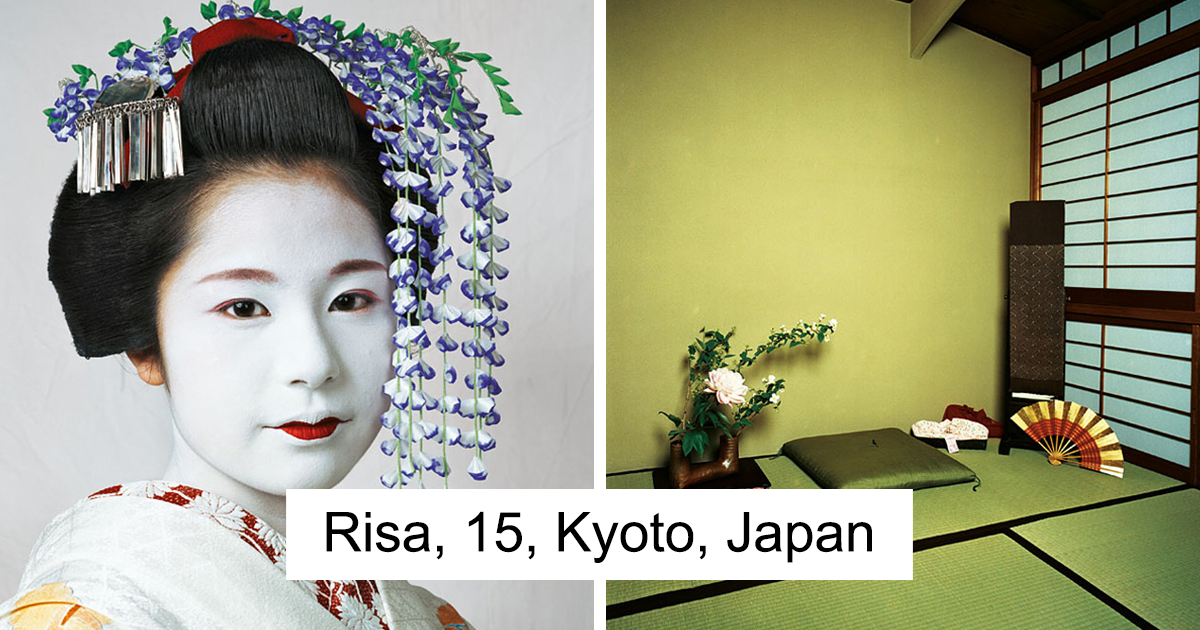
The widely shared “18 pics” selection from Where Children Sleep includes children from vastly different places and circumstances. Some of the best-known examples include Indira from Kathmandu, Nepal; Bilal from the West Bank; Alex from Rio de Janeiro, Brazil; Risa from Kyoto, Japan; Nantio from northern Kenya; Dong from Yunnan, China; and Jasmine, also known as Jazzy, from Kentucky in the United States. Each child’s story works like a small window, and together those windows form a global apartment building of childhood experience.
Indira, Kathmandu, Nepal
Indira’s story is often one of the most difficult for viewers to forget. She has been described as a young girl who worked in a granite quarry from an early age and lived with her family in a modest home. Her sleeping space speaks to economic pressure, child labor, and the way poverty can pull children into adult work long before they should have to understand words like “survival income.”
What makes the photograph so striking is not simply the lack of comfort. It is the contrast between childhood and responsibility. Many children her age are negotiating bedtime stories, missing socks, and whether broccoli is secretly a villain. Indira’s environment points to a much harsher negotiation: how a family gets through the day.
Bilal, Wadi Abu Hindi, The West Bank
Bilal, a Bedouin shepherd boy, is another unforgettable subject. His sleeping place has been described as outdoors with his father’s herd of goats. The image challenges the viewer’s assumptions about what a bedroom must be. There is no themed comforter, no glow-in-the-dark stars, no nightstand holding a half-finished glass of water. Yet the space is connected to family work, land, animals, tradition, and a daily rhythm very different from urban childhood.
Bilal’s portrait reminds us that not every sparse sleeping space has the same meaning. Some living conditions are shaped by poverty, some by culture, some by displacement, and many by a complicated mixture of all three. Good documentary photography does not flatten those differences; it invites us to ask better questions.
Jazzy, Kentucky, United States
Jasmine, known as Jazzy, offers a very different image of childhood. Her room is associated with beauty pageants, costumes, crowns, and performance. At first glance, the space may look like abundance with extra glitter and a side order of hairspray. But Mollison’s project is not simply a ranking system from “least stuff” to “most stuff.” Jazzy’s room opens another conversation: how children are shaped by ambition, parental dreams, consumer culture, competition, and identity.
Her room may be full, but fullness is not the same as freedom. A child surrounded by trophies can still be under pressure. A child with costumes can still be performing expectations she did not completely choose. That is one of the smartest parts of Where Children Sleep: it does not pretend that privilege is emotionally simple.
Alex, Rio De Janeiro, Brazil
Alex’s story, connected with Rio de Janeiro, brings viewers into the realities of children living in communities where space, security, and opportunity may be unevenly distributed. In many urban areas around the world, children grow up near wealth they can see but not access. Their bedrooms may sit only miles from luxury apartments, yet those miles can represent enormous gaps in infrastructure, schooling, safety, and family income.
This is where the project becomes especially sharp. It shows that inequality is not always separated by oceans. Sometimes it is separated by a road, a wall, a neighborhood boundary, or a postal code. Childhood can change dramatically within the same city.
Risa, Kyoto, Japan
Risa from Kyoto represents another kind of childhood environment, one shaped by culture, discipline, aesthetics, and social expectations. The series includes children whose rooms reflect not only income but also tradition and training. A sleeping space can tell us what a society values, what a family prioritizes, and what a child is being prepared to become.
That point is important because “living conditions” does not mean only poverty. It also includes rules, routines, gender expectations, education, labor, religion, entertainment, and the subtle messages children absorb from their surroundings. Bedrooms are not neutral. They whisper instructions.
Why The Series Still Matters Today
Where Children Sleep remains relevant because the questions it raises have not gone away. Children around the world still experience vastly different levels of safety, privacy, nutrition, education, and stability. Some wake up in rooms designed around hobbies and self-expression. Others wake up in places shaped by overcrowding, migration, disaster, work, or conflict. Some have shelves for toys. Others have to share every inch of available space with siblings, parents, animals, tools, or uncertainty.
The series also matters because it resists lazy storytelling. It would be easy to turn the photographs into a simple moral lesson: “Be grateful because others have less.” Gratitude is fine, of course. Gratitude keeps us from becoming the type of person who complains that the Wi-Fi is slow while sitting under a roof, beside a refrigerator, holding a device more powerful than old space missions. But the project asks for more than gratitude. It asks for attention.
Attention means noticing systems, not just feelings. Why do some children work? Why do some families lack secure housing? Why are children in conflict zones forced to sleep in unsafe conditions? Why does access to education depend so heavily on where a child is born? Why do wealthy societies still have children living in poverty? These questions are not comfortable, but neither is a world where comfort is distributed so unevenly.
Photography As A Tool For Empathy
Photography can be tricky when it deals with poverty or children. Done badly, it can turn people into props for pity. Done well, it can restore attention to people who are often discussed only in numbers. Mollison’s paired images work because they slow the viewer down. You do not simply glance at a child and move on. You compare the portrait with the room, then compare the room with your own memories, then compare your assumptions with the child’s actual story. That is a lot of emotional paperwork for one photograph, but the best images always make us sign something internally.
The neutral portrait style is especially effective. It gives each child dignity. The bedroom may be chaotic, luxurious, bare, cramped, or fragile, but the child is not reduced to the room. The child stands apart from it, almost saying, “This is where I sleep, but it is not all I am.”
That distinction matters for readers, teachers, parents, and anyone sharing the project online. The goal should not be to stare at children’s hardship like a museum exhibit of sadness. The better response is curiosity, humility, and action: learning more, supporting child-focused organizations, discussing inequality honestly, and resisting the urge to treat comfort as a personal achievement rather than a shared responsibility.
What Parents And Teachers Can Learn From The Series
For parents, Where Children Sleep can become a powerful conversation starter. It can help children understand that their daily routines are not universal. The bed they complain about making, the closet they insist is “too small,” or the desk buried under art supplies and mysterious crumbs may represent privileges other children do not have.
For teachers, the project can support lessons about geography, human rights, economics, visual literacy, and cultural diversity. Students can compare images thoughtfully: What objects appear in the room? What is missing? What does the sleeping space suggest about school, work, family, climate, or safety? What questions should we ask before making judgments?
The key is to guide discussion with respect. Children in the photographs should not become examples of “less fortunate people” in a vague, sentimental way. They are individuals. Some may be poor, some wealthy, some rural, some urban, some traditional, some modern, some protected, some exposed. Their lives are not lesson props; they are real human stories.
The Bigger Message Behind The Bedrooms
The strongest message of Where Children Sleep is that childhood is both universal and unequal. Universal, because children everywhere need love, sleep, food, play, safety, and the chance to become themselves. Unequal, because the conditions surrounding those needs vary wildly. A bedtime routine can include a story, a prayer, a chore, a security check, a long walk, a shared mat, or the sound of animals nearby. The word “bedtime” looks innocent until you ask where the bed is.
Mollison’s photographs do not offer a neat solution, and that is part of their honesty. A photo series cannot build houses, end conflict, rewrite labor laws, or fund schools by itself. What it can do is make distance feel smaller. It can make a viewer pause before reducing global inequality to a chart. It can help a child in one country realize that a child somewhere else has a completely different night, yet the same human need for comfort and care.
Personal Reflections And Experiences Inspired By “Where Children Sleep”
Looking at Where Children Sleep can make you remember your own childhood room with embarrassing clarity. Maybe you had a bedspread that looked like it was chosen by a committee of cartoon characters. Maybe your shelves were packed with books, plastic dinosaurs, sports medals, or tiny treasures that adults called “junk” because adults have a tragic inability to recognize sacred objects. Maybe your room was shared with siblings, which meant every square foot was a diplomatic zone and every blanket border was basically international law.
For many people, the first reaction to Mollison’s series is comparison. You compare your old bedroom to the photographs. Then you compare your current life to the children’s lives. Then, if you are honest, you compare your complaints to your comforts. That does not mean your struggles are fake. Everyone has problems, and a soft mattress does not magically solve loneliness, anxiety, family conflict, or fear. But the series does adjust the volume. It reminds you that some basics you may barely notice are, for others, life-changing forms of stability.
One of the most meaningful experiences related to this topic is the simple act of walking into a child’s room after viewing the series. Suddenly, ordinary objects become evidence. A night-light says someone cared about fear. A stack of schoolbooks says education is expected. A laundry basket says there are clothes to wash and a place to wash them. A messy floor says the child had time to play. Even the classic disaster zone of toys, socks, and one unidentified sticky object can begin to look like abundance. Annoying abundance, perhaps, but abundance all the same.
The series can also change how we think about charity. It is easy to feel moved for five minutes, share a post, and then return to regular programming, featuring coffee, deadlines, and wondering why printer ink costs more than perfume. But Where Children Sleep encourages a deeper response. It asks us to support policies and organizations that protect children’s rights: safe housing, access to school, clean water, health care, nutrition, and protection from exploitation. It also asks us to speak about poverty with precision. Poverty is not a personality flaw. It is not a lack of dreams. It is a lack of resources, safety, and choices.
On a personal level, the project may inspire families to talk differently at home. Instead of saying, “Finish your dinner because children elsewhere are hungry,” which usually produces guilt and very little vegetable enthusiasm, a parent might say, “Let’s learn how children live in different places and think about what fairness means.” That shift matters. Guilt closes people down. Understanding opens them up.
The most lasting experience the series offers is not sadness, although sadness is certainly invited and does not need to RSVP. The lasting experience is awareness. Once you see how much a sleeping space can reveal, you begin noticing the hidden architecture of childhood everywhere: the school bus stop, the apartment window, the rural path, the refugee tent, the suburban bedroom, the shared mattress, the trophy shelf, the packed suitcase. Every child sleeps somewhere. The question is whether that somewhere protects their body, supports their mind, and gives their future a fair chance to unfold.
Conclusion
“Where Children Sleep” is powerful because it turns the private act of sleeping into a public question about justice. Through portraits and bedrooms, James Mollison shows that childhood is shaped by far more than personality. It is shaped by housing, money, culture, geography, education, work, safety, family, and chance. The 18 widely shared images are not just fascinating photographs; they are invitations to look at the world with more honesty and less laziness.
The series does not ask viewers to pity children. It asks us to see them. That is a higher standard. Pity can be quick and self-satisfied. Seeing requires patience, respect, and responsibility. Whether a child sleeps under a decorated ceiling, beside goats, in a shared family room, in a dormitory, or on a thin mattress, the basic truth remains the same: every child deserves protection, dignity, rest, and room to dream.