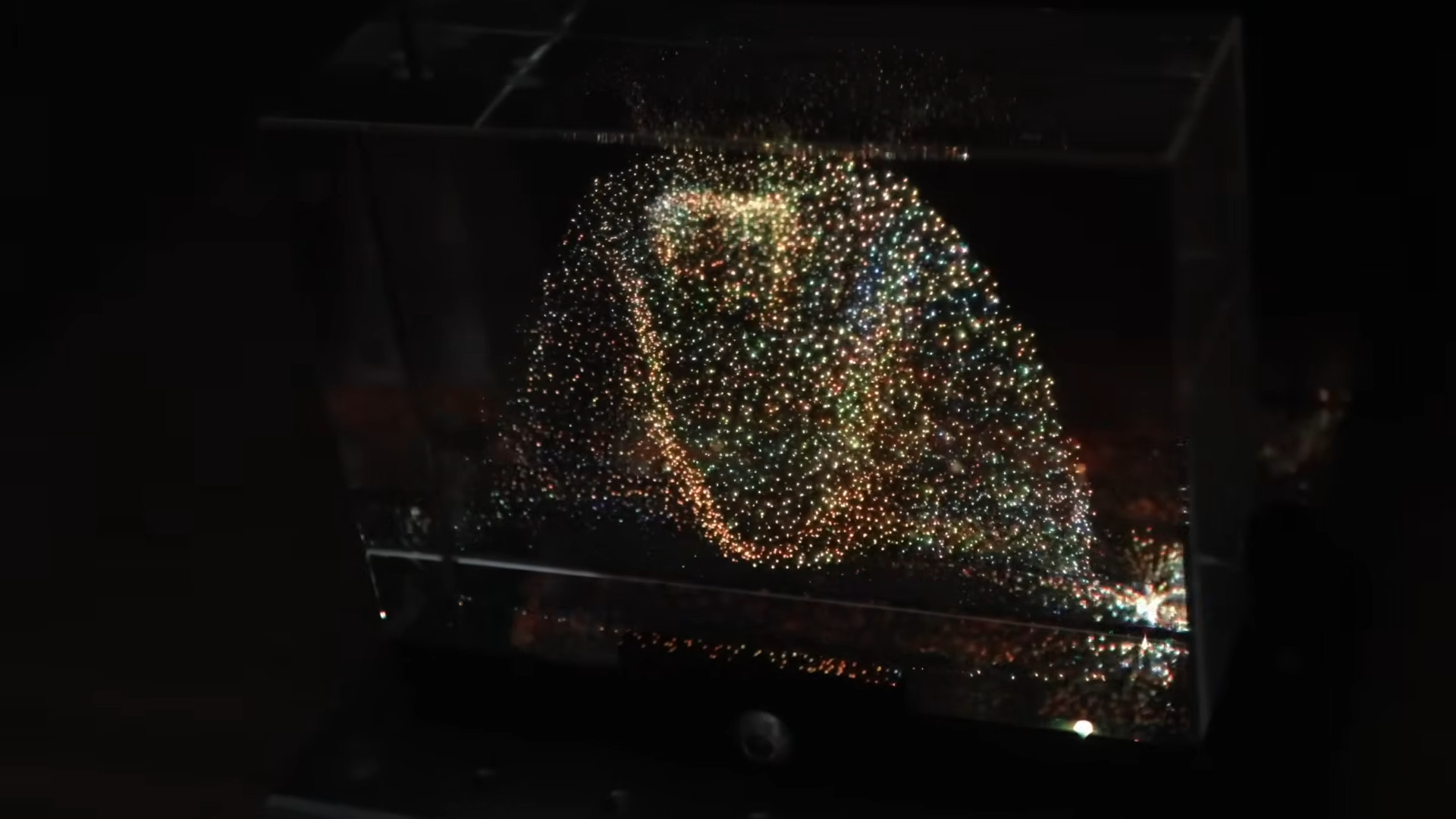
Imagine a glass block that looks like it escaped from a science museum gift shop, except instead of holding a frozen souvenir dolphin, it becomes a tiny stage for glowing 3D graphics. That is the charming idea behind a volumetric display with lasers and bubbly glass: a display that does not merely fake depth on a flat screen, but places visible points inside a real physical volume.
In a world where most screens are still flat rectangles shouting for attention from desks, pockets, dashboards, and refrigerators that absolutely did not need Wi-Fi, volumetric display technology feels refreshingly strange. It asks a simple question: what if pixels could become voxels, and what if those voxels could live inside glass, liquid, air, or another transparent medium?
The phrase “Volumetric Display With Lasers And Bubbly Glass” sounds like the title of a cyberpunk cocktail, but the concept is rooted in serious optics. The basic idea is to use a laser scanning system to illuminate tiny scattering points inside a clear material. Those points may be bubbles, microscopic structures, fluorescent regions, or light-emitting zones. When controlled precisely, they can form a three-dimensional image that viewers can see without wearing 3D glasses.
What Is a Volumetric Display?
A volumetric display creates images inside a three-dimensional space rather than on a two-dimensional surface. Traditional screens rely on pixels arranged in rows and columns. A volumetric display uses voxels, or volume pixels, arranged across width, height, and depth.
That difference matters. A flat monitor can show a picture of a cube. A volumetric display attempts to make the cube appear as if it occupies space inside the display volume. Walk to the side, and the object can still look three-dimensional because the light points exist in different positions, not just in a perspective trick printed on a flat panel.
Why Lasers Make the Idea Work
Lasers are useful in volumetric displays because they can be tightly focused, rapidly scanned, and precisely controlled. A focused beam can light up a specific point inside a display medium, then jump to another point, then another, fast enough that the human eye blends the sequence into a stable image.
This is similar in spirit to older vector displays, where a beam draws shapes one point or line at a time. The modern twist is that the drawing does not have to stay on a flat surface. With the right optics, a laser can address points in three-dimensional space. The result is less “screen” and more “tiny luminous sculpture.”
Where the Bubbly Glass Comes In
The “bubbly glass” idea is especially clever because tiny bubbles inside a transparent block can behave like scattering points. When a laser hits them, they catch and redirect light, making them visible. In other words, the bubbles become a ready-made cloud of addressable points.
In the maker-style demonstration that inspired this topic, a laser projector maps color onto tiny bubbles inside a crystal-like block. The bubbles are not random decoration anymore; they become a point cloud. With careful alignment, the system can display recognizable 3D forms. The resolution is modest compared with modern screens, but the effect is delightful because the image appears to occupy the glass itself.
Think of it as projection mapping, but instead of projecting onto a building, stage, or cake at an overenthusiastic wedding, the projector maps onto suspended specks inside glass. It is technically demanding, visually magical, and exactly the kind of project that makes engineers grin while non-engineers ask, “Wait, how is that not a hologram?”
Is It Actually a Hologram?
Not exactly. The word “hologram” is often used casually for almost any floating-looking 3D image, but volumetric displays and holographic displays are different technologies. Holography usually involves controlling the wavefront of light to reproduce depth cues through interference. Volumetric displays create visible points in physical space.
A bubbly-glass volumetric display is closer to a glowing 3D dot matrix than a true hologram. That does not make it less interesting. In some ways, it makes it easier to understand: if the laser can illuminate the right bubbles at the right time and color, the human eye sees a 3D shape.
The Science Behind Laser-Generated Voxels
Scientific research into volumetric displays has explored several ways to create voxels. Some systems use laser-induced plasma in air. Others use fluorescent materials, rare-earth-doped glass, glass-ceramics, or liquid screens where bubbles can be generated with focused ultrafast laser pulses.
Microbubble volumetric displays are particularly fascinating. In those systems, focused femtosecond laser pulses can generate tiny bubbles inside a liquid medium. Those bubbles scatter light and act as voxels. If the system can create and arrange them quickly enough, it can render visible 3D graphics inside the liquid.
Other approaches use rare-earth-doped glass. These materials can emit visible colors when excited by near-infrared lasers. That opens the door to more durable solid-state volumetric displays, where the display medium itself becomes an active optical material rather than a passive block waiting to be lit.
Why This Technology Feels So Different From VR and AR
Virtual reality puts a screen close to your eyes. Augmented reality overlays digital imagery onto your view of the world. Both can be powerful, but they usually depend on headsets, lenses, tracking, batteries, software platforms, and the user’s willingness to wear something that may make them look like a very focused scuba diver.
A volumetric display can be shared by multiple viewers at once. People can gather around it, look from different angles, point at features, and discuss the same 3D object together. That makes the technology attractive for education, medical visualization, engineering review, museum exhibits, data analysis, and public demonstrations.
Potential Uses for Volumetric Displays
Medical Imaging
Doctors already work with 3D data from CT scans, MRI scans, ultrasound, and microscopy. A volumetric display could make complex anatomy easier to inspect because the image can be viewed as a spatial object rather than a stack of flat slices. A surgeon planning a difficult procedure might examine a tumor, blood vessel, or organ from multiple angles without mentally reconstructing every detail from 2D images.
Engineering and Product Design
Engineers often need to evaluate complex assemblies. A volumetric display could show airflow, mechanical parts, architecture models, or robotics designs as spatial data. Instead of rotating a model on a monitor, a team could walk around a physical display volume and inspect the shape together.
Education and Museums
A glowing dinosaur skull inside glass? Students would notice. A 3D molecule that can be viewed from all sides? Chemistry suddenly becomes less like alphabet soup and more like a tiny universe. Volumetric displays are naturally engaging because they turn abstract information into visible spatial objects.
Art, Games, and Interactive Installations
Artists love media that misbehave in productive ways, and volumetric displays are full of creative possibilities. A bubbly-glass laser display could show animated icons, low-resolution characters, floating diagrams, or generative patterns. Even limited resolution can become an aesthetic rather than a flaw, much like pixel art turned technical limitation into style.
The Big Technical Challenges
The first challenge is resolution. A modern 4K screen contains more than eight million pixels. A prototype volumetric display with tens of thousands of points is impressive, but it is not going to replace a TV for watching sports, movies, or cooking videos where someone says “just a little garlic” and then adds half a bulb.
The second challenge is brightness. A voxel must be bright enough to see clearly, but the system must also remain safe and practical. Laser displays require careful optical design, shielding, calibration, and responsible handling. Any real-world product would need rigorous safety systems, especially because eyes and lasers have a famously terrible friendship.
The third challenge is color. Single-color volumetric displays are easier. Full-color displays require more complex laser control, materials, filtering, or multi-wavelength excitation. Researchers have made meaningful progress, but turning laboratory success into a rugged consumer product is a long road.
The fourth challenge is content. A volumetric display needs 3D data arranged as voxels or point clouds. Existing media pipelines are built around flat screens. To make volumetric displays useful, software must convert models, scans, animations, and game scenes into display-ready point data efficiently.
Why the Bubbly-Glass Approach Is So Appealing
The bubbly-glass method is appealing because it feels surprisingly approachable. It does not require the display to generate bubbles in real time or create plasma in open air. The scattering points already exist inside the glass. The system “only” needs to map light onto them accurately. Of course, “only” is doing Olympic-level heavy lifting in that sentence.
Still, the concept has practical elegance. The glass block provides structure, stability, and a visible volume. The bubbles provide scattering targets. The laser projector provides dynamic imagery. Together, they create a low-resolution but compelling volumetric display that demonstrates the core principle beautifully.
How It Compares With Bubblegrams
Many people have seen decorative glass cubes with etched 3D images inside them. These are often called bubblegrams. They are made by focusing lasers inside glass to create tiny internal marks. Bubblegrams are three-dimensional, but they are static. Once made, the image does not animate or update.
A laser-scanned bubbly-glass volumetric display is different because the glass points become a canvas for changing light. The internal bubble pattern may be fixed, but the projected image can change. That creates the possibility of animation, interactive graphics, and dynamic visual effects.
What Makes It SEO-Worthy and Future-Worthy
The topic “volumetric display with lasers and bubbly glass” sits at the intersection of several fast-growing interests: glasses-free 3D display technology, laser projection, spatial computing, holographic interfaces, maker hardware, and advanced materials. It is easy to explain visually, yet deep enough to reward serious readers.
It also taps into a cultural hunger for screens that feel less flat. People are surrounded by rectangles. Phones, monitors, tablets, TVs, dashboards, kiosks, and smart appliances all present digital worlds through flat panes. Volumetric display technology hints at a more physical future, where digital objects can be seen as objects, not just pictures of objects.
My Experience and Practical Takeaways From Volumetric Display Concepts
The most memorable thing about volumetric displays is how quickly they change the mood in a room. A flat screen can be impressive, especially when it is huge, bright, and expensive enough to make a wallet whimper. But a real 3D image inside a volume triggers a different reaction. People lean in. They move sideways. They test the illusion with their own eyes. Someone usually says, “Can I walk around it?” That curiosity is the real magic.
When studying projects like laser projection onto bubbly glass, the biggest lesson is that resolution is not the only measure of impact. A low-resolution 3D object can feel more surprising than a high-resolution 2D image because it occupies space in a way the brain recognizes immediately. The viewer does not need a tutorial. The object is simply there, glowing inside the medium like a tiny digital ghost with better manners.
Another practical lesson is that alignment matters enormously. In a normal projector setup, a little keystone correction can rescue the image. In a bubbly-glass volumetric display, the laser must match the 3D position of internal scattering points. The problem is no longer just left, right, up, and down. Depth joins the party, brings snacks, and makes everything harder. Manual alignment can work for a demonstration, but a polished system would benefit from calibration cameras, software correction, and automated mapping.
The display medium also changes the personality of the image. Glass feels permanent and jewel-like. Liquid bubble displays feel experimental and alive. Aerial plasma displays feel futuristic and slightly dramatic, as if a laboratory decided to cosplay as a spaceship. Rare-earth-doped glass suggests a more mature direction, where the material itself is engineered for brightness, color, and durability.
For creators, the best way to think about this technology is not as a replacement for flat screens, but as a new kind of visual instrument. Nobody expects a violin to replace a piano. They do different things beautifully. A volumetric display may not be ideal for spreadsheets, long articles, or watching a sitcom. But for molecules, terrain, anatomy, logos, sculptures, mechanical parts, and abstract data, it can offer a form of presence that flat media struggles to match.
The biggest caution is safety. Laser-based displays are not casual toys. Serious systems need proper shielding, beam control, interlocks, and engineering review. The fun comes from the visual effect, not from taking risks with optical equipment. A future consumer version would need to hide the danger behind carefully designed hardware, much like a Blu-ray player hides its laser safely inside a sealed device.
The best near-term opportunities may appear in controlled environments: museums, research labs, classrooms, trade-show booths, medical visualization rooms, and design studios. These settings can justify special hardware because the display does something ordinary screens cannot. Over time, better materials, cheaper scanning systems, smarter calibration, and improved 3D content pipelines could push volumetric displays toward wider adoption.
In that sense, bubbly glass is more than a clever demo. It is a reminder that the future of displays may not arrive as one perfect technology. It may arrive as a collection of strange experiments: lasers in glass, bubbles in liquid, voxels in air, light fields on panels, and holographic waveguides in glasses. Some will become products. Some will remain glorious lab creatures. All of them help move digital imagery out of the flatland.
Conclusion
A volumetric display with lasers and bubbly glass is not just a neat visual trick. It is a compact example of where display technology may be heading: toward spatial images, shared 3D viewing, and materials that turn light into visible depth. By mapping laser light onto tiny bubbles inside glass, the system transforms a static transparent object into a dynamic display volume.
The technology still faces real obstacles, including resolution, brightness, color control, safety, calibration, and content creation. But as a proof of concept, it is wonderfully persuasive. It shows that a 3D display does not need to be locked inside a headset or trapped on a flat panel. Sometimes, all it needs is clever optics, careful mapping, and a piece of glass full of tiny bubbles waiting for their big Hollywood moment.