Before MTV became a reality-TV jungle gym, before The Real World made awkward roommate drama a national export, and long before celebrities learned to cry beautifully in high-definition, the network had a strange little game show set in a basement. It was called Remote Control, and it looked like someone had locked a trivia contest, a comedy club, and a college dorm lounge in the same room with too much caffeine.
On paper, Remote Control was a pop culture trivia game show. In practice, it was a beautifully unhinged comedy laboratory where the rules mattered slightly less than the jokes, the contestants sat in recliners with seat belts, and losing players were yanked backward through breakaway walls like they had personally offended television itself. Most importantly, it became an early launching pad for several major comedy names, including Adam Sandler, Colin Quinn, and Denis Leary.
That is why this oddball MTV series still deserves attention. It was not just a weird show from the late 1980s. It was a preview of where American comedy, youth television, and pop culture humor were headed. It made TV trivia feel rowdy. It turned the game-show format inside out. And it gave future stars a place to be loud, silly, fast, sarcastic, and completely themselves.
What Was Remote Control?
Remote Control premiered on MTV in 1987 and ran through 1990. Created and developed by Joe Davola and Michael Dugan, the series was MTV’s first original non-music program and its first game show. That detail matters because MTV was still deeply associated with music videos at the time. The idea that the channel would air a game show was already a tiny act of rebellion. Naturally, MTV made sure the game show looked like it had been assembled by smart-aleck interns who had eaten nothing but microwave popcorn for a week.
The premise was simple but wonderfully ridiculous: host Ken Ober supposedly loved television so much that he set up a game show in the basement of his childhood home. Contestants answered questions about TV, music, movies, commercials, celebrities, and general pop culture. Instead of a polished quiz-show palace, the set looked like a cluttered rec room. The vibe was not “prime-time prestige.” It was “your funniest friend’s basement, except someone gave him a production budget and told him not to break anything expensive.”
Contestants sat in La-Z-Boy-style recliners facing a giant television screen. Categories were presented like TV channels, allowing the game to spoof the act of channel surfing. The show had music, sketches, strange characters, snacks dumped from above, and comic punishments. It was a game show, yes, but it behaved more like sketch comedy wearing a fake mustache.
Ken Ober: The Calm Eye of the Comedy Tornado
Every chaotic show needs one person who can stand in the middle of the madness and pretend this is all perfectly normal. For Remote Control, that person was Ken Ober. Ober hosted the show with a sharp, casual, slightly exasperated charm. He did not perform like a traditional game-show host with a lacquered smile and a suit that looked insured. He felt more like the guy at the party who knew every answer, every joke, and exactly how long the room could tolerate nonsense before needing the next question.
Ober’s role was crucial because the show’s comedy depended on speed. The trivia had to move. The sketches had to land. The contestants had to feel like they were part of the joke without being swallowed by it. Ober made the basement feel like a real place, even when people were being dragged through walls or showered with snacks. He gave the series just enough structure to keep it from becoming a televised junk drawer.
After Remote Control, Ober continued working in television, including producing and writing credits on comedy shows. But for many viewers, he remains the face of the series: the host who made MTV’s weirdest basement feel like the coolest room on cable.
Colin Quinn: The Sidekick Who Sounded Like New York Had Learned to Talk Back
Colin Quinn was one of the show’s defining voices. As the announcer and sidekick, Quinn brought a dry Brooklyn sarcasm that cut through the silliness. He did not sound like a traditional announcer. He sounded like someone who had seen enough television to be suspicious of it, which made him perfect for a show built on mocking television from the inside.
Remote Control gave Quinn a national platform years before his run on Saturday Night Live, where he later became known for Weekend Update and his blunt comic perspective. On MTV, he developed a rhythm that mixed commentary, mockery, and crowd work. He could be part of the game, part of the joke, and part of the audience’s reaction all at once.
His presence also helped establish the show’s tone. Remote Control was not interested in polite television. It loved television, but it also wanted to shove television into a locker and steal its lunch money. Quinn’s delivery made that attitude feel natural. He gave the show street-level sarcasm, a quality that would later become central to much of his comedy career.
Adam Sandler: Before the Movies, There Was Stud Boy
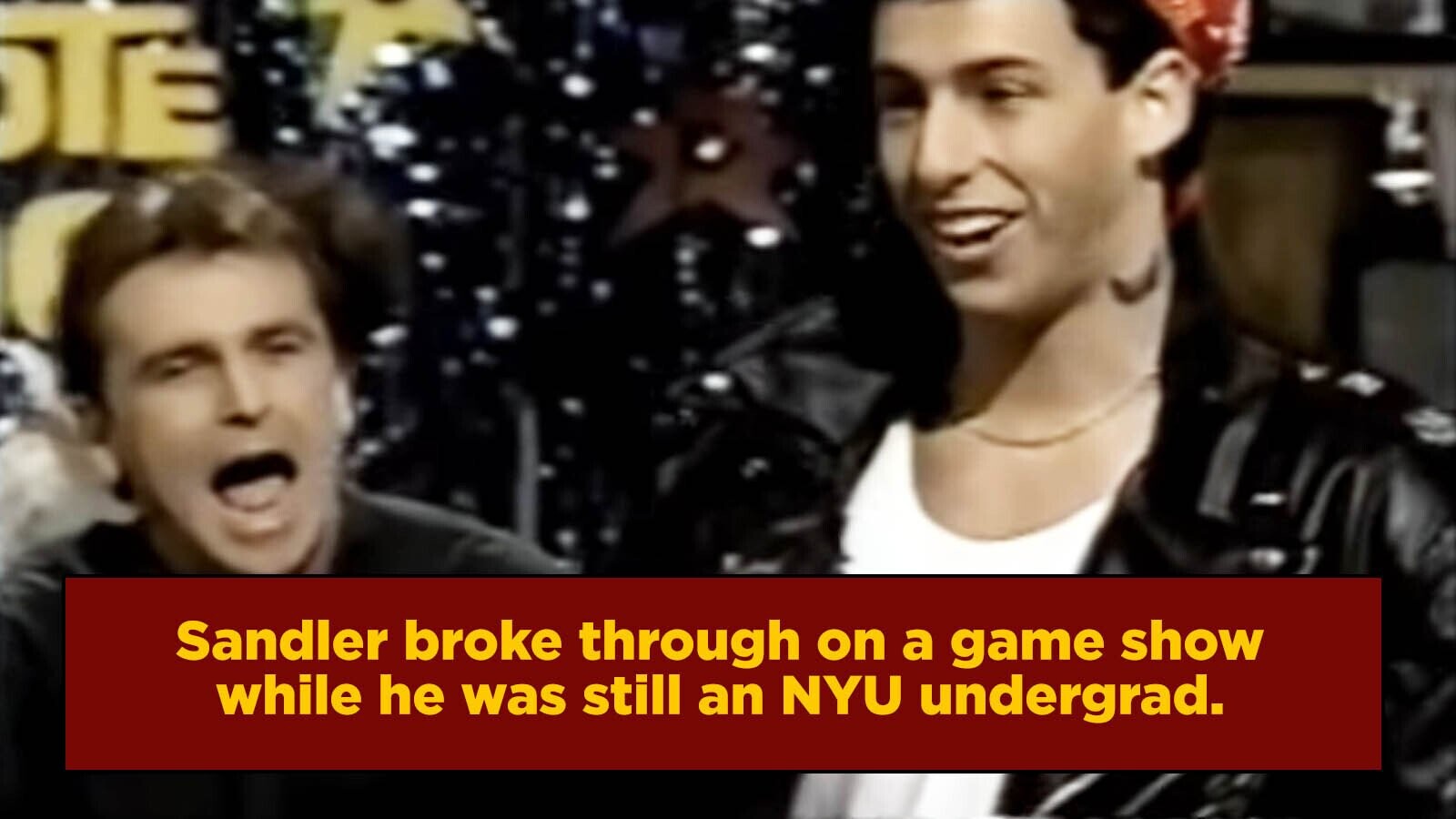
Long before Billy Madison, Happy Gilmore, The Wedding Singer, and the empire of Happy Madison comedies, Adam Sandler was a young comic turning up on Remote Control in oddball character bits. One of his best-known roles on the show was “Stud Boy,” a goofy, exaggerated persona that already hinted at the Sandler style: childish, musical, strange, sweetly dumb, and somehow more memorable than it had any right to be.
Sandler’s early appearances on MTV came around the same period as his work on The Cosby Show and before his breakout on Saturday Night Live. In retrospect, Remote Control looks like a sketchbook for the kind of characters he would later bring to mainstream comedy. He was not trying to be slick. He was building laughs out of awkward confidence, funny voices, and a willingness to look ridiculous.
That willingness became Sandler’s superpower. His later SNL songs and movie characters often came from the same comic DNA: exaggerated innocence, sudden bursts of absurdity, and a refusal to polish away the weird parts. Remote Control gave him a place where weird was not merely allowed; it was basically the dress code.
Denis Leary: Fast, Sharp, and Already Combustible
Denis Leary also appeared on Remote Control, contributing to sketches and playing characters before his later fame as a rapid-fire stand-up, actor, writer, and creator. Leary’s later public persona would become famous for speed, irritation, cigarettes, and ranting like a man trying to win an argument with a vending machine. On Remote Control, you can see the early ingredients of that energy.
Leary’s career would later include MTV promos, comedy albums such as No Cure for Cancer, film roles, and the acclaimed FX drama-comedy Rescue Me. But the MTV era helped introduce him to a younger, cable-savvy audience that liked comedy with bite. Remote Control was a good fit because it rewarded performers who could hit hard, move fast, and make the audience feel like anything might happen in the next ten seconds.
The show did not create Leary’s edge, but it gave that edge a playful television sandbox. He was part of a cast that treated pop culture as both sacred material and something worth spray-painting.
Why the Show Was So Weird and Why That Worked
The weirdness of Remote Control was not accidental. It was designed to feel like television for viewers who had grown up watching too much television. Instead of pretending game shows were glamorous, it mocked the format. Instead of treating trivia as noble knowledge, it turned pop culture into a contact sport. Instead of asking contestants to stand at podiums, it strapped them into recliners like they were preparing for a low-budget moon launch.
The show’s basement setting was genius because it instantly rejected the glossy perfection of older game shows. It said, “This is not your parents’ Jeopardy!” The clutter, props, fake family-home premise, and chaotic visual style made the series feel intimate and rebellious. It was as if MTV had converted a private obsession with television into a public party.
That tone also matched the late-1980s youth audience. MTV viewers were media-literate. They knew music videos, commercials, sitcoms, reruns, and celebrity culture. Remote Control trusted them to understand the references. It did not explain every joke. It threw jokes at the wall and expected the audience to keep up.
The Format: Trivia, Sketches, and Controlled Mayhem
Each episode featured contestants choosing “channels,” which represented categories. Some questions were straightforward pop culture trivia. Others were delivered through sketches, songs, fake commercials, or character bits. This allowed the writers and performers to turn a simple question into a mini-comedy scene.
There were also recurring bits that made the show feel less like a standardized game and more like a live comedy machine. The snack break was a classic example. Contestants might receive snacks in absurd ways, sometimes dropped from above. Losing players could be yanked out of their chairs and through walls. The grand prize round involved identifying music videos playing on multiple TV screens, which tied the game back to MTV’s core identity.
That format was smart because it mixed the familiar with the unpredictable. Viewers understood trivia. They understood TV channels. They understood game-show stakes. But they did not always know whether the next minute would include a serious question, a ridiculous character, or a contestant being treated like furniture with a pulse.
How Remote Control Predicted Modern Comedy
Looking back, Remote Control feels surprisingly modern. Its humor was meta before “meta” became a word people used in coffee shops while discussing streaming shows. It made jokes about television while being television. It used pop culture as raw material. It encouraged performers to create fast, memorable characters. It mixed game structure with sketch comedy. That combination now feels normal because modern entertainment is full of hybrids, but in the late 1980s, it was fresh and strange.
You can draw a line from Remote Control to later MTV comedy, including shows that blended sketches, youth culture, and absurdity. You can also see its spirit in internet comedy, where format-breaking, self-aware humor became the default setting. A YouTube trivia parody, a TikTok character bit, or a podcast segment mocking nostalgic media all owes something to the idea that pop culture can be both the subject and the punchline.
The show also understood something important about young audiences: they do not always want authority. Sometimes they want the format to be attacked from within. Remote Control did not ask viewers to respect the game show. It invited them to laugh at it, love it, and throw popcorn at it emotionally.
The Sandler-Quinn-Leary Connection
The most fascinating part of the show’s legacy is how different Sandler, Quinn, and Leary became. Sandler grew into one of the biggest comedy movie stars in America, known for goofy voices, sentimental underdogs, and broad physical comedy. Quinn became a sharp social observer, stand-up veteran, SNL figure, and solo-show performer. Leary developed a career built on combustible stand-up, acting, writing, and darker comic drama.
Yet all three made sense inside the Remote Control universe. The show had room for Sandler’s silly characters, Quinn’s verbal skepticism, and Leary’s sharper energy. That flexibility was part of its brilliance. It did not force every comic into the same mold. It created a noisy playground where different styles could bounce off each other.
In that sense, Remote Control was more than a game show. It was a talent incubator. It allowed young performers to test timing, build personas, and learn how to pop on camera. The stakes were low enough to encourage experimentation, but the platform was big enough to matter.
Why the Show Still Matters
It is easy to dismiss Remote Control as a nostalgic artifact, something remembered mainly by Gen X viewers who can still hear the theme song somewhere deep in the snack-food section of their brains. But the show matters because it captured a turning point in television. MTV was beginning to stretch beyond music videos. Comedy was becoming faster, more referential, and more self-aware. Pop culture knowledge was becoming a shared language.
Today, when nearly every show, meme, and online joke assumes you understand references from five different decades, Remote Control looks less like an oddity and more like an early warning signal. It predicted a culture where everyone has a remote control in their hand, a screen in their pocket, and a brain full of trivia nobody asked for but everyone somehow needs.
The series also reminds us that careers rarely begin in perfect conditions. Sometimes they begin on a strange MTV game show with recliners, fake channels, and jokes about TV reruns. Before fame looks inevitable, it often looks weird. In Sandler’s case, it looked like Stud Boy. In Quinn’s case, it sounded like sarcastic commentary from the corner. In Leary’s case, it came with a fuse already lit.
Experience Section: Watching Remote Control Feels Like Opening a Time Capsule With Spring-Loaded Confetti
Watching clips of Remote Control today is a strange experience, especially if your idea of a modern game show includes clean graphics, dramatic lighting, and contestants telling emotional backstories about their grandmother’s casserole recipe. Remote Control does not ask for your tears. It asks whether you know too much about television and whether you are willing to be hit with nonsense at professional speed.
The first thing you notice is the energy. Modern shows often try to look expensive. Remote Control tries to look like the basement won a dare. The set is busy, cramped, and proudly tacky. The recliners make the contestants look less like competitors and more like people who accidentally sat down during a party and were immediately drafted into a quiz war. That visual looseness gives the show its charm. It feels handmade in the best possible way.
The second thing you notice is how much comedy is packed into the format. A question is rarely just a question. It is an excuse for a character, a parody, a quick insult, a goofy category, or a visual gag. The show trains you to expect the unexpected, which makes even the normal trivia feel funnier. It is not polished in the modern streaming sense, but it has a pulse. It has the messy confidence of performers who know the joke may not be elegant, but it will not be boring.
Seeing Adam Sandler in this environment is especially fun because his later style is already visible in miniature. He has that young-comic fearlessness, the kind that says, “Yes, this voice is ridiculous, and yes, I will keep doing it until you laugh or leave.” Colin Quinn’s presence feels equally important. He grounds the weirdness with sarcasm, giving the show a human reaction to its own insanity. Denis Leary adds another flavor: sharper, faster, more combustible. Together, they create the sense that MTV had accidentally built a comedy farm system.
The experience also highlights something missing from much modern entertainment: productive roughness. Not everything on Remote Control is perfectly shaped. Some jokes are very much of their era. Some references now require the viewer to have a working knowledge of old sitcoms, forgotten commercials, and the social importance of channel surfing. But that roughness is part of the appeal. It feels alive because it is not over-sanded.
For writers, comedians, and content creators, the lesson is clear: format can be a playground. Remote Control did not become memorable by copying traditional game shows. It became memorable by asking what would happen if a game show was invaded by sketch comedy, music-video energy, and basement sarcasm. That is still a useful creative question today. What familiar format can be twisted? What old structure can carry new jokes? What boring room can become a comedy laboratory if you add the right people and remove the fear of looking silly?
That may be the real reason Remote Control still has a cult glow. It reminds us that entertainment history is not only made by perfect masterpieces. Sometimes it is made by weird experiments that give talented people enough room to become themselves. And sometimes, if the basement is strange enough, the future of comedy wanders in, sits in a recliner, and starts yelling answers at a television.
Conclusion: The Basement That Helped Build a Comedy Future
Remote Control was weird, loud, scrappy, and deeply aware of television’s absurdity. It arrived when MTV was still figuring out how far it could stretch beyond music videos, and it proved that young audiences would follow the network into stranger territory if the jokes were fast and the attitude felt real.
The show gave early exposure to Adam Sandler, Colin Quinn, and Denis Leary, three performers who would move in very different directions but carry traces of that MTV chaos with them. Sandler took the power of oddball characters into movies and SNL songs. Quinn sharpened his voice as a comic commentator. Leary turned speed and irritation into a full-blown comic identity. Each of them found, in some way, a useful basement.
That is the enduring charm of Remote Control. It was not simply a trivia show. It was a rebellious comedy workshop disguised as a game show. It laughed at television while adding something new to it. And for a few future stars, it was the strange, snack-covered, recliner-equipped beginning of much bigger things.