Note: This article is for educational publishing purposes only. It explains real estate credit as an investment theme and should not be treated as personal financial advice.
Why Real Estate Credit Is Suddenly the Cool Kid at the Finance Table
Real estate credit used to be the quiet corner of the investment world. Equity investors got the glossy brochures, the ribbon-cutting photos, and the heroic stories about buying a tired apartment building and turning it into a rent-producing masterpiece. Credit investors, meanwhile, sat nearby with spreadsheets, lien documents, and a strong preference for getting paid before everyone else. Not exactly Hollywood material.
But market cycles have a funny way of changing who gets invited to dinner. After years of higher interest rates, lower commercial property values, tighter bank lending, and a giant wall of maturing real estate loans, credit has moved from “boring fixed-income cousin” to “strategic income engine.” The phrase Talk Your Book: Investing in Real Estate Credit captures the moment perfectly: investors are no longer only asking who owns the building. They are asking who lends against it, at what loan-to-value ratio, with what covenants, and how much cushion sits between the loan and a bad day.
Real estate credit is not one single thing. It can include senior mortgages, construction loans, bridge loans, mezzanine debt, preferred equity, commercial mortgage-backed securities, and mortgage REIT exposure. Some strategies are conservative and income-focused. Others live further down the capital stack, where returns can look tastier but the risks come with extra hot sauce. The opportunity is real, but so is the homework.
What Is Real Estate Credit?
Real estate credit means investing in loans or debt-like instruments backed by real estate. Instead of buying the building, the investor helps finance the building. The borrower may be an apartment owner refinancing a multifamily property, a developer finishing a logistics warehouse, or a sponsor renovating an office tower that needs a second life and possibly a motivational poster.
The basic idea is simple. The lender provides capital. The borrower pays interest. The real estate serves as collateral. If things go well, the lender earns steady income and gets principal back. If things go badly, the lender may have legal rights to step in, restructure the loan, or take control of the asset. That priority is why many investors see real estate credit as a potentially attractive middle ground between traditional bonds and real estate equity.
The Capital Stack, Without the Headache
Picture a building’s financing like a layer cake. At the bottom is senior debt, usually the safest slice because it gets paid first and is secured directly by the property. Above that may sit mezzanine debt or preferred equity, which can offer higher yields but takes more risk. At the very top is common equity, where the owner enjoys the upside if values rise but absorbs the first losses if the deal goes sideways.
That structure matters because real estate credit investors are not all taking the same bet. A senior lender at 55% loan-to-value on a fully leased apartment property is playing a very different game from a mezzanine lender behind a transitional office building with uncertain leasing demand. Both are “real estate credit,” but one wears a seat belt, helmet, and reflective vest. The other might be riding a skateboard downhill while checking cap-rate assumptions.
Why Investors Are Paying Attention Now
The current environment has created a rare mix of caution and opportunity. Commercial real estate prices adjusted after interest rates rose. Banks, historically dominant lenders in commercial real estate, have become more selective. Many property owners still need to refinance loans that were originated when money was cheaper. At the same time, institutional and private lenders are stepping into the gap, looking to earn attractive yields with stronger structures than were common during the easy-money years.
In plain English: borrowers need capital, but capital is no longer free and friendly. That gives disciplined lenders more negotiating power. They can demand lower leverage, better covenants, stronger sponsors, cash reserves, and more conservative appraisals. For credit investors, the best opportunities often appear after the party ends, the lights turn on, and everyone realizes the punch bowl was financed at a floating rate.
The Bank Pullback Opens a Door
Regional banks and other traditional lenders still matter enormously, but many have been managing their exposure to commercial real estate. Elevated rates, office vacancies, regulatory attention, and deposit-cost pressure have encouraged some banks to reduce risk or sell loan portfolios. When banks step back, alternative lenders, private credit managers, insurance companies, debt funds, and mortgage REITs may step forward.
This does not mean every loan is suddenly a bargain. It means the market has become more selective. Good borrowers with strong assets can still find capital. Weaker borrowers may face higher costs, tougher terms, or painful refinancings. Real estate credit investors need to know the difference, because “secured by real estate” is not the same as “safe.” A loan backed by a great property at a conservative valuation can be a beautiful thing. A loan backed by a half-empty building with optimistic rent projections is just a spreadsheet wearing cologne.
The Main Types of Real Estate Credit Investments
Senior Commercial Mortgages
Senior mortgages are the first-priority loans secured by a property. They usually sit at the safest part of the capital stack and often target steady income rather than flashy upside. Investors may access this area through private real estate debt funds, insurance-company lending platforms, mortgage REITs, or securitized products. The key underwriting questions include property income, tenant quality, sponsor experience, debt-service coverage, maturity date, and loan-to-value ratio.
Bridge Loans
Bridge loans finance transitional properties. A borrower might use a bridge loan to lease up an apartment project, renovate a hotel, or stabilize a property before refinancing into permanent debt. These loans can offer higher yields because the business plan is not complete. The risk is execution. If the renovation runs late, leasing disappoints, or rates move against the borrower, the bridge can start looking less like a bridge and more like a very expensive pier.
Mezzanine Debt and Preferred Equity
Mezzanine debt and preferred equity sit below senior debt and above common equity. They can provide attractive income, but they absorb losses sooner than senior loans. These structures often depend heavily on asset quality, sponsor strength, and legal protections. Investors should understand whether they are being compensated for the added risk or simply being served a larger yield number with a tiny umbrella in it.
CMBS and Public Market Exposure
Commercial mortgage-backed securities, or CMBS, package pools of commercial real estate loans into tradable bonds. CMBS can offer liquidity and diversified exposure, but the structure can be complex. Delinquencies, maturity defaults, property-type concentration, and tranche position all matter. Office loans have been a particular pressure point in recent years, while industrial, multifamily, lodging, and retail each carry their own cycle-specific risks.
Mortgage REITs
Mortgage REITs provide another route into real estate credit. These publicly traded vehicles finance income-producing real estate by originating or purchasing mortgages and mortgage-backed securities. The benefit is accessibility: investors can buy shares through public markets. The trade-off is volatility. Mortgage REIT prices can move with rates, spreads, leverage, book values, and investor sentiment. They may be easier to buy than a private fund, but that does not make them simple.
What Makes Real Estate Credit Attractive?
1. Income Potential
The most obvious attraction is income. Real estate credit strategies typically focus on contractual interest payments. In a higher-rate world, new loans may offer coupons that look far more compelling than the ultra-low-yield environment investors endured for years. For income-oriented portfolios, that can be appealing, especially when the loans are backed by tangible collateral.
2. Collateral Support
Unlike unsecured corporate credit, real estate loans are tied to specific physical assets. That collateral can provide downside protection, especially when leverage is conservative and the asset generates reliable cash flow. A well-underwritten loan does not rely on vibes. It relies on rent rolls, appraisals, leases, operating history, market demand, and sponsor equity.
3. Priority Over Equity
Credit investors usually get paid before equity investors. That priority can be valuable during volatile periods. If a property value declines, the equity cushion absorbs the first loss before the senior lender is impaired. This is why loan-to-value discipline is central. The lower the leverage, the more room there is for things to go wrong before the lender takes a hit.
4. Diversification
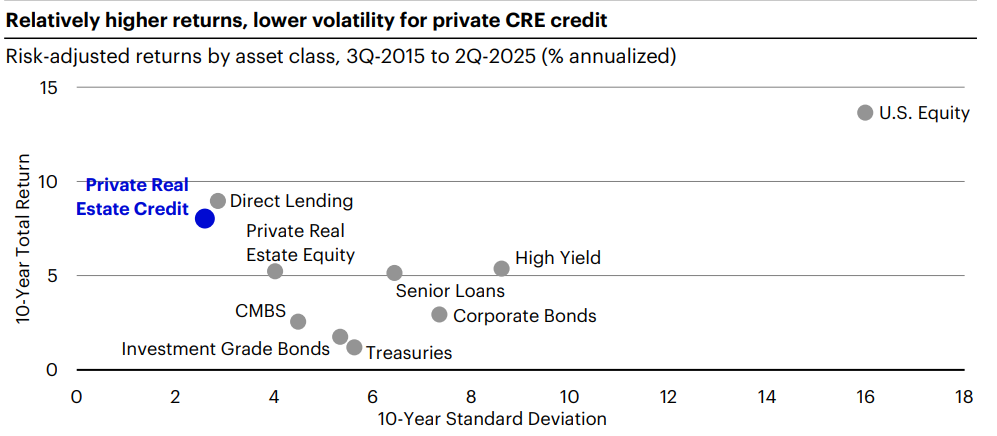
Private real estate credit may behave differently from public stocks, corporate bonds, and real estate equity. Its return pattern is often driven by income, loan structure, borrower performance, and collateral values rather than daily public-market sentiment. That does not eliminate risk, but it may provide a different source of return inside a broader portfolio.
The Risks: Because Every Yield Has a Backstory
Interest Rate Risk
Higher rates can help new lenders earn more income, but they can also pressure borrowers. Floating-rate debt becomes more expensive when rates rise. Borrowers with weak cash flow may struggle to cover interest payments. Even fixed-rate loans face refinancing risk when they mature into a more expensive market. A loan that looked comfortable at 3.5% financing can look like a treadmill set to “panic” at 7%.
Refinancing Risk
Commercial real estate is full of balloon maturities. Many loans do not amortize fully; they must be refinanced or paid off at maturity. If property values decline, rents weaken, or lending standards tighten, refinancing can become difficult. This creates opportunity for new lenders, but it also increases default and extension risk for existing debt holders.
Property-Type Risk
Not all real estate sectors are created equal. Multifamily can benefit from housing demand but may face oversupply in certain Sun Belt markets. Industrial has long-term tailwinds from logistics and e-commerce but is not immune to slower leasing. Retail has improved in many locations but remains highly asset-specific. Office is the complicated cousin at Thanksgiving: some trophy buildings are recovering, while obsolete properties remain under serious pressure.
Liquidity Risk
Private real estate credit funds may offer limited liquidity. Investors should understand lockups, redemption queues, gates, valuation policies, and whether the fund uses leverage. A loan portfolio can be performing on paper while still being hard to sell quickly at a fair price. Liquidity terms are not boring legal details; they are the emergency exits.
Manager Risk
Manager selection is critical. Strong real estate credit managers combine property expertise, credit discipline, legal structuring, servicing capacity, and workout experience. Anyone can lend money in a good market. The test comes when a borrower misses a payment, the appraisal gets revised downward, and the lender has to decide whether to extend, restructure, foreclose, or drink coffee until midnight.
How to Evaluate a Real Estate Credit Opportunity
Start With the Property
The best real estate credit analysis begins with the real estate. What is the asset? Where is it located? Who are the tenants? Are rents above or below market? Is the building useful, modern, and competitive? A “cheap” loan against a weak property can become expensive very quickly.
Study the Sponsor
The borrower matters. Experienced sponsors with meaningful equity at risk are usually better aligned with lenders. A sponsor who has navigated past cycles may handle stress better than one whose entire career was built on cheap debt and rising cap rates. Skin in the game is not a cliché; it is a risk-control tool.
Check the Loan Terms
Important terms include loan-to-value ratio, debt yield, interest coverage, maturity date, extension options, reserves, covenants, and recourse provisions. Investors should also ask where the loan sits in the capital stack. Senior debt at moderate leverage is very different from junior capital behind a large first mortgage.
Understand the Exit
Every real estate credit investment needs a credible repayment path. Will the loan be refinanced by a bank? Paid off through a sale? Converted into permanent agency financing? Supported by cash flow? If the exit depends on heroic rent growth, cap-rate compression, and a buyer arriving on a white horse, the lender may be underwriting a fairy tale.
Where Real Estate Credit Fits in a Portfolio
Real estate credit can serve several roles. For income-focused investors, it may provide yield backed by collateral. For alternative-investment allocations, it may diversify exposure away from pure equity risk. For investors who already own real estate equity, credit may offer a more defensive way to stay involved in the asset class.
Still, allocation size matters. Real estate credit should not be treated as a magical substitute for cash, investment-grade bonds, or broad diversification. It can be less liquid, more complex, and highly dependent on manager skill. A sensible approach is to define the role first: income, diversification, opportunistic lending, or inflation-sensitive real asset exposure. Once the role is clear, the structure becomes easier to evaluate.
Investors should also compare public and private routes. Public mortgage REITs and CMBS funds may offer easier access and daily pricing, but they can be volatile. Private funds may offer more direct exposure and potentially smoother reported returns, but they require careful due diligence and patience. There is no free lunch. There is, however, a menu with fine print.
The Big Picture: A Better Market for Lenders, Not a Risk-Free Market
The real estate credit story is not simply “banks are retreating, so private lenders win.” That is too easy. The better version is more nuanced. Higher rates reset values. Lower values improved entry points. Maturing debt created demand for capital. Bank caution reduced competition. Strong lenders can now negotiate better terms than they could during the zero-rate frenzy.
At the same time, distress is real in certain pockets. Office loans remain under pressure. Some multifamily markets face supply issues. Borrowers with floating-rate debt may still be squeezed. Private credit broadly has attracted scrutiny because rapid growth can encourage weak underwriting if managers chase assets just to deploy capital. The opportunity is not in buying everything. It is in being picky when borrowers need options.
That is why the best phrase in real estate credit might be “credit over yield.” A high coupon is nice, but getting repaid is nicer. The lender’s job is not to win a beauty contest for the biggest stated return. The lender’s job is to protect principal, structure downside protection, and earn an appropriate spread for the risk being taken.
Practical Experiences and Field Notes From Real Estate Credit Investing
One of the most useful experiences investors learn from real estate credit is that the property tour and the loan agreement tell two different stories. The property tour shows the lobby, the amenities, the leasing office, and the rooftop view that makes everyone briefly consider becoming a real estate mogul. The loan agreement shows the covenants, reserves, guarantees, default triggers, and remedies. Smart investors pay attention to both, but they trust the documents when the market gets rough.
A common lesson is that conservative leverage can turn an average deal into a durable one. Imagine two loans backed by similar apartment buildings. One is made at 55% loan-to-value with a strong sponsor and solid occupancy. The other is made at 78% loan-to-value with aggressive rent-growth assumptions. In a rising market, both may perform. In a weaker market, the first loan has room to breathe. The second loan may need everything to go right. Real estate credit is often about surviving the period when everything does not go right.
Another experience is that sponsor behavior changes when equity is thin. Borrowers with substantial cash invested usually work harder to protect the asset. Borrowers with little remaining equity may be more willing to hand back the keys or ask for concessions. This is why lenders care about current equity, not just original equity. If the property value has fallen enough, yesterday’s sponsor commitment may no longer provide today’s motivation.
Investors also discover that “extend and pretend” is not always foolish. Sometimes extending a loan is the most rational choice if the property is fundamentally sound but the capital markets are temporarily frozen. A lender may prefer more reserves, a partial paydown, a higher coupon, or tighter reporting rather than forcing a sale into a weak market. The key is whether the extension improves the lender’s position or merely delays recognition of a bad loan.
Real estate credit also teaches humility about appraisals. Valuation is part science, part market evidence, and part educated judgment. When transaction volume is low, appraisals can lag reality. A lender who relies only on a stale valuation may overestimate the equity cushion. Experienced investors stress-test exit cap rates, rent assumptions, vacancy, insurance costs, taxes, and refinancing rates. The goal is not to predict the future perfectly. The goal is to avoid needing a perfect future.
Finally, investors learn that communication is an early warning system. Late reporting, vague leasing updates, delayed financials, and repeated requests for waivers can reveal stress before a missed payment appears. Good managers monitor loans actively, not passively. They do not simply collect coupons and hope. They track tenants, local supply, borrower liquidity, insurance renewals, tax assessments, and capital expenditures. In real estate credit, boring discipline is a competitive advantage. The best lenders are not the loudest people in the room. They are the ones who read the footnotes before dessert.
Conclusion: Real Estate Credit Rewards Discipline
Investing in real estate credit is not about falling in love with buildings. It is about lending against them intelligently. The current market offers meaningful opportunities because borrowers need capital, banks are more selective, values have reset, and lenders can often demand better protection than they could a few years ago. But attractive conditions do not remove the need for rigorous underwriting.
The strongest real estate credit investors focus on collateral quality, conservative leverage, sponsor strength, loan structure, and realistic exits. They understand that yield is only attractive when it is collectible. They know the difference between temporary stress and permanent impairment. And they remember that a loan is not good because it has a high coupon; it is good because it gets paid back.
For investors seeking income, diversification, and exposure to real assets without taking the first-loss position of equity ownership, real estate credit deserves serious attention. Just bring a calculator, a skeptical mind, and a healthy respect for the phrase “maturity date.” In this corner of the market, patience is useful, paperwork matters, and the best returns often come from avoiding the loans that looked exciting for all the wrong reasons.