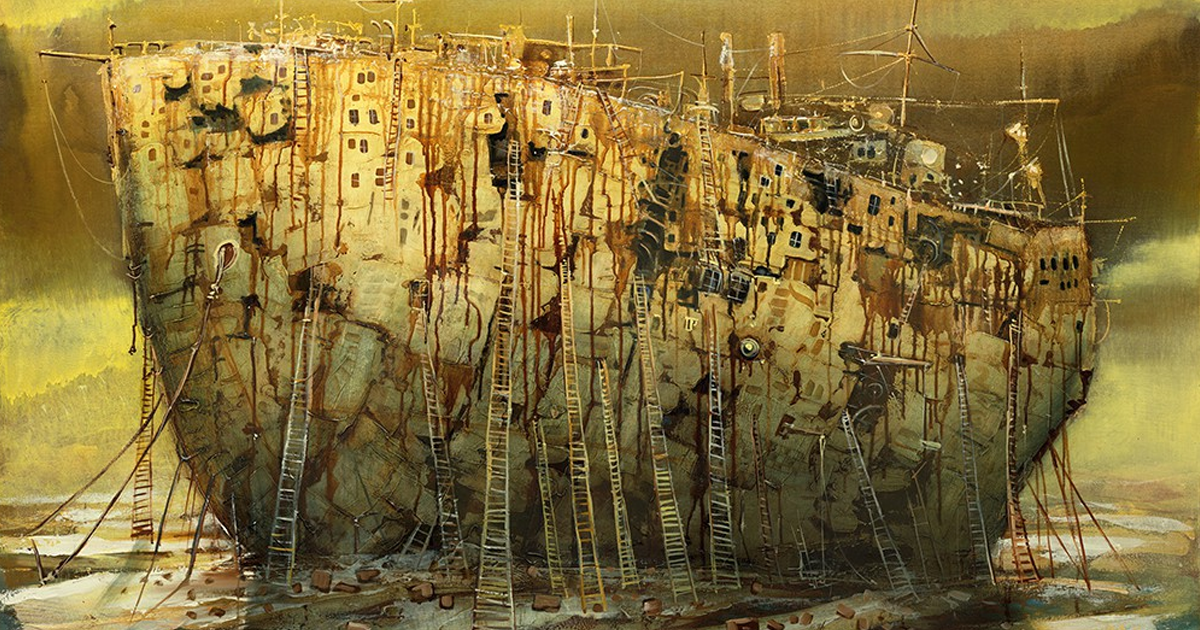
Some ships are built in shipyards. Others are built in sketchbooks, daydreams, rainy afternoons, and that mysterious corner of the imagination where a chimney, a sail, a fish skeleton, and a floating city somehow become best friends. My 21 Oil Paintings Of Fantasy Ships explores that second kind of vessel: impossible ships that do not ask permission from physics before setting sail.
The idea comes from the enchanting world of Lithuanian artist Modestas Malinauskas, whose fantasy ship paintings have fascinated art lovers online for years. A former fireman turned painter, Malinauskas is known for creating dreamlike oil paintings filled with surreal vessels, steampunk structures, layered textures, glowing skies, and tiny architectural details that reward slow looking. His ships feel less like machines and more like wandering characters: part boat, part house, part memory, part “please do not ask how this thing floats.”
Fantasy ship oil paintings sit at a beautiful intersection of maritime art, surrealism, steampunk design, and visual storytelling. They borrow the drama of traditional seascapes, the craftsmanship of oil painting, and the freedom of fantasy illustration. The result is art that can feel ancient and futuristic at the same time, like a pirate ship accidentally wandered into a dream and decided to stay for tea.
Why Fantasy Ships Work So Well In Oil Painting
Oil paint is almost unfairly good at creating atmosphere. It can be thin and luminous, thick and sculptural, sharp as a rigging line, or soft as fog over a harbor. That makes it a perfect medium for fantasy ships, where the viewer needs to believe in something unbelievable. A floating vessel with crooked towers and patchwork sails becomes convincing when light, shadow, texture, and color behave with emotional truth.
Traditional marine painters have long used ships to tell stories about exploration, danger, trade, weather, and human ambition. Museum collections are full of storm-tossed vessels, calm harbors, merchant ships, and symbolic boats. Fantasy ship paintings extend that history into a more imaginative space. Instead of documenting a real voyage, they suggest a hidden one. The destination is not Boston, Liverpool, or a Dutch harbor. It is somewhere between childhood memory and another planet.
The Magic Of The 21 Fantasy Ships
A collection of 21 fantasy ship paintings naturally invites the viewer to think in chapters. Each painting can feel like a separate stop on a strange maritime map. One ship might look like a floating village patched together from wood, metal, ladders, sails, pipes, and stubborn optimism. Another might seem stranded in golden light, carrying the silence of an old vessel that has survived more storms than it cares to discuss.
What makes these works memorable is not only the subject but the density of invention. The ships are often built from many small visual pieces: windows, towers, decks, masts, smoke stacks, ropes, panels, balconies, wheels, and odd mechanical hints. You do not simply look at the ship; you inspect it. Your eye boards the vessel, wanders around, gets lost, knocks politely on a tiny painted door, and then realizes there are twenty more doors.
Steampunk, Surrealism, And The Poetry Of Impossible Engineering
Many fantasy ships by Malinauskas and artists working in similar visual territory have a strong steampunk flavor. Steampunk art often imagines alternate technologies inspired by steam power, industrial machinery, brass fittings, old engines, airships, gears, and Victorian-era design. In fantasy ship painting, that influence gives vessels an aged mechanical soul. These are not sleek spaceships. They are clanking, smoking, patched, romantic machines that look as if they were repaired by a poet with a toolbox.
Surrealism also plays a major role. A ship may float through air, emerge from fog, become a city, or carry architecture that should logically collapse into the sea by lunchtime. Yet the painting does not need strict realism. It needs internal logic. The viewer must feel, “No, I cannot explain this vessel, but yes, I absolutely believe it has a captain.”
Oil Painting Techniques That Make Fantasy Ships Feel Alive
Layering And Glazing
One reason oil paintings can feel so deep is the use of layers. In indirect painting, artists may build an image through underpainting, opaque passages, and transparent glazes. Glazing allows light to pass through thin color layers and bounce back, creating luminosity that is difficult to fake. In fantasy ship paintings, this can make skies glow, water shimmer, fog soften, and old wooden hulls feel weathered rather than merely brown.
Palette-Knife Texture
Palette knives can create ridges, scraped surfaces, hard edges, and thick passages of paint. For fantasy vessels, this texture is especially useful. A palette knife can suggest rust, cracked boards, torn sails, rocky coastlines, or rough clouds. It also gives the painting a handcrafted energy. The ship does not look printed or polished; it looks built.
Thick Over Thin
Oil painters often follow the practical rule of building thicker paint over thinner layers. This helps the surface remain stable as layers dry at different speeds. Artistically, the rule also creates a natural rhythm: thin atmospheric beginnings, then stronger forms, then richer textures and highlights. A fantasy ship benefits from that process because it can emerge gradually, like a dream becoming architecture.
What Viewers Notice First
The first attraction is usually scale. Even when the actual canvas is modest, the ships feel enormous because of their detail and mood. A single fantasy vessel can suggest an entire civilization. Who lives inside? What do they eat? Why is there a tower on the stern? Is that chimney legal? Does the ship have insurance? These are not normal art-history questions, but fantasy art happily invites them.
The second attraction is color. Malinauskas is often associated with earthy, atmospheric palettes: warm golds, Baltic grays, autumnal browns, smoky greens, deep reds, and softened blues. These colors help the paintings avoid looking like ordinary digital fantasy posters. They feel tactile, aged, and slightly mysterious, as if the ships have been traveling through weather, memory, and maybe one or two suspicious thunderstorms.
How Fantasy Ships Tell Stories Without Words
A great fantasy ship painting does not need a written plot. The design itself becomes the plot. A cracked hull tells one story. A glowing window tells another. A vessel leaning into a storm suggests danger; a ship resting in golden stillness suggests memory, loss, or arrival. When the painting includes birds, smoke, distant land, odd buildings, or strange mechanical forms, those elements become clues.
This is why the series feels so appealing for viewers who love books, games, animation, or cinematic worldbuilding. Each painting feels like concept art for a novel that has not been written yet. The viewer becomes the writer. One person sees a refugee ship from a flooded kingdom. Another sees a traveling workshop. Someone else sees a retired pirate captain who now runs a bakery on deck. Art becomes a machine for creating stories.
Fantasy Ships And The Long Tradition Of Marine Art
Although fantasy ships are modern in spirit, they are connected to a long tradition of marine painting. Dutch Golden Age artists painted dramatic seascapes with ships struggling against wind and waves. British and American collections preserve images of merchant vessels, shipwrecks, harbors, coastlines, and symbolic boats. These works often used the sea as a metaphor for risk, trade, faith, empire, mortality, and human courage.
Fantasy ship paintings inherit that emotional vocabulary. The sea remains powerful, mysterious, and unpredictable. But the ship changes. It no longer has to be historically accurate. It can become a floating castle, an airborne workshop, a steampunk ferry, or a dream vessel carrying every half-remembered fairy tale the artist has ever loved.
Why The Number 21 Feels Right
Twenty-one paintings are enough to feel like a fleet. Not a random handful, not an endless archive, but a complete imaginative voyage. A collection of 21 fantasy ships gives viewers variety without exhaustion. Each work can have its own personality: the proud ship, the broken ship, the strange ship, the cozy ship, the haunted ship, the one that looks like it might sneeze smoke if startled.
For SEO readers searching for fantasy ship oil paintings, surreal ship art, steampunk vessel paintings, or fantasy maritime art, the appeal is easy to understand. These artworks combine the romance of sailing ships with the freedom of invented worlds. They are nostalgic and original at once.
What Artists Can Learn From These Paintings
Artists studying fantasy ship oil paintings can learn several useful lessons. First, strong fantasy design usually begins with recognizable structure. Even the wildest vessel needs a visual anchor: a hull, mast, deck, sail, engine, or cabin. Once the viewer recognizes “ship,” the artist can add delightful nonsense.
Second, detail works best when organized. Malinauskas-style fantasy ships often include many tiny elements, but they do not feel random. They cluster into larger shapes. Small windows create a tower. Pipes create rhythm. Sails create movement. Texture creates history.
Third, atmosphere matters as much as anatomy. A fantasy ship does not become magical only because it has weird machinery. It becomes magical because of the world around it: the glowing sky, the mist, the water, the wind, the strange quiet before something happens.
Experience: Living With The Idea Of 21 Fantasy Ships
Spending time with the idea of My 21 Oil Paintings Of Fantasy Ships feels less like viewing a gallery and more like walking through a harbor at dusk. Every vessel seems to be waiting for a different weather report from a different universe. Some look ready to launch. Some look as though they have just returned from a dangerous expedition and would prefer not to talk about it until after coffee.
The most enjoyable experience is the slow discovery. At first glance, a painting may present one large ship. Then the smaller details begin to wake up. A tiny cabin appears under a sail. A ladder climbs nowhere practical. A window glows as if someone inside is reading maps by candlelight. A chimney releases smoke into a sky that looks half real and half imagined. The painting becomes a puzzle, but not the annoying kind with missing corner pieces. It is the good kind, where every discovery makes the world feel bigger.
These works also remind us why handmade fantasy art still matters in a fast digital world. Oil painting has patience built into it. Layers dry slowly. Glazes need time. Textures are shaped by hand. That slowness becomes part of the emotional experience. The viewer senses that the ship was not generated in a blink; it was constructed, revised, waited on, scraped, softened, and finally allowed to breathe.
There is also something deeply comforting about imaginary ships. A ship is a promise of movement. It says there may be another shore, another chapter, another sky. A fantasy ship says all of that while wearing a crooked hat and carrying a lighthouse on its back. It does not need to be sensible to be meaningful. In fact, its refusal to be sensible is part of the charm.
Looking at 21 of these paintings together can inspire artists, writers, collectors, and daydreamers alike. A painter may notice the layered color and textured surfaces. A writer may imagine the crew. A designer may study the silhouettes and mechanical details. A casual viewer may simply smile because the ship looks like it has survived three storms, two legends, and one extremely confusing conversation with gravity.
That is the real achievement of fantasy ship oil paintings: they invite us to travel without leaving the room. They make the canvas feel like a port, the brushwork feel like weather, and the ship feel like a character with secrets. And honestly, any painting that makes you wonder where a floating steampunk vessel buys its spare parts has already done something wonderful.
Conclusion
My 21 Oil Paintings Of Fantasy Ships celebrates the rare pleasure of art that is technically rich, emotionally warm, and wildly imaginative. These paintings connect the history of marine art with the freedom of surreal fantasy, using oil layers, palette-knife textures, glowing color, and intricate design to create ships that feel both impossible and strangely believable.
Whether you are an artist looking for inspiration, a collector drawn to steampunk and surreal imagery, or simply someone who enjoys beautiful things that appear to have escaped from a dream, fantasy ship oil paintings offer a voyage worth taking. No passport required. A sense of wonder is recommended.