Type “Morse Code for China” into a search box and you may be asking one of two very different questions. First, you might want to know how to spell the English word China in International Morse code. Easy enough: -.-. …. .. -. .-. That is C-H-I-N-A, politely dressed in dots and dashes.
But the deeper question is far more interesting: how did Morse code work for the Chinese language, a writing system built from characters rather than an alphabet? That question opens a little trapdoor beneath the floor of communication history. Down there you find telegraph offices, codebooks, Chinese characters turned into four-digit numbers, radio operators tapping messages through static, and a surprisingly modern debate about how technology handles languages it was not originally designed for.
So yes, this article will show you the Morse code for “China.” But it will also explain why “Morse code for China” is not just a translation trick. It is a story about language, engineering, identity, and the human habit of making complicated things work anyway.
What Is the Morse Code for “China”?
In standard International Morse code, every Latin letter has a dot-and-dash pattern. Since “China” is written with five English letters, it is encoded letter by letter:
- C = -.-.
- H = ….
- I = ..
- N = -.
- A = .-
Put together, China in Morse code is:
-.-. …. .. -. .-
That version is useful for learning Morse, sending a simple message, or decorating a notebook if you enjoy looking mysterious at coffee shops. It treats “China” as an English word, not as Chinese characters.
If you write China in pinyin as Zhongguo, the Morse code becomes:
–.. …. — -. –. –. ..- —
That spells Z-H-O-N-G-G-U-O. It is closer to the Mandarin pronunciation of 中国, but it is still using the Roman alphabet. Morse code is doing what it does best: converting letters and numbers into signal patterns.
Why Chinese Morse Code Is More Complicated Than It Looks
Here is where things get spicy, or at least as spicy as telegraph history can get without someone spilling ink on a government form. Chinese writing is not alphabetic. A Chinese character usually represents a word, idea, or meaningful unit, not a single sound the way a letter does in English.
International Morse code was built for alphabets, especially the Latin alphabet used in many Western languages. It can handle letters, numbers, punctuation, and procedural signals. But it does not contain thousands of unique patterns for Chinese characters. Imagine memorizing a separate dot-and-dash sequence for every common Chinese character. That is not a code system; that is a punishment disguised as a hobby.
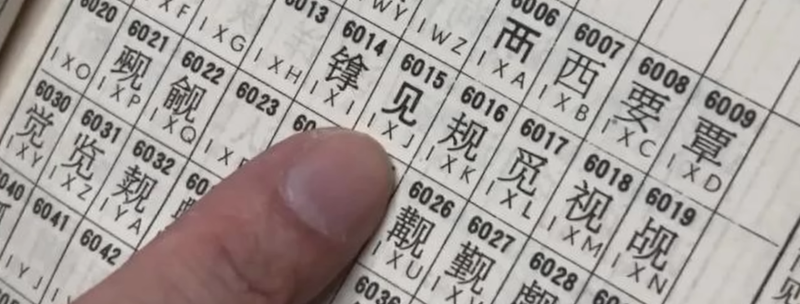
The solution was not to make Morse code enormous. Instead, Chinese telegraphy used a clever middle step: Chinese telegraph code, also known as Chinese commercial code. This system assigned Chinese characters to four-digit numbers. Operators could then transmit those digits using Morse code.
Chinese Telegraph Code: The Bridge Between Characters and Morse
The Chinese telegraph code solved a practical problem: how do you send Chinese characters over a telegraph network designed around short electrical pulses? The answer was to convert each character into a four-digit number, then send the number.
For example, the Chinese word for China, 中国, can be represented in standard Chinese telegraph code as:
0022 0948
The first code group, 0022, represents 中. The second, 0948, represents 国. Once the characters became numbers, Morse could handle them easily because Morse code already has patterns for digits.
How “中国” Could Be Sent Through Morse
To send 0022 0948, an operator would transmit each digit in Morse code:
- 0 = —–
- 2 = ..—
- 9 = —-.
- 4 = ….-
- 8 = —..
So the Chinese telegraph code for 中国 would be sent as digit groups, not as two giant custom Morse symbols. This is the key idea: Chinese Morse code was often Morse code carrying numbers from a Chinese character codebook.
Two Meanings of “Morse Code for China”
To keep things clear, here are the two main interpretations:
1. “China” as an English Word
If you mean the English word China, the Morse code is:
-.-. …. .. -. .-
This is perfect for basic Morse practice, radio demonstrations, classroom examples, and simple text conversion.
2. “China” as Chinese Characters
If you mean 中国, the historical telegraph method uses Chinese telegraph code first:
中国 = 0022 0948
Then those digits are sent in Morse. This method belongs to the world of telegraph offices, codebooks, administrative messages, diplomatic communications, and early information processing in Chinese.
A Short History of Morse Code and China
Morse code became famous in the 19th century because it made long-distance communication faster than any horse, ship, or exhausted messenger with good shoes. Samuel Morse’s early telegraph work in the United States helped show that complex messages could travel across wires almost instantly. The code itself used combinations of short and long signals: dots and dashes.
When telegraphy reached China in the 19th century, it met a language challenge. English could be spelled letter by letter. Chinese could not be handled that way without a conversion system. That led to Chinese telegraph codebooks, where characters were indexed as four-digit numbers.
This was not just a technical footnote. It was part of a larger story about how Chinese writing adapted to modern communication technologies. Morse code, typewriters, printing systems, indexing methods, and later computers all forced the same big question: how can a character-based writing system move through machines designed with alphabets in mind?
The answer, again and again, was not “Chinese cannot work with modern technology.” The answer was: build better systems. And people did.
Why Chinese Telegraph Code Was So Smart
The brilliance of Chinese telegraph code is that it separated the problem into two manageable layers.
Layer one: represent Chinese characters as numbers. Layer two: transmit the numbers using existing telegraph technology. That modular thinking feels surprisingly modern. It resembles how computers today separate what users see from what machines process underneath.
When you type a Chinese character on a smartphone, the device is not confused by the fact that the character is not alphabetic. It uses input methods, encoding standards, prediction, and software layers. In a distant historical sense, Chinese telegraph code was part of that same family of ideas: put a smart conversion layer between human language and machine signals.
That is why “Morse code for China” is more than a curiosity. It is a small window into the history of encoding itself.
Common Mistakes About Morse Code for China
Mistake 1: Thinking Every Chinese Character Has Its Own Morse Symbol
This sounds logical at first, but it would be wildly impractical. A full set of Morse symbols for thousands of Chinese characters would be slow, difficult to memorize, and easy to confuse. The telegraph codebook method was far more efficient.
Mistake 2: Using “CN” as If It Were the Morse Code for China
“CN” is a modern abbreviation people associate with China in some contexts, such as internet country codes. But in radio call-sign allocation, China is associated with the B-series ranges assigned by the International Telecommunication Union. Meanwhile, “CN” appears elsewhere in international call-sign allocations. So do not assume that “CN” automatically means China in every radio or Morse-related context.
Mistake 3: Confusing Morse Code With Encryption
Morse code is not encryption. It is an encoding system. Anyone who knows Morse can read it. Chinese telegraph code also was not automatically secret; if you had the codebook, you could decode the numbers. Of course, governments and military users sometimes added cipher methods on top of telegraph codes, but that is a separate layer. Morse itself is more like a flashlight alphabet than a locked safe.
Practical Examples
Example 1: Sending “China” in English
Message: CHINA
Morse: -.-. …. .. -. .-
This is the simplest and most common answer for beginners.
Example 2: Sending “Zhongguo” in Pinyin
Message: ZHONGGUO
Morse: –.. …. — -. –. –. ..- —
This represents the Mandarin pronunciation through Roman letters.
Example 3: Sending “中国” Historically
Chinese characters: 中国
Chinese telegraph code: 0022 0948
This is the more historically accurate path for Chinese-character telegraphy: characters become numbers, and numbers become Morse signals.
Is Morse Code Still Used in China?
Morse code is no longer the backbone of national communication anywhere. Phones, satellites, fiber-optic cables, digital radio, and the internet have taken over the daily work. Nobody is ordering noodles by telegraph unless they are running the world’s most historically dramatic restaurant.
Still, Morse code survives in amateur radio, training, aviation and maritime history, emergency communication culture, museums, hobbyist communities, and education. Many radio operators love Morse because it can travel far with low power and simple equipment. It also has a rhythm that feels almost musical once you stop panicking and start hearing letters instead of random beeps.
In China, as in many countries, amateur radio operators may encounter Morse code as part of radio culture. The language being discussed may be Chinese, English, or another language, but the Morse layer usually remains based on letters, numbers, abbreviations, and call signs.
Why This Topic Matters Today
At first glance, Morse code for China sounds like a small technical question. But it touches a much larger issue: how technology adapts to language diversity.
Many early communication systems were designed with alphabetic languages in mind. Chinese forced engineers, clerks, scholars, and operators to think differently. Instead of squeezing Chinese into an alphabet-shaped box, they built conversion systems, indexes, codebooks, and later input methods. That history matters because modern digital life still depends on encoding. Unicode, keyboards, search engines, translation tools, and messaging apps all rely on decisions about how language becomes machine-readable.
In other words, Chinese telegraph code was not a dusty museum oddity. It was an early chapter in the global story of information technology. The same basic question remains alive today: how do we make machines serve human language instead of making human language shrink to fit machines?
Experience Section: Learning Morse Code for China in Real Life
The first time you try to learn Morse code for “China,” it feels charmingly simple. C is -.-., H is …., I is .., N is -., and A is .-. You tap it out on a desk and feel like a secret agent with very limited office supplies. Then you discover Chinese telegraph code, and the floor drops out in the best possible way.
That is the moment the topic becomes memorable. You realize that “China” is not only a five-letter English word. It is also 中国, a two-character name with its own written history, pronunciation, and cultural weight. Sending it through Morse historically required a system that respected the structure of Chinese writing while still working with telegraph technology. That is a practical lesson in humility for anyone who thinks technology is neutral by default.
A good learning experience is to compare three versions side by side. First, write CHINA and convert it to Morse. Then write ZHONGGUO and convert that to Morse. Finally, write 中国 and look at the Chinese telegraph code 0022 0948. Suddenly, the same country name has three signal paths: English spelling, Mandarin romanization, and character-based telegraph encoding.
For beginners, this comparison is surprisingly powerful. It shows that Morse code is not magic. It does not “understand” meaning by itself. It carries symbols. The meaning comes from the system humans agree to use. If the agreed system is English spelling, Morse carries English letters. If the system is pinyin, Morse carries Romanized Mandarin. If the system is Chinese telegraph code, Morse carries digits that point back to Chinese characters.
One practical exercise is to tap “CHINA” slowly, leaving clear pauses between letters. Then tap “ZHONGGUO.” The second version is longer and more rhythmic. After that, try tapping the digits for 0022 0948. It feels completely different because numbers in Morse are longer patterns. You begin to understand why trained operators mattered so much. A tiny mistake in one digit could change the character, the message, or the mood of the receiving clerk, who probably already had enough problems before breakfast.
Another useful experience is listening instead of looking. Visual Morse charts are helpful, but Morse was often heard. When you listen to C-H-I-N-A, you start recognizing the “shape” of the word as sound. This is where Morse becomes less like memorizing a table and more like learning a short musical phrase. The code for China has a crisp start with C, a flutter of dots in H and I, then a clean N and A to finish. It is tidy, almost elegant.
The Chinese telegraph-code version teaches a different lesson. It feels more administrative, more like the machinery of history. You can almost imagine a clerk checking a codebook, confirming numbers, and sending a message across a network where speed mattered and errors could be expensive. That experience makes the topic feel real. It was not just dots and dashes floating in the air. It was people, offices, wires, codebooks, patience, and pressure.
Learning Morse code for China is valuable because it turns a simple conversion into a story. You get the beginner-friendly answer, but you also discover how languages and technologies negotiate with each other. The best part is that the lesson is still relevant. Every time we type, search, translate, or send a message today, we are relying on invisible encoding systems. Morse code just lets us hear that invisible world clicking out loud.
Conclusion
The Morse code for the English word China is -.-. …. .. -. .-. That is the quick answer, and it is useful. But the richer answer is that Chinese-language telegraphy historically used Chinese telegraph code, turning characters into four-digit numbers before sending those numbers through Morse.
For 中国, the Chinese telegraph code is commonly represented as 0022 0948. That example captures the genius of the system: do not force Morse to contain thousands of Chinese characters; instead, build a bridge between Chinese writing and telegraph signals.
So the next time someone asks for “Morse Code For China,” you can answer in two secondsand then, if they look curious, ruin their afternoon beautifully by explaining Chinese telegraph code.