Note: This article is written for educational and publishing purposes. Because molten metal, investment materials, burnout fumes, vacuum equipment, and microwave heating can create serious hazards, the content below explains the concept, risks, best practices, and safer alternatives rather than providing a do-it-yourself microwave casting tutorial.
What Does “Lost Print Vacuum Casting in a Microwave” Actually Mean?
“Lost print vacuum casting in a microwave” sounds like something a clever maker invented after drinking three coffees and staring too long at a 3D printer. The phrase usually points to a mashup of several real processes: lost-PLA or lost-resin casting, investment casting, vacuum-assisted casting, and microwave kiln heating. Each one has a legitimate place in modern fabrication. Put them together casually in a home microwave, however, and the project moves from “creative experiment” to “please explain this to the fire department.”
In traditional lost-wax casting, a wax pattern is embedded in investment material, burned out, and replaced by metal. In lost-print casting, the wax pattern is replaced by a 3D printed pattern, often made from PLA, castable resin, or other burnout-friendly materials. Industrial 3D printing companies describe printed patterns as useful for investment casting because they allow complex shapes, fast prototyping, and small-batch production without traditional tooling.
Vacuum casting enters the story because air bubbles are the enemy of clean detail. In jewelry and small-object casting, vacuum equipment may be used to de-air investment material or help molten metal fill fine cavities. The goal is smoother surfaces, sharper details, and fewer voids. Professional investment suppliers and jewelry casting references emphasize controlled mixing, vacuuming, burnout, and casting procedures because small changes can affect mold strength and final quality.
The microwave part is where the internet gets spicy. Microwave kilns exist, mostly for glass fusing and small ceramic-style craft projects. They rely on special kiln materials that absorb microwave energy and convert it into heat. But heating behavior can be uneven, hard to measure, and risky when moisture, fumes, metal, or unknown materials are involved. Microwave kiln safety discussions frequently warn that trapped moisture, rapid heating, and poor temperature control can crack materials or cause sudden failures.
The Basic Science Behind Lost Print Casting
The “Lost” Part
The word “lost” does not mean your print fell behind the workbench, although that happens too. It means the original pattern is destroyed during the process. A 3D print is used to create a cavity inside a mold. During burnout, the print is removed by heat, leaving behind a negative space. Metal is then cast into that empty space in a controlled foundry or jewelry-casting environment.
This method is popular because 3D printing makes shapes that would be annoying, expensive, or impossible to carve by hand. Lattice structures, organic curves, jewelry settings, miniature sculptures, replacement parts, and custom art objects can all begin as digital models. For artists and engineers, it is a beautiful idea: design on screen, print in plastic or resin, and eventually produce the form in metal.
The “Vacuum” Part
Vacuum is used in two common ways. First, it can remove bubbles from the investment slurry before the mold fully sets. Second, in some casting systems, vacuum helps draw molten metal into fine details. Air pockets can create pits, missing corners, rough textures, and the kind of surface defects that make a finished piece look like it spent the weekend fighting a cheese grater.
Vacuum does not magically fix bad design, poor sprue placement, moisture, dirty materials, or incomplete burnout. It is a quality-control tool, not a wizard. When used correctly in professional casting, it supports better flow and fewer defects. When used carelessly, it can add pressure, heat, and equipment hazards to an already risky process.
The “Microwave” Part
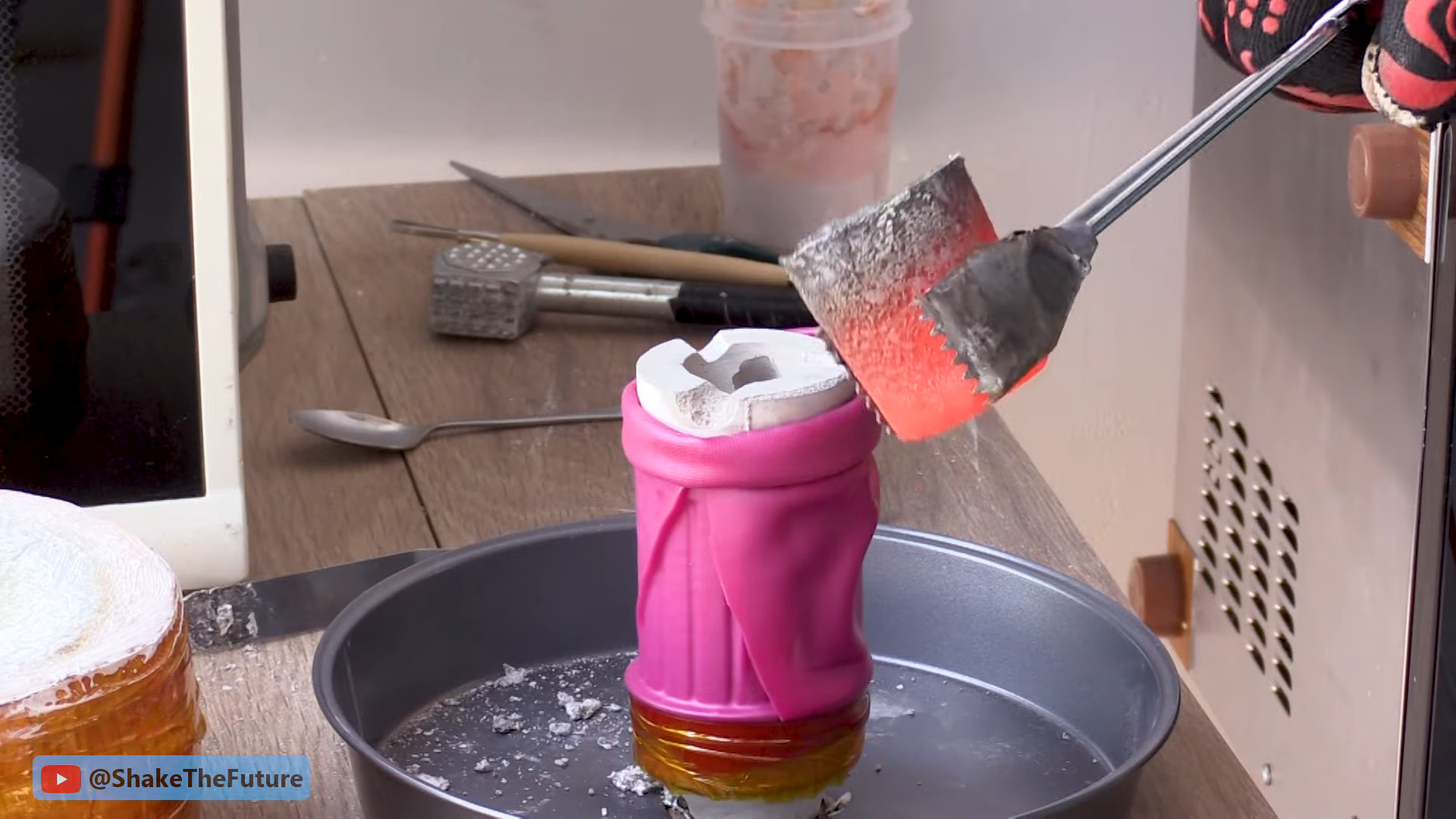
A microwave oven heats differently from a conventional kiln. Instead of surrounding a flask with controlled radiant heat, it excites materials that respond to microwave energy. Some microwave kilns are designed to turn that energy into high heat inside a small chamber. That does not make them equivalent to a programmable burnout kiln, a metal furnace, or a professional casting machine.
For lost-print casting, consistent burnout matters. The printed pattern must be removed cleanly, and the mold must be dry, strong, and properly conditioned. Industrial casting guides for printed patterns focus heavily on clean burnout, low ash, shell integrity, and controlled workflow because residue, expansion, or trapped material can crack molds or ruin castings.
Why Makers Are Interested in Microwave Casting
The appeal is obvious. A microwave is small, cheap compared with a kiln, and already sitting in many homes looking innocent. Add a 3D printer, a vacuum chamber, and a dream, and suddenly the internet begins whispering, “What if you could cast metal on a desktop?” It sounds efficient. It sounds futuristic. It also sounds like the opening scene of a safety training video.
Makers are drawn to this idea for several reasons. They want to turn PLA prints into metal objects without paying for a full foundry setup. Jewelry hobbyists want faster experiments. Product designers want metal prototypes without waiting weeks. Artists want to test shapes before committing to professional casting. In theory, small-scale microwave-assisted heating could reduce space requirements and shorten experiments.
In practice, microwave casting is limited by control. Casting is not only about reaching a hot temperature. It is about predictable heating, ventilation, moisture management, mold strength, metal behavior, protective equipment, and emergency planning. Professional foundry and safety sources repeatedly highlight hazards such as molten metal splash, steam explosions, fumes, dust, and heat stress.
The Biggest Safety Problem: Moisture and Molten Metal
If there is one rule that deserves a neon sign, it is this: moisture and molten metal are a terrible couple. Even tiny amounts of water trapped in investment, tools, scrap, or mold material can rapidly turn to steam when exposed to molten metal. That expansion can eject hot material violently. Foundry safety guidance treats moisture as one of the most serious hazards in casting environments.
This is one reason microwave heating can be especially concerning. Microwaves interact strongly with water molecules, and uneven heating can leave some areas hotter than others. A flask or mold that seems dry on the outside may not be uniformly dry inside. A conventional burnout kiln uses a planned heat cycle and known airflow to remove pattern material and moisture. A kitchen microwave does not become a burnout kiln just because someone gave it a pep talk.
There are also fumes to consider. Burning out plastic or resin patterns can release irritating or hazardous decomposition products. Investment materials and casting cleanup can involve silica-containing dust, and foundry operations may generate metal fumes and particulates. NIOSH and other occupational safety sources have documented silica, dust, fumes, and airborne contaminants as significant foundry health concerns.
Why Household Microwaves Are the Wrong Tool
A household microwave is designed to heat food, not investment flasks, refractory materials, hot crucibles, or metalworking experiments. It lacks the controls, insulation, ventilation, temperature monitoring, and safety systems used in proper casting equipment. It also may contain components that react badly to heat, sparks, fumes, or thermal shock.
Even when people use a separate microwave dedicated to craft heating, risks remain. Microwave kilns can heat rapidly and unevenly. Their internal temperatures may be difficult to measure accurately. Glass artists and kiln users often warn that fast heating can crack glass, shift materials, or make results unpredictable. Now replace small glass pieces with casting investment, burnout residue, vacuum equipment, and molten metal, and the risk level climbs like it heard there was free pizza upstairs.
For web readers searching this topic, the safest editorial position is clear: lost-print vacuum casting belongs in a controlled casting studio, school shop, jewelry lab, maker space with trained supervision, or professional casting service. Microwave kilns may be interesting for specific craft applications, but they should not be promoted as a casual shortcut for metal casting at home.
What a Safer Lost Print Casting Workflow Looks Like
Design for Casting, Not Just Printing
A model that prints well may not cast well. Thin walls, trapped volumes, unsupported details, and poor flow paths can lead to defects. A castable pattern should be designed with shrinkage, burnout, investment coverage, and metal flow in mind. Professional casting houses often review models before production because the digital design must respect physical metal behavior.
For example, a decorative ring with deep undercuts may look gorgeous on screen but create burnout or filling challenges. A small mechanical bracket may need thicker sections or redesigned corners. A figurine with delicate antlers might print beautifully and cast like a tragic spaghetti incident unless the gating and support strategy are planned by someone who knows casting.
Choose a Proper Pattern Material
PLA is widely discussed in hobby casting, but castable wax resins and specialized burnout resins are often preferred for cleaner results. Industrial and jewelry casting guides emphasize low ash, controlled burnout, and pattern preparation because residue inside the mold can cause pitting, porosity, or surface defects.
The material choice affects how the pattern expands, softens, drains, burns, and leaves the mold. Resin patterns may require special handling. Hollow printed parts may need drainage and cleaning. Solid prints can create expansion stress during burnout. These details are exactly why professional workflows exist: they turn “maybe it works” into repeatable results.
Use Controlled Burnout Equipment
Burnout is not just “make it hot until the print disappears.” A good burnout process removes the pattern, dries the investment, reduces residue, and prepares the mold for casting. Too much heat too quickly can crack the mold. Too little burnout can leave ash or unburned material. Poor airflow can trap fumes. In short, burnout is the part of the process where patience puts on safety glasses and saves the day.
A programmable kiln or professional burnout oven offers better control than microwave heating. It allows planned temperature changes, ventilation, and repeatability. For serious casting, that control is not a luxury. It is the difference between a clean mold and a mystery brick with regrets inside.
Let Professionals Handle the Pour
The actual casting pour is where risk becomes most visible. Molten metal can splash, spill, react with moisture, ignite nearby materials, and create fumes. Professional casting spaces use dedicated equipment, ventilation, fire-safe surfaces, protective clothing, training, and emergency procedures. Small-shop casting safety references stress that molten metal work requires serious preparation, not improvisation.
For many creators, the smartest workflow is hybrid: design and print the pattern yourself, then send it to a casting house. You keep the creative control and avoid turning your workspace into a tiny volcano with Wi-Fi.
Common Defects in Lost Print Vacuum Casting
Porosity
Porosity looks like tiny holes or sponge-like areas in the casting. It may come from trapped gas, poor metal flow, overheated metal, contaminated material, or investment problems. Vacuum assistance can reduce some air-related defects, but it cannot compensate for dirty burnout or poor casting design.
Surface Pitting
Surface pits often appear when ash, residue, bubbles, or investment flaws transfer to the metal surface. Printed patterns must be cleaned and prepared carefully. Investment should be mixed and de-aired properly. The mold should be burned out completely. In casting, tiny problems enjoy becoming expensive problems. They are ambitious that way.
Incomplete Fill
Incomplete fill happens when metal does not reach every part of the cavity. Thin details, poor gating, low mold temperature, or inadequate casting force can contribute. Vacuum casting helps in some contexts, especially with small detailed items, but the design must still be castable.
Mold Cracking
Mold cracking may occur when the pattern expands too much, burnout is too aggressive, the investment is weak, or moisture remains inside. Printed patterns can behave differently from wax, so burnout schedules and investment choices must be matched to the pattern material. This is another reason microwave shortcuts are risky: the mold needs control, not vibes.
Where Microwave Casting Fitsand Where It Does Not
Microwave kilns can be useful tools in specific craft contexts, especially small glass projects, when used according to manufacturer guidance. They are compact and fascinating. They also demand respect because the heating is rapid, localized, and not always easy to observe. For lost-print metal casting, however, they should be discussed as experimental and risky rather than recommended.
A responsible article about “lost print vacuum casting in a microwave” should not tell readers to modify appliances, melt metal in food equipment, bypass ventilation, or improvise with unknown materials. Instead, it should help readers understand the idea, recognize the hazards, and choose safer paths: professional casting services, supervised maker spaces, jewelry schools, or properly equipped studios.
Practical Examples of Safer Use Cases
Jewelry Prototype
A designer creates a ring in CAD, prints it in castable resin, checks the sizing, and sends the pattern or file to a casting house. The casting shop handles investment, burnout, vacuum casting, finishing, and metal quality. The designer receives a metal piece without needing to manage fumes, molten metal, or equipment risk.
Small Sculpture
An artist prints a miniature sculpture in sections, refines the surface, and works with a bronze foundry. The foundry advises on wall thickness, gates, vents, and finishing. The result is more reliable than trying to force a complex art casting through a tiny improvised heating setup.
Engineering Concept Model
A product developer needs a small metal proof of concept. Instead of attempting desktop casting, the developer uses 3D printing for iteration and then orders a professional investment casting or metal printing service for the final prototype. This approach may cost more upfront, but it avoids failed pours, unsafe experiments, and parts that look like they were chewed by a robot goat.
Experience-Based Notes: What People Learn the Hard Way
The first experience most makers have with lost-print casting is not a perfect shiny object. It is usually a lesson wearing a crusty investment shell. People quickly discover that 3D printing and casting are not one skill but several skills stacked in a trench coat. A print can look perfect and still fail during burnout. A mold can seem fine and still trap bubbles. A casting can fill completely and still show surface defects. The process rewards patience, testing, documentation, and humility.
One of the biggest lessons is that surface preparation matters. Layer lines, resin residue, support scars, and tiny print defects can transfer into the final casting. Many beginners assume metal will somehow make everything look more professional. It will not. Metal is honest. Brutally honest. If the print has a scratch, the casting may preserve that scratch like a historical monument.
Another lesson is that investment material is not just “powder plus water.” Mixing quality, timing, temperature, vacuum de-airing, and cleanliness all affect the mold. A rushed mix can trap bubbles. A dirty container can introduce defects. An old or damp investment can behave unpredictably. Professional casting references are strict about investment handling because the mold is the stage on which the entire drama performs.
Burnout is where many experiments go sideways. Printed materials do not always disappear like wax. Some expand before burning. Some leave ash. Some need special preparation. If the pattern is thick, sealed, or poorly drained, pressure can build inside the mold. That pressure can crack investment or leave residue. Makers who succeed often learn to design patterns specifically for burnout rather than simply printing a solid object and hoping heat will solve the problem. Heat is powerful, but it is not a therapist.
Vacuum equipment also teaches respect. A good vacuum setup can improve investment quality, but it must be matched to the material and used in a controlled environment. Too much bubbling, poor seals, weak pumps, or rushed timing can create inconsistent results. Vacuum is helpful, but it is not a magic delete button for bad planning.
The microwave idea teaches the sharpest lesson: convenience is not the same as control. A microwave kiln may look like a shortcut, but casting depends on predictable heat and safe handling. Without reliable temperature control, proper ventilation, moisture management, and equipment designed for molten metal, results can become unpredictable and dangerous. Many experienced makers eventually move away from improvised heating and toward professional kilns, casting classes, or service bureaus. That shift is not defeat. It is wisdom with fewer burn marks.
For anyone writing, researching, or planning around lost print vacuum casting, the best experience-based advice is simple: separate creativity from the hazardous operations. Design boldly. Print carefully. Test dimensions. Learn how casting works. Then let properly equipped people handle burnout and metal pouring until you have formal training and a safe studio. The final object will usually be better, and your microwave can return to its true calling: reheating leftovers without becoming part of an insurance claim.
Conclusion
Lost print vacuum casting is a powerful bridge between digital design and traditional metalwork. It allows creators to turn 3D printed patterns into detailed metal objects, from jewelry to prototypes to small sculptures. Vacuum techniques can improve mold quality and casting detail, while castable print materials can make complex designs more accessible than ever.
But adding a microwave to the equation requires caution. Microwave heating is not a replacement for controlled burnout, professional casting equipment, ventilation, or foundry safety. The safest and most realistic path is to use 3D printing for design freedom, then rely on trained casting professionals or supervised facilities for burnout and metal pouring. Creativity should be exciting, not explosive.