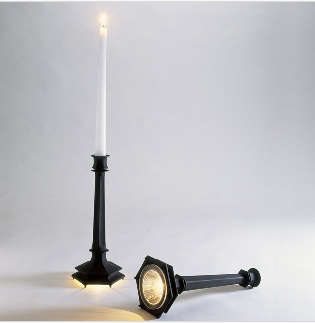
Some lighting objects are designed to disappear into a room. David Weeks’ Castlight does the opposite. It stands there with the quiet confidence of a dinner-party guest who brought both dessert and a fully charged emergency plan. At first glance, it looks like a clean, modern candlestick. Look again, and the base reveals a second personality: an LED flashlight ready for blackouts, midnight snack missions, and that one drawer where batteries go to retire.
The brilliance of the David Weeks Castlight is not that it tries to be futuristic. It is that it updates one of the oldest household lighting objectsthe candlestickwithout stripping away its charm. It combines candlelight, portable LED light, sculptural form, and practical preparedness in a single tabletop object. That combination makes it more than a novelty. It is a small design lesson in how good lighting can be beautiful, useful, and slightly witty all at once.
In the world of modern lighting design, where pendants often look like satellites and floor lamps sometimes require an engineering degree to assemble, Castlight feels refreshingly direct. It asks a simple question: what if the object you already keep out in the open could also help when the power goes out?
Who Is David Weeks?
David Weeks is a Brooklyn-based designer widely associated with sculptural lighting, carefully balanced forms, and objects that feel both industrial and playful. His studio, founded in 1996, has become known for large-scale handmade fixtures, technical precision, and a design language built around proportion, movement, and material honesty. Before establishing his own studio, Weeks studied sculpture and painting at the Rhode Island School of Design, a background that helps explain why his work often feels closer to functional sculpture than ordinary household hardware.
That artistic foundation matters when discussing the Castlight. This is not a flashlight disguised as decor in the awkward way some “clever” gadgets pretend to be elegant. It is a designed object first. The utility comes naturally because the form has been considered. Like many David Weeks Studio pieces, it treats function as a design problem rather than a checklist item.
What Is the David Weeks Castlight?
The David Weeks Castlight is a hybrid object: part candlestick, part battery-powered LED flashlight. Historical product descriptions identify it as a decorative candleholder with a rubberized grip and an LED light built into the base. When the flashlight is switched on, the lower portion glows, giving the piece a second source of illumination beyond the candle itself.
Its proportions were compact enough for a mantel, dining table, console, or bedside surface. Archived descriptions list the Castlight at approximately 11 inches tall and 4.5 inches wide and deep, powered by three AA batteries. It was also described as being made from cast resin with a battery-powered LED. Those details place it firmly in the late-2000s moment when LED lighting was moving from pure utility into the world of lifestyle design.
The concept is simple enough to explain in one sentence: no power, use the flashlight; no batteries, use the candle. That simplicity is the joke, the charm, and the usefulness.
Why Castlight Still Feels Smart
Design ages in different ways. Some objects look dated because they were chasing a trend. Others remain interesting because they solved a problem with personality. Castlight belongs in the second group. It does not rely on an app, a voice assistant, a proprietary charging dock, or a tiny blinking light that requires emotional support. It relies on two familiar technologies: fire and battery-powered LED light.
That is why the David Weeks Castlight still feels relevant. Modern homes are full of beautiful objects that do nothing and useful objects that no one wants to look at. Castlight bridges that gap. It is visible enough to be part of the room, but functional enough to earn its place when conditions change.
A Decorative Object With a Job
Most emergency flashlights are hidden in drawers, garages, closets, or the mysterious household zone known as “I swear it was right here.” Castlight solves that problem by becoming display-worthy. You do not need to hide it because it looks intentional. In fact, the more visible it is, the better it works as emergency lighting.
A Candleholder With a Backup Plan
Traditional candleholders offer atmosphere but not always safety or reliability. Castlight adds a practical layer. The flashlight component gives you portable directional light, while the candle creates ambience. It is a small but clever reversal: instead of choosing between romance and readiness, you get both.
The Design Language: Minimal, Humorous, and Useful
Castlight works because it does not overexplain itself. The silhouette references a classic candlestick, but the base has a modern, tactile presence. The rubberized grip suggests utility. The glowing underside gives the object a gentle visual surprise. It looks domestic, but it behaves like a tool.
This balance is very David Weeks. His broader lighting work often plays with equilibrium, moving parts, rotated shades, and forms that appear simple until you notice the engineering underneath. Castlight compresses that attitude into a small household accessory. It is not a chandelier, but it carries the same interest in proportion and performance.
The humor matters too. A candlestick-flashlight could easily become a gimmick. Castlight avoids that by being genuinely useful. It makes you smile because the idea is obvious only after someone else has designed it. That is usually the sign of a strong product: once you see it, you wonder why every candleholder has not been doing this for years.
Castlight and the Evolution of LED Lighting
LED lighting changed how designers think about illumination. Compared with traditional incandescent bulbs, LEDs are more energy efficient, compact, and flexible. They produce light through a semiconductor rather than a glowing filament, allowing designers to place light in smaller, cooler, and more unusual forms.
For Castlight, LED technology made the hybrid idea possible. A traditional bulb in the base would have been bulky, hot, and visually awkward. An LED could be tucked into the lower portion of the object and powered by ordinary batteries. That allowed the piece to remain compact while still providing functional light.
This is where Castlight becomes more than a cute accessory. It represents a broader shift in lighting design: light no longer had to come only from ceiling fixtures, table lamps, or exposed bulbs. It could be embedded into objects, furniture, architectural details, and portable tools. Today, that idea feels normal. When Castlight appeared, it felt clever and fresh.
Emergency Lighting: The Practical Side of the Pretty Object
Power outages have a way of making everyone suddenly interested in practical design. The most beautiful pendant light in the world is not very helpful when the electricity stops. Emergency guidance from safety organizations typically recommends flashlights or battery-powered lighting instead of relying on open flames during outages. Candle safety guidance also emphasizes stable holders, distance from flammable materials, and never leaving candles unattended.
Castlight does not eliminate the need for safe habits, but it does encourage better preparedness. Because it is designed to sit out in the open, the flashlight is easier to find. Because it also holds a candle, it acknowledges that people still love the warmth and ritual of flame. The object quietly says: enjoy the glow, but keep a practical beam close by.
Where Castlight Makes the Most Sense
In a living room, Castlight could sit on a mantel or side table as a conversation piece. In an entryway, it becomes a grab-and-go light if the power fails as you are heading out. On a dining table, it offers candlelit atmosphere with a useful surprise. Near a bed, it can function as a decorative object that is far more attractive than the average emergency flashlight.
Its best placement is somewhere visible, stable, and easy to reach. That is the whole point. A flashlight hidden in a box is an object of faith. A flashlight inside a candlestick on your console is a plan.
How to Style David Weeks Castlight at Home
The David Weeks Castlight fits especially well in interiors that mix warmth and restraint. It can work in a modern apartment, a renovated brownstone, a cabin with good taste, or a minimalist room that needs one object with a wink. Because its form is simple, it does not fight with other decor. Because its concept is unusual, it still earns attention.
On a Mantel
Place Castlight with a small stack of art books, a ceramic bowl, or a framed print. The candlestick shape gives height, while the flashlight base keeps it from feeling old-fashioned. It is an easy way to make a mantel feel curated instead of crowded.
On a Dining Table
Castlight belongs naturally in a dining setting. It can create the familiar ritual of candlelight while also giving guests something to ask about between the salad and the moment everyone debates whether one more bottle of wine is “reasonable.” Use it as a single centerpiece for a small table or pair it with lower objects for balance.
On a Bedside Table
As bedside lighting, Castlight is more symbolic than primary. It is not meant to replace a reading lamp, but it can serve as backup light and visual interest. It is particularly useful for people who like practical objects but refuse to make their bedroom look like a hardware aisle.
What Castlight Teaches About Good Product Design
The best products often combine three qualities: they solve a real problem, they feel good to use, and they look good enough to keep. Castlight checks all three. It solves the “where is the flashlight?” problem. It offers the tactile pleasure of a grip and the visual pleasure of candlelight. It also looks intentional in a room.
Another lesson is that innovation does not always mean adding complexity. Castlight is not smart-home technology. It does not send notifications. It will not ask to update its firmware while you are trying to find the fuse box. Its intelligence lies in pairing two simple tools in a thoughtful way.
That is a valuable reminder for homeowners, designers, and product developers. A useful object does not need to announce itself as useful. It can be elegant first and practical when needed.
Is the David Weeks Castlight Still Worth Talking About?
Yes, especially because it captures a design idea that remains important: homes should be beautiful, but they should also work. The Castlight sits at the intersection of decorative lighting, emergency preparedness, and collectible design. Even if it is not as widely available today as a standard retail lamp, it remains a strong reference point for anyone interested in clever lighting objects.
It also feels relevant in a world where many people are rethinking domestic comfort. We want homes that feel calm, prepared, personal, and not overly complicated. Castlight delivers that in miniature. It is the rare object that can make a blackout feel slightly less chaotic and a dinner table slightly more interesting.
Buying and Collecting Considerations
Because Castlight has appeared in archived product listings rather than as a continuously promoted mainstream item, shoppers may need to look through vintage design marketplaces, resale platforms, design archives, or specialty shops. When evaluating one, check the condition of the resin body, the rubberized grip, the battery compartment, and the LED function. If buying for actual emergency use, confirm that the light works and that the battery contacts are clean.
Collectors may value Castlight not only as an object but as a snapshot of a specific design era. It reflects the moment when independent designers, small studios, and accessible design retailers were bringing witty, useful, design-forward products to a broader audience. It also connects to David Weeks’ larger body of work, where sculptural thinking and function often meet.
Conclusion: A Small Light With a Big Idea
The David Weeks Castlight proves that lighting design does not have to choose between beauty and usefulness. It can be sculptural, funny, practical, and quietly prepared for disaster. Its candlestick form nods to centuries of domestic ritual, while its LED flashlight base pulls it into modern life. That tension is what makes it memorable.
In a category crowded with lamps that merely look nice, Castlight does something better: it participates in the life of the home. It is ready for dinner, ready for atmosphere, and ready for the moment the lights go out. That is not just clever design. That is hospitality with batteries.
Personal Experiences and Practical Reflections on Lighting: David Weeks Castlight
Living with an object like the David Weeks Castlight changes the way you think about household lighting. Most people treat lighting as background infrastructure. You flip a switch, the room appears, and that is the end of the story. But a piece like Castlight reminds you that light is also ritual. It is how a room slows down in the evening, how a table becomes inviting, and how an ordinary corner suddenly feels considered.
Imagine using Castlight during a small dinner at home. The overhead lights are dimmed, the food is on the table, and the candle gives the room that flattering glow that makes everyone look like they slept eight hours and definitely did not check email at 11:45 p.m. Someone notices the base and asks what it is. You twist or lift it into its second role, and suddenly the object becomes a story. That is the kind of design people remember because it is not just seen; it is experienced.
There is also a comforting practicality to it. Many households own emergency flashlights, but few people can locate them quickly. They are usually in a utility drawer under expired coupons, mystery screws, and a charging cable for a device nobody owns anymore. Castlight avoids that problem by refusing to hide. It looks good enough to stay in plain sight, which means it is actually available when needed. In real life, that matters more than any product brochure language.
The object also encourages a healthier relationship with preparedness. Emergency gear often feels severe, while decorative objects often feel frivolous. Castlight softens that divide. It says preparedness can live on a dining table. It can be part of the decor. It can be elegant, even a little funny. That is a smart psychological move because the best emergency tool is the one you can find, use, and maintain without turning your home into a bunker.
From a styling perspective, Castlight would work beautifully in a room that values contrast. Put it against warm wood and it becomes modern. Place it near stone, concrete, or black metal and it feels architectural. Set it beside ceramics or linen and it becomes softer. The design is restrained enough to adapt, but the concept is strong enough to stand out. That makes it useful for interior designers who want one object to carry both visual and conversational weight.
What I appreciate most about the Castlight idea is its refusal to be overdesigned. It does not try to solve every lighting problem. It does not pretend to be a chandelier, camping lantern, sculpture, and smart speaker all in one. It simply combines candleholder and flashlight with confidence. That restraint is rare. In many homes, especially smaller apartments, the best objects are the ones that perform more than one job without looking desperate for applause.
In daily use, a Castlight-style object would be most valuable near transitions: the entry table, the hallway console, the living room mantel, or the bedside surface. These are places where light is both decorative and practical. They are also the places you pass during a power outage, when calm design suddenly becomes very useful design. A beautiful flashlight you can actually find is not a luxury. It is common sense wearing a nicer outfit.
Ultimately, the experience of Castlight is about trust. You trust it to look good when nothing dramatic is happening. You trust it to help when something inconvenient happens. And you trust that the designer understood the home not as a showroom, but as a place where dinners, outages, jokes, rituals, and practical needs all coexist. That is why David Weeks’ Castlight remains such a charming lighting object: it respects both the poetry and the panic of domestic life.