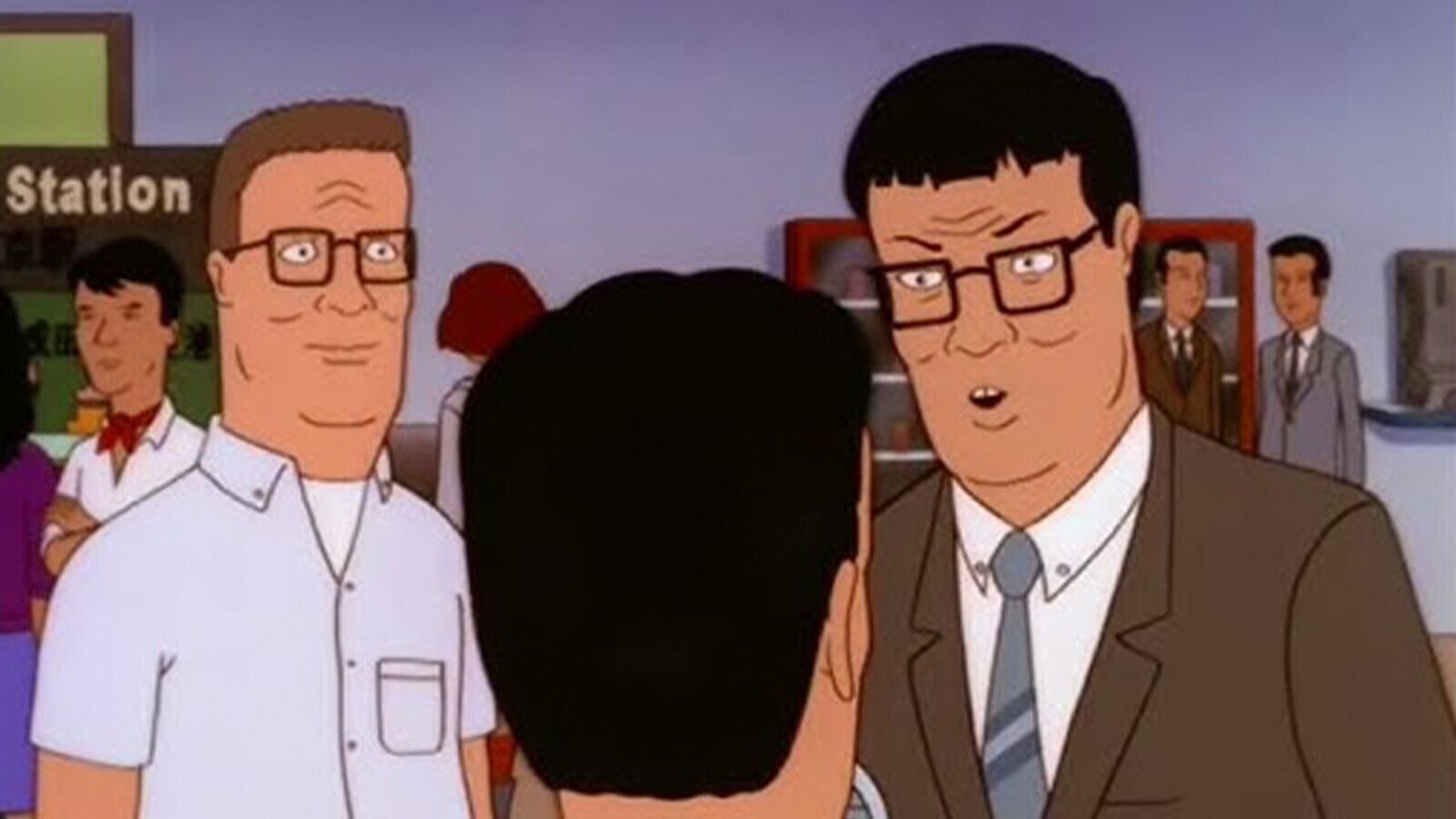
There are few sentences on the internet more likely to make people stop scrolling than this one: there are Japanese fans of King of the Hill debating subs versus dubs. It sounds like a joke somebody invented after staying up too late with caffeine, anime memes and a YouTube clip of Hank Hill saying something deeply Texan in perfectly polite Japanese. And yet, like Bobby Hill discovering comedy, the weird idea turns out to have a real beating heart.
No, this does not mean every household in Japan has a framed portrait of Hank next to a rice cooker. The internet has definitely inflated the scale of the phenomenon. But it does mean that for years, a niche but very real group of viewers has been fascinated by King of the Hill, especially by the unusual experience of hearing one of America’s most culturally specific sitcoms translated into Japanese. That fascination led to the same argument anime fans everywhere know by heart: is it better to watch the original version with subtitles, or a dubbed version that lets the jokes land in real time?
And once you ask that question about King of the Hill, things get delightfully weird. Because unlike a flashy action anime, Mike Judge and Greg Daniels’ quietly brilliant Texas sitcom lives and dies on rhythm, tone, understatement and character voice. You can translate the words. Translating the vibe? That’s where the propane starts leaking.
Why King of the Hill Even Clicks With Japanese Viewers
Part of the appeal is that King of the Hill is built like a slice-of-life series in American work boots. It is not driven by giant plot twists, apocalyptic stakes or characters screaming their life philosophy at the moon. It is a show about neighbors, families, social awkwardness, petty pride, quiet disappointment and the tiny wars people wage over yard care, parenting and dinner. If that sounds suspiciously close to the emotional engine of slice-of-life anime, that is because it kind of is.
The show’s genius has always been its low-key realism. Other animated sitcoms often sprint toward chaos, while King of the Hill strolls toward uncomfortable truth. It notices how people talk, how they dodge embarrassment, how they cling to routine, and how affection often hides inside complaint. Hank Hill can say more with a disappointed grunt than some TV characters say in three monologues and a therapy session.
That realism gives the series unusual export power. Even when the setting is deeply Texan, the emotional logic is universal. Every country has stubborn dads. Every culture has neighbors who know too much. Every family has at least one person who believes they are the only adult left in civilization. Hank just happens to be carrying that burden while selling propane and trying not to have a nervous breakdown over novelty grilling.
That is why the Japanese interest in the show feels odd only for about five seconds. After that, it feels inevitable. Once viewers get past the cowboy hat of it all, King of the Hill reveals itself as a patient, humane comedy about ordinary life. In other words, it is not the opposite of anime at all. It is just anime’s calm American cousin who grills on weekends and distrusts decorative fruit.
The Very Specific Problem of Translating Texas
Here is where the subs-versus-dubs argument becomes more than a generic fandom food fight. King of the Hill is not hard to understand because the plot is complicated. It is hard to localize because the comedy is packed into speech patterns, pauses, class signals, regional flavor and character-specific delivery. That is the kind of material that makes translators earn every penny and probably a stress headache.
Subtitles and dubs solve different problems. Subtitles preserve the original performances, which matters a lot in a show where Hank’s clipped frustration, Peggy’s overconfidence, Bobby’s oddball enthusiasm and Dale’s paranoid wheeze do so much narrative lifting. But subtitles also ask viewers to read while listening to a show whose funniest moments often depend on dead air, awkward pacing or overlapping reactions. A joke can technically survive translation and still lose its laugh if the viewer is busy sprinting through text at the bottom of the screen.
Dubbing solves that timing problem. A dubbed line can hit at the right moment, follow the cadence of the scene and free the audience to watch faces, gestures and visual comedy. That matters in King of the Hill, a series that is more physically expressive than people remember. Hank’s little posture shifts, Peggy’s confident smirk, Bobby’s gleeful commitment to chaos, and Bill’s spiritual collapse all work better when your eyes are not playing ping-pong with subtitles.
But dubbing creates a second, nastier challenge: voice identity. Fans do not just love what these characters say. They love how they sound. Mike Judge’s Hank is not simply “a serious man with a Texas accent.” Pamela Adlon’s Bobby is not simply “a boy who says funny things.” These performances are carved so precisely into the characters that replacing them can feel less like translation and more like swapping out somebody’s skeleton.
Why the Dub Is So Fascinating
The Japanese dub of King of the Hill has attracted curiosity for exactly this reason. Hearing Hank, Bobby and Boomhauer in Japanese is not just a novelty. It is a crash course in how much of a sitcom lives inside voice texture. Fans who prefer subtitles often argue that the original English audio preserves the social DNA of the series. Hank’s stiffness, Bobby’s rasp, Dale’s frantic edge and Peggy’s self-satisfaction are part of the joke. Change them too much, and the show still functions, but it becomes a slightly different machine.
That is especially true with a character like Boomhauer, whose semi-incomprehensible speech is already a localization puzzle wrapped in another localization puzzle. In English, the humor partly comes from the fact that he sounds like a man speaking from inside a blender while everyone around him somehow understands every word. In another language, that trick can become too clear, too clean, or too consciously “acted.” Once Boomhauer starts sounding a little too understandable, the whole illusion wobbles.
And yet dub supporters have a strong case. Comedy is rhythm. If you have to read your way through a line that is supposed to land like a casual mutter, the moment changes. Fans who back the dub often value flow over purity. They would rather hear a line that fits the scene than read a line that is technically closer to the original but arrives like homework.
That tension is the heart of the debate. One side says, “Give me the original performance, because authenticity matters.” The other says, “Give me the joke when it is supposed to be funny, because comedy is timing.” Both sides are right. Which is deeply annoying, because it means no one gets to win with the smug confidence of a man explaining cast-iron skillet care at a cookout.
Why This Debate Has Lasted So Long
The argument has endured because it taps into something bigger than one show. Around the world, fans do not simply consume stories. They negotiate with them. They ask how much should be preserved, how much should be adapted and where “authenticity” actually lives. Is authenticity in the original voice? The exact wording? The emotional intent? The laugh timing? The cultural context? The answer changes depending on the work.
That is why the broader sub-versus-dub fight never dies. It is not just a technical preference. It brushes up against identity, access, status and fandom habits. Some viewers want the original audio because it feels closer to the creator’s intent. Some prefer dubs because they are more immersive, easier to follow or more accessible. Some bounce between both depending on the series. Anyone pretending there is one morally superior answer is usually one forum post away from sounding like they need fresh air.
With King of the Hill, the debate becomes unusually rich because the series is so culturally specific. Anime fans in the United States often argue over whether English dubs flatten Japanese nuance. Here, the direction of travel flips. Japanese viewers and online fans are dealing with American regional nuance, Southern dryness and a flavor of middle-American speech that does not glide neatly into another language. Suddenly the same questions apply in reverse.
In that sense, King of the Hill is almost the perfect test case. It is not carried by spectacle. It is carried by subtlety. If a translation works, you feel it immediately. If it misses, you also feel that immediately. There is nowhere to hide behind explosions, orchestral swells or magical attack names shouted at 90 decibels.
Did Japan Really Spend “Decades” Fighting Over This?
Let’s put down the internet megaphone for a second. The funniest version of this story is that all of Japan has been locked in a generation-long cultural civil war over whether Hank Hill sounds better dubbed or subbed. Reality is more modest and more believable. The fandom appears to be niche, persistent and internet-boosted rather than massive and national. The argument has popped up over the years because clips circulate, fans rediscover the dub, and newer viewers stumble into the same question older viewers already asked.
That still matters. Niche fandoms are often where the most interesting conversations happen, because the people involved actually care about the details. In this case, those details include how only part of the show received a Japanese dub, how later viewing options leaned more heavily on subtitles and original English audio, and how that split practically guaranteed debate. If viewers cannot even access the whole series in the same format, of course they are going to argue about which format deserved to win.
The recent Hulu revival only poured more lighter fluid on the conversation. Once the series returned, online chatter revived too. Fans old and new had another reason to revisit the question, compare how the show feels in different languages and wonder whether a broader Japanese dub could ever return. Streaming has a funny way of reopening old arguments and giving them a new haircut.
What the Debate Reveals About the Show Itself
Maybe the most flattering thing about this entire subs-versus-dubs saga is what it says about King of the Hill. The show is strong enough to survive translation, strange enough to become a cross-cultural curiosity, and subtle enough to make people obsess over delivery. That is not a minor achievement for a sitcom about a propane salesman who thinks enthusiasm should be regulated.
It also proves that the series has always been more sophisticated than its modest surface suggests. The best episodes do not scream for attention. They earn it through observation, emotional precision and deep trust in character. That kind of storytelling often travels better than louder, more aggressively local comedy, because it is built on behavior people recognize. Embarrassment translates. Family tension translates. Neighborly pettiness absolutely translates.
What may not translate perfectly is the exact music of the original voices. And that is fine. In some ways, that imperfection is the whole fun of the Japanese King of the Hill phenomenon. Fans are not just arguing over preference. They are listening to culture move from one set of vocal instincts to another. They are hearing what gets preserved, what gets bent and what gets hilariously weird in transit.
The Experience of Watching Hank Hill in Japanese
Watching King of the Hill in Japanese is the kind of experience that starts as a novelty and ends as a tiny philosophical crisis. At first, the brain mostly goes, “Wait, why is this happening?” Then it adjusts, the scene continues, and suddenly the impossible becomes normal. Hank still feels like Hank. Bobby still feels like Bobby. Dale still sounds like a conspiracy theory given human form. But the emotional texture shifts just enough to make the familiar feel newly visible.
That is why people become obsessed with comparing the two versions. The original English track has the comfort of authorial closeness. It feels rooted. You can hear the dryness of Texas speech, the flatness that makes the jokes sneak up on you, and the exact character choices embedded in every pause. It is the version that lets Hank’s exasperation simmer at the perfect low boil. It is the version where Peggy’s confidence is both heroic and ridiculous. It is the version where Bobby sounds like a lovable little chaos goblin who has somehow wandered into a deeply repressed household and decided to make art out of it.
The Japanese dub, though, offers a different thrill. It turns a familiar American sitcom into a kind of cultural mirror maze. Scenes you know by heart suddenly reveal what was always doing the heavy lifting. Sometimes the translated line works beautifully, and you realize the joke was stronger than its original language. Sometimes the moment lands a little differently, and you realize the laugh depended less on wording than on vocal attitude. Sometimes a character sounds just close enough to the original to be impressive, and just different enough to feel uncanny. That uncanny feeling is half the entertainment.
For fans, the comparison becomes almost intimate. You are not merely deciding which track is “better.” You are deciding which version gives you the fuller emotional meal. Do you want authenticity in performance, even if that means reading during quick exchanges? Or do you want ease, flow and local immediacy, even if the voices feel a little less definitive? It is not unlike deciding whether to eat barbecue at the original smokehouse or a very talented place overseas that understands the technique but seasons it with different instincts. Either way, you are still eating. The question is what flavor of truth you want.
And that is probably why the argument refuses to die. Once you have heard Hank Hill in Japanese, you cannot un-hear him. The experience rearranges your understanding of the show just enough to make comparison irresistible. You start noticing timing more. You notice how much of Bobby’s charm lives in vocal grit. You notice that Boomhauer may be one of the least translatable sitcom characters ever created. You notice that a “simple” cartoon has suddenly become a masterclass in performance theory. Not bad for a show whose lead character would probably roll his eyes at the phrase “performance theory” and go back to trimming the lawn.
So yes, the legend of Japanese King of the Hill fandom may be internet-enhanced. But the fascination is real, and the subs-versus-dubs debate around it makes perfect sense. Because once a show is this carefully made, translation does not just move dialogue from one language to another. It changes the temperature of the room. And for a sitcom built on tiny shifts in temperature, that change is everything.
Conclusion
The idea of Japanese fans arguing over King of the Hill subtitles versus dubbing sounds like a meme because it is one. But it is also more than a meme. It is a genuinely revealing case study in how comedy travels, how fandoms form and how translation reshapes character-driven television. The reason the debate has legs is simple: both sides are protecting something valuable. Sub fans want the original performance and cultural texture. Dub fans want timing, immersion and a version that breathes naturally in their own language.
And King of the Hill is exactly the sort of show that makes those priorities collide. Its humor is small-scale, precise and deeply human. It can survive translation, but not without changing shape. That is not a flaw. That is the whole story. In the end, the Japanese subs-versus-dubs debate does not just tell us something about localization. It tells us why King of the Hill endures at all: because even halfway around the world, people still recognize a great sitcom when they hear one say, in whatever language, the emotional equivalent of “that boy ain’t right.”