Note: This original article is written in an oral-history-inspired editorial style, synthesized from publicly available production records, awards archives, episode summaries, and published interviews with creators and performers. It does not reproduce source text or invent direct quotations.
Every great Christmas special needs three things: a ridiculous plan, a sincere heart, and at least one character who looks emotionally unprepared for the consequences of friendship. In 1995, A Pinky and the Brain Christmas delivered all three, wrapped them in a hypnotic doll called Noodle Noggin, and dropped them down the chimney of television animation history.
For fans of Pinky and the Brain, the phrase “NARF!” is not just a nonsense word. It is a tiny comic firework, a reminder of Pinky’s strange sweetness, and the perfect entry point into one of the most beloved holiday episodes of the 1990s. A Pinky and the Brain Christmas begins like a typical world-domination scheme and ends like a stealth emotional ambush. One minute, Brain is preparing to conquer humanity through mass-produced mind-control toys. The next, he is undone by Pinky’s pure-hearted Christmas letter. That is not a plot twist. That is a mousetrap for the soul.
The Setup: Two Mice, One Planet, Zero Chill
Pinky and the Brain was built on a beautifully simple comic engine. Brain, voiced with magnificent self-importance by Maurice LaMarche, is a genetically altered lab mouse who believes he should rule the world because, frankly, have you seen the world? Pinky, voiced by Rob Paulsen, is his cheerful, chaotic companion, a noodle-brained optimist who somehow understands the emotional universe better than the genius beside him.
Their nightly routine is legendary: Brain asks whether Pinky is pondering what he is pondering; Pinky responds with something spectacularly unhelpful; Brain launches a plan; reality files a complaint. The formula was funny because it was both absurd and recognizable. Brain is every overplanner who thinks one more spreadsheet will fix existence. Pinky is every friend who brings snacks, asks the wrong question, and accidentally saves the day.
By the time A Pinky and the Brain Christmas aired on The WB in December 1995, the characters had already moved from recurring Animaniacs favorites into their own spotlight. The Christmas episode gave the series a bigger emotional canvas. Instead of parodying only politics, media, or science fiction, it took aim at the holiday-special format itself: sentiment, Santa, letters, gifts, miracles, and the annual television tradition of making viewers cry into a bowl of festive popcorn.
How the Christmas Special Found Its Story
The special was written by Peter Hastings, one of the key creative voices behind many classic Pinky and the Brain stories. The episode was directed by Rusty Mills, with Steven Spielberg credited as executive producer through the broader Amblin and Warner Bros. animation partnership. That creative environment mattered. The best Animaniacs and Pinky and the Brain material had a rare confidence: jokes could be silly enough for children, smart enough for adults, and odd enough to make everyone wonder who had approved them. Apparently, someone did. Probably with a very powerful stamp.
The story reportedly went through a difficult development process before finding its emotional center. The final premise is deliciously Brain-like: Brain calculates that if he can place a hypnotic Noodle Noggin doll in every home on Earth, he can use Christmas morning to command the planet. Making a billion dolls himself would take more time than even a megalomaniac mouse can reasonably budget, so he decides to exploit the most efficient manufacturing-and-delivery operation known to civilization: Santa’s workshop.
That idea is funny because it is both insane and weirdly logical. If you are a tiny lab mouse with global ambitions, Santa Claus is not a holiday icon; he is a distribution network with a beard. Brain sees Christmas not as a season of giving but as a logistics opportunity. Somewhere, a business-school professor just nodded and then felt bad about it.
The Noodle Noggin Plan: Peak Brain, Peak Comedy
The Noodle Noggin doll is one of Brain’s most memorable inventions because it looks like an innocent toy and functions like a tiny authoritarian broadcast tower. The joke is wonderfully blunt: Brain wants to conquer the world through a children’s craze. In the 1990s, when toy marketing, holiday shopping, and Saturday morning cartoons were all part of the same cultural snow globe, that premise had extra bite.
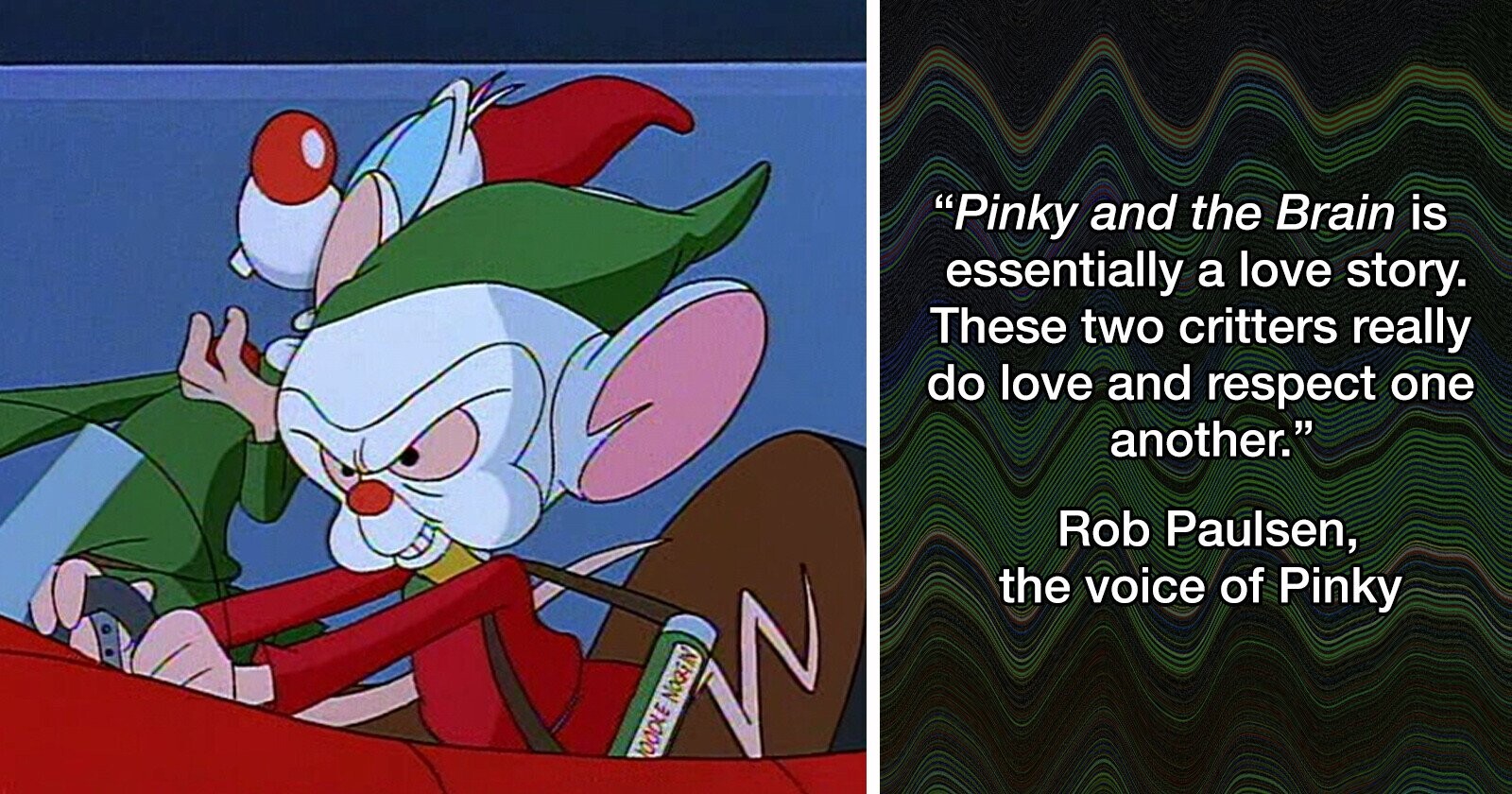
Pinky and Brain travel to the North Pole, disguise themselves as elves, and slip Brain’s toy design into Santa’s production system. The episode has the rhythm of a caper. There are disguises, workplace gags, reindeer jokes, suspicious elves, and the wonderful indignity of two laboratory mice trying to navigate holiday bureaucracy. The North Pole is not presented as a glowing postcard; it is a busy operation full of deadlines, mailrooms, and management issues. Santa’s workshop, it turns out, may run on joy, but it also runs on paperwork.
What makes the comedy work is that the special never forgets who Brain is. He is not suddenly softened because snow is falling. He remains arrogant, strategic, impatient, and hilariously offended by everyone else’s lack of genius. Pinky, meanwhile, remains completely invested in Christmas. He writes to Santa. He believes. He hopes. He gets excited. He is the one character in the room who understands the holiday on its own terms, which Brain mistakes for childishness because Brain often confuses emotional intelligence with a firmware error.
Why Pinky’s Letter Still Hurts So Good
The episode’s famous emotional turn comes near the end, after Brain’s plan has essentially worked. That is important. This is not a story where Brain fails before temptation arrives. He actually gets the world within his reach. The dolls are delivered. The hypnotic mechanism functions. Humanity is ready to obey. For once, the laboratory mouse is not defeated by a loose wire, bad math, or Pinky’s misunderstanding of cheese. Brain wins.
Then he reads Pinky’s letter to Santa.
The letter’s meaning is simple: Pinky asks for nothing for himself and wants Brain to receive the happiness and recognition he never gets. It is a childlike request, but not a childish one. Pinky sees Brain’s loneliness. He sees the effort behind the bluster. He understands that Brain’s obsession with ruling the world is tangled up with wanting to matter. The letter does not argue with Brain. It loves him. That is why it destroys him.
This is the secret of the special. It does not ask Brain to become a different character. It lets him remain Brain while briefly revealing the feeling underneath the armor. Brain’s face, voice, and posture shift because he realizes that Pinky’s loyalty is not stupidity. It is devotion. He has been accompanied, forgiven, encouraged, and loved by someone he routinely insults. That realization is more powerful than any Noodle Noggin.
The Voice Performances: Comedy With a Pulse
Rob Paulsen and Maurice LaMarche are the emotional engine of Pinky and the Brain. Their performances work because they are not merely doing funny voices. Pinky’s high, elastic energy and Brain’s grand, Orson Welles-like authority create a classic comedy contrast, but the relationship beneath the contrast is what gives the show its staying power.
In the Christmas special, LaMarche has to let Brain crack without turning him into syrup. That is a delicate acting challenge. Too little emotion and the ending feels cold; too much and Brain stops being Brain. The performance lands because the feeling seems to embarrass him. Brain is moved, furious about being moved, and then even more moved by the fact that he is furious. It is a tiny operatic collapse in a tiny mouse body.
Paulsen’s Pinky is just as essential. Pinky could easily become annoying in weaker hands: too loud, too random, too much like a squeaky toy that learned British vowels. Instead, Paulsen gives him warmth. Pinky’s nonsense words, including the immortal “Narf,” feel like bubbles rising from an honest heart. When Pinky is sad, the show does not mock him. It asks the audience to care, and somehow, despite the hypnotic dolls and talking mice, we do.
A Christmas Special That Beat the Big Kids
A Pinky and the Brain Christmas went on to win the 1996 Primetime Emmy Award for Outstanding Animated Program for programming one hour or less. That achievement matters because the animated category included serious competition. The win confirmed what fans already knew: beneath the rapid-fire jokes and cartoon lunacy, this was expertly made television.
The special also earned recognition for its storyboarding, a reminder that emotional animation is not only about writing and acting. Storyboards shape timing, expressions, reveals, and the silent beats that allow a jokeor a tearto land. In a comedy this fast, the quiet moments are especially valuable. Brain reading the letter works because the episode slows down just enough for the audience to sit with him. The world may be hypnotized, but for a few seconds, the show stops moving.
Why the Episode Became a Holiday Classic
The best Christmas episodes are not simply episodes with trees in them. They reveal something essential about the characters. A Pinky and the Brain Christmas does exactly that. It turns Brain’s desire for world domination into a test of character, and it turns Pinky’s innocence into the moral center of the story.
It also understands that holiday sentiment works best when it surprises us. If the episode had begun with Brain learning the true meaning of Christmas, viewers might have rolled their eyes so hard they could see the inside of their childhood. Instead, the special hides its sincerity inside a ridiculous heist. It earns the ending through comedy, then lets the emotion sneak in wearing elf shoes.
Another reason the episode endures is its balance of adult and child appeal. Children can follow the bright, funny adventure: mice go to Santa’s workshop, Brain makes a toy, Pinky loves Christmas, chaos happens. Adults catch the sharper layers: consumer culture, mass persuasion, workplace satire, the absurdity of power, and the familiar sadness of someone who cannot admit he needs affection. That layered writing is why so many viewers return to the special years later and discover that it has grown up with them.
The Real Genius: Brain Chooses Not to Rule
Brain’s final choice is the episode’s most meaningful idea. When he has the world under his control, he does not command worship. He does not declare himself emperor. He does not demand a palace, a crown, or a billion tiny stools so everyone can look him in the eye. Instead, overwhelmed by Pinky’s generosity, he uses his moment of absolute power to wish everyone a Merry Christmas.
Then he destroys the equipment.
That last action matters. Brain knows himself. He understands that if the machine remains intact, tomorrow’s Brain may be less sentimental and more conquest-ready. Smashing the device is both a tantrum and a moral decision. It is Brain’s version of putting the cookies away before eating the whole tin. Noble? Yes. Loud? Also yes. Very Brain.
In that moment, the episode suggests that love does not necessarily cure ambition, pride, or insecurity. It interrupts them. It creates a pause long enough for a better choice. Brain will try to take over the world again. Of course he will. That is the show. But the Christmas special proves there is something inside him more powerful than ambition, even if he would rather file a patent than admit it.
Legacy: NARF as a Holiday Feeling
Decades after its original broadcast, A Pinky and the Brain Christmas remains a favorite among animation fans, 1990s nostalgia lovers, and anyone who enjoys holiday specials with a side of global conquest. Its reputation has grown because it represents a specific golden quality of Warner Bros. television animation from that period: smart, musical, fast, literate, silly, and unafraid to be sincere when the story called for it.
The title phrase “NARF!” captures that legacy. It is nonsense, but meaningful nonsense. It signals a world where language can be playful, friendship can be weird, and a mouse with a damaged attention span can understand Christmas better than a genius. Pinky’s heart is the episode’s North Star. Brain may build the machine, but Pinky gives the story its soul.
Viewing Experiences: Why Rewatching This Special Feels Different as an Adult
Watching A Pinky and the Brain Christmas as a kid is mostly about the fun of it. The colors are bright, the jokes are quick, the North Pole is busy, and Brain’s plan has that perfect cartoon logic where the impossible seems only mildly inconvenient. A child can enjoy the episode as a holiday adventure about two mice sneaking into Santa’s workshop. Pinky is funny. Brain is bossy. The doll is creepy in the way many 1990s toys were creepy, which is to say: probably fine, but maybe do not leave it staring at you overnight.
Watching it as an adult is a different experience. Suddenly, Brain is not just a funny villain-protagonist. He is a portrait of exhaustion wrapped in ambition. He works constantly. He fails constantly. He tells himself that ruling the world will finally make everything make sense. That is absurd, but it is also a recognizable emotional trap. Many adults have their own version of “take over the world.” It might be a promotion, a perfect house, a flawless project, a number in a bank account, or the belief that once everything is controlled, peace will arrive wearing a tidy little hat.
Then Pinky’s letter lands differently. As a child, it is sweet. As an adult, it can feel almost unfair. Pinky asks for Brain to be seen. Not fixed. Not corrected. Seen. That is a powerful thing to put inside a cartoon Christmas special. It reminds viewers that the people who seem most difficult may also be the people most desperate for tenderness, though they may accept it with the grace of a stapler falling down stairs.
The episode also becomes a tradition because it is short enough to revisit and rich enough to reward revisiting. It can fit between wrapping gifts, baking cookies, or pretending not to panic about shipping deadlines. It offers the cozy pleasure of nostalgia without becoming empty comfort food. There is still a sharp little story inside it. The jokes keep it from getting too sugary, and the ending keeps the jokes from floating away.
For families, the special works as a bridge between generations. Parents who grew up with Animaniacs can share it with children who may know modern animation better than 1990s television blocks. The kids get the mice and the toys. The adults get the craft, timing, and emotional architecture. Everyone gets “Narf.” In a media world overflowing with holiday content, that shared experience is valuable. Not every Christmas special needs to be grand, glossy, or aggressively magical. Sometimes it only needs two lab mice, one impossible plan, and one letter kind enough to stop a would-be dictator in his tracks.
That is why A Pinky and the Brain Christmas still works. It understands that Christmas stories are not really about perfect people becoming perfecter. They are about interruption: a selfish plan interrupted by generosity, cynicism interrupted by wonder, loneliness interrupted by friendship. Brain may never stop trying to take over the world, but for one Christmas morning, he discovers that being loved by one strange little mouse might be better than ruling everyone else.
Conclusion: The Tiny Christmas Special With a Giant Heart
A Pinky and the Brain Christmas remains one of the rare animated holiday specials that can make viewers laugh at a hypnotic toy scheme and then quietly devastate them with a letter. Its genius lies in contrast: big ambition versus small kindness, sarcastic comedy versus sincere emotion, world domination versus friendship. Brain’s plan may be the plot, but Pinky’s love is the point.
In the end, the special earns its place as a Christmas classic because it remembers what many holiday stories forget: sentiment is strongest when it comes from character. Pinky is not sweet because the calendar says December. He is sweet because that is who he has always been. Brain is not moved because the script demands a lesson. He is moved because Pinky’s goodness finally gets past the security system around his heart.
NARF, indeed.