A child’s room has a remarkable ability to generate clutter from apparently innocent objects. One picture book becomes twelve. One wooden rabbit acquires an entire extended family. A “small collection” of building blocks somehow spreads across the floor like a brightly colored geological event.
That is why the best children’s furniture does more than look charming in photographs. It must organize everyday life, survive changing interests, fit into limited space, and remain attractive after the nursery years are over. The Hiya Bookshelf, designed by Spot On Square, approached that challenge with a clean geometric form, a combination of open and concealed storage, and finishes intended to work in modern homes.
Although the original Hiya Bookshelf has been discontinued, its design remains relevant. It offers a useful case study in how a modern kids’ bookshelf can balance grown-up aesthetics with the wonderfully unpredictable reality of children.
What Is the Hiya Bookshelf?
The Hiya Bookshelf was part of Spot On Square’s Hiya collection, a coordinated line of modern children’s furniture created by founders Bob and Nicole Springer. The collection included nursery and bedroom pieces designed around simple forms, contrasting finishes, and an eco-conscious philosophy.
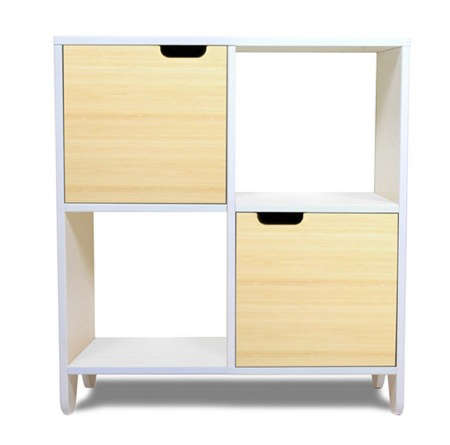
The bookshelf used a compact rectangular cabinet divided into four main compartments. Two sections remained open for books, toys, or display objects, while doors covered the upper-left and lower-right compartments. This alternating arrangement gave the front a checkerboard-like rhythm without making the piece look busy.
Historical product descriptions identified a polar-white body with door options that included painted white, birch plywood, or natural bamboo. Later versions of the broader Hiya collection also appeared with walnut-stained birch details. The bookshelf was shipped fully assembled and included a safety strap for attachment to the wall. Its original price generally ranged from about $499 to $625, depending on the finish.
In other words, this was not a flimsy shelf intended to retire after the board-book era. It was designed as substantial children’s room furniture that could eventually move into a hallway, family room, office, or grown-up bedroom without announcing, “I once stored fourteen plush dinosaurs.”
Why the Design Still Works
It Balances Display and Concealment
The Hiya Bookshelf’s strongest idea is the simplest one: some belongings deserve to be displayed, while others should be allowed to disappear behind a door.
Open shelving makes favorite books easy to see and reach. It can also hold a small lamp, framed artwork, a wooden toy, or a rotating display related to the child’s latest obsession. Concealed compartments, meanwhile, provide shelter for visual troublemakers such as puzzle bags, electronic accessories, half-finished crafts, mismatched game pieces, and plastic toys that appear to have been designed by a committee of caffeinated rainbows.
This combination is especially useful in children’s rooms because completely open storage can become visually noisy. Completely closed storage has the opposite problem: children may forget what they own or need an adult to retrieve everything. Apartment Therapy similarly recommends balancing display with concealment so a child’s space feels personal without looking chaotic.
It Looks Modern Without Feeling Cold
Minimalist furniture sometimes becomes so serious that one worries about placing a juice box near it. The Hiya design avoids that trap. Its straight lines and white frame feel architectural, while the contrasting wood doors add warmth and character.
That restraint gives the contents room to provide color. Children’s books already bring bright illustrations, playful typography, and lively spines into a room. A neutral bookshelf acts like a gallery wall for those colors rather than competing with them.
The result works well in Scandinavian-inspired rooms, contemporary nurseries, midcentury interiors, and simple bedrooms built around natural materials. It can also calm a room with patterned wallpaper or colorful bedding by providing one visually quiet anchor.
It Can Grow Beyond the Nursery
Longevity matters when choosing children’s room furniture. A crib may have a clearly defined lifespan, but a well-designed bookcase should remain useful for years. Architectural designers frequently recommend choosing classic primary furniture and introducing age-specific personality through accessories that can be changed inexpensively.
The Hiya Bookshelf fits that strategy. In a nursery, it can hold board books, blankets, baskets, and care supplies. During the preschool years, it becomes book and toy storage. For an older child, it can organize chapter books, art materials, schoolwork, and collections. Later, it can function as a compact cabinet for records, office supplies, games, or household storage.
How to Style a Hiya Bookshelf in a Child’s Room
For a Nursery
In a nursery, place frequently used items in the most accessible open compartment. Board books, soft toys, and a small basket of sensory objects can remain within easy reach. Use the closed sections for backup diapers, extra bedding, health supplies, or items that should stay away from curious hands.
Keep the styling simple. A row of books, one soft basket, and one meaningful decorative object will usually look better than filling every available inch. Empty space is not wasted space. It gives the shelf room to breathe and leaves space for the collection of books that relatives will inevitably bring after declaring, “This one was my favorite.”
A comfortable chair, floor cushion, or washable rug placed nearby can turn the shelf into a compact reading corner. Reading Rockets recommends keeping a varied home library with material at different reading levels, including books a child can enjoy independently and others best shared with an adult.
For a Toddler or Preschooler
At this stage, accessibility becomes especially important. Place durable books, puzzles, and a limited selection of toys in the lower open area. Store less frequently used materials behind the doors or higher up.
Rather than putting every book on display, rotate the selection every few weeks. Ten visible choices can be more inviting than fifty tightly packed spines. A smaller collection also makes cleanup less overwhelming and gives forgotten books the magical ability to return later as “new” books.
Add simple picture labels inside the closed compartments or on removable bins. Images of blocks, art supplies, animals, or puzzles can help children return objects to the correct place. NAEYC has highlighted picture labels as a practical visual support that allows children to participate more independently in cleanup routines.
For a School-Age Child
As children begin reading independently, organize the shelf according to the way they naturally search. Categories might include funny books, animals, mysteries, school references, graphic novels, and current favorites. Alphabetical organization may satisfy adults, but a seven-year-old looking for “the dragon book with the shiny cover” has a different cataloging system.
One concealed compartment can become a homework station for notebooks, pencils, chargers, and folders. The other can store craft materials, games, or treasured collections. Use open shelves for books and a few objects that reflect the child’s personality.
Involving children in these decisions makes the room feel like theirs. Let them select a few display items and decide how categories should be labeled. Good organization is easier to maintain when it matches the user rather than the organizer’s fantasy version of the user.
Creating a Reading Nook Around the Bookshelf
A bookshelf becomes much more effective when the surrounding area invites children to use it. Fortunately, a reading nook does not require custom carpentry, an unused turret, or a personal interior designer waiting behind the curtains.
Start with comfortable seating. A floor cushion, small upholstered chair, beanbag, or washable mat can be enough. Include lighting that is bright enough for reading but softer than the room’s main overhead fixture. A wall-mounted reading light is particularly useful in a small room because it preserves floor space.
Place the seating close enough that choosing another book does not require crossing the room. Add a blanket and one or two pillows, but avoid building a textile mountain that consumes the reader before the first page.
Design publications consistently emphasize the same basic ingredients for children’s reading corners: accessible book storage, comfortable seating, and appropriate lighting. The nook can occupy a bedroom corner, an area beside a window, a section of a playroom, or even part of a shared family space.
Making the Most of a Small Children’s Room
The Hiya Bookshelf was promoted as a storage solution for smaller spaces, and its closed rectangular form supports that purpose. Unlike a wide toy chest, it uses vertical space while keeping the footprint relatively controlled.
Position it against a clear wall rather than squeezing it behind a swinging door. In a narrow room, place it near the foot of the bed or beside a desk so one piece can support several activities. In a shared bedroom, a bookshelf can help define a reading or play zone, though it should remain securely anchored rather than used as an unstable freestanding divider.
Avoid covering the top with heavy decorative objects. Leaving the top mostly clear makes the room feel less crowded and prevents tempting items from encouraging climbing. Wall art above the shelf can provide personality without adding another layer of surface clutter.
For maximum flexibility, use removable boxes or shallow trays inside the compartments. Containers prevent small pieces from migrating into mysterious household locations, including under beds, inside shoes, and apparently into neighboring zip codes.
Safety Comes Before Styling
Any bookcase placed in a child’s room should be attached securely to the wall, regardless of its weight, price, or apparent stability. Children may pull on doors, climb shelves, or use furniture for support in ways adults do not anticipate.
The U.S. Consumer Product Safety Commission advises anchoring furniture with shelves, drawers, or doors to prevent tip-over injuries. The Hiya Bookshelf originally included a safety strap, but buyers purchasing a used unit should confirm that suitable anchoring hardware is present and appropriate for the wall type. Replacement hardware may be necessary.
Place heavier books and objects in the lowest compartments. Do not store attractive toys on top, where a child may be tempted to climb. Check hinges periodically, confirm that doors close correctly, and repair loose components promptly.
Used furniture deserves an especially careful inspection. Look for swelling, cracked panels, peeling finishes, loose fasteners, unstable joints, damaged hinges, sharp edges, and missing hardware. A handsome cabinet is not a bargain when it wobbles like a nervous giraffe.
Organizing the Shelf Without Overcomplicating It
A children’s bookshelf should help the household function, not become a new hobby that requires a label maker, a spreadsheet, and quarterly committee meetings.
Begin with four simple categories that match the Hiya layout:
- Open upper section: Current favorites and decorative objects
- Closed upper section: Supplies requiring adult supervision
- Open lower section: Child-accessible books, toys, or puzzles
- Closed lower section: Small pieces, rotating toys, or visual clutter
Leave approximately 15 to 20 percent of the available space empty. This makes it easier to return objects without forcing them into tightly packed rows. Review the contents every season and remove books that have been outgrown, broken toys awaiting an unrealistic repair miracle, and supplies that have quietly dried into archaeological specimens.
Maintain variety in the book collection. Include fiction, nonfiction, poetry, comics, magazines, wordless picture books, and stories representing different families, cultures, abilities, and experiences. NAEYC recommends making diverse books independently accessible to children and selecting materials that reflect both their lives and the wider world.
Potential Drawbacks of the Hiya Bookshelf
No piece of furniture is perfect, particularly when viewed through the practical lens of family life.
First, the Hiya Bookshelf was positioned as premium designer furniture. Its historical price was significantly higher than basic cube shelving or flat-pack bookcases. Buyers were paying for the distinctive design, coordinated finishes, substantial construction, and the ability to use the piece beyond childhood.
Second, alternating doors create attractive concealed storage but may not suit families who prefer completely open Montessori-style shelving. Young children cannot see the contents behind the doors, so labels or consistent categories become useful.
Third, the product is discontinued. Availability now depends largely on resale listings, remaining inventory, or secondhand marketplaces. Condition, finish, included hardware, and price can vary widely.
Finally, the Hiya is not a front-facing book display. Traditional shelves show book spines rather than full covers. Younger children often respond well to visible covers, so families may wish to place a small picture-book ledge or rotating display beside the cabinet.
What to Look for in a Hiya Bookshelf Alternative
Because the original model is no longer widely available, shoppers can recreate its most successful qualities without finding an exact duplicate.
Look for a modern kids’ bookshelf with a mix of open and closed compartments, a neutral body, durable doors, rounded or smoothly finished edges, and a stable structure that can be anchored. Natural wood accents will produce a similar warm-modern appearance.
Choose dimensions based on actual belongings rather than an idealized product photograph containing seven books and one ceramic bird. Measure the longest picture books, the largest storage bins, and the available wall space. Remember to account for baseboards, nearby outlets, door swings, and floor vents.
Prioritize flexible furniture over heavily themed designs. A rocket-shaped shelf may delight a four-year-old astronaut, but a simple white-and-wood cabinet can adapt when that astronaut becomes a ten-year-old marine biologist, drummer, chess player, or expert collector of objects found in parking lots.
Real-Life Experience: Living With a Hiya-Style Bookshelf
The following is a practical composite scenario based on common family-room organization experiences rather than a claim of personal product ownership.
During the first week with a Hiya-style bookshelf, the most noticeable improvement is not that the room suddenly looks professionally styled. It is that several unrelated categories of belongings finally have addresses.
The lower open compartment quickly becomes the child’s territory. Board books sit upright beside two baskets: one for blocks and one for toy animals. Because the shelf is low and visible, the child begins selecting books without asking for help. The process is not always graceful. Sometimes six books are removed to reach the seventh, and occasionally a stuffed bear is placed on the shelf while a book is tucked into the bear’s bed. Still, the child is interacting with the collection rather than waiting for an adult to present it.
The lower closed compartment becomes the parent’s favorite feature. It holds puzzles with loose pieces, a container of magnetic tiles, and several toys that make noises no reasonable object should make before coffee. Closing the door reduces visual clutter immediately. The room still belongs to a child, but it no longer looks as though every possession is applying for attention at once.
The upper open compartment works best when it is edited. An early attempt to display framed art, keepsakes, six books, a wooden train, and a decorative lamp produces a miniature yard sale. After removing half the objects, the shelf looks calmer. Three forward-facing books are rotated weekly, while one framed drawing and a small wooden toy provide decoration.
The upper closed compartment initially stores extra blankets. That system lasts approximately ten days before the family realizes art supplies need secure storage more urgently. Washable markers, paper, glue sticks, and modeling dough move behind the door. The blankets relocate to a closet, where they begin their own complicated political struggle for territory.
After a month, the family adds picture labels to the toy baskets. Cleanup improves, although not in the miraculous manner suggested by lifestyle advertisements. The child can return blocks and animals independently, but sometimes decides that all objects belong in one basket because “they are having a meeting.” This is accepted as partial organizational success.
The bookshelf also changes the bedtime routine. Instead of choosing from an overstuffed bookcase, the child selects from a rotating group of favorites. Fewer visible options reduce negotiation, and the reading chair beside the shelf creates a natural place to settle down. The parent can reach another book without standing up, an underrated luxury after a long day.
As the child grows, the contents change without requiring new furniture. Board books give way to picture books, then early readers. Toy baskets become containers for craft materials and school supplies. The framed nursery print is replaced by the child’s own artwork. The cabinet remains visually consistent even as its purpose evolves.
The most useful lesson is that the furniture does not create organization by itself. It creates boundaries. Open spaces invite use; closed spaces limit visual noise; compartments encourage categories. The family still needs to rotate books, remove outgrown items, and resist the urge to fill every shelf. Yet those chores become easier because the room has a structure.
That is the real appeal of the Hiya concept. It does not attempt to hide the fact that children own colorful, oddly shaped, rapidly multiplying belongings. It simply gives those belongings a clean architectural frameworkand gives adults a pair of doors to close when the toy meeting runs overtime.
Conclusion
The Hiya Bookshelf remains an appealing example of thoughtful children’s room design. Its crisp shape, contrasting finishes, open shelves, and concealed compartments address several needs at once: displaying books, hiding clutter, saving space, and adapting as a child grows.
Its lasting value is not limited to one discontinued product. The broader lesson is to choose children’s furniture that respects both sides of family life. A child needs independence, accessibility, color, and room for imagination. An adult needs safety, durability, flexibility, and somewhere to place the puzzle with three pieces missing.
Whether you find an original Hiya Bookshelf secondhand or select a modern alternative, anchor it securely, keep everyday books within reach, rotate the contents, and leave a little empty space. A well-planned bookshelf can do more than organize a room. It can make reading easier to begin, cleanup easier to understand, and the entire space more enjoyable to use.