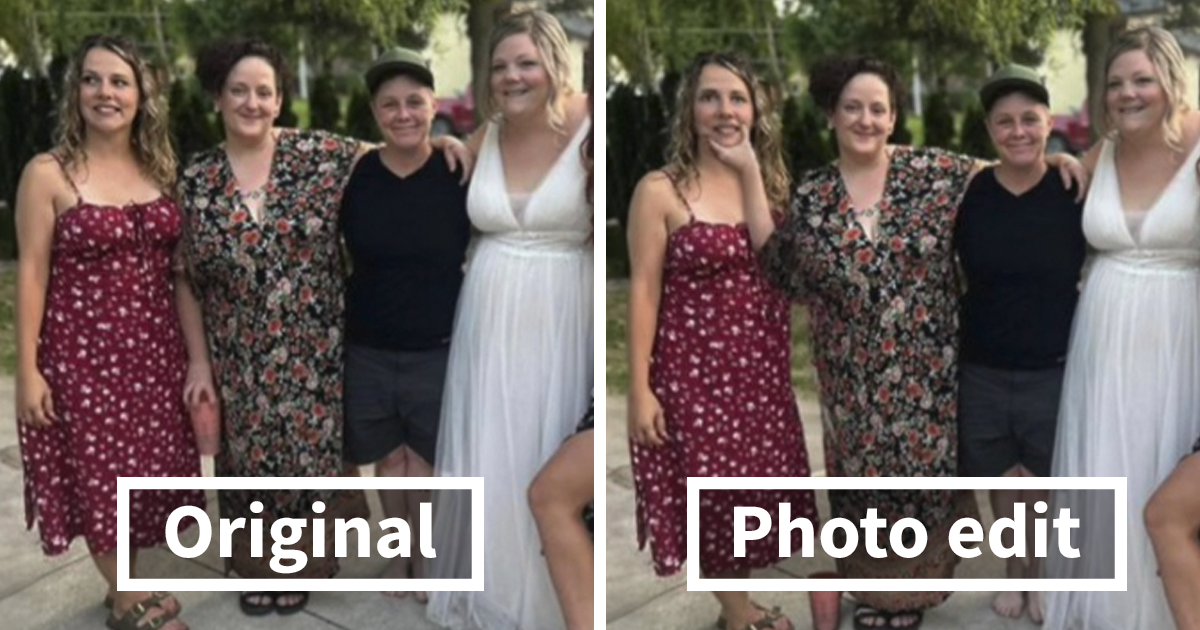
Some people ask for a photo edit and expect a small miracle. A cleaner background. A brighter smile. Maybe a missing photobomber removed from the frame like he was never there. But every once in a while, the internet gifts us a Photoshop troll who reads those requests with the energy of a mischievous lawyer reviewing a contract: technically correct, emotionally chaotic, and absolutely committed to the bit.
That is the magic behind viral TikTok Photoshop edits where creators take instructions far too literally. Someone says, “Can you make me look taller?” and suddenly they are stretched like a human breadstick. Someone asks, “Can you remove my ex?” and the entire photo becomes a lonely landscape with the emotional temperature of a rainy Tuesday. The result is not just funny Photoshop work. It is comedy built on language, expectation, and the tiny disaster that happens when people forget to be specific online.
The trend fits perfectly into TikTok’s fast-moving culture of visual jokes, remix humor, and creator-led entertainment. On a platform built for quick reactions and repeat viewing, literal Photoshop trolling has everything: a setup, a reveal, a before-and-after transformation, and that delicious second where viewers realize the editor did exactly what was requestedjust not what was intended.
Why Literal Photoshop Trolls Are So Funny
The joke works because it uses one of the oldest comedy tricks in the book: malicious compliance. A person gives an instruction. The editor follows it. The problem is that the instruction has two meanings, and the troll chooses the funniest one.
Ask to “make the background less distracting,” and a polite editor might blur the crowd. A Photoshop troll might remove the entire world behind you and leave you floating in a blank void like a confused passport photo from another dimension. Ask to “put me somewhere cooler,” and instead of a beach or a city skyline, you may end up inside a refrigerator. Technically, that is cooler. Spiritually, it is a crime against common sense. Comedically, it is gold.
This is why TikTok audiences love these edits. The viewer knows a twist is coming, but the exact form of the twist is unpredictable. The best edits are not random; they are painfully literal. They reveal how casual language can be bent into absurdity. Every caption becomes a trapdoor.
The Rise Of The Photoshop Request Comedy Format
Photoshop trolling did not begin on TikTok, but TikTok helped make the format feel faster, louder, and more shareable. For years, internet-famous editors have accepted photo-editing requests and returned edits that turn vague instructions into visual punchlines. Creators like James Fridman helped popularize the idea of “be careful what you ask for” photo manipulation, often mixing humor with surprisingly thoughtful messages about confidence and self-image.
More recently, creators such as OscarKDesign have brought that same energy into short-form video culture, where every edit can be packaged as a mini story. The formula is simple: show the original image, display the request, pause just long enough for viewers to guess the outcome, then reveal the edit. That rhythm is basically a comedy drumroll with pixels.
On TikTok, this format thrives because it rewards rewatching. Viewers often replay the reveal to catch the detail they missed the first time: the tiny person moved into the corner, the dog transformed into the “main character,” the background object that was not removed but promoted to CEO of the photo. The more ridiculous the interpretation, the more likely people are to comment, tag friends, and send in their own doomed requests.
What Makes These Hilarious Edits Work
1. The Request Sounds Normal At First
The best Photoshop troll edits begin with an innocent request. “Can you make me stand out?” “Can you make the photo more romantic?” “Can you make my friend look less awkward?” These are normal things people might ask a real editor. That normal setup gives the punchline room to explode.
2. The Edit Is Technically Correct
A great troll edit is not merely silly; it obeys the wording. If someone asks to “make the tree disappear,” the editor might not remove the tree from the picture. They might make it vanish behind a magician’s curtain. If someone asks to “make my boyfriend look like less of a red flag,” the editor might literally cover him in green flags. The joke is in the loophole.
3. The Reveal Is Visual And Immediate
Unlike a long written joke, a Photoshop troll edit pays off instantly. One glance tells the story. That makes it ideal for TikTok, Instagram, Facebook, and any platform where people are scrolling at the speed of a caffeinated squirrel.
4. The Humor Feels Playful, Not Cruel
The strongest examples avoid punching down. They tease the request, not the person. There is a big difference between making someone feel foolish and turning their vague wording into a harmless visual gag. When done well, the edit feels like a wink rather than a slap.
Examples Of Classic “Too Literal” Photoshop Humor
Imagine someone asks, “Can you make it look like I’m holding the sun?” A sincere editor might adjust the perspective so the sunset aligns with the person’s hand. A Photoshop troll might place a giant flaming star directly in their palm, turning the photo into a safety violation visible from space.
Or consider the classic request: “Can you make my legs longer?” A realistic editor might subtly elongate the lower body. A troll might stretch the legs down the street until the person looks like they commute by stepping over neighborhoods. The edit is ridiculous, but it exposes the absurdity of chasing perfect proportions in the first place.
Another favorite category is the “remove this person” request. When someone asks to remove an ex, a photobomber, or a stranger in the background, the troll can interpret “remove” in endless ways. The person might be turned into a cardboard cutout, hidden in a trash can, launched into the sky, or replaced by a suspiciously emotional empty chair. The edit becomes a tiny breakup movie in one image.
Then there are requests like “make me look rich.” A polished editor might add a luxury background. A troll might surround the person with Monopoly money, a crown made of receipts, and a yacht so fake it looks like it was purchased from a suspicious pop-up ad. Again, the joke works because it delivers the conceptjust with zero interest in subtlety.
Why TikTok Is The Perfect Home For Photoshop Trolls
TikTok has a special talent for turning small jokes into recurring formats. A creator finds a funny idea, repeats it with variations, and lets the audience participate. Photoshop trolling fits that ecosystem beautifully because each request becomes a new episode.
The audience does not just watch; it plays along. Commenters suggest edits. Followers send photos. People try to write requests that are impossible to misinterpret, only to discover that a determined troll can misinterpret anything. “Please remove the guy in the red shirt, but do not change anything else” sounds safeuntil the editor changes the guy’s shirt to blue and declares the red-shirt problem solved.
This interactive loop makes the format feel alive. The creator is not merely posting finished art; they are hosting a game where language is the obstacle course and Photoshop is the clown car.
The Hidden Skill Behind The Chaos
It is easy to look at these edits and think the joke is effortless, but good Photoshop trolling requires real skill. The editor has to understand composition, lighting, shadows, scale, masking, and timing. A bad edit can still be funny, but a clean absurd edit is much funnier because it looks almost believable for half a second.
That half-second matters. The viewer’s brain says, “Wait, that looks professionally done,” and then immediately says, “Why is this man sitting inside a cereal bowl?” The contrast between technical polish and ridiculous content is what makes the joke land harder.
Modern editing tools have also changed what creators can do. With object removal, background replacement, generative fill, and AI-assisted image editing becoming more accessible, creators can produce increasingly elaborate visual jokes. But the tool is not the comedy. The comedy is the choice. A button can remove a background; it takes a human troublemaker to replace it with a courtroom sketch of a raccoon.
Why We Love Watching People Get Exactly What They Asked For
Part of the appeal comes from a universal fear: being misunderstood. Everyone has sent a message that came out wrong, asked for something too vaguely, or realized too late that their wording could be taken in a terrible direction. Photoshop trolls turn that fear into a harmless visual prank.
There is also a tiny lesson hiding under the laughter. Online, clarity matters. If you ask strangers to edit your photo, the internet may help youor it may turn your beach selfie into a documentary about sand. These edits remind us that communication is messy, context is fragile, and punctuation should probably get more respect.
The Body Image Twist: When Trolls Get Surprisingly Wholesome
Not every Photoshop request should become a joke. Some people ask editors to change their bodies because they feel insecure. The best creators know when to stop trolling and start being kind. A request to “make me prettier” or “fix my face” can be answered with humor, but it can also be answered with a reminder that the person does not need fixing.
That is where the format becomes more meaningful than simple meme content. Photoshop has long been connected to unrealistic beauty standards, especially online. Literal edits can poke fun at the strange demands people make of their own images, but they can also push back against the idea that every photo needs to be optimized, filtered, polished, and approved by the imaginary board of social media perfection.
In a world where everyone can edit everything, a silly troll edit can feel oddly refreshing. It says: what if we stopped trying to look flawless and started laughing at the pressure to be flawless?
How Brands And Creators Can Learn From This Trend
There is a reason Photoshop troll content spreads so easily. It has a repeatable structure, a clear hook, and a built-in reveal. For content creators, the lesson is not “go troll your audience.” The lesson is to create formats people can understand instantly and anticipate happily.
For brands, the trend shows the power of playful interpretation. A product demo can be boring. A visual joke can be memorable. A creator who understands timing and audience participation can turn a simple edit into a shareable moment. The trick is to keep the humor warm, avoid humiliating real people, and make sure the joke serves the viewer instead of just chasing shock value.
What Makes “86 Times” Lists So Clickable
List-style headlines work especially well for this topic because every edit is a self-contained punchline. Readers do not need a long backstory. They can jump from one ridiculous transformation to another, collecting laughs like digital snacks. The number “86” also suggests abundance: not one funny edit, not five, but a full buffet of Photoshop nonsense.
That matters for SEO and user experience. People searching for “funny Photoshop edits,” “TikTok Photoshop troll,” “hilarious photo editing requests,” or “Photoshop requests taken literally” usually want examples, explanations, and quick entertainment. A strong article gives them all three: context, analysis, and enough visual description to make the humor feel alive even without embedding every image.
Experience Section: What These Edits Teach Us About Asking For Help Online
After spending time with this kind of content, one thing becomes obvious: the internet is very good at answering the exact question you asked, not always the question you meant. That is funny when the result is a fake shark in a wedding photo. It is less funny when you are trying to explain something important in an email, a work brief, or a message to a designer who has not yet learned to read minds.
The first experience lesson is that details matter. When people ask for Photoshop help, they often assume the editor understands the emotional goal. “Make this look better” might mean cleaner lighting, less clutter, warmer colors, or simply “please make me feel less awkward about this picture.” But to a troll, that sentence is an open playground. The more vague the request, the more room there is for chaos to put on tap shoes.
The second lesson is that humor can make criticism easier to accept. A literal Photoshop edit gently exposes how strange some image requests sound. People ask to look taller, thinner, richer, cooler, younger, more mysterious, less tired, and occasionally like they have never met a carbohydrate. A funny edit turns those pressures into something laughable. It does not lecture the viewer; it lets the absurdity speak for itself.
The third lesson is about creative restraint. The funniest Photoshop trolls know when to stop. They do not need to make every edit mean-spirited. Sometimes the most memorable response is a supportive one, especially when a person asks to change something deeply personal. Good comedy has a steering wheel. Without it, the joke crashes into cruelty.
The fourth lesson is that people enjoy seeing skill used for nonsense. There is something delightful about a talented editor spending real effort on a completely unnecessary result. It is the same reason people love elaborate cake fails, dramatic pet portraits, and overproduced videos about extremely minor inconveniences. Skill plus silliness is a powerful combination.
Finally, these edits remind us that the internet is at its best when people are playing together. The requester writes the setup. The editor creates the twist. The audience reacts, comments, and tries to outsmart the next round. It is a collaborative joke machine powered by ambiguity, pixels, and the universal human desire to say, “Okay, that was stupid, but I laughed.”
Conclusion
“86 Times A TikTok Photoshop Troll Took Instructions Too Seriously And Created Hilarious Edits” is more than a collection of funny before-and-after images. It is a celebration of internet wordplay, visual comedy, and the delightful danger of vague instructions. These edits work because they are clever, fast, and technically obedient in the most unhelpful way possible.
In a social media world crowded with polished selfies and perfect filters, Photoshop trolls offer something refreshingly unserious. They take the pressure to look flawless and turn it into a punchline. They remind us that photos can be edited, but so can expectations. And if you ever ask a stranger online to “make the picture cooler,” do not be shocked when you end up standing next to a penguin in an industrial freezer.
Note: This article is written from synthesized public information about TikTok creator culture, Photoshop-request humor, photo-editing tools, and widely covered literal-edit creators. Source links are intentionally not inserted to keep the publishable HTML clean.