Human beings looked at mountains and apparently thought, “Nice start, nature, but can we add elevators?” That is the spirit behind the 31 tallest buildings in the world: glass, steel, concrete, money, ambition, and enough vertical engineering to make your neck file a formal complaint.
This ranking focuses on completed skyscrapers measured by architectural height, the standard commonly used for official tall-building lists. That means spires count, but antennas, flagpoles, and temporary equipment do not. In other words, a building cannot win the height race by wearing a metal hat.
From Dubai’s record-breaking Burj Khalifa to New York’s skinny supertalls and China’s fast-rising financial towers, these buildings are more than bragging rights. They are mixed-use cities in the sky, tourist magnets, engineering laboratories, and sometimes very expensive ways to say, “Our skyline needed drama.”
What Counts as One of the Tallest Buildings in the World?
A skyscraper ranking can get surprisingly technical. Some lists include observation towers, telecommunications masts, or structures still under construction. This article keeps things clean: only completed, occupiable buildings are included, and they are ranked by architectural height. That is why towers such as the Tokyo Skytree or Canton Tower, while incredibly tall, are not part of this building-focused list.
The tallest buildings in the world also reveal a major shift in global development. The skyscraper was once strongly associated with Chicago and New York. Today, the top ranks are dominated by Asia and the Middle East, especially China, the United Arab Emirates, Malaysia, and Saudi Arabia. The modern supertall building is no longer just an office block; it is often a hotel, residence, retail hub, observatory, and national symbol stacked into one vertical package.
31 Tallest Buildings in the World Ranked
1. Burj Khalifa Dubai, United Arab Emirates
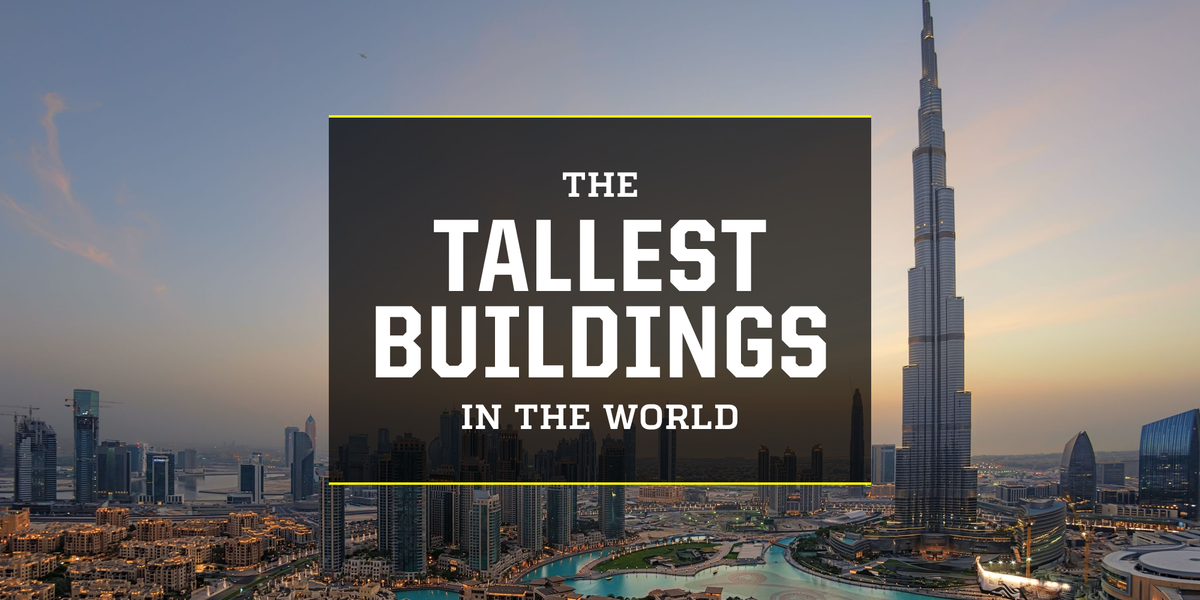
Height: 828 meters / 2,717 feet. Completed: 2010. The Burj Khalifa remains the tallest building in the world and the undisputed heavyweight champion of the skyline. Its Y-shaped plan and buttressed core help it resist wind while supporting offices, residences, the Armani Hotel, restaurants, and observation decks. It is less a building than a vertical mic drop.
2. Merdeka 118 Kuala Lumpur, Malaysia
Height: 679 meters / 2,227 feet. Completed: 2023. Merdeka 118 is the second tallest building in the world and the tallest in Southeast Asia. Its name honors Malaysia’s independence, and its faceted design gives Kuala Lumpur a futuristic new landmark that seems to shout, politely but firmly, “Look up.”
3. Shanghai Tower Shanghai, China
Height: 632 meters / 2,073 feet. Completed: 2015. Shanghai Tower twists as it rises, reducing wind loads and creating one of the most recognizable profiles in modern architecture. Its double-skin facade, sky gardens, hotels, offices, and observation areas make it a vertical city with excellent posture.
4. Makkah Royal Clock Tower Mecca, Saudi Arabia
Height: 601 meters / 1,972 feet. Completed: 2012. Standing near the Grand Mosque, the Makkah Royal Clock Tower is part of the massive Abraj Al Bait complex. Its huge clock faces dominate the skyline and serve millions of pilgrims visiting Mecca each year.
5. Ping An Finance Center Shenzhen, China
Height: 599 meters / 1,965 feet. Completed: 2017. Shenzhen grew from a fishing town into a global tech and finance hub, and Ping An Finance Center looks like that story turned into a skyscraper. Sleek, sharp, and businesslike, it is one of the tallest office buildings on Earth.
6. Lotte World Tower Seoul, South Korea
Height: 555 meters / 1,819 feet. Completed: 2017. Lotte World Tower blends offices, residences, retail, hotel space, and observation decks. Its tapered shape gives Seoul a graceful vertical landmark, proving that a supertall building can be both muscular and elegant.
7. One World Trade Center New York City, United States
Height: 541 meters / 1,776 feet. Completed: 2014. One World Trade Center is the tallest building in the United States. Its symbolic height of 1,776 feet references American independence, while its location gives it a deep emotional role in New York’s rebuilt downtown skyline.
8. Guangzhou CTF Finance Centre Guangzhou, China
Height: 530 meters / 1,739 feet. Completed: 2016. This mixed-use tower combines offices, residences, hotel rooms, and retail. Its design also supports high-speed elevators, making it not just tall but impressively efficient for people who prefer their vertical commute with a little less waiting.
9. Tianjin CTF Finance Centre Tianjin, China
Height: 530 meters / 1,739 feet. Completed: 2019. Equal in height to its Guangzhou sibling, Tianjin CTF Finance Centre has a softer, curving form. Its rounded corners help manage wind forces, which is useful when your building is trying to behave politely at 530 meters.
10. CITIC Tower Beijing, China
Height: 528 meters / 1,731 feet. Completed: 2018. Also known as China Zun, CITIC Tower takes inspiration from an ancient Chinese ritual vessel. The result is a skyscraper that feels both modern and culturally rooted, standing as Beijing’s tallest building.
11. Taipei 101 Taipei, Taiwan
Height: 508 meters / 1,667 feet. Completed: 2004. Taipei 101 once held the world title and remains one of the most beloved skyscrapers ever built. Its pagoda-inspired design, giant tuned mass damper, and New Year’s fireworks have made it a global icon.
12. Shanghai World Financial Center Shanghai, China
Height: 492 meters / 1,614 feet. Completed: 2008. Nicknamed “the bottle opener” because of its trapezoid opening near the top, Shanghai World Financial Center adds character to the Pudong skyline. It houses offices, hotel space, and observation decks.
13. International Commerce Centre Hong Kong
Height: 484 meters / 1,588 feet. Completed: 2010. Rising above West Kowloon, the International Commerce Centre gives Hong Kong one of its strongest skyline anchors. It includes offices, hotel space, and views that make Victoria Harbour look like a carefully arranged postcard.
14. Wuhan Greenland Center Wuhan, China
Height: 476 meters / 1,560 feet. Completed: 2023. Wuhan Greenland Center brings another Chinese megatall-adjacent landmark into the global ranking. Its mixed-use program includes hotel, office, and serviced apartment space, reflecting the modern skyscraper’s “why choose one function?” philosophy.
15. Central Park Tower New York City, United States
Height: 472 meters / 1,550 feet. Completed: 2020. Central Park Tower is the tallest residential building in the world. Located on Manhattan’s Billionaires’ Row, it offers luxury living with views that probably make even pigeons feel underdressed.
16. Lakhta Center St. Petersburg, Russia
Height: 462 meters / 1,516 feet. Completed: 2019. Lakhta Center is Europe’s tallest building. Its twisting glass form rises dramatically near the Gulf of Finland, giving St. Petersburg a futuristic counterpoint to its historic architecture.
17. Vincom Landmark 81 Ho Chi Minh City, Vietnam
Height: 461 meters / 1,513 feet. Completed: 2018. Vincom Landmark 81 is Vietnam’s tallest building and a major symbol of Ho Chi Minh City’s rapid growth. It includes residential, hotel, retail, and observation spaces inside a striking bundled design.
18. The Exchange 106 Kuala Lumpur, Malaysia
Height: 454 meters / 1,488 feet. Completed: 2019. The Exchange 106 helped redefine Kuala Lumpur’s financial skyline before Merdeka 118 arrived and stole the vertical spotlight. It remains one of Southeast Asia’s most important office towers.
19. Changsha IFS Tower T1 Changsha, China
Height: 452 meters / 1,483 feet. Completed: 2018. Changsha IFS Tower T1 combines hotel and office uses in a dense commercial district. It shows how China’s second-tier cities have embraced supertall construction with serious enthusiasm.
20. Petronas Twin Tower 1 Kuala Lumpur, Malaysia
Height: 452 meters / 1,483 feet. Completed: 1998. Petronas Twin Tower 1 once shared the title of tallest building in the world. Its Islamic geometric influences and famous skybridge make it one of the most recognizable skyscrapers on the planet.
21. Petronas Twin Tower 2 Kuala Lumpur, Malaysia
Height: 452 meters / 1,483 feet. Completed: 1998. Petronas Twin Tower 2 matches its twin in height and prestige. Together, the towers transformed Kuala Lumpur’s image and remain proof that sometimes two skyscrapers are better than one.
22. Suzhou IFS Suzhou, China
Height: 450 meters / 1,476 feet. Completed: 2019. Suzhou IFS brings hotel, office, and serviced apartment space into one sleek tower. It stands near Jinji Lake, adding a dramatic vertical punctuation mark to one of China’s most elegant urban areas.
23. Zifeng Tower Nanjing, China
Height: 450 meters / 1,476 feet. Completed: 2010. Zifeng Tower combines hotel and office functions with a sharply angled form. It helped establish Nanjing as a serious player in China’s supertall building boom.
24. Wuhan Tower Wuhan, China
Height: 443 meters / 1,454 feet. Completed: 2019. Wuhan Tower is another strong entry from a city that has built upward fast. Its hotel, residential, and office spaces make it a classic mixed-use supertall.
25. Willis Tower Chicago, United States
Height: 442 meters / 1,451 feet. Completed: 1974. Formerly known as Sears Tower, Willis Tower ruled the world skyline for decades. Its bundled-tube structural system made skyscraper history and still gives Chicago one of the most powerful silhouettes in architecture.
26. KK100 Shenzhen, China
Height: 442 meters / 1,449 feet. Completed: 2011. KK100 is a smooth, curved tower in Shenzhen that houses hotel and office space. It is elegant, efficient, and tall enough to make nearby buildings look like they are still in high school.
27. Guangzhou International Finance Center Guangzhou, China
Height: 439 meters / 1,439 feet. Completed: 2010. This tower helped establish Guangzhou’s Zhujiang New Town as a major business district. Its triangular form and mixed-use program make it both practical and visually distinctive.
28. 111 West 57th Street New York City, United States
Height: 435 meters / 1,428 feet. Completed: 2021. Also known as Steinway Tower, 111 West 57th Street is one of the world’s skinniest skyscrapers. Its terracotta and bronze detailing give Manhattan’s supertall era a surprisingly old-school dose of glamour.
29. One Vanderbilt Avenue New York City, United States
Height: 427 meters / 1,401 feet. Completed: 2020. One Vanderbilt rises beside Grand Central Terminal and strengthens Midtown Manhattan’s skyline. It combines office space with a popular observation experience, making it useful for both workers and skyline hunters.
30. 432 Park Avenue New York City, United States
Height: 426 meters / 1,397 feet. Completed: 2015. With its strict grid and pencil-like profile, 432 Park Avenue is impossible to ignore. Some people love it, some people roast it, but everyone sees it.
31. Marina 101 Dubai, United Arab Emirates
Height: 425 meters / 1,394 feet. Completed: 2017. Marina 101 rises in Dubai Marina and combines residential and hotel functions. It is part of a skyline so crowded with tall buildings that 425 meters somehow feels casual, which is frankly ridiculous.
Key Patterns Behind the World’s Tallest Buildings
Asia Dominates the Supertall Era
The ranking makes one thing very clear: the modern skyscraper race has moved east. China alone claims a large share of the top 31, with towers in Shanghai, Shenzhen, Guangzhou, Tianjin, Beijing, Wuhan, Changsha, Suzhou, and Nanjing. These buildings reflect rapid urbanization, financial growth, and the desire to create instantly recognizable city identities.
The Middle East Builds Icons, Not Just Offices
Dubai and Saudi Arabia use supertall buildings as symbols of global ambition. Burj Khalifa transformed Dubai’s international image, while the Makkah Royal Clock Tower combines height with religious tourism on an enormous scale. In these cities, skyscrapers are not merely real estate projects; they are statements large enough to appear in airline window views.
New York Still Matters
The United States no longer dominates the tallest-building rankings the way it did in the twentieth century, but New York remains highly competitive. One World Trade Center, Central Park Tower, 111 West 57th Street, One Vanderbilt, and 432 Park Avenue all appear in the top 31. Manhattan may not own the global height crown anymore, but it still knows how to make a skyline dramatic.
Mixed-Use Is the New Normal
Many of the tallest buildings in the world are not single-purpose towers. They combine offices, hotels, apartments, shopping, restaurants, observation decks, and event spaces. This mixed-use model helps justify the cost of construction and keeps buildings active beyond regular office hours. Basically, the modern supertall wants to be a neighborhood, a business district, and a selfie background all at once.
Why Do Cities Build So Tall?
The practical answer is land value. In dense urban centers, building upward can be more efficient than spreading outward. The emotional answer is pride. Tall buildings become instant landmarks, giving cities a visual identity that postcards, tourism campaigns, and movie establishing shots can use forever.
There is also a technological reason. Advances in high-strength concrete, wind engineering, elevator systems, damping devices, facade design, and computer modeling have made previously impossible heights achievable. Every new generation of skyscrapers learns from the last one. Willis Tower helped prove the power of bundled tubes. Taipei 101 showcased tuned mass damping to control movement. Burj Khalifa pushed buttressed-core engineering to record-breaking height. Shanghai Tower showed how aerodynamic twisting and double facades can improve performance.
Still, tall does not automatically mean better. Supertall buildings are expensive to build, complex to maintain, and energy-intensive if poorly designed. The best ones succeed because they solve engineering problems while serving the city around them. The worst ones risk becoming very tall trophies with very complicated plumbing.
Experience: How to Enjoy the 31 Tallest Buildings in the World Like a Smart Traveler
Visiting the tallest buildings in the world is not just about buying a ticket, riding an elevator, and pressing your face against the glass like a delighted gecko. The best experience comes from understanding the building before you go, choosing the right time of day, and knowing what kind of view you want.
For photography, sunset is usually the golden hour champion. Observation decks at Burj Khalifa, Taipei 101, Lotte World Tower, One World Trade Center, Shanghai Tower, and One Vanderbilt can be spectacular when the city shifts from daylight to neon. However, sunset time slots are often more crowded and more expensive. If you prefer calm over drama, early morning can be a better choice. The light is softer, the crowds are thinner, and you have a lower chance of accidentally collecting 47 strangers in your skyline photo.
Weather matters more than people think. A cloudy day from the street may still offer atmospheric views, but heavy haze can turn an expensive observation deck into a tour of gray soup. In cities such as Dubai, Shanghai, Shenzhen, and Kuala Lumpur, humidity, haze, or sand can affect visibility. Before booking, check the forecast and search for real-time skyline cameras if available.
It also helps to experience these buildings from the ground. The Burj Khalifa is impressive from its observation deck, but it is arguably more powerful when viewed from the Dubai Fountain area, where its full height becomes obvious. One World Trade Center feels different when seen from the 9/11 Memorial plaza. Petronas Twin Towers are best appreciated from KLCC Park, where the symmetry and skybridge create a postcard-perfect composition. Taipei 101 looks especially dramatic from Elephant Mountain, where the city stretches below it like a glowing circuit board.
If you are traveling with kids, choose buildings with interactive exhibits or nearby attractions. One Vanderbilt’s Summit experience, Lotte World Tower’s surrounding entertainment complex, and the retail areas near Shanghai Tower or Petronas Twin Towers can make the visit feel less like “please admire this elevator” and more like a full outing. For travelers who dislike heights, lobby architecture, public plazas, malls, and exterior viewpoints can still deliver a satisfying experience without requiring a personal negotiation with gravity.
Budget is another important detail. Observation decks can be pricey, especially in premium sunset windows. A smart strategy is to pick one paid deck in a city and enjoy other towers from free public viewpoints, parks, waterfronts, or rooftop restaurants. Sometimes the best skyscraper view is not from the tallest building; it is from the building across from it.
Finally, remember that skyscrapers are living pieces of infrastructure. They are not just tourist attractions. People work, sleep, dine, clean, repair, secure, and manage these towers every day. The next time you stand below one of the 31 tallest buildings in the world, take a moment to appreciate the invisible systems: elevators, fire safety, water pressure, wind engineering, waste management, window cleaning, and the brave humans who maintain places most of us would not even climb in a video game.
Conclusion
The 31 tallest buildings in the world show how architecture has become a global language of ambition. Dubai holds the crown with Burj Khalifa, Kuala Lumpur has surged upward with Merdeka 118 and the Petronas Twin Towers, China dominates the rankings with a forest of supertalls, and New York continues to prove that vertical drama is part of its civic DNA.
These towers are not only about height. They are about identity, engineering, economics, tourism, and the human urge to make something unforgettable. Some are elegant, some are symbolic, some are controversial, and some look like they were designed after someone said, “What if the skyline needed a punctuation mark?” Together, they tell the story of cities competing, experimenting, and reaching higher than ever before.
Note: This article ranks completed buildings by architectural height and focuses on real, verifiable skyscraper information. Future projects under construction may change the ranking after completion.