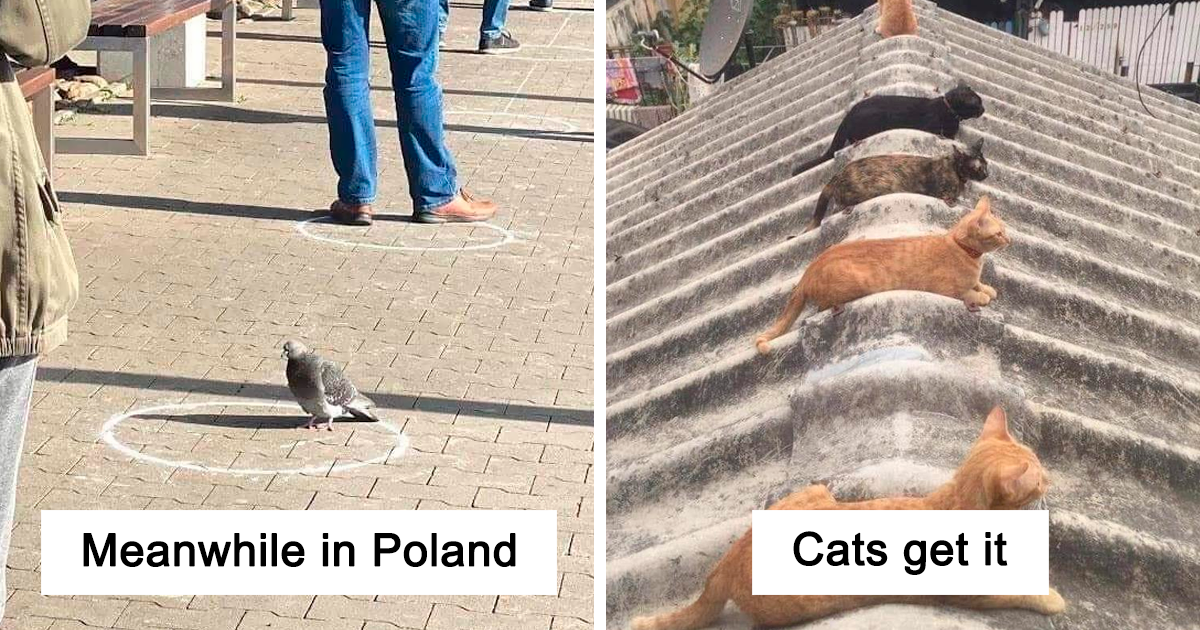
There was a strange moment during the pandemic when humans were still learning how far six feet really was, while animals seemed to have already read the memo, laminated it, and placed it neatly beside the water bowl. Across sidewalks, parks, rooftops, fences, beaches, and empty city streets, people began sharing funny animal pictures online that looked suspiciously like public-service announcements from the animal kingdom.
A row of pigeons standing on separate pavement squares. Cats sitting in windows like tiny neighborhood inspectors. Dogs politely avoiding nose-to-nose greetings. Seagulls spaced out as if waiting for coffee. Deer strolling through quiet neighborhoods with the calm confidence of creatures who had just discovered free parking. These images became a welcome pocket of humor during a difficult time, reminding people that even when life felt heavy, nature could still deliver a punchline with feathers, paws, hooves, or whiskers.
Of course, animals were not actually following government health guidelines. A goose was not reading CDC updates before deciding where to stand. But the joke landed because many animal behaviors already look wonderfully organized from a human point of view. And in a few fascinating cases, animals really do change their social behavior to reduce disease risk. So while the viral photos were mostly comedy, the science behind animal spacing is more interesting than you might expect.
Why “Social Distancing Animals” Became So Popular Online
The internet has always loved animal content. Add a global pandemic, millions of people stuck at home, and a shared craving for something lighter than breaking news, and suddenly a pigeon with personal boundaries becomes a celebrity. Social distancing animals were funny because they flipped the script. Humans were the ones struggling with confusing floor stickers, awkward sidewalk dances, and grocery-store spacing. Animals, meanwhile, appeared to be handling it with natural dignity.
The humor worked especially well because the photos were simple. You did not need a long caption to understand a cat sitting six feet away from another cat. You did not need a PhD in epidemiology to laugh at cows evenly spaced in a field like they were attending a very serious outdoor meeting. The images spoke a universal language: “Look, even the animals get it.”
These pictures also gave people a sense of connection. During lockdowns and stay-at-home periods, many people were separated from family, friends, coworkers, classmates, and ordinary social rituals. Sharing a funny dog photo or a perfectly spaced flock of birds was a tiny way to say, “I saw this, it made me smile, and I thought of you.” That mattered.
Do Animals Really Practice Social Distancing?
In the human sense, no. Animals do not follow public-health posters or argue about mask policies in comment sections. Lucky them. But in the biological sense, many species do adjust their behavior when disease risk is present. Scientists often call this behavioral immunity, and it includes avoiding sick individuals, grooming contaminated group members, self-isolating, or changing movement patterns.
For example, some lobsters abandon shared dens when they detect signs of illness. Certain insects reduce contact with infected nestmates. Honeybees and ants can alter colony behavior to slow the spread of pathogens. Some primates, fish, birds, and bats have also shown forms of avoidance or reduced interaction when disease is detected. In other words, “keep your distance” is not just a human idea. Nature has been running its own version of health-and-safety training for a very long time.
That scientific backdrop made the online joke even better. The viral animal pictures were not proof that pigeons had become public-health experts, but they did accidentally point toward a real truth: spacing, avoidance, and changed social behavior are common survival tools across the natural world.
25 Funny Times Animals Looked Like They Were Following Social Distancing Rules
Below are the kinds of animal moments that made people grab their phones, snap a picture, and post it online for the rest of us to enjoy. Some were pets being unintentionally hilarious. Others were wild animals benefiting from quieter human spaces. All of them gave the internet exactly what it needed: a little comedy wearing fur, feathers, or an expression of complete innocence.
1. Pigeons Standing on Separate Pavement Squares
Few images captured the mood better than pigeons spaced neatly across sidewalk tiles. It looked as if each bird had claimed a personal square and signed a tiny lease. Pigeons naturally spread out while foraging, but during the pandemic, the pattern looked hilariously official.
2. Dogs Waiting Apart Like Polite Neighbors
Some dogs looked surprisingly disciplined while waiting outside stores, parks, or vet clinics. One dog sitting several feet from another can look like a model citizen. The truth is usually simpler: leashes, owners, curiosity, and snack expectations. Still, the result was adorable.
3. Cats Refusing Contact Because Cats Invented It
Cats did not need a pandemic to understand distancing. They have been practicing selective social interaction since ancient Egypt, possibly earlier. A photo of two cats sitting on opposite ends of a couch felt less like a public-health lesson and more like normal cat diplomacy.
4. Seagulls Lined Up Like They Were Waiting for Takeout
Seagulls often stand apart while watching for food, but photos of them spaced across railings or parking lots looked like a beach-town version of a socially distanced lunch line. Somewhere, a French fry was in danger.
5. Cows Spread Across a Field in Perfect Formation
A herd of cows grazing with even gaps between them can look like rural geometry. The animals are usually just feeding comfortably, but to pandemic-era eyes, they looked like they had received a memo from the barn manager.
6. Ducks Crossing the Road in a Responsible Queue
Ducks already have a gift for orderly movement. A line of ducks crossing a quiet road looked like a feathered version of “please wait your turn.” Their little waddles only made the scene more official.
7. Deer Taking Over Empty Neighborhoods
As human activity dropped in many places, deer were spotted more often in quiet neighborhoods, parks, and streets. They were not social distancing from each other as much as enjoying fewer cars, fewer crowds, and fewer surprises.
8. Goats Roaming Quiet Streets
One of the most memorable lockdown wildlife stories involved goats wandering through a Welsh town. Their confident takeover energy was unmatched. They looked less like visitors and more like they had finally won a property dispute.
9. Jackals Exploring Urban Parks
In some cities, wildlife moved more freely through spaces that were usually crowded with people. Jackals in urban parks became a striking example of how quickly animals can respond when human presence changes.
10. Birds Enjoying the Quiet
Bird activity became a major topic during the pandemic. With quieter roads, airports, and city centers, many people noticed birds more often. Some research suggested that certain bird species used human-altered areas differently when traffic and noise dropped.
11. A Cat Sitting in a Marked Circle
Any time a cat sat inside a floor marker, the internet had a field day. Cats love circles, boxes, bags, and mysterious boundaries. A social distancing circle was basically a luxury apartment with no rent.
12. Dogs Avoiding Dog Park Chaos
Some pet owners shared photos of dogs sitting apart at parks or on walking paths. While many dogs would happily break every distancing rule to sniff a new friend, leashes and cautious owners created scenes of canine restraint.
13. Squirrels Keeping Their Own Tree Branches
Squirrels are not exactly famous for calm behavior, but photos of them perched apart on branches looked like a tiny woodland staff meeting. Agenda item one: acorns. Agenda item two: more acorns.
14. Flamingos Gathering With Natural Spacing
Large birds such as flamingos often create visually stunning patterns when they gather. During lockdowns, more people paid attention to bird movement and wetland scenes, making naturally spaced flocks feel symbolic and peaceful.
15. Horses Standing Nose-to-Nose, Then Deciding Against It
Horse photos often captured animals with just enough distance between them to look hilariously cautious. In reality, horses use body language, space, and positioning constantly. They are large animals with opinions, and those opinions take up room.
16. Rabbits Sitting Apart Like Tiny Introverts
Two rabbits sitting several feet apart can look like the softest possible safety briefing. Rabbits are alert prey animals, and spacing can simply reflect comfort, grazing, or awareness. Still, the photos were irresistibly cute.
17. Zoo Animals Observing Empty Walkways
At some zoos and animal facilities, animals experienced unusual quiet when visitor traffic stopped or decreased. Photos of animals looking out at empty paths carried a strange emotional weight: funny, beautiful, and slightly eerie all at once.
18. Sheep Acting Like Lawn-Care Professionals
In some places, sheep were used to graze areas that humans were not maintaining as usual. A flock spread across a golf course or field looked like both a landscaping crew and a spacing demonstration.
19. Raccoons Working the Night Shift
Raccoons have always been experts at appearing where they should not be. During quieter nights, photos of raccoons exploring empty spaces looked like they were checking whether humans had finally abandoned the snack economy.
20. Monkeys Spacing Out on Railings
In some cities around the world, monkeys became more visible when normal human traffic changed. When photographed sitting apart on walls or railings, they looked like commuters waiting for a bus that had absolutely no intention of arriving.
21. Sea Lions Relaxing in Human Spaces
Images of sea lions lounging around quiet waterfront areas became part of the broader “animals during lockdown” conversation. Their expression usually seemed to say, “This was always ours, but thanks for leaving.”
22. Geese Controlling the Sidewalk
Geese are not followers of rules; geese are the rules. When they occupied sidewalks in spaced-out formations, people joked that even geese understood public order. The geese, naturally, understood only that everyone should move aside.
23. Cats Holding Window Conferences
Apartment cats became stars of the pandemic internet. Photos of cats watching the street from separate windows looked like a neighborhood surveillance network. No delivery driver, squirrel, or suspicious leaf went unreported.
24. Dogs Becoming Remote-Work Coworkers
Pets did not always keep distance indoors. Many became clingy coworkers, keyboard blockers, and meeting crashers. But some dogs sat several feet away from desks with the solemn patience of employees waiting for lunch break.
25. Animals Accidentally Making Humans Feel Better
The best “social distancing animals” photos were not just funny because of spacing. They were funny because they made a difficult global moment feel a little less lonely. A bird on a railing, a cat in a circle, or a dog waiting politely became a small reminder that laughter had not gone extinct.
The Bigger Story Behind Animals During Lockdown
While the funny photos were often lighthearted, the pandemic also created a rare chance for scientists to study how animals respond when human activity suddenly changes. Researchers later described this period as the “anthropause,” a dramatic slowdown in travel, traffic, commuting, and public movement.
Some studies found that wildlife movement changed when humans stayed home. Mammals in certain areas traveled farther or approached roads differently. Bird observations in North America suggested that many species appeared more often in human-altered habitats during lockdown conditions. Quieter environments may have allowed people to notice birds more, while also making some urban spaces more usable for wildlife.
This does not mean the pandemic was “good for nature” in a simple way. The reality was complicated. Some animals benefited from reduced traffic and noise. Others suffered because they depended on human food sources, tourism, rescue networks, or regular care. Shelters, zoos, veterinarians, and animal-care workers had to adapt quickly. Pets provided comfort to millions of people, but pet owners also had to learn how to plan for emergencies and reduce unnecessary exposure when sick.
The viral photos, then, were only the funny surface of a much deeper story about human-animal relationships. They showed how closely our lives overlap with animals, even when we are not paying attention. When humans changed their routines, animals noticed. When streets became quiet, birds, deer, jackals, goats, and countless smaller creatures responded in ways that were sometimes visible, sometimes subtle, and often surprising.
Why These Pictures Still Make Us Smile
Years later, the phrase “social distancing animals” still brings back a specific kind of internet humor: gentle, observant, and a little absurd. The photos worked because they let people laugh without ignoring reality. They were not making fun of suffering. They were finding a small, harmless comedy in the shared weirdness of the moment.
They also reminded us that animals are endlessly good at becoming mirrors. A cat sitting alone looked like every introvert thriving at home. A dog staring through a window looked like every extrovert counting the minutes until normal life returned. Pigeons on separate tiles looked like the entire grocery store experience, but with more feathers and less hand sanitizer.
That is the quiet magic of animal pictures online. They turn ordinary behavior into a story we can understand. A duck line becomes discipline. A cow field becomes a classroom. A squirrel on a branch becomes a public-health ambassador with questionable attention span. We know the animals are not actually performing for us, and that makes it even better.
Experiences Related to Animals Following Social Distancing Rules
One reason this topic still feels so relatable is that many people had their own small animal moments during lockdowns. You did not need to live near a famous wildlife sighting to experience it. Sometimes the most memorable scenes happened right outside an apartment window or during a short neighborhood walk.
For many pet owners, dogs became the unofficial emotional-support staff of quarantine. Daily walks turned into one of the few acceptable outdoor routines, and suddenly people noticed the rhythms of their neighborhoods in a new way. A dog pausing at the end of a leash while another dog passed on the opposite side of the street looked like excellent manners, even if the dog was silently planning a full-body greeting. Owners became experts at the “sidewalk shuffle,” gently steering pets around strangers, cyclists, mail carriers, and other dogs while pretending not to look awkward.
Cats created a different kind of experience. Indoor cats watched their humans stay home all day and reacted with a mix of joy, suspicion, and mild workplace harassment. Some cats loved the extra attention. Others seemed offended that their private kingdom now had a full-time tenant. People shared photos of cats sitting on laptops, occupying office chairs, or staring from a strategic distance as if enforcing a new household policy: together, but not too together.
Backyards also became tiny nature theaters. Families noticed squirrels chasing each other along fences, birds visiting feeders more often, rabbits appearing at dusk, and lizards sunning themselves on patios. These were not necessarily new animals, but people finally had time to see them. The slower pace turned ordinary sightings into events. A robin hopping across the lawn could become the highlight of the afternoon. A raccoon caught on a security camera could become family news.
In cities, the experience was even more striking. With less traffic and fewer crowds, people heard birdsong more clearly. Empty streets made animal movement easier to notice. A single deer on a road, a fox near a building, or ducks crossing a parking lot felt cinematic. These moments made many people realize that wildlife had always been sharing the landscape with us, just slightly out of frame.
Online sharing amplified that feeling. Someone posted a photo of spaced-out pigeons, and strangers from different cities recognized the joke instantly. Someone else posted a dog sitting far from another dog, and the comments filled with stories about pets, walks, and quarantine habits. The pictures became a shared scrapbook of an unusual time, blending comedy, comfort, and curiosity.
The most meaningful experience may have been the reminder to pay attention. Social distancing animals were funny, but they also encouraged people to look closer at everyday life. A sidewalk was not just a sidewalk; it was a stage for pigeons. A window was not just a window; it was a cat’s observation deck. A quiet street was not empty; it was temporarily available to creatures that had been waiting for a little room.
That lesson still applies. Even when the world is busy again, animals continue to offer tiny scenes of surprise and humor. They do not need captions, trends, or perfect timing. They simply exist in their own strange, beautiful ways, and sometimes we are lucky enough to notice.
Conclusion
The viral charm of “25 Times People Noticed Animals Following Social Distancing Rules And Decided To Share The Pics Online” comes from a perfect mix of humor, timing, and truth. The pictures were funny because animals appeared to understand human rules better than humans did. But they were also meaningful because they revealed how closely animal behavior, public spaces, and human routines are connected.
From cats claiming personal territory to birds thriving in quieter cities, from goats roaming empty streets to dogs becoming cautious walking partners, these moments gave people something light to share during a heavy period. They also reminded us that nature is never as far away as it seems. Sometimes it is standing six feet apart on a sidewalk, looking suspiciously like it knows exactly what it is doing.