The NFL’s Offensive Player of the Year award is the league’s annual reminder that football is, in fact, supposed to be fun. It’s the trophy for the season’s
most unavoidable offensive forcethe guy who made defenses look like they were buffering, the player whose highlights you saw so often you started humming them
like a jingle.
For the 2022 season, the conversation was especially spicy because the “usual” rules were in flux. Recent history suggested the award often leans non-QB, while
betting markets and analyst panels were juggling a perfect storm of elite wide receivers, a few monster running backs, and quarterbacks who treat 40 touchdowns
like a casual weekend project.[1][2][3]
How Offensive Player of the Year Usually Works
Offensive Player of the Year (OPOY) is an Associated Press honor announced at NFL Honors, and it tends to reward “offensive dominance” more than “most valuable
human calculator at quarterback.” That matters because MVP and OPOY can overlap, but voters often treat OPOY like a spotlight for the non-QB who made the season
unforgettableespecially when a quarterback is the obvious MVP choice.[6]
Recent precedent supported that mindset: elite receivers and running backs have taken turns owning the award, from record-chasing receiving seasons to
volume-and-efficiency rushing campaigns.[6] Still, the rule isn’t “quarterbacks need not apply.” It’s more like “quarterbacks must be so ridiculous
that voters can’t politely look away.”
So, to rank 2022 contenders, we leaned on three ingredients: (1) recent production and role clarity, (2) team context (scheme, supporting cast, and offensive
philosophy), and (3) the very real gravitational pull of narrativebecause trophies are handed out by humans, not spreadsheets.
2022 OPOY Predictions, Ranked
This ranking reflects how the 2022 race looked heading into the season and as early-season expectations settled: a mix of analyst forecasts, betting odds, and
“this offense is about to feed this guy until the fork breaks.”[1][2][4][9]
-
#1: Justin Jefferson, WR, Minnesota Vikings
If you wanted a “safe” OPOY bet in 2022, Jefferson was the closest thingif only because his definition of a bad day was “still drew double coverage for
four quarters.” He entered the year coming off a 108-catch, 1,616-yard, 10-touchdown season, and the setup screamed “more volume, more spotlight.”[12]The OPOY recipe for a receiver is pretty straightforward: top-tier yardage, enough touchdowns to avoid the “great season, wrong award” shrug, and at least a
couple of nationally televised moments where defenders do the helpless backpedal that says, “Coach, I did my best.” Jefferson checked every box, plus the
league-wide consensus: analysts were already treating him like a front-runner.[1][9] -
#2: Jonathan Taylor, RB, Indianapolis Colts
Taylor’s case was built on the oldest argument in football: “Give the ball to the guy who keeps turning first downs into existential dread.” He led the NFL
in rushing yards in 2021 with 1,811, and the workload projection for 2022 stayed massive.[11]Running back OPOY campaigns usually need two things: undeniable production and a “this offense is him” identity. Taylor had bothplus the kind of weekly
consistency voters notice even when they’re not trying. Betting boards treated him as one of the primary favorites, which matters because markets often
capture the early “award narrative” before it becomes a talk-show personality trait.[2][4] -
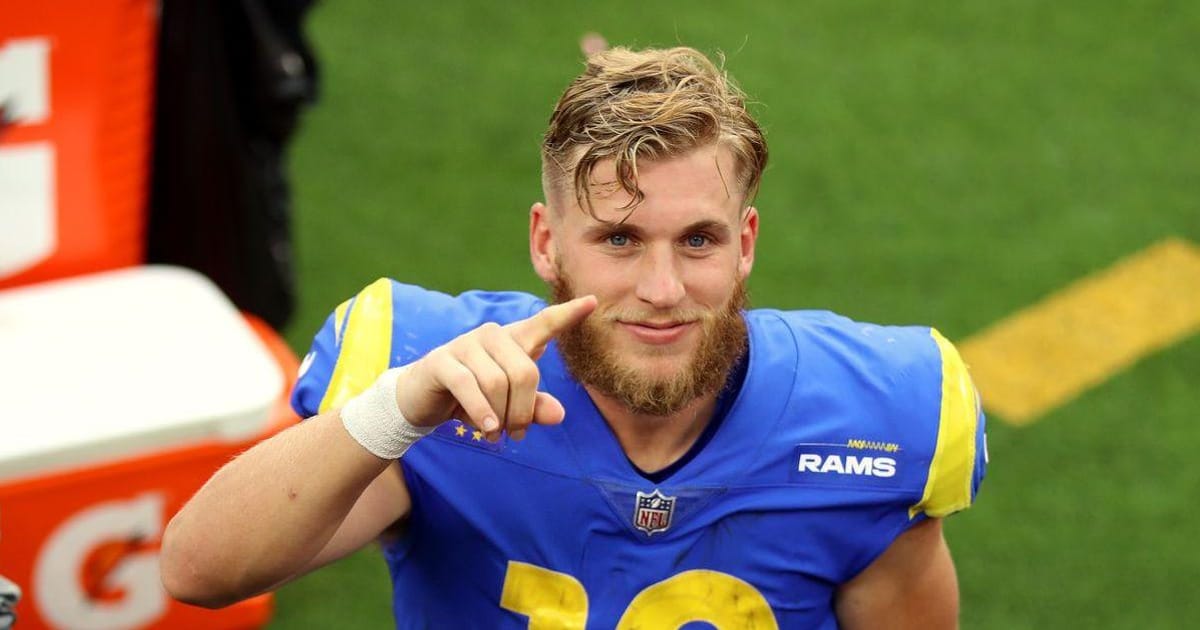
#3: Cooper Kupp, WR, Los Angeles Rams
Kupp’s 2021 season was so loud it still echoed into 2022: 145 receptions, 1,947 receiving yards, and 16 receiving touchdownsnumbers that look like a video
game slider got bumped to “Unfair.”[10]The only reason he wasn’t an automatic repeat pick is simple: repeating is hard when every defense spends the offseason stapling your highlight reel to a
whiteboard. Still, sportsbooks and analysts kept him near the top because the Rams’ offensive identity was obvious: when in doubt, find Kupp. When not in
doubt, also find Kupp, but with a little extra flair.[2][3] -
#4: Ja’Marr Chase, WR, Cincinnati Bengals
Chase entered 2022 with the most dangerous combination for an award race: proven big-play explosiveness and room to grow. As a rookie, he posted 81 catches,
1,455 yards, and 13 touchdownsplus the kind of “oh wow” chunk plays that live forever on highlight shows.[13]The case for Chase was about ceiling. If Cincinnati’s passing game took even a modest step forward, Chase had a plausible path to leading the league in
receiving touchdownsor turning every other catch into a 60-yard stress test for safeties. OPOY voters love receivers who don’t just win routes; they ruin
defensive coordinators’ evenings. -
#5: Davante Adams, WR, Las Vegas Raiders
Adams moving to Las Vegas didn’t lower his OPOY ceilingit changed the storyline. In Green Bay, he was already a statistical machine (123 catches, 1,553
yards, 11 touchdowns in 2021), and the trade created a fresh narrative: new team, same problem for defenses.[15]For awards, narrative matters almost as much as production. A receiver dominating after a headline offseason move is exactly the kind of plot voters can
summarize in one sentencewhile still sounding smart at a party. If the Raiders’ offense leaned heavily on Adams near the goal line and in critical moments,
he’d have the “signature season” profile that often wins this trophy. -
#6: Tyreek Hill, WR, Miami Dolphins
Hill’s speed is the closest thing the NFL has to a cheat code you’re allowed to use in public. He arrived in Miami via a blockbuster trade, immediately
turning every defensive back’s biggest fear into a weekly appointment.[15]Even before the season’s midstream award chatter heated up, odds-focused coverage had Hill in the thick of the conversation, which tracks with how OPOY
voters respond to game-breaking ability: when a player can tilt coverages on every snap, raw stats often follow.[5][15] -
#7: Deebo Samuel, WR/RB, San Francisco 49ers
Deebo’s candidacy was the most unique because his job description was basically “yes.” In 2021, he piled up 1,770 scrimmage yardsreceiver work, runner
work, and the occasional “wait, is that allowed?” gadget brilliance.[14]The question wasn’t talent. It was usage and sustainability. Hybrid roles are amazing until the body starts filing complaints with HR. But if San Francisco
leaned into his versatility againand if the offense needed him to be the centerpieceDeebo had a clear path to an OPOY season built on volume plus novelty,
which is a great combination when voters are choosing between multiple stars with similar yardage totals. -
#8: Josh Allen, QB, Buffalo Bills
Here’s the quarterback dilemma: if a QB is the best offensive player, he might win MVP instead, and OPOY becomes the “someone else was incredible” award.
But Allen had the kind of dual-threat profile that can break that patternbig passing numbers plus meaningful rushing production.[15]In 2021, Allen, Patrick Mahomes, and Justin Herbert were all living in the same neighborhood statisticallyhigh volume, high touchdowns, constant pressure on
defenses to pick a poison.[15] If MVP voters drifted toward another quarterback or a more team-success-driven narrative, Allen’s physical style and
highlight factor could still pull OPOY votes. -
#9: Patrick Mahomes, QB, Kansas City Chiefs
Mahomes is always in the conversation because “creative chaos” is still offense. And while defensive schemes spent years trying to persuade him to be
boringhe’s stubbornly refused to accept the premise. His 2021 production sat right at the top of the league’s passing leaderboard cluster, and the Chiefs’
offense remained a weekly fireworks show.[15]The 2022 question was narrative: would the offense look different after major roster changes, and would Mahomes’ dominance be framed as “still elite” or
“most impressive reinvention”? Voters love a reinvention arcespecially one that still ends with defenses looking exhausted. -
#10: Justin Herbert, QB, Los Angeles Chargers
Herbert’s case was the modern quarterback thesis: high attempts, high yards, and enough explosive plays to keep the offense permanently “on.” The 2021
passing leaderboard shows exactly why he entered 2022 as a major award threathe was already producing at the top-tier volume level that wins hardware.[15]For Herbert to jump from “elite” to “award-winning,” the Chargers needed the headline moments: a few signature comeback wins, nationally visible shootouts,
and the kind of late-season surge that makes voters say, “Okay, I can’t ignore this anymore.” -
#11: Jalen Hurts, QB, Philadelphia Eagles
Hurts was the “bet on improvement” quarterback. His 2021 stat profile showed real passing growth plus impact rushing volume3,144 passing yards and 784
rushing yards with 10 rushing touchdowns in 2021, which is the kind of dual-threat shape that can flip an award race fast.[15]If the Eagles’ passing game took a meaningful leap (without losing the rushing identity that makes Hurts special), he had a plausible path to the kind of
season that forces voters to treat him as more than a “nice story.” OPOY isn’t a participation trophy. But it does love a breakout. -
#12: Christian McCaffrey, RB, Carolina Panthers
McCaffrey is the perfect OPOY archetype when healthy: a running back who produces like a top receiver and makes defenses declare a minor emergency when he
motions out wide. His 2019 season (2,392 scrimmage yards) is a reminder of what his ceiling looks like when everything aligns.[15]The reason he landed here isn’t about abilityit’s about availability and team context. Still, preseason award picks and commentary kept him in the orbit of
OPOY because the path is obvious: if he plays a full season and the offense features him relentlessly, his dual-threat output can look different enough from
the rest of the field to win the vote.[8]
Honorable Mentions (a.k.a. “Don’t Be Surprised If…”)
-
Derrick Henry: If healthy and back to peak workload, he always has a “lead the league in rushing and dare voters to say no” route to the
award. Recent OPOY history supports the idea that a dominant rushing season can still win big.[6] - Travis Kelce: Tight ends rarely get the same award love as wideouts, but if the position market share gets silly enough, voters notice.
-
Any surprise breakout receiver: Every season produces one player who turns “nice talent” into “why is he always open?” If that player also
lands on a winning team, the award door cracks open.
Fan Experience: Tracking the 2022 OPOY Race in Real Time
The fun part about predicting OPOY isn’t the final answerit’s the weekly emotional whiplash. One Sunday, your top candidate posts 180 yards and a touchdown,
and the award feels inevitable. The next week, he gets bracket coverage, finishes with 58 yards, and suddenly the group chat is declaring the trophy “wide open”
with the confidence of a weather forecast.
The experience usually starts with the “numbers reflex.” Fans pull up box scores and leaderboards, hunting for the cleanest argument: total yards, touchdowns,
yards per touch, targets, or those deliciously simple lines like “1,800 rushing yards” that don’t require additional explanation. It’s not that the eye test
disappearsit’s that the scoreboard provides instant talking points, and arguing is a cherished NFL side quest.
Then comes the part where football reminds you it’s not played in a spreadsheet: context. A receiver gets 17 targets because the team’s defense is allergic to
third downs, and suddenly his volume looks like both a compliment and a cry for help. A running back posts 140 yards but needed 34 carries, and half the
internet debates whether that’s dominance or stubbornness. Quarterbacks complicate everything, because every great QB season raises the same question: “Is this
MVP… and if so, who gets OPOY?”
The weekly experience also has a highlight-reel economy. One outrageous catch on a prime-time game can do more for an award narrative than two quiet 8-catch
afternoons at 1:00 p.m. That’s why players like Jefferson, Hill, and Deebo felt like constant threats: their best plays were not just productivethey were
memorable. Fans don’t only remember yardage; they remember defenders looking confused, angles collapsing, and the broadcast team running out of synonyms for
“fast.”
If you’ve ever followed the race while playing fantasy football, you know it adds an extra layer of comedy. The same player can be both your weekly hero and
your personal villain, depending on whether his 40-point day happened on your roster or against it. That overlap doesn’t decide awards, but it absolutely fuels
the loudness of the conversation, and loudness is the unofficial currency of NFL discourse.
And finally, there’s the late-season “sweep the leg” phase: schedule strength, weather games, injuries, and team playoff positioning. A star who is clearly
better than everyone else can still lose momentum if the team starts resting him, or if a lingering injury turns explosive plays into respectable jogs. The
best part (for fans) is that this uncertainty keeps the debate alive. The worst part (also for fans) is realizing you’ve spent three months arguing about a
trophy you don’t get to vote onwhile still feeling emotionally invested like you’re on the committee.
Final Takeaway
In 2022, the cleanest OPOY paths belonged to players who combined elite production with a simple, repeatable story: Jefferson dominating every coverage plan,
Taylor powering an offense through sheer volume, Kupp continuing his target-hog magic, and a handful of game-breaking receivers and quarterbacks ready to hijack
the conversation with one unforgettable month.[1][2][5][6]
The safest prediction is rarely “the most talented player.” It’s the player most likely to be unavoidableon film, on leaderboards, and on national
highlightsweek after week. That’s the real OPOY profile.