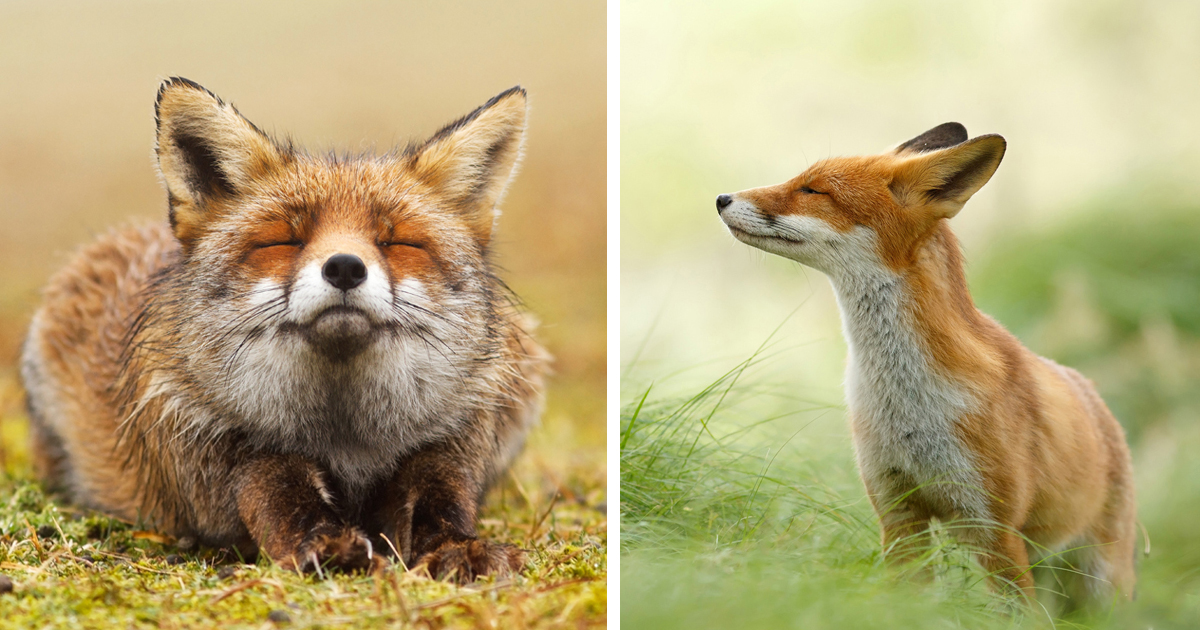
There are wildlife photos that make you gasp, photos that make you whisper “how did they get that shot?”, and then there are fox photos that make you want to cancel your meetings, brew tea, and stare calmly into the middle distance like a tiny orange monk. That is the magic behind Zen Foxes, a beloved wildlife photography theme associated with Dutch nature photographer Roeselien Raimond, whose portraits of wild red foxes capture something unexpectedly human: stillness, comfort, curiosity, and the noble art of doing absolutely nothing.
At first glance, the idea sounds simple. A fox sits in the grass with closed eyes. Another relaxes in falling snow. A young fox appears to smile as sunlight warms its fur. But the more you look, the less simple these images become. They are not staged studio portraits or cartoon woodland fantasies. They are patient observations of wild animals in real environments, captured when the foxes appear relaxed enough to let down their guard. In other words, Zen Foxes are not just cute. They are a reminder that the wild world is full of small, quiet dramasand occasionally, one very fluffy creature who looks like it has just discovered inner peace.
This article explores the story behind the Zen Foxes series, why red foxes are such expressive photography subjects, what makes ethical wildlife photography so important, and why these beautiful wild foxes keep charming viewers across the internet. Bring your curiosity. Leave your chicken coop unattended at your own risk.
Who Is the Photographer Behind Zen Foxes?
Roeselien Raimond is a Dutch wildlife photographer, writer, and visual storyteller known for soulful images of animals in natural settings. Before focusing seriously on photography, she worked in creative fields including art therapy and web design. That background matters because her work does not feel like simple documentation. It feels emotional, painterly, and carefully composed without becoming artificial.
Her fox photography gained widespread attention because it approached red foxes differently from the usual folklore package. For centuries, foxes have been labeled sly, sneaky, thieving, suspicious, and generally guilty of something even when standing still. Raimond’s images quietly challenge that reputation. Instead of presenting foxes as villains from a chicken-themed crime documentary, she shows them as individuals: playful, tired, affectionate, alert, relaxed, and sometimes wonderfully ridiculous.
The Zen Foxes theme became especially memorable because it captures foxes in moments of visible calm. Their eyes are closed. Their faces soften. Their bodies settle into grass, dunes, frost, or snow. The effect is almost meditative. The animals seem to be enjoying sun, air, weather, and pause. Whether or not a fox is actually “smiling” in the human sense is beside the point. The photographs invite viewers to notice the body language of comfortand to see wild animals as living beings with rhythms of rest, not merely hunters, pests, or fairy-tale tricksters.
Why Wild Foxes Make Such Captivating Subjects
The star of the Zen Foxes story is the red fox, scientifically known as Vulpes vulpes. Red foxes are among the most widely distributed land mammals in the world, living across many parts of North America, Europe, Asia, and northern Africa. They are famously adaptable, thriving in forests, grasslands, dunes, farmland, suburbs, and even cities. If nature handed out survival résumés, the red fox would list “resourceful omnivore,” “night-shift specialist,” “excellent listener,” and “can look adorable while committing minor mischief.”
Physically, red foxes are built for visual drama. Their reddish-orange coats glow beautifully against green grass, pale sand, gray winter skies, or white snow. Their black legs and black-tipped ears add contrast, while the white-tipped tail acts like nature’s punctuation mark. A fox in snow is practically a ready-made painting: one brushstroke of flame wandering through a quiet white world.
Behaviorally, foxes are even more interesting. They hunt small mammals, birds, insects, and other available foods, but they also eat fruit, carrion, and human-associated scraps when living near people. Their large ears help them detect hidden prey, and their famous pouncing styleleaping high and landing with front paws forwardis one of the great athletic performances of the animal kingdom. It is elegant, precise, and occasionally looks like someone threw a fox at the ground.
Yet foxes are not only hunters. They rest, groom, communicate, raise young, store food, scent-mark territory, play, and observe. They have a wide range of vocalizations and expressive body language. For a photographer willing to watch quietly for many hours, a fox is not a single “type” of animal. It is a personality in fur.
The Meaning of “Zen” in Zen Foxes
The word “Zen” in Zen Foxes is not meant to turn foxes into tiny spiritual teachers with miniature meditation cushions. It is a playful way to describe a rare and beautiful state: a wild animal appearing completely at ease. In many wildlife photographs, the mood is actionrunning, hunting, fighting, fleeing, catching, splashing. Zen Foxes offers the opposite: the emotional power of stillness.
That stillness is hard to photograph because it cannot be forced. A relaxed fox is relaxed precisely because it does not feel pressured. If a photographer approaches too quickly, crowds the animal, blocks its path, or behaves like a paparazzo chasing a celebrity into a grocery store, the moment disappears. The fox becomes alert, and the image changes from peaceful to suspicious. The Zen Foxes approach depends on patience, distance, and acceptance of whatever nature offers.
That may be the deeper charm of the series. The photographs are not simply about foxes resting. They are about a photographer learning to slow down enough to witness rest. In that sense, the camera becomes less of a hunting tool and more of a listening device. The best image happens when the photographer stops demanding a performance and lets the animal exist.
Why These Fox Photos Went Viral
Wild fox photography is popular for obvious reasons: foxes are beautiful, expressive, and familiar enough to feel approachable while still being wild enough to feel magical. But the Zen Foxes images spread widely because they delivered something people wanted without knowing they wanted it. In a digital world filled with alerts, outrage, hot takes, and recipes that somehow require thirty-seven ingredients, a relaxed fox with closed eyes feels like a public service.
Viewers respond because the photos create emotional contrast. A fox is usually imagined as quick, clever, and elusive. Seeing one pause in apparent bliss surprises us. The images also avoid cheap cuteness. They are adorable, yes, but they are not merely “aww” content. They have mood, composition, atmosphere, and respect for the animal. A Zen Fox photo can make you smile, but it can also make you think: When was the last time I simply sat in sunlight without checking my phone?
The photographs also benefit from strong visual storytelling. A fox in a snowstorm suggests resilience. A fox basking in warm grass suggests contentment. A fox cub with half-closed eyes suggests innocence, curiosity, and possibly the smug satisfaction of having just discovered its own tail. Each image feels like a small scene from a larger life.
Red Fox Behavior: More Than a Pretty Face
Understanding red fox behavior makes the Zen Foxes series even richer. Red foxes are often solitary hunters, but they are not emotionless loners. During breeding and pup-rearing seasons, fox families can show strong bonds. Both parents may help care for young, and kits learn through play, exploration, and observation. Those playful moments are not random cuteness; they are part of development.
Foxes also communicate in multiple ways. They use sound, scent, posture, facial expression, and tail movement. Their tail, often called a brush, helps with balance, warmth, and signaling. When a fox curls up and wraps that luxurious tail around its body, it is not just posing for a winter postcard. It is conserving heat with style. Humans invented blankets; foxes grew one and attached it permanently.
Because foxes adapt so well to human-influenced landscapes, people sometimes encounter them in suburban areas. Seeing a fox during the day does not automatically mean it is sick. Red foxes can be active at different times depending on food availability, season, safety, and local conditions. Still, a wild fox should never be fed or approached. Admiration is good. Handouts are not. A fed fox can become habituated, which increases risks for both the animal and people.
The Ethics Behind Beautiful Wildlife Photography
Zen Foxes also opens an important conversation about ethical wildlife photography. The most beautiful wildlife image is not worth stressing, chasing, baiting, cornering, or endangering an animal. Ethical photographers prioritize the subject’s well-being over the shot. That means keeping distance, using long lenses, avoiding dens and nesting areas, staying quiet, respecting local rules, and leaving the habitat as undisturbed as possible.
Good wildlife photography often looks effortless only because the effort is hidden. Behind a peaceful fox portrait may be hours of walking, waiting, freezing, missing the shot, accepting failure, and quietly sharing space with mosquitoes who did not sign a consent form but participated enthusiastically anyway. The photographer’s job is not to make the animal perform. It is to be ready when real behavior happens.
This is especially important with foxes because they are intelligent, sensitive, and highly aware of their surroundings. A fox that changes behavior because of a human presence is telling us something: we are too close, too loud, or too interesting in the wrong way. The best response is to back off. A calm fox is a gift; it is not a product on demand.
How Zen Foxes Changes the Fox Stereotype
Foxes have carried a complicated reputation in human culture. In stories, they are tricksters, thieves, charmers, and deceivers. Some of that folklore comes from real fox intelligence and opportunism. A fox will absolutely take advantage of easy food, weak fencing, or a person who believes “just one snack won’t hurt.” But the stereotype is incomplete.
Raimond’s work helps widen the frame. Her foxes are not props for old myths. They are wild animals with individual expressions and behaviors. Some look gentle. Some look bold. Some look like they know a secret and are deciding whether you deserve it. By documenting different moods and personalities, the photographs encourage viewers to replace the flat idea of “the fox” with a more accurate one: foxes are adaptive, expressive, and complex.
This matters because the way people imagine animals affects how they treat them. When a species is seen only as a pest or villain, compassion shrinks. When people see beauty, behavior, and individuality, they are more likely to value coexistence. A single fox portrait will not rewrite centuries of folklore overnight, but it can open a small door. Sometimes conservation begins with curiosity. Sometimes it begins with a fox who appears to be smiling like it has achieved inbox zero.
Why the Images Feel So Peaceful
The visual calm of Zen Foxes comes from several elements working together. First, there is the fox itself: a warm-colored animal with elegant lines and expressive features. Second, there is the setting. Soft grass, snow, dunes, and gentle light create a natural stage without clutter. Third, there is timing. Closed eyes, relaxed ears, and settled posture communicate ease. Fourth, there is restraint. The images do not need dramatic editing or forced spectacle. The quiet is the point.
In a strong Zen Fox photo, negative space becomes part of the story. A blurred background allows the fox’s face to hold attention. Snow softens the world. Sunlight turns fur into a glowing edge. The viewer is not overwhelmed with detail. Instead, the image invites a slower gaze. That is rare online, where most visuals shout for attention. Zen Foxes whispersand somehow, the whisper wins.
Lessons From Zen Foxes for Everyday Life
It would be easy to turn these foxes into motivational posters. “Be present.” “Stay wild.” “Nap strategically.” All useful advice, especially the last one. But the real lesson is subtler. Foxes do not relax because a wellness app reminded them to breathe. They relax when their needs are met and the environment feels safe. That is a practical lesson for humans too. Calm is not only a mindset; it is often a condition created by space, security, and freedom from constant threat.
Zen Foxes also reminds us that rest is part of survival. Wild animals cannot afford endless wasted energy. They hunt, patrol, raise young, and stay alert when necessary. When the chance to rest appears, they take it. Humans, meanwhile, often treat rest like a suspicious luxury. A fox would probably find our calendar notifications very confusing. “You scheduled relaxation for 6:15 but moved it to next Thursday? Fascinating. Also, terrible.”
Finally, the series teaches attention. Beautiful moments often happen quietly and briefly. To see them, we have to stop rushing through the landscape as if nature were a checklist. The fox in the grass is not performing for us. It is living. Our privilege is to notice.
Experience Notes: A Slow Morning With the Spirit of Zen Foxes
The best way to understand Zen Foxes is to imagine a morning in the field when nothing seems to be happening. The sky is pale. The grass is wet enough to make your socks question your life choices. Your camera feels heavier than it did at home, where everything seemed romantic and possible. You have told yourself you are “going wildlife watching,” but mostly you are standing still while small birds judge you from a shrub.
Then, somewhere at the edge of the dunes or brush, a shape appears. Not dramatic. Not cinematic. Just a flicker of red moving between beige stems. A fox. Your first instinct is to raise the camera quickly, but that movement feels too loud, even if it makes no sound. So you wait. The fox pauses, looks around, and continues. It is not coming to you. It is not fleeing from you. It is simply being a fox, which is already more interesting than most scheduled entertainment.
After a while, the fox settles in a patch of weak sunlight. It sits, then lowers itself down. The ears remain alert at first, turning like little radar dishes. A distant bird calls. A breeze moves the grass. Nothing spectacular happens. And that is exactly when the morning becomes special. The fox’s eyes narrow. Its body softens. Its head tilts slightly toward the warmth. For a few seconds, it looks completely comfortable in the world.
This is the kind of moment Zen Foxes celebrates. It is not about conquering nature or collecting proof that you were close to something wild. It is about earning, through patience and restraint, the chance to witness an animal at peace. You may take a photograph. You may miss the photograph. Either way, you leave with something valuable: the memory of a wild creature trusting the morning enough to rest inside it.
There is humor in the experience too. Wildlife photography sounds noble until you remember how much time it involves crouching in damp places, misidentifying bushes as animals, and taking seventeen photos of absolutely nothing because the “fox” turned out to be a reddish clump of grass. But those awkward hours are part of the practice. They teach humility. Nature does not care about your content calendar. Foxes do not accept creative direction. The light will change when it feels like it. Your job is to show up, behave well, and stay awake.
By the time you walk home, the best image may not even be on the memory card. It may be the feeling of having slowed down enough to match the pace of the place around you. That is the real Zen Fox experience: not just seeing a fox, but briefly borrowing its rhythm. Hunt when hungry. Rest when safe. Pay attention. Keep your tail warm. And never underestimate the spiritual power of sitting quietly in a sunbeam.
Conclusion: Why Zen Foxes Still Captures Hearts
Zen Foxes: Photographer Documents Beautiful Wild Foxes is more than a charming wildlife photography theme. It is a celebration of patience, ethical observation, and the quiet beauty of red foxes living their own complex lives. Roeselien Raimond’s images stand out because they do not reduce foxes to stereotypes. They reveal mood, personality, softness, alertness, humor, and calm.
In a noisy online world, these foxes offer a rare visual pause. They remind us that wild animals are not always in chase mode, that rest can be as meaningful as action, and that the most memorable photographs often happen when the photographer stops pushing and starts noticing. A fox closing its eyes in the sun may look simple. But simple things, when seen clearly, can be surprisingly profound.
Note: This article is original, publication-ready HTML body content based on synthesized public information about Roeselien Raimond’s fox photography, red fox behavior, and responsible wildlife-viewing practices.