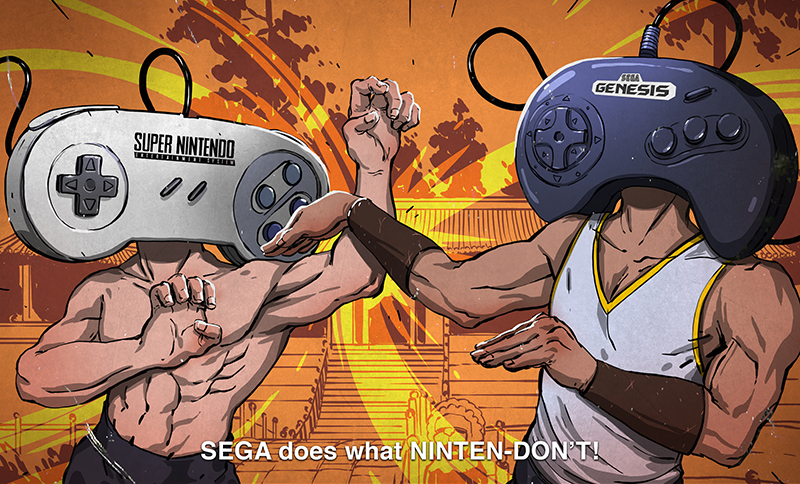
The console wars have always looked like a fight about logos, mascots, exclusive games, and whichever plastic box looked coolest under the television. But under the marketing confetti, the real contest has been architectural. Every winning console generation was shaped by a hardware philosophy: speed versus color, raw compute versus developer friendliness, exotic chips versus familiar toolchains, and lately, storage pipelines versus teraflop bragging rights.
To understand who “wins” the console wars, we need to look beyond sales charts and fan arguments that age about as gracefully as a scratched rental disc. Winning is not only about building the most powerful machine. It is about building the right machine: affordable enough to sell, efficient enough to manufacture, simple enough for developers to master, and distinctive enough to produce games people remember years later.
This architectural study explores how console design choices shaped the fortunes of Sega, Nintendo, Sony, and Microsoft, from the 16-bit era to today’s SSD-powered, ray-traced, hybrid future. The lesson is clear: the best console architecture is not always the biggest engine. Sometimes it is the engine that lets developers drive fast without needing a PhD, a soldering iron, and three cups of emergency coffee.
What “Winning” Really Means in Console Architecture
A console can win in several ways. It can win the market by selling the most units. It can win the developer race by being easy to program. It can win culturally by producing unforgettable games. Or it can win technically by introducing an idea that influences future hardware long after the original machine has left store shelves.
Architecture sits at the center of all four. A console’s CPU, GPU, memory layout, storage system, audio hardware, operating system, and development tools create the boundaries of what games can do. Those boundaries become creative prompts. Sometimes they produce magic. Sometimes they produce loading screens long enough to let you reconsider your life choices.
The 16-Bit War: Sega Genesis vs. Super Nintendo
The Sega Genesis and Super Nintendo Entertainment System remain one of the cleanest examples of two competing architectural philosophies. The Genesis used a Motorola 68000 main CPU supported by a Zilog Z80, giving it strong general-purpose performance for fast arcade-style games. Developers could push quick scrolling, sharp action, and responsive gameplay. That technical personality matched Sega’s aggressive brand perfectly: fast, loud, and slightly convinced it owned a leather jacket.
The Super Nintendo took a different route. Its Ricoh 5A22 CPU was slower on paper, but Nintendo surrounded it with powerful graphics and audio subsystems. The SNES could display richer colors, use advanced background effects, and deliver a warmer, more sample-based sound thanks to its dedicated audio hardware. Where Genesis often felt like an arcade cabinet in your living room, the SNES felt like a miniature animation studio that occasionally asked the CPU to please keep up.
Why the SNES and Genesis Both Had Architectural Wins
Sega’s architecture favored speed and directness. Nintendo’s favored presentation and special effects. That is why the Genesis became a natural home for games that emphasized fast scrolling and aggressive pacing, while the SNES excelled at lush platformers, cinematic role-playing games, and visual tricks such as Mode 7 scaling.
The important takeaway is that architecture shaped identity. Sonic the Hedgehog was not just a mascot; he was a hardware statement. Super Mario World and The Legend of Zelda: A Link to the Past were not only great games; they were proof that Nintendo’s slower CPU could be balanced by art direction, audio richness, and clever graphics hardware.
The PlayStation Shift: When CDs and Developer Access Changed Everything
Sony’s original PlayStation did not win because it had the most elegant 2D sprite hardware. It won because it understood the industry’s transition to 3D better than most competitors. Its MIPS-based CPU, dedicated geometry hardware, CD-ROM format, and relatively approachable development environment gave studios a practical path into polygonal games.
The CD-ROM was especially important. It gave developers far more storage than cartridges, reducing manufacturing costs and enabling full-motion video, larger soundtracks, and bigger worlds. Yes, it also gave us some spectacularly awkward pre-rendered cutscenes, but progress often arrives wearing compression artifacts.
Nintendo’s cartridge-based Nintendo 64 had strengths, including fast access times and strong 3D hardware, but cartridges were expensive and storage-limited. The PlayStation’s architecture aligned better with where third-party development was going. Sony did not merely sell hardware; it sold a development ecosystem.
PlayStation 2: Exotic Power Meets Market Gravity
The PlayStation 2 is a fascinating case because it was both difficult and wildly successful. Its Emotion Engine combined a MIPS CPU core with vector processing units designed for geometry and multimedia work. On paper, it was a beast. In practice, it was a beast that sometimes demanded developers bring a chair, a whip, and a manual thick enough to stop a door.
Yet the PS2 won massively because architecture was only one part of the machine’s total strategy. It arrived with DVD playback at a time when DVD players were desirable household devices. It had backward compatibility with the original PlayStation. It had enormous third-party support. And over time, developers learned to exploit the Emotion Engine’s strengths.
Games like Gran Turismo, God of War, Shadow of the Colossus, and Metal Gear Solid 3 showed that difficult hardware could still produce legendary results when the install base was large enough and studios had enough time to master it. The PS2 proved that a console can be architecturally strange and still dominate if the total value proposition is irresistible.
Xbox and GameCube: Familiarity, Balance, and the PC Connection
Microsoft entered the console market with the original Xbox, a machine that looked architecturally familiar to PC developers. It used an Intel CPU, NVIDIA graphics technology, a hard drive, and a DirectX-based development model. That made it easier for many Western studios to bring PC-like games to the living room.
The Xbox did not outsell the PS2, but it introduced ideas that became central to console design: built-in storage, online infrastructure through Xbox Live, and a developer environment that reduced friction. Halo: Combat Evolved became the proof point. The hardware enabled a console shooter that felt modern, expansive, and technically confident.
Nintendo’s GameCube, meanwhile, was compact, efficient, and surprisingly capable. Its IBM PowerPC-based CPU and ATI graphics hardware formed a balanced machine with clean memory access and strong performance. But the mini-disc format limited storage, and Nintendo’s family-friendly brand positioning did not always attract the same third-party momentum as Sony’s massive PS2 ecosystem.
Xbox 360 vs. PlayStation 3: Developer Friendliness Beats Theoretical Muscle
The seventh generation gave us one of the clearest architectural lessons in console history. The Xbox 360 used a custom IBM PowerPC CPU and an ATI-designed GPU called Xenos, which was notable for its unified shader approach. It also used a unified memory pool, giving developers flexibility when balancing graphics, game logic, and assets.
The PlayStation 3, by contrast, used the Cell Broadband Engine, a highly ambitious processor with a PowerPC-based core and multiple Synergistic Processing Elements. Cell was powerful, but difficult. Developers had to divide work carefully across specialized processing units and manage data movement explicitly. In expert hands, the PS3 could produce spectacular results. In ordinary production schedules, it could produce headaches wearing a Blu-ray logo.
Early multiplatform games often ran better on Xbox 360 because its architecture was easier to use and its tools were more familiar. Over time, Sony’s first-party studios learned to push the PS3 hard, producing games like Uncharted 2, The Last of Us, and Killzone 2. But the broader lesson remained: theoretical performance is not the same as accessible performance.
The Wii: Winning by Refusing the Arms Race
Nintendo’s Wii looked underpowered compared with the Xbox 360 and PS3. Architecturally, it was closer to an evolved GameCube than a traditional next-generation leap. Its Broadway CPU and Hollywood graphics chip were efficient rather than extravagant. By raw numbers, it did not belong in the same gym as Sony and Microsoft’s machines.
Then it sold like crazy.
The Wii won because Nintendo changed the battlefield. Motion controls, accessible games, low power consumption, small hardware, and a lower price point mattered more than shader counts. Wii Sports did what no spreadsheet could: it made people who did not consider themselves gamers pick up a controller and start laughing in the living room.
This was architecture as strategy. Nintendo did not build the most powerful console. It built a machine optimized for a new input method, a broad audience, and profitable hardware economics. The Wii is a reminder that the console war is not always won by building the biggest cannon. Sometimes it is won by handing grandma a bowling ball.
PS4 and Xbox One: The Great Return to PC-Like Architecture
After the complexity of the PS3 era, both Sony and Microsoft moved toward x86-based AMD architectures for the PlayStation 4 and Xbox One. This was a major philosophical shift. Instead of exotic custom processors that required specialized programming models, the industry moved closer to PC-style development.
The PS4 gained an early advantage with stronger graphics performance, simpler messaging, and a developer-friendly memory setup built around GDDR5. The Xbox One, while ambitious as an entertainment hub, used a more complicated memory arrangement involving DDR3 and ESRAM. It also launched with messaging that made many gamers wonder whether Microsoft had temporarily misplaced the “game” part of “game console.”
Architecturally, the PS4’s clarity helped. Developers had a straightforward target. Players had a straightforward pitch. Sony’s system was powerful, accessible, and focused. In console design, elegance often beats cleverness when cleverness requires a footnote.
PS5 vs. Xbox Series X: Storage, Throughput, and the Modern Bottleneck
The PlayStation 5 and Xbox Series X share a broad architectural foundation: AMD Zen 2 CPUs, RDNA 2-class graphics, SSD storage, ray tracing support, and high-bandwidth memory. On paper, the Xbox Series X has a stronger GPU specification, with more compute units and higher theoretical shader performance. The PS5 counters with extremely fast custom storage and a highly specialized I/O pipeline.
This generation shifted the conversation from “How many polygons can you push?” to “How quickly can you feed the machine?” Open worlds, high-resolution textures, instant travel, and dense environments depend heavily on storage throughput and decompression. The PS5’s custom SSD architecture was designed to reduce bottlenecks between storage and memory. Microsoft’s Xbox Velocity Architecture pursued a similar goal with a broader system combining SSD bandwidth, hardware decompression, sampler feedback streaming, and software tools.
Why SSD Architecture Matters More Than People Expected
Old consoles were often designed around hiding slow storage. Elevators, narrow corridors, long door animations, and suspiciously talkative NPC walks frequently existed because the system needed time to load data. SSD-based consoles reduce that design tax. Developers can stream assets faster, build denser environments, and move players through worlds with fewer pauses.
That does not magically make every game better. Bad pacing can survive any storage medium. But faster I/O changes what designers can assume. The architecture encourages worlds that are less segmented and more responsive. In modern console design, the storage subsystem is no longer a boring box labeled “where the game lives.” It is part of the creative engine.
Nintendo Switch and Switch 2: Hybrid Architecture as Competitive Weapon
The Nintendo Switch changed the console conversation again by combining handheld and home play into a single system. Its NVIDIA Tegra-based architecture was not as powerful as the PS4 or Xbox One, but that was not the point. The point was flexibility. A game could follow the player from the couch to the train to the airplane seat where the tray table is somehow always too small.
The Switch succeeded because its architecture served its lifestyle promise. It used mobile-oriented silicon, detachable controllers, cartridges, docking, and aggressive power management to create a console that was not trying to beat Sony and Microsoft at their own game. It created a new category between traditional console and handheld.
Switch 2 continues that idea with a more modern NVIDIA-based design, including AI upscaling technologies such as DLSS and hardware features associated with ray tracing. This matters because Nintendo can use machine-learning reconstruction to close part of the visual gap while keeping the system portable. In plain English: instead of carrying a furnace in your backpack, the console can use smarter rendering tricks to look better than its raw wattage might suggest.
The Hidden Winner: Tools, APIs, and Developer Experience
Every console generation teaches the same quiet lesson: developers are the real power users. If a system is hard to program, its best games may arrive late, cost more, or require unusually specialized teams. If a system is easy to target, third-party support improves, ports arrive faster, and studios can focus more energy on design rather than hardware survival.
This is why Xbox 360 gained early multiplatform strength, why PS4 was so attractive to developers, and why PS5 and Xbox Series X both leaned into familiar AMD technology. It is also why Nintendo succeeds when its hardware concept is so clear that developers immediately understand the design opportunity.
A console’s architecture is not only silicon. It includes SDKs, graphics APIs, debugging tools, documentation, engines, certification processes, online services, and platform policies. The fastest chip in the world will not help if the development pipeline feels like assembling furniture with instructions printed in invisible ink.
Backward Compatibility and Ecosystem Architecture
Modern console wars are increasingly ecosystem wars. Backward compatibility, cloud saves, subscription libraries, digital purchases, cross-play, and account systems now matter almost as much as GPU performance. Microsoft has pushed especially hard on backward compatibility and Game Pass as architectural extensions of the Xbox platform. Sony has emphasized exclusive software, fast hardware, and a premium console experience. Nintendo has leaned on portability, first-party franchises, and a distinctive hardware identity.
The architecture of a console is therefore not locked inside the box. It extends into servers, stores, libraries, controllers, social systems, and upgrade paths. A player choosing a console today is also choosing a digital neighborhood. Nobody wants to move neighborhoods if their entire game library is already sitting comfortably on the couch.
So Who Actually Wins the Console Wars?
Architecturally, there is no permanent winner. Each generation rewards a different kind of bet. Sega won moments by prioritizing speed and attitude. Nintendo won generations by understanding play patterns better than hardware charts. Sony repeatedly won by balancing performance, developer support, media formats, and strong software. Microsoft changed the industry through online services, PC-like development, and ecosystem thinking.
The true winner is usually the company that best aligns hardware design with market timing. The PS2 aligned DVD playback, backward compatibility, and a massive game library. The Wii aligned motion control with mass-market accessibility. The PS4 aligned developer-friendly power with a clear gamer-focused message. The Switch aligned mobile silicon with a hybrid lifestyle. The PS5 and Xbox Series X aligned SSD-based architectures with modern game streaming demands.
Winning the console wars, then, is not about one number. It is about coherence. The hardware, price, tools, software, services, and brand promise must point in the same direction. When they do, the console feels inevitable. When they do not, even impressive hardware can become an expensive trivia question.
Experience Notes: What Console Architecture Teaches Players, Developers, and Tech Fans
Anyone who has lived through several console generations knows that specifications tell only half the story. The other half appears slowly, one game at a time. A console may launch with impressive numbers, but its real personality emerges when developers stop treating it like a new machine and start treating it like a familiar instrument.
The first experience lesson is patience. Early games rarely show the full power of a console. Launch titles are often built under brutal deadlines with immature tools. Developers are still learning memory behavior, shader performance, CPU scheduling, storage quirks, and platform rules. That is why late-generation games often look dramatically better than launch games on the same hardware. The box did not magically grow new muscles; developers simply learned where the muscles were hiding.
The second lesson is that convenience wins more often than enthusiasts admit. Gamers love arguing about teraflops, but families, casual players, and even many dedicated fans care about load times, controller comfort, game availability, noise, heat, storage space, and whether the system lets them play quickly after dinner. Architecture becomes meaningful when it improves everyday use. The Switch’s instant portability, the PS5’s fast loading, and Xbox’s Quick Resume all show that user experience can be as important as visual power.
The third lesson is that constraints create identity. The SNES had a sound and color personality. The Genesis had speed and bite. The PS2 had a certain shimmering, ambitious weirdness. The Wii had physical play. The Switch had freedom of location. These identities were not accidents. They came from hardware choices, cost limits, controller designs, media formats, and company philosophy. When a console has clear constraints, developers often create around them in memorable ways.
The fourth lesson is that developer trust compounds over time. Studios want stable tools, clear documentation, predictable performance, and a large audience. If a console is difficult but popular, developers may endure the pain. If it is difficult and commercially uncertain, support can fade quickly. That is the harsh truth behind many technically interesting systems that never became dominant. Good architecture is not only powerful; it is inviting.
The fifth lesson is that no console wins forever. A company can dominate one generation and stumble in the next because the architectural bet changes. Sony learned this between PS2 and PS3, then corrected course with PS4. Nintendo moved from the blockbuster Wii to the troubled Wii U, then rebuilt momentum with Switch. Microsoft surged with Xbox 360, lost clarity with Xbox One, and then shifted toward services and ecosystem strategy. The console war is less like a final boss and more like a long-running tournament where every round changes the rules.
For tech fans, the best way to study console architecture is not to ask, “Which machine is strongest?” A better question is, “What problem was this machine built to solve?” The Genesis solved speed. The SNES solved audiovisual richness. The PlayStation solved accessible 3D and affordable media. The PS2 solved living-room value. The Xbox solved PC-style development and online infrastructure. The Wii solved approachability. The Switch solved location freedom. The PS5 and Xbox Series X solve throughput, responsiveness, and ecosystem continuity.
That is why console architecture remains so fascinating. Each machine is a time capsule of engineering trade-offs. It reveals what a company believed players wanted, what developers could handle, what components were affordable, and what future the platform holder was willing to bet on. Sometimes the bet is brilliant. Sometimes it is a very expensive way to learn humility. Either way, the console wars are not really fought in commercials. They are fought on motherboards, in memory buses, inside dev kits, and finally in the games that make players forget the hardware exists at all.
Conclusion
Winning the console wars has never been as simple as building the most powerful box. The history of console architecture shows that success comes from alignment. Hardware must match software strategy. Performance must match price. Innovation must match developer capability. And the final product must give players something they can instantly understand, whether that is arcade speed, cinematic 3D, motion control, portable freedom, or instant loading.
The greatest consoles were not perfect machines. They were focused machines. They made smart trade-offs and turned those trade-offs into identity. That is the real architectural secret behind winning the console wars: do not build hardware that merely looks impressive in a chart. Build hardware that makes unforgettable games easier to create, easier to play, and easier to love.