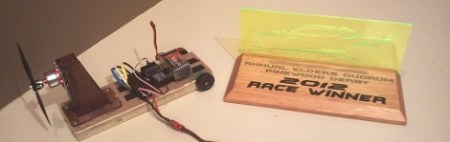
A standard Pinewood Derby asks what you can accomplish with a block of pine, four plastic wheels, four nail-like axles, and a five-ounce limit. A no holds barred Pinewood Derby asks a more mischievous question: What happens when the engineering rulebook loosens its necktie?
The answer is not simply “buy exotic parts and add more weight.” Winning an unlimited or outlaw Pinewood Derby requires careful interpretation of the rules, disciplined testing, precise alignment, and a car designed for the actual track. Expensive hardware cannot rescue a vehicle that wiggles down the lane like a shopping cart with one rebellious wheel.
Important note: “No holds barred” should always mean every modification permitted by the written class rules. It does not mean ignoring venue restrictions, inspection requirements, or basic safety. Pressurized-gas devices, pyrotechnics, combustion systems, exposed batteries, and powered launch mechanisms should never be used unless organizers expressly authorize them and provide appropriate safety procedures. Many classes labeled “unlimited” still require gravity-powered, free-wheeling cars with stationary weights.
Understand What “No Holds Barred” Actually Means
Pinewood Derby rules are usually established by the local pack, district, church, school, company, or racing organization. There is no single rule sheet that governs every event. Traditional specifications often include a maximum length of 7 inches, a maximum width of 2 3/4 inches, a maximum weight of 5 ounces, at least 1 3/4 inches between the wheels, and approximately 3/8 inch of clearance beneath the body. Your event may change any of those numbers.
An unlimited class might permit aftermarket wheels, bent axles, extended wheelbases, three-wheel contact, precision-machined components, or alternative body materials. Another event may call its division “unlimited” while still banning bearings, liquid lubricants, moving weights, motors, suspension systems, and starting devices.
Create a rule matrix before designing the car
Turn the event rules into a simple checklist covering the following categories:
- Maximum length, width, height, weight, and wheelbase
- Minimum ground clearance and distance between wheels
- Approved body, axle, wheel, bearing, and lubricant materials
- Whether three-wheel contact or rail riding is permitted
- Whether weights must remain fixed
- How the starting gate contacts the nose
- Whether the official scale is final
- When lubrication and repairs are allowed
This step is less glamorous than ordering polished titanium parts, but it prevents the slowest performance modification ever invented: disqualification.
Build Around the Physics of the Track
A gravity-powered Pinewood Derby car begins with gravitational potential energy. In simplified form, that energy is represented by mgh: mass multiplied by gravitational acceleration and vertical height. During the run, the car converts that stored energy into forward motion and wheel rotation while friction, vibration, aerodynamic drag, and impacts with the center rail consume part of it.
Your mission is therefore straightforward: begin with as much usable energy as the rules allow and waste as little of it as possible. Straightforward does not mean easy. A chef’s mission is also “make dinner,” yet somehow the kitchen still ends up looking like a flour tornado passed through town.
Place the center of mass rearward, but not recklessly
On a typical track with a sloped starting section, a rear-weighted car places its center of mass slightly farther uphill and higher than a comparable front-weighted car. This can provide a small potential-energy advantage. Dense materials such as tungsten make it easier to concentrate weight in a compact area near the rear axle while keeping the body low and narrow.
For many conventional cars, a balance point roughly 3/4 to 1 1/4 inches in front of the rear axle offers a useful compromise between speed and stability. That is a starting range, not a sacred commandment carved into a pine tablet. A smooth aluminum track may tolerate a more aggressive rear bias, while a rough or poorly joined track may punish it with bouncing, fishtailing, or derailment.
Test stability before moving the center of mass farther back. The fastest theoretical setup is worthless when the car exits the lane and attempts to qualify for aviation.
Keep the mass low
Mounting weight low in the body reduces the tendency to rock from side to side. It also helps the car remain composed during the transition from the slope to the flat. Drill weight pockets into the underside or rear section, secure every component mechanically or with a dependable adhesive, and cover exposed cavities if required by the rules.
Avoid loose shot, sliding weights, or casually taped coins. Moving mass can destabilize the car, and many race rules specifically prohibit it. Tape also has the unfortunate habit of becoming independent at the exact moment an inspector is watching.
Reduce Rotational Weight When the Rules Allow It
A moving Pinewood Derby car must accelerate both its body and its spinning wheels. Energy used to rotate the wheels is energy temporarily unavailable for forward acceleration. Reducing wheel massespecially material near the outer rimcan improve acceleration because rim weight contributes strongly to rotational inertia.
This is one reason precision lightweight wheels can be valuable in an unlimited Pinewood Derby. However, wheels that are extremely thin may warp, wobble, crack, or lose consistency. The goal is not to create the world’s most delicate plastic onion ring. Choose wheels that are light, round, balanced, and strong enough to survive repeated runs.
Inspect every wheel instead of trusting the package
Mount each wheel on a straight test axle and spin it slowly. Watch the tread and inner edge from several angles. Reject wheels that move noticeably from side to side, show an irregular bore, or stop abruptly in the same position. If machining is permitted, use matched wheels with verified dimensions rather than four parts that merely share a mailing envelope.
Confirm that the wheel tread and inner hub surfaces are smooth. A wheel that contacts the car body, axle head, and center rail at random turns a precision racer into a tiny friction convention.
Give the Axles an Unreasonably Good Finish
Axle preparation is one of the highest-value improvements in Pinewood Derby racing. Stock axles may contain burrs beneath the head, stamped ridges, rough surfaces, or slight bends. These defects scrape against the wheel bore and convert useful energy into heat.
If your rules permit axle modification, begin by selecting the straightest pieces. Remove obvious burrs carefully with a fine file, then progress through increasingly fine abrasive papers or polishing compounds. The finished contact surface should be smooth and reflective without being reduced so aggressively that the axle becomes undersized or fragile.
Do not confuse polishing with excavation
Coarse sanding can remove too much material, create flat spots, or change the axle diameter. Work gradually, inspect frequently, and protect the portion of the axle that must fit securely into the body. A polished axle should look refined, not as though it survived an argument with a bench grinder.
Where legal, precision axles can provide better straightness and consistency than modified stock nails. Match axle diameter to the wheel bore with enough clearance for free rotation but not so much that the wheel rattles and changes direction under load.
Make Alignment the Centerpiece of the Build
A straight, stable car usually beats a more exotic car that repeatedly strikes the center rail. Each impact changes the vehicle’s direction, flexes the wheels, and wastes speed through friction and vibration. Alignment is therefore not a final adjustment performed five minutes before bedtime. It is a primary design system.
Use three-wheel contact when permitted
Many competitive cars intentionally raise one front wheel so only three wheels touch the track. This eliminates the rolling resistance and alignment problems associated with a fourth loaded wheel. The remaining front wheel becomes the dominant steering wheel.
The rear wheels should track cleanly without migrating toward the body or contacting the center guide. Slight axle cant can encourage the rear wheels to move outward toward their axle heads, helping keep them away from the car body and center rail.
Consider a controlled rail-riding setup
A properly tuned rail rider gently steers the dominant front wheel toward the center guide while keeping the rear wheels off it. Instead of wandering unpredictably from side to side, the car makes one controlled contact and follows the rail with minimal correction.
Begin with a mild steering input, such as approximately one inch of movement toward the rail over four feet of travel, and adjust based on testing. A very rear-heavy car may need slightly more steering for stability. Too little can produce oscillation; too much creates continuous scrubbing. The ideal setting is the smallest reliable amount that keeps the car composed on the actual track.
Some rules prohibit bent axles, three-wheel configurations, or intentional rail riding. Once again, the rule sheet is not decorative literature. Read it.
Choose Lubrication for the Class, Not the Advertisement
Dry graphite is commonly required in traditional and many unlimited Pinewood Derby classes. It reduces friction between the axle and wheel bore without leaving liquid residue on the track. Apply a modest amount to the bore and axle, spin the wheel repeatedly, and cycle the wheel inward and outward to distribute the lubricant.
Graphite often performs better after a short break-in period. Complete that process before inspection if the rules prohibit later lubrication. Excess powder scattered across the tread can reduce consistency, so clean the outer rolling surface before racing.
If an outlaw class permits oil, use a lubricant specifically compatible with the wheel and axle materials. More is not automatically better. Excess liquid can migrate onto the tread, attract debris, or produce inconsistent behavior. Never mix lubricant systems without testing; a mysterious graphite-and-oil paste is rarely the technological breakthrough its creator hopes it will be.
Design a Body That Is Light, Rigid, and Track-Friendly
A thin wedge, plank, or low-profile body generally provides enough rigidity while leaving room for concentrated ballast. Reducing frontal area can also lower aerodynamic drag, although axle friction, wheel quality, and alignment usually produce larger gains on a short Pinewood Derby track.
Keep the body symmetrical and avoid decorative features that interfere with neighboring lanes, the timing bridge, or the starting mechanism. A dramatic pointed nose may look fast while failing to rest correctly against the starting pin. A narrow, flat contact area is usually more reliable.
Do not remove so much wood that the chassis flexes
An ultrathin body can twist when the axles are installed or when the car enters the track transition. Chassis flex changes wheel alignment and can erase the advantage of lightweight construction. Reinforce vulnerable areas around axle holes and weight pockets while keeping unnecessary mass out of the front.
Remember that cosmetic paint, clear coat, decals, and accessories add weight. Finish the body before making the final weight adjustment. Otherwise, your beautiful paint job may force an emergency date with a drill press.
Test Like an Engineer Instead of Guessing Like a Magician
Build a repeatable test lane or obtain practice time on a track similar to the race setup. Even an eight- to twelve-foot inclined board can reveal alignment defects, wheel migration, rubbing, and instability. A longer track with an electronic timer provides better performance data, but a smartphone capable of slow-motion video can still expose wobble and rail impacts.
Change only one variable at a time
Run a baseline configuration several times and record every result. Then change one itemsteering angle, lubricant, wheel set, ballast location, or axle configurationand repeat the same number of runs. Six to ten runs per setup can help separate a genuine improvement from random variation.
Track both average speed and consistency. A car that occasionally produces a brilliant time but frequently wobbles may lose a multi-heat event to a slightly slower vehicle that repeats its performance. In racing, reliability is speed that remembered to show up.
Build for the actual race track
Track design changes the optimal setup. A long, steep slope rewards potential energy and quick acceleration. A long flat section emphasizes low friction and stable alignment. Rough joints demand additional stability. A short stopping section may make an extremely heavy outlaw car difficult or unsafe to catch.
Ask organizers about the track material, lane width, center rail, starting gate, timing system, slope-to-flat transition, and shutdown area. These details are more useful than copying a champion design built for an entirely different track.
Prepare for Inspection and Race Day
If the class has a five-ounce limit, aim slightly below it on your own scale and include an approved method for small adjustments. Differences between household scales and the official race scale are common. Removable threaded trim weights are more professional than arriving with a pocketful of coins and the optimism of a pirate.
Bring a small pit kit containing the written rules, approved lubricant, spare axles, spare wheels, a screwdriver, a small file, fine abrasive paper, adhesive, a scale, and legal adjustment weights. Do not modify the car after inspection unless race officials allow it.
Before check-in, verify:
- The car fits within every dimensional limit
- The nose rests correctly against the starting pin
- The wheels clear the body and center guide
- All weights and decorations are firmly secured
- The car rolls smoothly without visible wobble
- No lubricant is present on the tread
- The alignment settings have not shifted during transport
Transport the car in a padded box that prevents pressure on the wheels and axles. A perfectly aligned racer should not spend the drive to the event sliding beneath a soccer cleat and a half-empty juice box.
Experiences and Lessons From Competitive Pinewood Derby Builds
The most useful Pinewood Derby experiences rarely begin with a flawless victory. They begin with a car that looks unbeatable on the workbench and then reveals, under timed testing, that one rear wheel has been rubbing the body during the entire run.
A common workshop scenario involves two unlimited-class cars. The first uses expensive lightweight wheels, precision axles, a dramatic aerodynamic body, and aggressively rearward tungsten ballast. The second uses less exotic parts but receives several hours of careful axle preparation and alignment. During early tests, the glamorous first car records one outstanding run followed by several mediocre ones. Slow-motion video reveals that it oscillates across the lane and repeatedly hits the center rail. The simpler car travels quietly and produces nearly identical times on every run.
After the first car is adjusted into a mild rail-riding configuration, it becomes both faster and more consistent. The lesson is difficult to ignore: premium components create potential, but alignment converts that potential into results.
Another recurring experience concerns center-of-mass placement. Builders often move weight farther and farther backward because rear weight is associated with speed. Initial tests may improve until the balance point crosses the car’s stability threshold. The front becomes too light, the car bounces during the transition, and the rear swings sideways. Moving a small amount of ballast forward can produce a faster overall result even though the theoretical potential-energy advantage decreases. Controlled speed beats dramatic instability.
Lubrication provides a similar lesson. A builder may apply a heroic cloud of graphite immediately before a timed run and expect an instant improvement. Instead, the first passes are inconsistent because the powder has not been distributed through the wheel bores. After the wheels are spun, cycled, and cleaned, the times stabilize. Preparation matters more than spectacle, although graphite-covered fingers do provide convincing evidence that serious engineering occurred.
Rule interpretation can decide the competition before the starting gate drops. One car may be technically brilliant but fail inspection because its bearings, wheel dimensions, liquid lubricant, or movable ballast violate a small paragraph in the class rules. Experienced builders read the rules twice, identify ambiguous language, and ask organizers for clarification in writing. They design around confirmed permissions rather than assuming that “unlimited” means “anything found in a machine shop.”
Testing logs also become surprisingly valuable. Memory tends to remember the fastest run and forget the five slower ones that followed. A written record shows whether a change improved the average, reduced variation, or merely produced one lucky result. Builders who record axle settings, wheel combinations, ballast positions, lubrication cycles, and timed runs can return to the best configuration instead of trying to reconstruct it at midnight.
Finally, competitive builds repeatedly demonstrate that a quiet car is often a fast car. Rattling, clicking, oscillation, and visible wheel movement are signs that energy is being lost. A well-prepared car may look almost uneventful as it travels down the lane: no violent corrections, no bouncing, and no theatrical collision with the rail. Then the timer displays the winning number. In Pinewood Derby racing, boring motion can produce extremely exciting results.
Conclusion: Win the Race Before the Gate Opens
Winning a no holds barred Pinewood Derby is not about attaching every legal upgrade to a wooden body and hoping the collection becomes fast. It is about creating a balanced system in which the body, ballast, wheels, axles, lubrication, and alignment work together.
Begin with the exact rules. Concentrate legal weight low and toward the rear while preserving stability. Reduce wheel inertia if permitted, polish every friction surface, and treat alignment as the heart of the project. Test one variable at a time, build for the actual track, and prepare carefully for inspection.
The winning car is often not the wildest machine in the room. It is the one whose builder eliminated dozens of tiny energy losses that everyone else dismissed as unimportant. Pinewood Derby races are decided in fractions of a second, and fractions of a second are where patience goes to collect trophies.