Sometimes art arrives wearing a beret, carrying a leather portfolio, and speaking in confident gallery-wall vocabulary. Other times, it appears in the bottom of a coffee cup, inside a paint spill, across a rusty door, or on a foggy window that looks like it was designed by a moody landscape painter with excellent lighting instincts. That second kind is accidental art, and honestly, it has no business being so good.
The charm of accidental art is that it sneaks up on us. Nobody planned the perfect splash of black paint that suddenly resembles a leaping deer. Nobody trained frost to sketch delicate feathers on glass. Nobody asked the last sip of coffee to become a tiny forest silhouette. Yet these small visual miracles happen constantly, turning ordinary life into an unlicensed museum where admission is free and the curator is chaos.
The popular idea behind “When Accidental Art Is Better Than Your Actual Art (202 Pics)” is simple: people notice beautiful, strange, or hilarious images that were created unintentionally and share them because they feel almost impossible. The result is a celebration of unintentional masterpieces, where luck, physics, human perception, and everyday messes join forces like a suspiciously talented art collective.
What Is Accidental Art?
Accidental art is visual beauty created without deliberate artistic planning. It might come from spilled paint, cracked pavement, shadows, clouds, mold, water stains, coffee rings, melted wax, peeling posters, rust, smoke, ice, or a perfectly timed reflection. The key ingredient is surprise. The image was not designed to be art, but the viewer recognizes it as art anyway.
That recognition matters. A stain is only a stain until someone sees a mountain range in it. A splash is only a splash until it becomes a deer, dragon, galaxy, or tiny haunted Victorian mansion. Accidental art happens in the gap between the world making random marks and the human brain saying, “Wait a minute, that’s actually kind of brilliant.”
Accidental Art vs. Found Object Art
Accidental art is closely related to found object art, but they are not exactly the same. Found object art usually involves an artist choosing an existing object and placing it in a new context. Accidental art, on the other hand, often begins with no artist at all. It is discovered rather than constructed. The “artist” may be gravity, weather, time, corrosion, heat, traffic, a distracted barista, or your cat knocking over watercolor supplies at 2 a.m.
Still, the two ideas overlap. Both challenge the old-fashioned belief that art must come from expensive materials, formal training, or a painfully serious studio atmosphere. Sometimes the masterpiece is already there. Someone just has to notice it before it gets wiped off the counter.
Why Accidental Art Feels So Magical
Accidental art delights us because it seems to break the rules. We expect beauty to come from intention. We expect composition to require planning, color theory, and at least one dramatic sigh. When a puddle reflection accidentally looks like a portal to another dimension, it feels like the universe briefly borrowed an art degree.
There is also a democratic thrill to it. You do not need to be a museum curator to appreciate a coffee stain that resembles a misty forest. You do not need to know the difference between Cubism and Surrealism to enjoy a paint spill that looks like a galloping horse. Accidental art invites everyone in, including people who normally walk through galleries wondering whether they are allowed to say, “I don’t get it.”
The Brain Loves Patterns
One big reason accidental art works is pareidolia, the human tendency to see meaningful images in random patterns. That is why people see faces in electrical outlets, animals in clouds, landscapes in marble, or tiny screaming ghosts in burnt toast. Our brains are powerful pattern-making machines. They do not merely record the world; they interpret it, edit it, and sometimes add a mustache.
This is not a flaw. Pattern recognition helps humans understand their environment quickly. In daily life, it allows us to identify faces, read expressions, and spot familiar shapes in complicated scenes. In art, it lets us transform stains, textures, and shadows into stories. A random mark becomes interesting because our minds complete the picture.
The “202 Pics” Appeal: Tiny Accidents, Big Reactions
A large collection of accidental art works because every picture offers a tiny surprise. One image may show paint before mixing, swirling like a cosmic nebula trapped in a hardware-store can. Another may show a black paint drop that resembles a graceful animal. Another might show coffee residue forming a forest line so atmospheric it looks ready for a fantasy paperback cover.
The best examples usually share three qualities: a recognizable shape, strong contrast, and emotional timing. A dark stain on a light background is easier to read. A crack that resembles lightning feels dramatic. Frost that looks like feathers feels delicate. A rust pattern that resembles a map feels mysterious, as if your old shed is quietly planning a voyage.
Common Types of Accidental Masterpieces
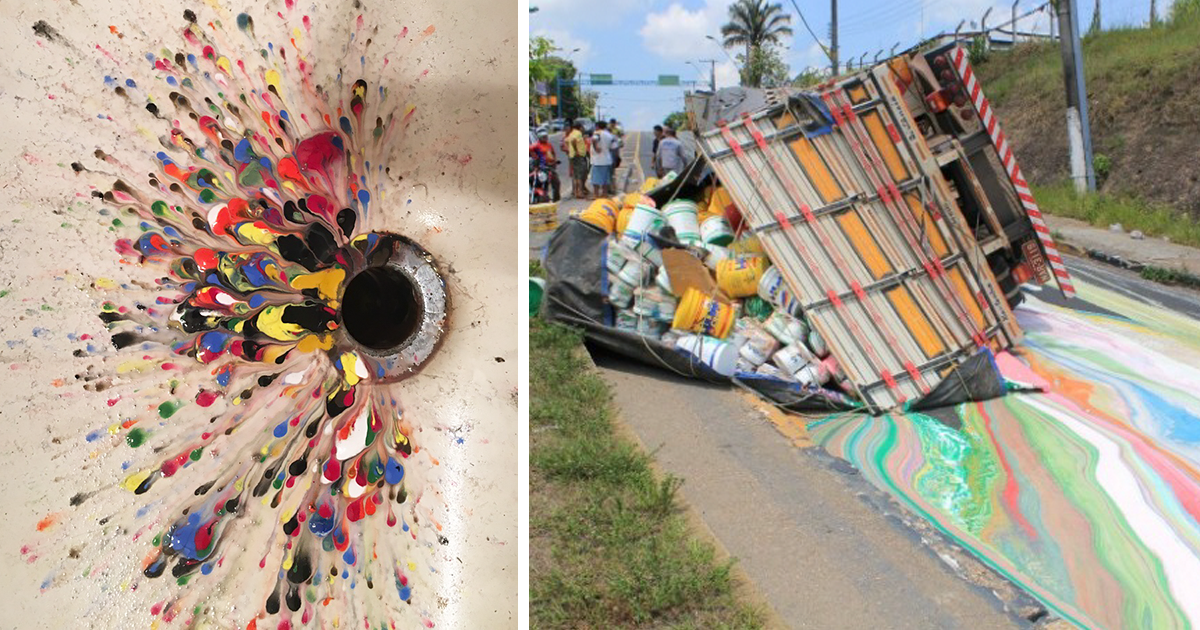
Paint accidents are classics because paint already behaves like art material. Before colors are mixed, they can create marbled patterns, galaxies, waves, flowers, or abstract landscapes. A single drip can spread in a way that suggests motion, anatomy, or a creature mid-leap.
Coffee and food marks are another favorite. Coffee rings become moons. Latte foam becomes clouds. Burn marks become faces. Sauce splatters become modern art, although explaining that to the person cleaning the kitchen may be less successful.
Weather-made art may be the most elegant category. Frost, snow, rain, fog, and sunlight can create images that look impossibly intentional. Ice forms botanical patterns on glass. Rainwater turns pavement into reflective cityscapes. Sunlight through blinds paints temporary stripes across a wall, and suddenly your apartment is doing minimalism better than you are.
Decay and texture create some of the richest accidental images. Peeling paint, rust, cracked stone, worn wood, and old posters can develop layers that resemble abstract paintings. Time becomes the brush. Neglect becomes the medium. The result often looks expensive, which is mildly insulting to everyone who has ever paid for art supplies.
Accidental Art Has Serious Art-History Relatives
The funny thing about accidental art is that it may look like internet fun, but its spirit has deep roots in modern art. Many major art movements explored chance, randomness, found materials, and the unconscious long before people started photographing suspiciously artistic stains with smartphones.
Surrealism and Automatism
Surrealist artists were fascinated by dreams, the unconscious mind, and images that seemed to emerge without strict rational control. Automatism encouraged artists to draw or write with reduced conscious direction, allowing unexpected forms to appear. In other words, Surrealists understood that the mind can produce strange and powerful images when it stops trying to behave at the dinner table.
Accidental art often feels Surrealist because it reveals the uncanny inside the ordinary. A stain becomes an animal. A shadow becomes a figure. A cracked wall becomes a mountain range. It suggests that reality has a secret imagination of its own.
Dada, Readymades, and the Power of Choice
Dada and the readymade tradition challenged the idea that art must be handmade or traditionally beautiful. When an ordinary object is selected, titled, and reframed, viewers are asked to think differently about value, authorship, and meaning. That same shift happens when someone photographs a random spill and calls it beautiful. The object did not change. The way we look at it did.
Accidental art depends on this act of noticing. A puddle is not transformed by magic. It is transformed by attention. The viewer becomes part artist, part curator, and part excited friend saying, “No, seriously, come look at this before it dries.”
Abstract Expressionism and Controlled Chaos
Abstract Expressionist painters helped make splashes, drips, gestures, and material behavior central to modern painting. Jackson Pollock’s drip technique, for example, made the movement of paint itself part of the work. While his paintings were not random in a simple sense, they embraced fluid motion, chance effects, and physical process.
That is why a beautiful spill can remind us of serious abstract art. The line between accident and intention is not always clean. Paint pools, bleeds, streaks, and dries according to physical forces. Artists may guide those forces, but they do not fully control them. Accidental art is what happens when the forces skip the artist and go straight to the wall.
Is Accidental Art Actually Better Than “Real” Art?
The title is playful, of course. Accidental art is not automatically better than intentional art. A stunning photo of a paint spill does not erase centuries of drawing, sculpture, design, craft, and human imagination. But accidental art can feel better in a specific way: it is fresh, surprising, and free from overthinking.
Actual art can suffer from pressure. The artist wants meaning, polish, originality, and maybe a comment section that does not behave like a raccoon in a keyboard factory. Accidental art has none of that anxiety. It simply appears. It has no résumé, no artist statement, no gallery lighting, and no fear of being misunderstood. That confidence is hard to beat.
The Beauty of Not Trying Too Hard
One reason accidental art is so appealing is that it reminds us how attractive imperfection can be. The modern internet is full of polished images, filtered faces, curated rooms, and carefully arranged “casual” moments that took forty-six attempts. Accidental art cuts through that. It is messy, temporary, and honest.
There is comfort in seeing beauty emerge from disorder. It suggests that not every mistake is a failure. Sometimes the spilled ink looks better than the planned sketch. Sometimes the leftover coffee makes the moodiest forest you have ever seen. Sometimes the cracked sidewalk has more personality than your entire Pinterest board.
How to Spot Accidental Art in Everyday Life
The easiest way to find accidental art is to slow down and look at surfaces. Walls, floors, windows, tables, streets, sinks, and old metal objects are full of accidental compositions. Look for contrast, repetition, symmetry, unusual textures, and shapes that remind you of something else.
Lighting is especially important. A boring corner at noon may become dramatic at sunset. A puddle may look ordinary until it reflects neon signs. A dusty car window may become a canvas when someone half-cleans it. Accidental art often lasts only a few minutes, which is why the camera roll has become the modern sketchbook.
Try the “Three-Second Museum Test”
When you notice a strange mark or texture, ask yourself: Would I stop for three seconds if this were framed in a gallery? If the answer is yes, take the photo. You do not need to prove it is a masterpiece. The point is to train your eye to recognize visual interest in ordinary places.
After a while, you may start seeing accidental compositions everywhere: the marble pattern in a countertop, the galaxy inside a soap bubble, the face on a power outlet, the storm cloud in a dirty windshield. Congratulations. Your brain has joined the unpaid staff of the Museum of Weird Little Things.
Why Accidental Art Performs Well Online
Accidental art is perfect for the internet because it is visual, quick to understand, and easy to share. A good accidental image produces an instant reaction: “How is that real?” “That looks like a painting.” “I see a dragon.” “Why is my breakfast more talented than me?”
It also invites participation. People love comparing what they see in the same image. One viewer sees a fox; another sees a flame; another sees a wizard having a difficult Tuesday. This makes accidental art interactive without needing a complicated explanation.
Collections of accidental art also create momentum. One image is amusing. Two are interesting. Two hundred become a pattern of their own, proving that the world is constantly generating visual jokes, optical poems, and tiny masterpieces for anyone paying attention.
Experience Section: What Accidental Art Teaches Us About Creativity
Spending time with accidental art changes the way you think about creativity. At first, you may treat these images as lucky one-offs, little visual coincidences that make you smile and move on. But after seeing enough of them, a deeper lesson appears: creativity is not only about making things from nothing. It is also about recognizing what is already there.
Many people believe they are “not artistic” because they cannot draw a realistic hand, paint a portrait, or sculpt anything more advanced than a suspicious potato. Accidental art gently argues against that. It shows that an artistic eye is not limited to technical skill. It includes curiosity, patience, humor, and the ability to notice beauty before it disappears.
There is also a useful lesson for anyone who makes intentional art. Mistakes are not always enemies. A drip can create movement. A smudge can soften a scene. A torn edge can add energy. A color mixture you did not plan can become the best part of the piece. Many artists learn to collaborate with accidents rather than immediately correcting them. The trick is knowing when a mistake is truly a mistake and when it is your artwork trying to become more interesting without asking permission.
In everyday life, accidental art can make routine moments feel more alive. Waiting for coffee becomes a chance to study foam patterns. Walking past an old wall becomes a small visual adventure. Cleaning up spilled paint becomes slightly less tragic when you notice that the puddle looks like a storm over the Atlantic. Even chores can become more tolerable when the soap bubbles look like tiny planets.
Personally, the best way to experience accidental art is not to hunt too aggressively for it. If you force the search, every stain starts auditioning for greatness, and that can get exhausting. Instead, keep a relaxed eye open. Let the world surprise you. The most memorable accidental images usually appear when you are not expecting them: a sunset reflected in a cracked phone screen, a leaf shadow shaped like a bird, a rain trail on glass that looks like a mountain path.
Accidental art also teaches humility. Human beings love to think we are in charge of beauty. We build museums, write reviews, frame canvases, and debate whether a banana taped to a wall is genius, nonsense, or lunch. Then nature, gravity, and spilled coffee casually produce something gorgeous in five seconds. That does not make human art less meaningful. It makes the world feel more generous.
The real gift of accidental art is attention. It asks us to look twice. It reminds us that beauty is not always polished, planned, or expensive. Sometimes it is temporary, weird, messy, and sitting on the kitchen counter next to a paper towel. Sometimes the best gallery is the ordinary world, and the best opening night is the moment you notice.
Conclusion: The World Is Making Art Behind Your Back
“When Accidental Art Is Better Than Your Actual Art (202 Pics)” is funny because it touches a real truth: beauty often appears when nobody is trying to manufacture it. Paint spills, coffee stains, frost patterns, rust marks, shadows, clouds, and cracked walls can all become accidental masterpieces when seen from the right angle.
These images work because they combine chance with perception. The world creates random forms, and the human brain turns them into meaning. That partnership is ancient, playful, and endlessly entertaining. It connects internet humor with serious ideas from Surrealism, found object art, Abstract Expressionism, and psychology.
So the next time your art project goes sideways, do not panic immediately. Step back. Squint a little. Rotate the paper. Take a photo. You may not have ruined anything. You may have accidentally hired chaos as your assistant, and chaos, when properly supervised, has surprisingly good taste.