If your attic could talk, it would probably say, “Please stop storing broken lamps up here and start paying attention to the insulation.” Fair request. Attic insulation is one of the least glamorous home upgrades, but it can make a major difference in comfort, energy efficiency, indoor air quality, and whether your upstairs bedroom feels like a toaster oven in July.
The tricky part is that there is no single “best attic insulation” for every home. Fiberglass batts, blown-in cellulose, loose-fill fiberglass, spray foam, mineral wool, rigid foam boards, and radiant barriers all have strengths, weaknesses, and ideal use cases. Some are budget-friendly. Some are excellent for air sealing. Some handle fire better. Some should be installed only by pros unless your hobbies include regretting things while wearing disposable coveralls.
This guide breaks down the most common types of attic insulation, their pros and cons, where they work best, and what homeowners should consider before choosing a material. We will keep the science practical, the advice honest, and the attic jokes lightly dustedunlike your actual attic.
Why Attic Insulation Matters
Attic insulation slows heat transfer between your living space and the attic. In winter, it helps keep heated air from escaping upward. In summer, it helps reduce heat gain from the roof. The key measurement is R-value, which describes how well insulation resists heat flow. The higher the R-value, the better the insulating performance, assuming the material is installed correctly.
That last part matters. Poorly installed insulation is like a winter coat with the zipper open: technically present, not especially useful. Gaps, compression, moisture, blocked ventilation, and air leaks can reduce performance dramatically. Before adding more attic insulation, homeowners should usually address air sealing around plumbing penetrations, wiring holes, recessed lights, attic hatches, chimneys, and top plates.
Before Choosing Attic Insulation: The Big Factors
Climate Zone
A home in Minnesota needs a different insulation strategy than a home in Florida. Colder climates typically benefit from higher attic R-values, while hot climates may also benefit from radiant barriers and careful ventilation. Local energy codes and utility programs may recommend specific R-value ranges for ceilings and attics.
Attic Type
Most homes have a vented attic, where insulation sits on the attic floor and outdoor air moves through soffit and ridge or roof vents. Some homes have an unvented conditioned attic, where insulation is applied along the roof deck, often with spray foam or a carefully designed hybrid system. The wrong material in the wrong assembly can invite moisture problems, so this is not a place for “I saw a guy do it online” engineering.
Air Sealing
Fiberglass, cellulose, and mineral wool are thermal insulation materials, but they do not automatically stop air leaks. Air sealing should come first. Otherwise, warm, moist indoor air can sneak into the attic, condense on cold surfaces, and create mold or wood decay problems. Translation: your attic can turn into a biology experiment, and not the fun school-science-fair kind.
Moisture and Ventilation
Attic insulation must work with ventilation, not against it. In a vented attic, soffit vents should remain open, baffles should preserve airflow, and bathroom fans should vent outdoorsnot into the attic. Blowing warm shower air into an attic is basically sending mold an engraved invitation.
1. Fiberglass Batt Insulation
Fiberglass batts are the pink, yellow, or white blanket-like insulation rolls many homeowners recognize. They are made from fine glass fibers and are commonly installed between attic joists.
Pros of Fiberglass Batts
Affordable and widely available: Fiberglass batts are easy to find at home improvement stores and are often one of the lower-cost attic insulation options.
DIY-friendly: Homeowners with basic safety gear can install batts in accessible attics. They are pre-cut or rolled, so installation is relatively straightforward in open spaces.
Noncombustible material: Fiberglass itself does not burn easily, although facings such as kraft paper may be combustible and must be installed according to code.
Good for simple attic layouts: In attics with standard joist spacing and few obstructions, batts can perform well when carefully fitted.
Cons of Fiberglass Batts
Gaps reduce performance: Batts must be cut and fitted around pipes, wires, framing, and odd corners. Even small gaps can reduce effectiveness.
Easy to compress: Compressing fiberglass lowers its R-value. If you jam R-30 insulation into a space designed for less thickness, you do not magically get better performance; you get expensive fluff with an attitude problem.
Not an air barrier: Fiberglass slows heat flow but does not stop air movement. Air sealing must be handled separately.
Can irritate skin and lungs during installation: Installers should wear gloves, long sleeves, eye protection, and a mask or respirator.
Best Use
Fiberglass batts are best for accessible attics with regular framing and homeowners who want a budget-friendly option. They are less ideal for irregular, cluttered, or hard-to-reach attic spaces.
2. Loose-Fill Fiberglass Insulation
Loose-fill fiberglass is blown into the attic using a machine. Instead of coming in blanket form, it consists of small fluffy particles that settle across the attic floor.
Pros of Loose-Fill Fiberglass
Good coverage: Blown fiberglass can cover uneven joists, odd corners, and existing insulation more easily than batts.
Lightweight: Fiberglass is lighter than cellulose, which can be helpful in older homes where ceiling structure is a concern.
Moisture-resistant fibers: Fiberglass does not absorb moisture the same way cellulose can, though moisture in an attic is still a serious issue.
Works well as a top-up layer: Loose-fill fiberglass can often be blown over existing attic insulation to increase R-value.
Cons of Loose-Fill Fiberglass
Requires equipment: Installation typically requires a blowing machine. Some stores rent machines with material purchases, but it is still more involved than rolling out batts.
Air movement can reduce performance: In windy attics, loose fiberglass can be affected by air movement if baffles and air sealing are poor.
Settling and uneven depth: Like most loose-fill products, it must be installed to the correct depth and coverage. A thin area near the attic hatch can become a comfort weak spot.
Best Use
Loose-fill fiberglass is a strong choice for topping off existing insulation, covering irregular attic floors, and improving attic R-value without removing older insulation that is still clean and dry.
3. Cellulose Insulation
Cellulose insulation is usually made from recycled paper products treated with fire-retardant chemicals. It is most often blown into attics as loose-fill insulation.
Pros of Cellulose
Excellent coverage: Cellulose settles into cracks and gaps better than batts, making it useful in older attics with lots of framing interruptions.
Good thermal performance: Cellulose generally provides solid R-value per inch and can reduce convection within the insulation layer.
Sound dampening: Its density helps reduce noise transfer. Your attic may not become a recording studio, but it can become less echo-prone.
Recycled content: Cellulose is appealing to homeowners who prioritize recycled building materials.
Cons of Cellulose
Heavier than fiberglass: Cellulose adds more weight to the ceiling assembly, so very old or fragile structures may need evaluation.
Can absorb moisture: If roof leaks, bath fan leaks, or condensation problems exist, cellulose can hold moisture and lose performance.
Settling must be considered: Installers need to account for settled depth so the final R-value remains adequate over time.
Dusty installation: Blown cellulose can be messy, and protective equipment is necessary.
Best Use
Cellulose is excellent for older homes, irregular attic floors, and homeowners looking for a dense, recycled, blown-in option. It is not ideal in attics with unresolved moisture problems.
4. Spray Foam Insulation
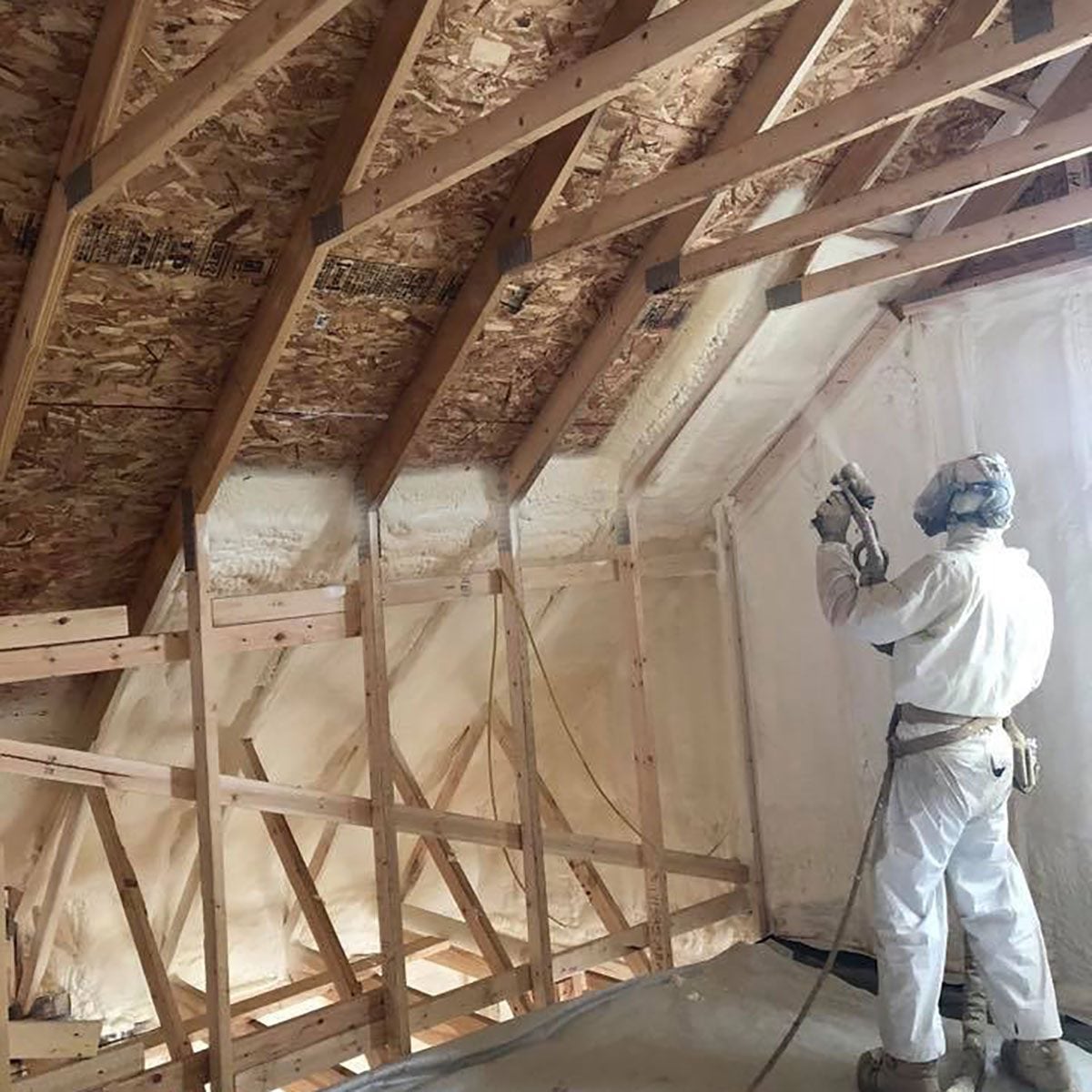
Spray polyurethane foam is applied as a liquid that expands and hardens. It comes mainly in two forms: open-cell spray foam and closed-cell spray foam. In attics, spray foam is often applied to the underside of the roof deck to create an unvented conditioned attic, though it can also be used selectively for air sealing.
Pros of Spray Foam
Excellent air sealing: Spray foam can seal cracks and gaps while insulating, making it powerful for reducing air leakage.
High performance per inch: Closed-cell spray foam offers a high R-value per inch, useful when space is limited.
Can bring ducts into conditioned space: If HVAC equipment or ductwork is located in the attic, insulating the roof deck may reduce energy losses.
Closed-cell foam adds moisture resistance: Closed-cell foam can act as a vapor retarder and may help control condensation when used correctly.
Cons of Spray Foam
Expensive: Spray foam is usually one of the highest-cost attic insulation options.
Professional installation is strongly recommended: Poor mixing, wrong thickness, bad ventilation, or improper application can create odor, performance, or health concerns.
Can hide roof leaks: Foam applied to the roof deck may conceal small leaks until damage becomes more advanced.
Safety matters: During installation, spray foam chemicals require careful handling, ventilation, and protective equipment. Occupants should follow manufacturer and contractor guidance for re-entry.
Open-Cell vs. Closed-Cell Spray Foam
Open-cell foam is lighter, softer, and usually less expensive. It provides air sealing but is more vapor-permeable. Closed-cell foam is denser, more expensive, and provides higher R-value per inch along with better moisture resistance. In colder climates or complex roof assemblies, closed-cell foam is often favored because moisture control becomes more demanding.
Best Use
Spray foam is best for homes with attic HVAC systems, complex air leakage problems, or roof-deck insulation designs created by qualified professionals. It is not the cheapest solution, and it is not magic in a candespite what enthusiastic sales pitches may suggest.
5. Mineral Wool Insulation
Mineral wool, also called rock wool or stone wool, is made from natural rock or industrial slag spun into fibers. It is available as batts and loose-fill products, though batts are more common in residential projects.
Pros of Mineral Wool
Fire resistance: Mineral wool handles high temperatures extremely well, making it attractive where fire performance matters.
Water resistance: It does not absorb water easily and can retain shape better than some materials when exposed to minor moisture.
Sound control: Its density helps reduce sound transmission.
Firm batts: Mineral wool batts are often easier to cut precisely and friction-fit than floppy fiberglass batts.
Cons of Mineral Wool
Higher cost: Mineral wool usually costs more than fiberglass.
Less availability: It may not be as easy to find in all sizes or R-values.
Still needs careful installation: Gaps, compression, and missing air sealing can reduce performance.
Best Use
Mineral wool is a strong choice for homeowners who want fire resistance, sound control, and durable batt insulation. It is especially useful in attic areas where precise fitting is important.
6. Rigid Foam Board Insulation
Rigid foam boards include materials such as polyisocyanurate, extruded polystyrene, and expanded polystyrene. In attics, rigid foam is more often used in specialized roof assemblies, attic access covers, knee walls, or above roof sheathing rather than simply laid across the attic floor.
Pros of Rigid Foam Board
High R-value per inch: Some foam boards provide strong thermal resistance with relatively little thickness.
Useful for air sealing details: Foam board can be cut and sealed with compatible tapes or foams to create attic hatch covers, knee wall backing, or insulation dams.
Good for continuous insulation: When used above roof decking or on walls, rigid foam can reduce thermal bridging through framing.
Cons of Rigid Foam Board
Not simple for open attic floors: Foam board is awkward around joists, wires, ducts, and uneven surfaces.
Must be detailed carefully: Seams, edges, and penetrations need sealing to perform well.
Code requirements: Foam plastics often require ignition or thermal barriers depending on location and exposure.
Best Use
Rigid foam board is best for attic hatches, knee walls, roof assemblies, and continuous insulation details. It is not usually the first choice for a standard DIY attic floor insulation upgrade.
7. Radiant Barriers
Radiant barriers are reflective materials, usually foil-faced, installed in attics to reflect radiant heat. They are not traditional insulation and do not work the same way as fiberglass, cellulose, or foam.
Pros of Radiant Barriers
Helpful in hot, sunny climates: Radiant barriers can reduce summer heat gain, especially when cooling ducts are located in the attic.
Can improve comfort: In the right climate, they may help reduce attic temperatures and cooling load.
Pairs with insulation: A radiant barrier can complement attic insulation rather than replace it.
Cons of Radiant Barriers
No inherent R-value: Radiant barriers reflect radiant heat but do not provide the same conductive resistance as thermal insulation.
Less useful in cold climates: In colder regions, adding more conventional insulation is often more cost-effective.
Dust reduces performance: Reflective surfaces lose effectiveness when dusty, and attics are basically dust museums with rafters.
Best Use
Radiant barriers are best for hot climates with strong sun exposure, especially when the attic contains ducts or HVAC equipment. They should be viewed as an add-on, not a replacement for proper attic insulation.
8. Vermiculite Insulation: A Special Warning
Some older homes contain vermiculite attic insulation, a pebble-like material that may look gray, brown, or silver-gold. The important issue is that some vermiculite insulation may contain asbestos contamination.
If you find vermiculite in your attic, do not disturb it. Do not rake it, vacuum it, bag it, or perform a dramatic “home improvement hero” moment. Contact a qualified asbestos professional for evaluation and guidance. Disturbing asbestos-containing material can release dangerous fibers into the air.
Quick Comparison of Attic Insulation Types
| Insulation Type | Best For | Main Pros | Main Cons |
|---|---|---|---|
| Fiberglass Batts | Simple, open attics | Affordable, DIY-friendly, widely available | Gaps and compression reduce performance |
| Loose-Fill Fiberglass | Adding insulation over existing layers | Lightweight, good coverage, easy top-up | Needs blower, can be affected by air movement |
| Cellulose | Older homes and irregular attic floors | Dense coverage, recycled content, good sound control | Heavier, can hold moisture, settles over time |
| Spray Foam | Air sealing and roof-deck insulation | Excellent air barrier, high performance, useful for conditioned attics | Expensive, needs expert installation, safety precautions required |
| Mineral Wool | Fire resistance and sound control | Durable, fire-resistant, water-resistant | Costs more, less common than fiberglass |
| Rigid Foam Board | Attic hatches, knee walls, roof assemblies | High R-value per inch, useful for air-sealed details | Awkward for attic floors, code detailing required |
| Radiant Barrier | Hot, sunny climates | Reflects radiant heat, helps reduce cooling load | No true R-value, dust reduces effectiveness |
How to Choose the Best Attic Insulation
Choose Fiberglass Batts If…
You want a budget-friendly DIY project, your attic framing is simple, and you are willing to cut carefully around obstacles. Batts are not glamorous, but they are dependable when installed correctly.
Choose Blown-In Fiberglass If…
You need to top off existing insulation or cover an attic with lots of uneven areas. It is a practical choice when you want better coverage without removing everything already in place.
Choose Cellulose If…
You want dense coverage, recycled material, and good performance in an older attic. Just make sure leaks, ventilation issues, and moisture problems are fixed first.
Choose Spray Foam If…
You have ducts or HVAC equipment in the attic, major air leakage issues, or a professional design for an unvented conditioned attic. Spray foam can be excellent, but it deserves expert installation and a realistic budget.
Choose Mineral Wool If…
You value fire resistance, sound control, and a firmer batt product. It costs more, but it can be a premium choice for certain attic details.
Choose a Radiant Barrier If…
You live in a hot, sunny climate and already have adequate conventional insulation. A radiant barrier can help with summer heat, but it should not be treated as a substitute for R-value.
Common Attic Insulation Mistakes
Skipping Air Sealing
Adding insulation without sealing air leaks is one of the most common attic mistakes. Warm air will still escape through gaps, carrying moisture with it. Seal first, insulate second.
Blocking Soffit Vents
Insulation should not block soffit vents in a vented attic. Use baffles to maintain airflow from the eaves to the upper roof vents.
Covering Recessed Lights Incorrectly
Some recessed lights are not rated for direct insulation contact. Covering the wrong fixture can create a fire hazard. Check fixture ratings and use approved covers when needed.
Ignoring the Attic Hatch
The attic hatch is often a large weak spot. Insulate and weatherstrip it. Otherwise, it behaves like a tiny uninvited skylight for your expensive conditioned air.
Installing Over Moisture Problems
If insulation is wet, moldy, or compressed, do not simply bury the evidence under new material. Fix the roof leak, duct leak, bath fan problem, or condensation issue first.
Experience-Based Tips for Choosing and Living With Attic Insulation
After comparing attic insulation options, one practical lesson stands out: the “best” material is often the one that fits the house, the budget, and the installer’s skill level. A perfectly installed basic material can outperform a premium product installed carelessly. In other words, your attic does not care how impressive the label looks if the insulation is full of gaps.
For many homeowners, the smartest starting point is not buying insulation. It is inspection. Go into the attic safely on a cool day, bring good lighting, and look for uneven insulation, bare spots, rodent damage, water stains, disconnected ducts, and bathroom fans dumping moist air into the attic. If the attic already smells musty or you see dark staining on roof sheathing, pause the insulation project and solve the moisture problem first.
Another real-world tip: measure what is already there. If you have a few inches of older fiberglass or cellulose, you may not need a full replacement. Clean, dry existing insulation can often remain in place, with new blown-in material added over it. This is usually more affordable than removal. However, if the old insulation is contaminated by pests, smoke, mold, or water damage, removal may be the healthier choice.
Homeowners who choose fiberglass batts should take their time. The job looks easy until you meet the first electrical wire, plumbing vent, or weird framing corner apparently designed by a raccoon with a drafting license. Cut batts to fit snugly, do not fold them around obstacles, and avoid leaving gaps. For best performance, unfaced batts are often used when adding over existing insulation, because additional vapor-facing layers can trap moisture.
For blown-in insulation, depth markers are very helpful. Install rulers or attic markers before blowing material so you can see whether the insulation is reaching the desired depth across the entire attic. Many attics end up with a nice fluffy mountain near the access hatch and sad little valleys near the eaves. Uniform coverage matters.
If hiring a contractor, ask specific questions. What R-value are they installing? What material and brand? Will they air seal before insulating? Will they install baffles at the soffits? How will they protect recessed lights, flues, and attic access? Will they provide before-and-after photos? A good contractor will answer clearly. A vague contractor may say, “Don’t worry, we’ll make it cozy,” which is sweet but not a specification.
Spray foam deserves extra caution. It can be an excellent solution, especially when moving the thermal boundary to the roof deck, but it changes how the attic behaves. Ventilation, combustion safety, indoor air quality, and roof moisture control must be considered. Always use trained installers, confirm the product type, and follow re-entry guidance after installation. Spray foam is not a casual Saturday experiment unless your Saturday plans include chemical safety data sheets.
Radiant barriers are often oversold. They can help in hot climates, particularly with ducts in the attic, but they are not a miracle blanket for every home. If your attic has poor insulation depth, air leaks, and blocked vents, fix those first. A shiny foil layer will not rescue a poorly sealed attic any more than sunglasses will fix a leaky roof.
Finally, think of attic insulation as a system. The insulation, air sealing, ventilation, roof condition, ductwork, and attic hatch all work together. When the system is right, rooms feel more even, HVAC equipment works less aggressively, and the house becomes quieter and more comfortable. You may never brag at dinner that your attic has excellent thermal resistancebut you will notice when the upstairs stops behaving like a seasonal punishment chamber.
Conclusion
Choosing among the different types of attic insulation is not about chasing the trendiest material. It is about matching the insulation to your attic design, climate, moisture conditions, budget, and performance goals. Fiberglass batts are affordable and DIY-friendly. Loose-fill fiberglass and cellulose are excellent for coverage. Spray foam provides powerful air sealing and can create conditioned attic space when properly designed. Mineral wool offers durability, fire resistance, and sound control. Rigid foam board is useful for specialty details, while radiant barriers can help in hot climates.
The biggest takeaway is simple: attic insulation works best when installed as part of a complete attic system. Seal air leaks, protect ventilation, manage moisture, choose the right R-value, and install the material carefully. Do that, and your attic can stop being the mysterious upstairs cave where comfort and utility bills go to wrestle.
Note: This article is based on synthesized U.S. building-science, energy-efficiency, environmental safety, and home-improvement guidance. Homeowners should always verify local building codes, manufacturer instructions, and safety requirements before installing or removing attic insulation.