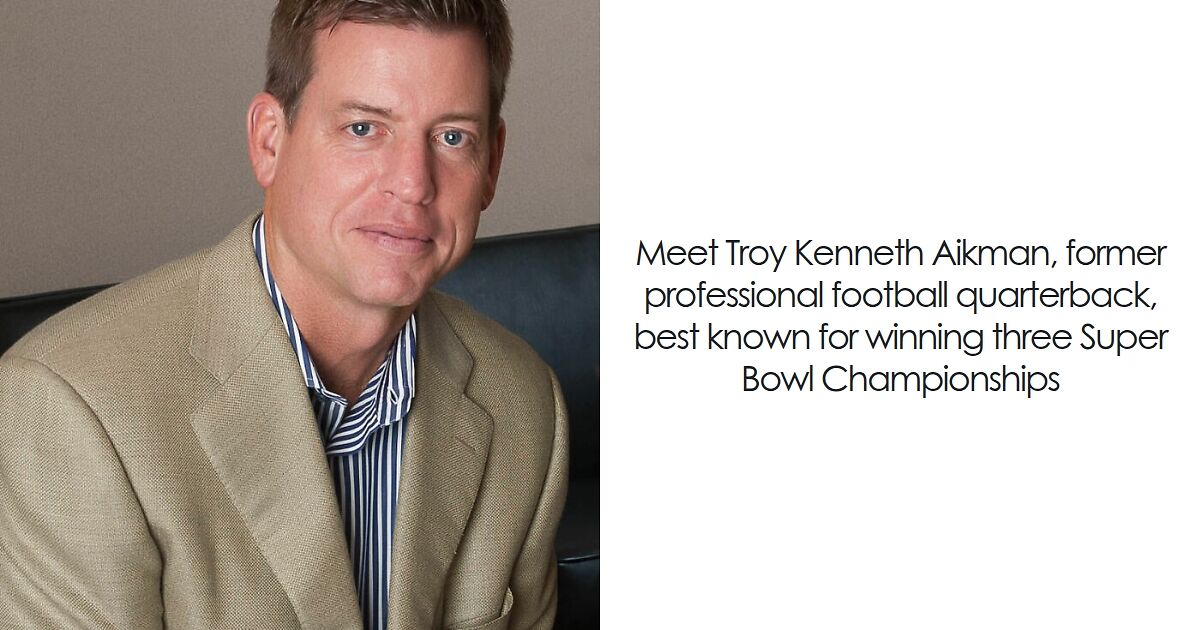
Troy Aikman is one of those rare football names that still sounds like it belongs under bright stadium lights, even decades after his final NFL snap. As the steady-armed quarterback of the Dallas Cowboys dynasty of the 1990s, Aikman became the face of clean execution, calm leadership, and championship football. He was not the loudest player in the room, and he was not the guy doing a touchdown dance long enough to qualify as cardio. Instead, he won with timing, toughness, accuracy, and a poker face that could survive a playoff blitz.
For fans searching for a complete Troy Aikman biography, his story runs far beyond three Super Bowl rings. It begins in California, grows in small-town Oklahoma, takes a dramatic turn through college football, peaks with the Dallas Cowboys, and continues today through broadcasting, business, philanthropy, and advisory work in the NFL. Aikman’s career is a case study in how elite talent becomes legendary when paired with discipline, structure, and the right supporting cast.
Early Life: From California Roots To Oklahoma Grit
Troy Kenneth Aikman was born on November 21, 1966, in West Covina, California. He spent part of his childhood in Cerritos before his family moved to Henryetta, Oklahoma, when he was 12. That move mattered. Henryetta was not a glamour factory for future NFL quarterbacks, but it gave Aikman a tougher, quieter foundation. He played football and baseball, developed a reputation as a gifted athlete, and became an All-State quarterback at Henryetta High School.
There was even a baseball path available. The New York Mets showed interest in Aikman after high school, but he chose football. That decision worked out reasonably well, unless you are a Mets fan still wondering what might have been. Aikman enrolled at the University of Oklahoma, where he joined one of college football’s most powerful programs under Barry Switzer.
College Career: Oklahoma, Injury, UCLA, And Reinvention
The Oklahoma Beginning
Aikman’s college football career started with promise at Oklahoma. He became a rare freshman starter for the Sooners and appeared ready to become the next big thing in Norman. Then came the twist: an ankle injury during the 1985 season changed everything. Oklahoma shifted toward a wishbone offense better suited to Jamelle Holieway, and Aikman realized his future as a passer needed a different system.
That is the first major lesson in the Troy Aikman career story: sometimes a setback is not a dead end; it is a transfer portal before the transfer portal became a weekly national soap opera.
The UCLA Breakthrough
Aikman transferred to UCLA, sat out the 1986 season, and returned as the polished passer he was meant to be. With the Bruins, he posted a 20-4 record as a starter across the 1987 and 1988 seasons. He won the Davey O’Brien Award as the nation’s top quarterback, earned consensus All-American honors in 1988, and finished third in the Heisman Trophy voting.
At UCLA, Aikman proved he was not merely a strong-armed prospect. He was a field general. He could read coverage, manage tempo, and deliver the ball accurately from the pocket. His college success made him the clear prize of the 1989 NFL Draft.
The 1989 NFL Draft: A Cowboy At No. 1
The Dallas Cowboys selected Troy Aikman with the first overall pick in the 1989 NFL Draft. The timing was dramatic. Jerry Jones had purchased the Cowboys, Jimmy Johnson had replaced legendary coach Tom Landry, and the franchise was preparing for a full rebuild. Aikman was not stepping into a luxury suite with a playbook; he was stepping into a construction zone wearing shoulder pads.
His rookie season was brutal. The Cowboys finished 1-15, and Aikman went winless as a starter. Still, there were flashes. He threw for a then-rookie-record 379 yards against the Phoenix Cardinals, showing the arm talent that made Dallas believe. The team around him simply was not ready yet. In football terms, Aikman was trying to bake a championship cake while the kitchen was still on fire.
Building The Dallas Cowboys Dynasty
The early losses did not define Aikman. They hardened him. By 1990, the Cowboys improved to 7-9. In 1991, Aikman completed an NFC-best 65.3 percent of his passes, and Dallas went 11-5. The pieces were coming together: Emmitt Smith in the backfield, Michael Irvin at wide receiver, Jay Novacek at tight end, and one of the nastiest offensive lines in NFL history clearing the way.
Aikman’s role in that offense is sometimes misunderstood. Because the Cowboys ran so effectively with Emmitt Smith, critics occasionally reduce Aikman to a caretaker. That is unfair. Aikman was not asked to throw 45 times every Sunday because Dallas did not need chaos to win. But when the Cowboys needed a precise third-down throw, a playoff strike, or a calm answer after momentum shifted, Aikman delivered. He was the luxury sedan of quarterbacks: not flashy for the sake of flash, but smooth, powerful, and built to last.
Super Bowl Glory And Career Highlights
Super Bowl XXVII: The MVP Performance
The 1992 season was Aikman’s breakout masterpiece. He threw for career highs in completions, passing yards, and touchdown passes while leading Dallas to a 13-3 record. In Super Bowl XXVII against the Buffalo Bills, Aikman completed 22 of 30 passes for 273 yards and four touchdowns. The Cowboys won 52-17, and Aikman was named Super Bowl MVP.
That performance remains one of the cleanest big-game quarterback displays in NFL history. He was accurate, poised, and merciless. The Bills turned the ball over repeatedly, and Aikman made sure Dallas turned those opportunities into points. It was the moment the Cowboys officially returned to football royalty.
Three Super Bowl Championships
Aikman led the Cowboys to victories in Super Bowls XXVII, XXVIII, and XXX. Winning one Super Bowl is difficult. Winning three in four seasons is dynasty territory. During that run, Dallas became the NFL’s measuring stick, and Aikman became the quarterback every defense had to respect. If opponents loaded up to stop Emmitt Smith, Aikman could punish them through the air. If they softened coverage, Smith and the offensive line could turn the game into a slow-motion steamroller.
Six Pro Bowls And Franchise Records
Aikman earned six Pro Bowl selections from 1991 through 1996. He finished his NFL career with 2,898 completions, 32,942 passing yards, 165 touchdown passes, and a 61.5 percent completion rate. At the time of his retirement, he stood among the greatest players in Cowboys history and remained one of the most respected quarterbacks of his era.
He also collected 90 wins during the 1990s, which at the time was the most by any starting quarterback in a single decade. That statistic captures Aikman’s real value. He was built for winning football, not fantasy football debates. His job was to lead, execute, protect the ball, and make championship plays. He did exactly that.
Leadership Style: Calm, Demanding, And Efficient
Troy Aikman’s leadership style was not theatrical. He did not need to turn every huddle into a motivational movie scene. His authority came from preparation and credibility. Teammates knew he had absorbed the game plan, understood defensive looks, and would take hits without flinching. That type of leadership is quieter, but it lasts longer.
He also played in an era when quarterbacks took more punishment than modern fans may realize. Concussions and injuries eventually shortened the later part of his playing career. Yet Aikman’s reputation for toughness stayed intact. He was not a scrambling magician; he was a pocket passer who stood in and made throws with defenders closing fast. That requires courage, timing, and a very strong relationship with your chiropractor.
Retirement And Hall Of Fame Honors
Aikman retired after the 2000 NFL season and officially moved into the next chapter of his career in 2001. His football résumé made the Hall of Fame conversation simple. He was inducted into the Dallas Cowboys Ring of Honor in 2005 and entered the Pro Football Hall of Fame in 2006. In 2008, he was inducted into the College Football Hall of Fame, recognizing his outstanding UCLA career.
These honors reflect more than numbers. Aikman’s legacy is tied to winning, leadership, and the revival of America’s Team. He was the quarterback who helped turn a 1-15 team into a three-time Super Bowl champion. That is not a glow-up; that is a full franchise renovation.
Broadcasting Career: From The Pocket To The Booth
After retiring, Aikman moved quickly into broadcasting. He joined FOX Sports and became one of the network’s top NFL analysts, most famously working alongside play-by-play announcer Joe Buck. Their partnership became one of the most recognizable booths in football, calling regular-season games, playoff matchups, NFC Championship Games, and multiple Super Bowls.
In 2022, Aikman and Buck moved to ESPN to become the lead voices of Monday Night Football. Aikman’s broadcasting style mirrors his playing style: direct, prepared, and occasionally sharper than a cornerback’s trash talk. He explains quarterback decisions, offensive structure, and coaching choices with the eye of someone who has actually stood in the pocket while very large people tried to rearrange his afternoon.
Business, Philanthropy, And Life Beyond Football
Aikman’s post-football life has also included business and charitable work. The Troy Aikman Foundation, founded in 1992, has supported children’s causes, including projects connected to children’s hospitals. He has also been involved in business ventures, including EIGHT Elite Light Beer, a brand connected to his famous No. 8 jersey and marketed around clean ingredients and a lighter profile.
In 2026, Aikman also drew attention for advisory work connected to the Miami Dolphins’ front-office search process. While his main public role remains broadcasting, that consulting work showed how highly his football judgment is still valued. Decades after his playing career, NFL organizations still see him as someone who understands quarterbacks, team building, leadership, and the difference between a plan and a wish wearing a headset.
Why Troy Aikman Still Matters
Troy Aikman matters because his career challenges the modern obsession with volume stats. He did not play in an offense designed to inflate passing numbers. He played in a system designed to win championships. His greatness is best understood through context: playoff execution, command of the huddle, accuracy under pressure, and the trust he earned from coaches and teammates.
In today’s NFL, quarterbacks are often judged by highlight clips, social media debates, and passing totals that look like arcade scores. Aikman’s career asks a different question: did the quarterback make the team better when it mattered most? In his case, the answer is written in silver and blue, with three Lombardi Trophies doing most of the talking.
Experiences And Lessons From Troy Aikman’s Career
One of the most useful experiences connected to Troy Aikman’s career is the lesson of patient development. His rookie season could have crushed a young quarterback. Starting 0-11 is not exactly the kind of opening act that makes fans write poetry. Yet Aikman did not panic. He learned. The Cowboys built around him. Coaches refined the system. Talent arrived. Over time, a painful beginning became the foundation for a dynasty. For anyone building a career, business, team, or creative project, that lesson is powerful: early failure is not proof that the mission is doomed.
Another experience worth studying is Aikman’s transfer from Oklahoma to UCLA. At Oklahoma, his skills did not perfectly fit the direction of the offense after his injury. Rather than stubbornly staying in a system that limited his future, he made a difficult move. At UCLA, he found the right environment and became a national star. That applies far beyond football. Sometimes talent does not need more effort; it needs the right setting. A gifted person in the wrong system can look average. The same person in the right system can become exceptional.
Aikman’s career also shows the value of role clarity. He did not need to be the statistical king every season because the Cowboys had a complete team. Emmitt Smith carried the running game. Michael Irvin stretched defenses with physical receiving. The offensive line controlled the trenches. Aikman’s job was to run the machine at championship speed. In many workplaces, teams fail because everyone wants to be the hero. The Cowboys succeeded because their stars understood how their roles fit together.
There is also a communication lesson from Aikman’s second career in broadcasting. Many former athletes struggle to explain the game clearly, but Aikman built credibility by translating complex football ideas into plain language. He can discuss coverage, protection, quarterback mechanics, and coaching decisions without making the audience feel like they accidentally wandered into a graduate seminar on blitz pickup. That skill matters in any field: expertise becomes more valuable when people can understand it.
Finally, Aikman’s story is a reminder that legacy is built in chapters. High school athlete, Oklahoma quarterback, UCLA star, No. 1 draft pick, winless rookie, Super Bowl MVP, Hall of Famer, broadcaster, businessman, consultant, philanthropist each phase added something different. The headline may be “Dallas Cowboys legend,” but the full story is richer. Troy Aikman’s career highlights are not just about trophies. They are about adjustment, resilience, leadership, timing, and knowing when to throw the ball away before life’s pass rush gets there.
Conclusion
Troy Aikman’s biography is the story of a quarterback who turned precision into power. From Henryetta High School to UCLA, from the painful rebuild of the Dallas Cowboys to three Super Bowl championships, Aikman built a career defined by winning. He was not the flashiest quarterback of his generation, but he was one of the most reliable when the stakes were highest.
His post-playing career has only expanded his influence. As a broadcaster, Aikman remains one of football’s most familiar voices. As a businessman and advisor, he continues to show that his understanding of the game did not retire with his jersey. Whether fans remember him for Super Bowl XXVII, the Cowboys dynasty, his No. 8, or his Monday night commentary, Troy Aikman remains a central figure in modern NFL history.
Note: This article was written from a synthesis of reputable public sports biography and football record sources, including official Hall of Fame, NFL, Dallas Cowboys, UCLA, ESPN, and related U.S. sports references. Source links were not inserted per publishing requirements.