Famous landmarks are usually famous for one obvious reason: the giant statue, the glittering tower, the ancient arena, the postcard-perfect view, or the fact that your uncle once took 800 blurry vacation photos there. But some of the world’s most recognizable places have a second personality hiding behind the curtain. Under the stairs, behind the monument, above the train station, beneath the museum floor, or tucked behind a locked door is another storysometimes stranger, quieter, and far more interesting than the main attraction.
These crazy secret places hidden in famous locations are not fantasy movie sets or conspiracy-theory leftovers. They are real rooms, tunnels, courts, crypts, vaults, and underground chambers that exist inside or beneath landmarks millions of people visit every year. Some were built for practical reasons. Some were built for prestige. Some were forgotten, rediscovered, restored, or turned into limited-access tours. And some are still so discreet that tourists can walk right past them while eating a pretzel and never know they missed anything.
Let’s step away from the souvenir shop and peek into the hidden corners of famous places around the world.
Why Do Famous Places Have Hidden Spaces?
Secret places usually exist because famous locations are more complicated than they look. A monument needs foundations. A theater needs backstage rooms. A museum needs storage. A theme park needs hidden operations. A train station needs mechanical guts. A government building may need offices, security areas, or, apparently, a basketball court because even serious people need to miss layups.
These hidden spaces reveal how landmarks actually work. They remind us that every iconic location has two versions: the polished public version and the behind-the-scenes version full of workers, machinery, history, and odd little decisions that somehow survived for decades.
1. The Hall of Records Behind Mount Rushmore
Mount Rushmore is famous for the four presidential faces carved into the Black Hills of South Dakota. But behind the head of Abraham Lincoln is one of America’s strangest hidden chambers: the Hall of Records.
Sculptor Gutzon Borglum wanted the space to become a grand archive explaining the meaning of the monument and preserving important national documents for future generations. The original dream was huge, almost cinematic: a vault carved into the mountain, reached by a dramatic stairway. Work began, but the plan was never completed as imagined.
Today, the chamber contains a repository with porcelain enamel panels that tell the story of Mount Rushmore, the presidents chosen, the people who carved it, and key parts of United States history. Visitors cannot casually stroll inside, which is probably for the best. A hidden archive inside a mountain already sounds like the opening scene of an adventure movie; adding flip-flops and snack crumbs would ruin the mood.
2. Gustave Eiffel’s Private Apartment Inside the Eiffel Tower
The Eiffel Tower is already dramatic enough without needing a secret apartment, but apparently Gustave Eiffel disagreed. Near the top of the tower, Eiffel included a private apartment where he could work, entertain select guests, and enjoy a view of Paris that said, “Yes, I may have overachieved.”
The space was not designed as a full-time home with a bedroom. Instead, it functioned more like a private office and reception room, furnished with a living area, desks, a piano, a kitchen, and basic facilities. It became a place where Eiffel could host important visitors and conduct scientific work high above the city.
For years, the idea of a cozy room tucked inside an iron landmark fascinated visitors. It still does. The Eiffel Tower’s apartment is the perfect example of a hidden place that feels both practical and wildly theatrical. Most people build a home office near a window. Eiffel put his in the sky.
3. The Utilidor Tunnels Beneath Walt Disney World’s Magic Kingdom
Magic Kingdom at Walt Disney World is engineered to feel effortless. Characters appear in the right place, trash disappears, supplies move smoothly, and the fantasy remains intact. That magic depends partly on a massive hidden support system: the utilidors.
These utility corridors run beneath the guest-facing areas of Magic Kingdom and allow cast members, supplies, and operations to move out of sight. They help preserve the illusion that each themed land is its own world. You do not want a cowboy from Frontierland casually power-walking through Tomorrowland with a turkey leg and a clipboard. The utilidors help prevent exactly that type of emotional confusion.
Guests can access parts of the system through special behind-the-scenes tours, but for most visitors, the tunnels remain invisible. They are one of the most famous examples of hidden infrastructure making a public fantasy feel seamless.
4. A Tennis Club Above Grand Central Terminal
Grand Central Terminal in New York City is known for its celestial ceiling, grand staircases, and rushing commuters. But above the crowds sits one of the most unexpected hidden places in Manhattan: the Vanderbilt Tennis Club.
Located on the fourth floor of the terminal, the club includes a regulation-size hardcourt and practice areas. The idea of playing tennis above one of the busiest transportation hubs in America feels like something invented during a particularly bold lunch meeting. Yet it is real, open to the public by reservation, and wonderfully New York.
Below, people sprint for trains. Above, someone is trying to perfect a backhand. If that is not urban poetry, what is?
5. The Abandoned City Hall Subway Station Under New York
New York’s old City Hall subway station is one of the city’s most beautiful transit ghosts. Opened as part of the original subway system in 1904, it was designed with elegant arches, skylights, tilework, and a sense of civic grandeur that made commuting feel almost noble.
The station closed in 1945 because its curved platform could not easily serve longer modern trains. Instead of being demolished, it remained beneath City Hall Park, hidden from everyday passengers. Today, access is limited through special New York Transit Museum tours.
What makes the station so fascinating is the contrast. The active subway system is loud, practical, and often held together by caffeine and civic stubbornness. Hidden beneath it is a jewel box of early-20th-century ambition, reminding visitors that public infrastructure was once built with beauty as part of the blueprint.
6. Millions of Books Beneath Bryant Park and the New York Public Library
The New York Public Library’s Stephen A. Schwarzman Building is famous for its stone lions, grand reading rooms, and scholarly atmosphere. But many visitors never realize that beneath the building and nearby Bryant Park is a vast storage system holding millions of research materials.
The Milstein Research Stacks preserve huge portions of the library’s collections in a state-of-the-art environment. While people aboveground drink coffee, read novels, and debate whether pigeons have too much confidence, an enormous archive quietly lives below them.
This hidden place is not spooky in the haunted-house sense. It is spooky in the “civilization depends on cataloging” sense. And frankly, that may be more powerful.
7. The Ellis Island Hospital Complex
Ellis Island is best known as the gateway through which millions of immigrants entered the United States. But beyond the main museum area is the island’s hospital complex, a haunting and historically rich set of buildings on the south side.
The hospital once served immigrants who needed medical evaluation or treatment before entering the country. It included wards, kitchens, staff areas, laundry facilities, and spaces for contagious disease care. After decades of abandonment, parts of the complex can now be visited through guided hard-hat tours.
The hidden hospital changes the emotional texture of Ellis Island. It reminds visitors that arrival was not always quick or joyful. For some families, hope paused in a ward, a waiting room, or a medical inspection area. The peeling walls and quiet corridors tell a human story that the main halls cannot fully contain.
8. The Lincoln Memorial Undercroft
Most visitors approach the Lincoln Memorial by looking up: the columns, the steps, the seated statue, the words carved into stone. But beneath the memorial is a huge undercroft, a structural space filled with concrete columns supporting the monument above.
For decades, this cavernous area was largely hidden from public view. It includes construction history, structural drama, and even old markings and graffiti left by workers. The space has been developed into an interpretive experience, giving visitors a new way to understand how the memorial was built and how it has functioned as a stage for American history.
The undercroft proves that even a monument dedicated to solemn reflection has a basement with secrets. History, like a good house, always has more going on downstairs.
9. James Smithson’s Crypt Inside the Smithsonian Castle
The Smithsonian Castle in Washington, D.C., looks like something that wandered out of a medieval daydream and decided to manage museums. Inside is a small chapel-like space that serves as the crypt of James Smithson, the British scientist whose bequest founded the Smithsonian Institution.
Smithson never visited the United States while alive, yet his remains eventually came to Washington. His crypt is located at the Castle’s north entrance, creating one of the strangest and most poetic hidden corners in American cultural life: the founder of a great institution resting inside the institution he made possible from across an ocean.
It is not flashy. It is not loud. But it is deeply memorable, especially when you realize how many visitors pass through Smithsonian spaces without knowing the founder’s story is literally built into the Castle.
10. Fort Wood Beneath the Statue of Liberty
The Statue of Liberty is known worldwide as a symbol of freedom, welcome, and New York Harbor. But the statue’s pedestal sits on the remains of Fort Wood, an early-19th-century defensive fort built in the shape of an eleven-pointed star.
Before Liberty Island became famous for the statue, the fort was part of a harbor defense system. The star-shaped walls still form a dramatic base around the monument. Many visitors focus on the statue above and miss the military structure below, even though the two are physically connected.
This hidden-in-plain-sight detail adds depth to the landmark. Liberty is standing on a fort. Symbolically, that is a lot to unpack before lunch.
11. The Secret Sound Installation in Times Square
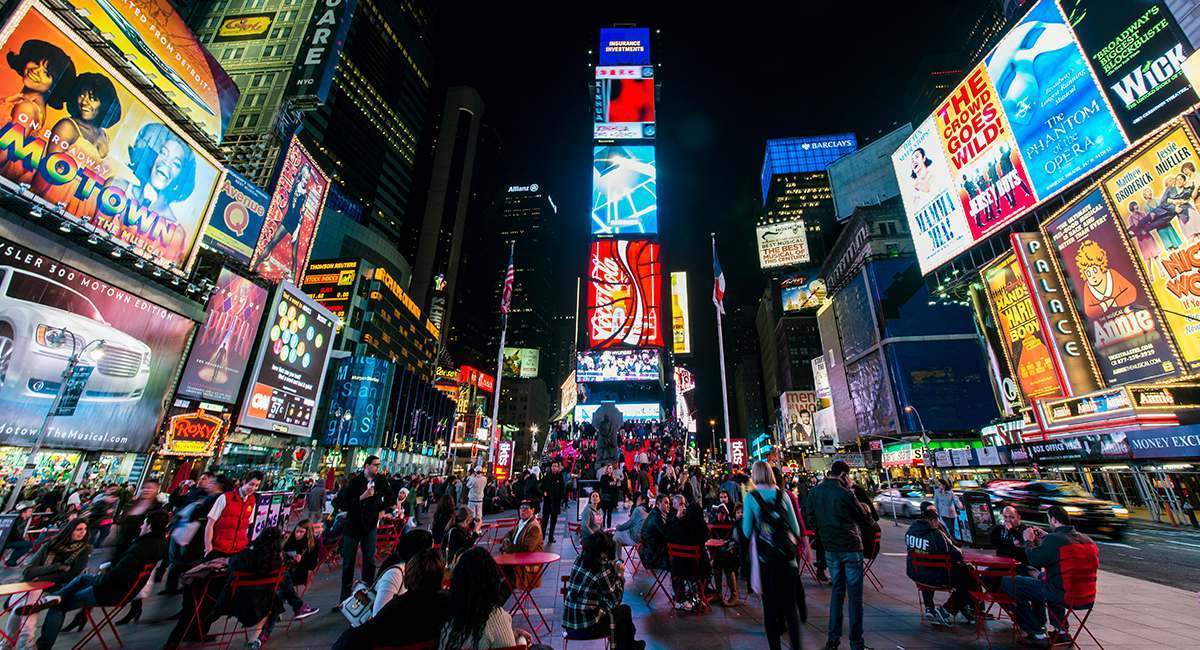
Times Square is one of the loudest, brightest, most aggressively caffeinated places on Earth. So naturally, one of its best secrets is not something you see, but something you hear.
Artist Max Neuhaus created a subtle sound installation called “Times Square,” which emanates from beneath a pedestrian area near Broadway between 45th and 46th Streets. The work is deliberately unmarked. It blends into the surrounding noise as a deep harmonic hum, waiting for attentive passersby to notice it.
This is a secret place without walls. The hidden location is sonic rather than architectural. Thousands of people may walk over it without realizing they are passing through an artwork. In a neighborhood full of billboards shouting for attention, the coolest secret whispers from a grate.
12. The Roxy Suite Inside Radio City Music Hall
Radio City Music Hall is famous for the Rockettes, Art Deco glamour, and grand performances. Hidden inside the building is the Roxy Suite, once the private apartment of impresario Samuel “Roxy” Rothafel.
The suite features lavish design details, including a gold-leaf ceiling and elegant paneling. It served as a private entertaining space for notable guests and remains one of the most glamorous hidden rooms in New York entertainment history.
Many theaters have dressing rooms. Radio City has a secret luxury apartment. That feels appropriate for a place where even the lobby looks dressed for an award ceremony.
13. The Medieval Moat Beneath the Louvre
The Louvre is now the world-famous museum where visitors crowd around the Mona Lisa and pretend not to be disappointed by its size. But beneath the museum is evidence of a much older Louvre: the medieval fortress that once defended Paris.
Visitors can encounter parts of the medieval moat and foundations, reminders that the Louvre began as a fortress before becoming a royal palace and later a museum. This underground history is easy to overlook when your itinerary is dominated by paintings, sculptures, and the urgent search for a restroom.
The hidden medieval Louvre is a powerful example of architectural layering. One famous location can contain several previous lives, stacked like a historical layer cake. A very French layer cake, naturally.
14. The Underground Hypogeum of the Colosseum
Rome’s Colosseum is iconic from the outside, but its most fascinating secrets lie below the arena floor. The hypogeum was the underground network where gladiators, animals, stage machinery, workers, and props waited before rising into the spectacle above.
To ancient spectators, dramatic appearances in the arena may have felt almost magical. Beneath the floor, however, was a complicated backstage system of tunnels, cages, lifts, and labor. The Colosseum was not just an amphitheater; it was an entertainment machine.
Modern visitors who access the underground areas get a very different view of the monument. From below, the Colosseum feels less like a ruin and more like a working theater whose machinery has finally been exposed.
15. The Basketball Court Above the U.S. Supreme Court
The U.S. Supreme Court Building is known for marble columns, constitutional arguments, and an atmosphere so serious it practically wears a tie. Yet inside the building, above the courtroom, is a basketball court nicknamed “The Highest Court in the Land.”
The court is not a tourist attraction in the usual sense, but it has become a beloved piece of Washington lore. Clerks and staff have used the space for recreation, with one important rule: no playing while the Court is in session, because bouncing basketballs above solemn legal arguments is apparently distracting. Imagine trying to debate constitutional law while someone upstairs bricks a three-pointer.
This hidden space is delightful because it humanizes an intimidating institution. Even the highest court needs a place where people can sweat, compete, and argue about fouls instead of federal doctrine.
What These Hidden Places Teach Us
The best secret places are not just trivia. They change how we understand famous landmarks. The Hall of Records makes Mount Rushmore feel like a time capsule. The utilidors make Disney’s fantasy feel engineered. The City Hall subway station reminds us that public transportation can be beautiful. The Ellis Island hospital complicates a national story with vulnerability and waiting. The Louvre’s medieval moat proves that even the most polished museum has old stone bones.
These hidden places also reveal that famous locations are never finished stories. They are living systems. They get renovated, repurposed, sealed off, rediscovered, and reinterpreted. Sometimes the secret room becomes a tour. Sometimes the hidden tunnel remains backstage. Sometimes the most interesting part is not whether you can enter, but simply knowing it exists.
Experiences Inspired by Crazy Secret Places Hidden in Famous Locations
Visiting famous landmarks becomes much more exciting when you stop treating them like checklist items and start treating them like layered mysteries. Anyone can stand in front of a monument, take a photo, and move on. The better experience begins when you ask, “What am I not seeing?” That question turns an ordinary visit into a treasure hunt.
Imagine arriving at Grand Central Terminal during rush hour. The obvious experience is the crowd: shoes clicking, announcements echoing, commuters moving like schools of fish with briefcases. But knowing that a tennis court sits above all that chaos changes the whole scene. Suddenly the building feels less like a station and more like a vertical city. While thousands of people below are chasing trains, someone upstairs is chasing a yellow ball. That contrast is the magic.
The same thing happens at the Statue of Liberty. Most visitors look upward, focusing on the torch and crown. But once you know about Fort Wood, you begin looking at the base differently. The star-shaped fort turns the island into a palimpsest of American history: defense, immigration, symbolism, tourism, and national identity all layered into one place. The statue does not become less inspiring. It becomes more complicated, which is usually what makes history worth remembering.
At Ellis Island, learning about the hospital complex adds emotional weight. A standard museum visit can feel orderly and educational. The hospital story adds uncertainty and vulnerability. It reminds you that every immigration record belonged to a human body, not just a name on a manifest. Some people arrived healthy and hopeful. Others arrived sick, frightened, or separated from relatives. The hidden hospital turns statistics into lived experience.
Secret places also reward slower travel. In Times Square, the hidden sound installation asks visitors to do the opposite of what the neighborhood encourages. Instead of looking up at screens, you listen down toward the pavement. Instead of rushing, you pause. The reward is subtle, but that is the point. Not every landmark experience needs fireworks. Sometimes the most memorable discovery is a strange hum under your feet.
For travelers, the lesson is simple: famous places are better when you research their hidden corners before you go. Look for special tours, basement exhibits, old service areas, architectural remnants, and official behind-the-scenes programs. Ask guides what visitors usually miss. Read plaques. Notice doors. Look down, up, and behind you. The main attraction may be famous for a reason, but the secret spaces often provide the story you tell friends later.
And if you cannot physically enter these hidden places, knowing about them still changes the visit. You may never walk freely into Mount Rushmore’s Hall of Records or casually shoot hoops above the Supreme Court, but awareness adds imagination. It gives a landmark depth. It lets you stand in a crowded tourist spot and feel like you are in on a quiet joke with history.
Conclusion
Crazy secret places hidden in famous locations prove that landmarks are rarely as simple as they appear. Beneath the polished surfaces are service corridors, forgotten stations, private apartments, hidden archives, crypts, hospitals, courts, moats, and underground chambers. These spaces make famous destinations feel alive because they reveal the work, ambition, oddity, and humanity behind the postcard image.
The next time you visit a famous location, do not only ask what everyone came to see. Ask what most people miss. The answer might be under your feet, above your head, behind a locked door, or humming quietly from a sidewalk grate while the rest of the world walks by.