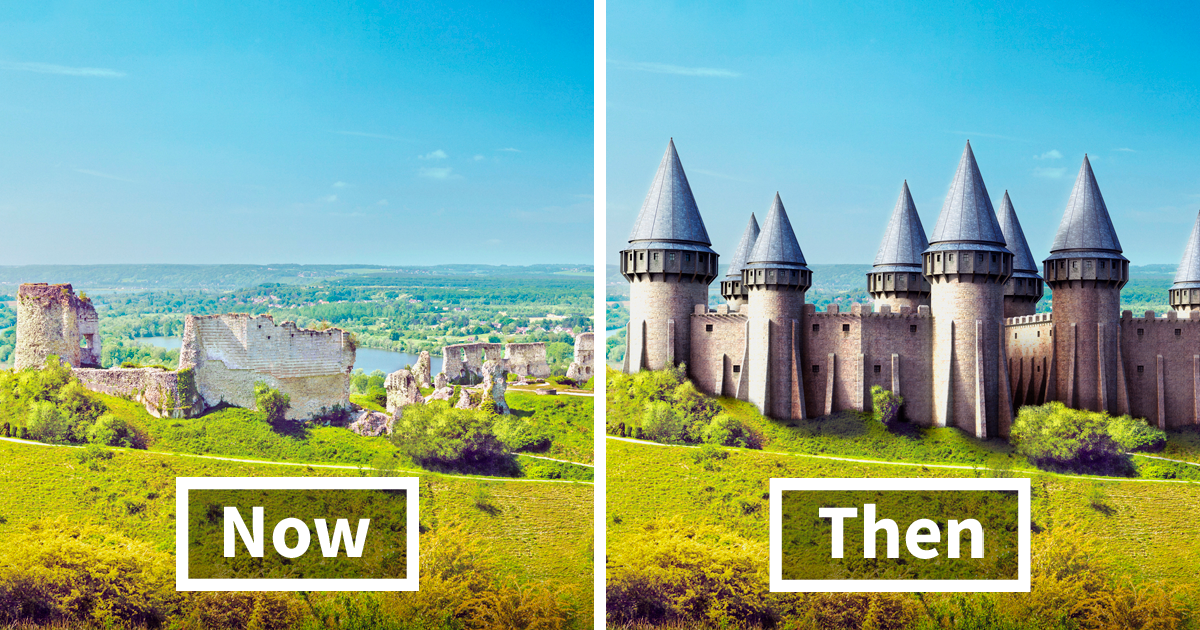
Europe has a talent for drama. Give it a hilltop, a fog bank, a suspiciously poetic raven, and suddenly you have a castle that looks like it was designed by someone who expected both a siege and a moody album cover. Today, many of the continent’s once-mighty fortresses survive as broken walls, empty windows, and wind-battered towers. But before they became romantic ruins, these castles were busy, loud, defended, decorated, and sometimes downright intimidating machines of power.
Digital reconstructions of ruined European castles have given modern travelers a rare treat: the chance to imagine these places not as skeletons of stone, but as complete architectural statements. Roofs return. Towers stand tall. Gatehouses regain their bite. Courtyards fill back in. Suddenly, a pile of weathered masonry becomes a working fortress again, and history stops whispering and starts clearing its throat.
Below, we explore seven castles across Europe that were digitally reimagined before time, fire, war, politics, and plain old neglect turned them into ruins. Each one tells a different story: royal ambition, family wealth, military strategy, betrayal, tragedy, and the eternal human belief that “placing a castle on a terrifying cliff” is a perfectly normal real estate decision.
Why Ruined Castles Still Fascinate Us
Ruined castles are powerful because they leave just enough to the imagination. A complete castle tells you what it is. A ruined castle asks you to participate. You see a curtain wall and wonder how high it rose. You pass through a broken gate and picture horses, guards, servants, merchants, prisoners, and maybe one very irritated cook trying to feed a garrison before sunrise.
Medieval castles were not simply stone decorations. They were fortified residences, symbols of authority, military strongholds, administrative centers, and occasionally luxurious homes wrapped in defensive armor. Their thick walls, towers, keeps, baileys, moats, and gatehouses were built to resist siege warfare, control territory, and remind everyone nearby who held the keyssometimes literally.
When these castles fell into ruin, they did not vanish all at once. Some were burned. Some were abandoned after warfare changed. Some were stripped for building materials. Others were damaged by earthquakes, landslides, or political punishment. What remains today is often only the final chapter of a much longer story.
1. Samobor Castle, Croatia
Before the Ruins: A Fortress Above a Medieval Market Town
Samobor Castle sits on Tepec Hill above the town of Samobor, not far from Zagreb. In its prime, it would have looked less like a sleepy forest ruin and more like a hard-working medieval fortress watching over trade routes and political borders. Built in the 13th century during the struggles between Bohemia and Hungary, the castle is commonly associated with King Ottokar II of Bohemia, whose ambitions stretched across Central Europe.
Today, visitors see fragments of walls, a surviving guard tower base, remains of defensive structures, and traces of later modifications. But the reconstructed version helps us imagine a compact stone stronghold with roofed towers, enclosed rooms, defensive walkways, and a commanding view over the town below. In later centuries, especially during the 16th century, the fortress was expanded and altered, giving it more residential and stylistic features.
Samobor Castle was not just a military object. It was also a seat of local power. Owners came and went, and the relationship between nobles and townspeople was not always warm and cozy. Think less “storybook harmony” and more “neighborhood association meeting, but with swords.” By the time the town of Samobor acquired the property in 1902, the castle had already slipped from strategic asset into picturesque ruin.
Before ruin set in, Samobor Castle likely combined rugged defensive practicality with later touches of comfort. Its restored appearance would have included taller walls, more complete towers, wooden roofs, inner chambers, and a chapel area. The modern ruin may be quiet, but the original castle would have been an active hilltop headquarters with guards, horses, household staff, storage areas, and a constant eye on the roads below.
2. Château Gaillard, France
Before the Ruins: Richard the Lionheart’s Defiant Masterpiece
Château Gaillard was not built to be subtle. Perched above the Seine River at Les Andelys in Normandy, it was constructed by Richard I of EnglandRichard the Lionheartin the late 12th century. The project moved with astonishing speed, reportedly completed in only about two years, which is impressive considering that modern people can take longer to assemble a bookshelf and still end up with one extra screw.
The castle’s name has often been translated as “saucy,” “cheeky,” or “defiant,” and that personality fits. Château Gaillard was designed to protect English-held Normandy from the French monarchy. It guarded the Seine River valley and made a bold architectural statement: Richard was not planning to give up Normandy without a fight.
In its prime, Château Gaillard was one of the most advanced fortifications of its age. It used layered defenses, strong towers, dry moats, and carefully arranged baileys. The keep rose from a powerful inner ward, while outer defenses forced attackers to work through one obstacle after another. Its walls were not merely barriers; they were a defensive system.
Yet even the strongest castle can meet a bad Tuesday. In 1204, King Philip II of France captured Château Gaillard after an eight-month siege. The castle changed hands during later conflicts, including the Hundred Years’ War, but by the late 16th century it had lost its military usefulness. Henry IV of France eventually ordered its demolition because a restored fortress could become a dangerous rebel stronghold.
Before falling into ruins, Château Gaillard would have appeared bright, compact, aggressive, and highly controlled. Its completed towers, roofed buildings, and enclosed wards would have dominated the Seine like a stone warning sign. The ruins still look dramatic today, but the reconstructed castle reveals what Richard intended: not romance, not nostalgia, but raw strategic confidence.
3. Dunnottar Castle, Scotland
Before the Ruins: A Sea-Cliff Fortress With a Crown-Jewel Story
Dunnottar Castle is the sort of place that makes you understand why Scottish history comes with bagpipes. Located near Stonehaven on Scotland’s northeast coast, the castle stands on a rocky headland surrounded by steep cliffs and the North Sea. Even as a ruin, it looks almost impossible to attack without developing second thoughts and a sudden interest in farming.
The site’s history stretches far beyond the surviving stone buildings. Early Christian activity is associated with the area, and the headland has deep roots in Pictish and medieval history. A chapel was consecrated there in the 13th century, and Sir William Keith built the first major stone castle structure in the late 14th century. Later additions transformed Dunnottar into a substantial fortified residence.
In its complete form, Dunnottar would have been a complex of halls, chambers, storehouses, defensive walls, courtyards, and towers packed tightly onto the cliff platform. Its position made it both beautiful and militarily valuable. The sea protected much of the perimeter, while the narrow landward approach could be defended with far fewer people than an open lowland castle would require.
Dunnottar is famously linked to William Wallace, who is said to have retaken the site from English forces in 1297 during the Wars of Scottish Independence. Later, in the 17th century, the castle became central to the dramatic hiding of the Honours of Scotlandthe Scottish crown jewelsduring the wars involving Oliver Cromwell’s forces. In other words, Dunnottar was not just scenic; it was trusted with national treasure.
The castle’s decline accelerated after the Keith family lost it following Jacobite political trouble in the early 18th century. Its valuables were stripped, and the buildings decayed. Before that, however, Dunnottar was a formidable coastal stronghold, part fortress, part noble residence, part emergency vault for a kingdom’s identity. Not bad for a place where the weather still acts like it wants rent.
4. Menlo Castle, Ireland
Before the Ruins: A Noble Family Home on the River Corrib
Menlo Castle, near Galway City in western Ireland, is different from some of the more aggressively military castles on this list. It was not primarily a battlefield monster bristling for war. Built in the 16th century, it served as the home of the Blake family, one of Galway’s powerful Anglo-Norman families. It was a fortified residence, yes, but also a country house that reflected wealth, status, and local influence.
Today, Menlo Castle is famous for its ivy-covered walls, which make it look as if nature has politely but firmly reclaimed the lease. Before its ruin, however, it would have had a roof, floors, glazed or shuttered windows, chimneys, interior rooms, and the daily movement of a landed household. The Blakes lived there for centuries, and the estate would have included gardens, service areas, and connections to the surrounding agricultural landscape.
Menlo did have defensive elements, including a cannon, because even comfortable families in early modern Ireland understood that “just in case” was not paranoiait was planning. But the castle’s main identity was domestic. It represented continuity, property, and family prominence.
The tragedy that turned Menlo Castle into a ruin came in 1910, when a fire destroyed the building. The blaze claimed the life of Eleanor Blake, daughter of Sir Valentine Blake, and left the once-lived-in residence a hollow shell. Unlike castles ruined by siege or royal order, Menlo’s fall was personal and sudden. Its empty windows are not just architectural remains; they are reminders of a house that was still part of living memory when disaster struck.
Reconstructed, Menlo Castle would regain its manor-like dignity: tall walls, rooflines, chimneys, windows, and a riverfront presence. It would look less like a haunted illustration and more like what it once wasa family seat where people slept, argued, hosted guests, managed land, and probably complained about the damp. Because Ireland may be magical, but laundry still had to dry somehow.
5. Olsztyn Castle, Poland
Before the Ruins: A Limestone Eagle’s Nest
Olsztyn Castle in southern Poland is part of the dramatic landscape associated with the Trail of the Eagles’ Nests, a chain of medieval fortifications set among limestone rocks between Kraków and Częstochowa. Its name fits the setting beautifully. These castles often perch on high rocky outcrops like stone birds of prey, scanning the horizon for danger, merchants, armies, and presumably anyone foolish enough to attack uphill.
The castle is known from the medieval period and was expanded in the 14th century, especially under King Casimir III the Great, who strengthened Poland’s border defenses. Olsztyn protected important routes and helped secure the Silesian–Lesser Poland frontier. Its natural rock base made it visually striking and tactically useful.
In its prime, Olsztyn Castle would have looked far more complete than the scattered ruins visible today. It likely included a high castle, middle and lower defensive zones, walls that joined natural rock formations, towers, gates, and domestic or administrative buildings. A tall round towerone of its most recognizable surviving featuresonce served as a prison and remains a powerful visual clue to the castle’s former scale.
Olsztyn suffered badly during the Swedish wars in the 17th century, especially during the period known as the Swedish Deluge. After military damage and changing defensive needs, the castle declined. Parts of its materials were later reused, and what remained became a ruin integrated into the rocky landscape.
Before ruin, Olsztyn would have been an impressive combination of architecture and geology. Instead of forcing a castle onto the land, builders used the land as part of the castle. Walls rose from cliffs. Towers extended the height of the rocks. The finished structure must have looked less like a building sitting on a hill and more like the hill had grown armor.
6. Spiš Castle, Slovakia
Before the Ruins: One of Central Europe’s Great Castle Complexes
Spiš Castle in Slovakia is enormous. Occupying a vast hilltop area near Spišské Podhradie, it ranks among the largest castle complexes in Central Europe. Even as a ruin, it sprawls across the landscape with enough confidence to make smaller castles feel underdressed.
The castle’s origins reach back to the 12th century, when it served as a frontier fortress near the northern edge of the medieval Hungarian kingdom. Over time, Spiš became more than a defensive site. It developed into a regional administrative and aristocratic center. In the 15th century, the Zápoľský family transformed parts of it into a more refined Gothic residence, adding comfort, prestige, and architectural ambition to its military bones.
Before falling into ruin, Spiš Castle would have been a layered and complex environment. Multiple courtyards, palaces, towers, walls, gates, chapels, and service spaces filled the hilltop. The reconstructed version restores the vertical force of its towers and the completeness of its walls, making it easier to understand how powerful it looked from below. For travelers approaching the region, Spiš must have appeared as both a fortress and a statement of noble dominance.
A major fire in 1780 devastated the castle, and neglect followed. By the time modern conservation efforts began, much of the complex had already become the haunting ruin seen today. Preservation work in the 20th century helped stabilize its walls and protect what remained. Its historical value is now internationally recognized as part of a UNESCO World Heritage landscape.
Spiš Castle’s pre-ruin appearance matters because it reminds us that castles were not static. They evolved. A frontier fortress could become a noble residence. A military compound could gain elegant halls. A defensive site could become a cultural landmark. Spiš is not just a ruin; it is a timeline in stone, with each layer showing how power adapted to changing centuries.
7. Poenari Castle, Romania
Before the Ruins: Vlad the Impaler’s Cliff-Top Fortress
Poenari Castle, also called Poenari Fortress, is perched above the Argeș River valley in Romania. It is strongly associated with Vlad III, better known as Vlad the Impaler, the Wallachian ruler whose reputation helped inspire the later Dracula legend. If Bran Castle is the celebrity tourist photo-op, Poenari is the grimmer historical workout: visitors face roughly 1,480 steps to reach the ruins. Medieval defense, apparently, was also cardio.
The site’s earlier roots go back before Vlad, but in the 15th century he recognized its strategic value and strengthened it into one of his main fortresses. Its position on a steep cliff made it extremely difficult to attack. The fortress had an elongated shape, strong walls, watchtowers, and a commanding view over the surrounding valleys and mountain approaches.
Before ruin, Poenari would have looked severe, compact, and almost fused to the cliff. It was not a plush palace designed for leisurely banquets under velvet canopies. It was a refuge, lookout, and military stronghold. The walls and towers would have created a narrow defensive crown on the rock, allowing a relatively small group of defenders to control access and observe movement below.
Legends surrounding Vlad and Poenari are dramatic, as one might expect from a ruler whose historical brand is not exactly “gentle neighbor.” Stories claim he forced disloyal boyars to help rebuild the fortress. While details vary across accounts, the association between Vlad and Poenari remains powerful because the location fits his reputation: harsh, strategic, remote, and unforgiving.
The castle was later abandoned, and natural disasters added to its decay. Landslides and earthquakes damaged portions of the structure, leaving the ruin that stands today. Yet even broken, Poenari retains its authority. Its reconstructed form shows why Vlad valued it: from below, it would have looked nearly untouchable, a stone warning nailed to the mountainside.
What These Seven Castles Reveal About Europe’s Past
Together, these seven castles show that Europe’s ruined fortresses were never one-size-fits-all. Samobor guarded routes and local power. Château Gaillard challenged a king. Dunnottar protected a cliff and later a nation’s crown jewels. Menlo housed an influential family. Olsztyn fused limestone and defense. Spiš grew from frontier fortress to aristocratic residence. Poenari turned geography into intimidation.
Their ruins also show why castles decline. Military technology changed. Political families lost power. Fires broke out. Stones were reused. Earth moved. Roofs collapsed. Once a castle no longer had a functionor once maintaining it became too expensiveit could go from mighty stronghold to extremely scenic liability in just a few generations.
Digital reconstructions do not replace the real ruins. Instead, they help decode them. When you see a restored roofline, tower, or gatehouse, the remaining stones suddenly make more sense. A broken wall becomes part of a defensive circuit. A lonely tower becomes a prison, lookout, or last refuge. A grassy courtyard becomes a center of movement and daily life.
Conclusion: The Beauty of Castles Before and After Ruin
The magic of ruined European castles lies in the tension between what remains and what disappeared. Their present forms are beautiful because time has softened them, but their reconstructed forms are thrilling because they restore the ambition behind the stone. These were not passive monuments. They were built to defend, impress, govern, shelter, threaten, and survive.
Seeing what these seven castles looked like before falling into ruins reminds us that history is not just a list of dates. It is architecture under pressure. It is families rising and falling. It is kings daring rivals to attack. It is fire, weather, politics, engineering, and human ego stacked into walls thick enough to outlast their owners.
And perhaps that is why we still love them. A ruined castle lets us stand in two centuries at once: the present, where ivy climbs the stones, and the past, where banners snapped in the wind and someone in a tower was probably yelling about the gate.
Experience: Walking Through Castles That Time Tried to Forget
Visiting a ruined castle is a different experience from touring a polished palace. A palace tells you where to look. A ruin makes you work for it. You climb a path, step over uneven ground, duck through a broken doorway, and suddenly your imagination has a full-time job. There may be no velvet rope, no glittering chandelier, and no perfectly labeled royal teacup, but there is something better: atmosphere.
At Samobor Castle, the experience begins with the climb from town. The ruin feels tucked into the landscape, and that short walk helps visitors understand why the fortress mattered. You look down at modern Samobor and realize the castle once watched movement, trade, and possible threats. The view is not just pretty; it is strategic. Medieval builders loved a good view for the same reason real estate agents do, except their version included spotting enemies before lunch.
Château Gaillard offers a more dramatic lesson in royal ambition. Standing above the Seine, you can still sense Richard the Lionheart’s confidence. The ruins do not need to be complete to feel powerful. The cliff, river, and remaining stonework all explain the castle’s purpose. A visitor can trace the defensive logic: control the valley, command the approaches, force attackers into difficult positions, and look magnificent while doing it.
Dunnottar is all about weather, rock, and scale. The walk down and back up to the castle is part of the story. Wind comes off the North Sea, cliffs drop away, and the ruin feels like it belongs to the edge of the world. It is easy to understand why crown jewels were hidden there. If you were choosing a place to protect something priceless, “nearly impossible to reach without regretting your footwear” would be a strong selling point.
Menlo Castle feels more intimate. Its ivy-covered walls are beautiful, but the story is sadder and more domestic. You are not only looking at a ruin; you are looking at the remains of a home. Imagining its roof, windows, fires, rooms, and family life changes the mood. The castle becomes less about battles and more about memory.
Olsztyn and Spiš reward visitors who enjoy landscapes that do half the storytelling. Their hills, rocks, walls, and open spaces show how medieval builders used terrain as a defensive partner. Poenari, meanwhile, turns the visit into a physical challenge. After hundreds of steps, the fortress feels earned. From the top, the view explains everything: power, fear, refuge, and control.
The best way to experience these ruins is to look twice. First, see what is there: stone, grass, towers, gaps, sky. Then see what was there: roofs, guards, kitchens, smoke, horses, torches, doors, storage rooms, arguments, alliances, and lives. That second view is where ruined castles become unforgettable.
Note: This article is an original, fully rewritten SEO draft based on real historical information from reputable castle-history, preservation, encyclopedia, travel, and cultural sources. No source links are embedded so the HTML remains clean for web publishing.