Some machines whisper, “I was designed by a committee.” Others kick open the garage door wearing a helmet and yell, “What if Ben-Hur had a throttle?” A motorcycle-pulled chariot belongs firmly in the second category. It is part motorsport, part circus act, part engineering dare, and part evidence that humans will always find new ways to make wheels more dramatic.
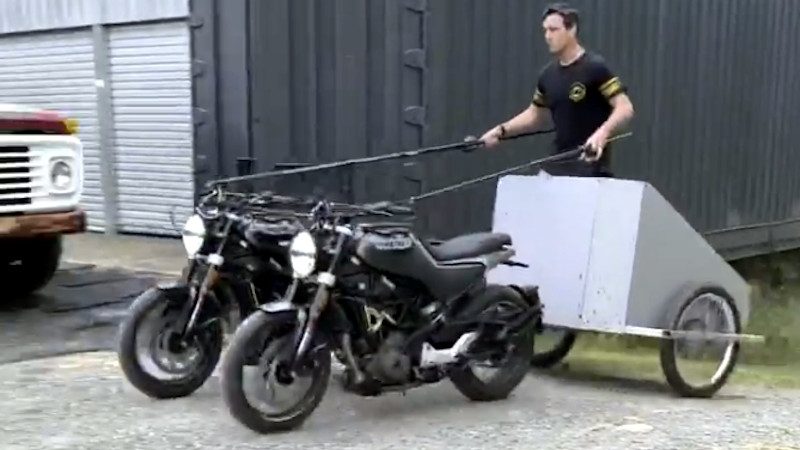
The modern example that grabbed attention is a wild motorcycle chariot built around two Husqvarna Svartpilen 401 motorcycles and piloted by Australian stunt rider Jack Field. Instead of horses, the chariot uses a pair of compact, punchy street bikes. Instead of leather reins attached to bridles, the rider stands on a two-wheeled platform and operates rigid control arms connected to the motorcycles. The result looks like ancient Rome wandered into a motorcycle paddock and immediately asked for premium fuel.
At first glance, the machine seems like a joke with excellent fabrication. Look closer, and it becomes a surprisingly clever study in balance, steering geometry, rider control, mechanical sympathy, and controlled chaos. It is not the sort of thing anyone should build for the morning commute, unless the commute includes a dirt arena, safety crew, and a crowd that has signed up to see something ridiculous. But as an exhibition vehicle, it is fascinating.
What Is A Motorcycle Chariot?
A motorcycle chariot is exactly what it sounds like: a chariot-style platform pulled by one or more motorcycles. In the earliest versions, the motorcycles often had riders on them, while a person in the chariot played the part of the dramatic Roman hero behind them. Later designs became more adventurous. Some used riderless motorcycles controlled from the chariot, turning the whole rig into a strange hybrid between a team of horses, a sidecar outfit, and a homemade race machine.
Traditional horse-drawn chariots were light, two-wheeled vehicles designed for speed and maneuverability. Motorcycle chariots borrow the same basic visual language: a standing driver, a small rear platform, and power units arranged in front like a team. The difference is that motorcycles do not respond to “whoa,” do not appreciate oats, and come with clutches, throttles, brakes, gearing, and a strong desire to keep moving forward.
That makes the motorcycle chariot a complicated toy. It needs a strong frame, reliable steering links, predictable throttle response, braking control, and enough room for the charioteer to shift body weight without being launched into tomorrow. The fun is obvious. The physics are less forgiving.
The Modern Dual-Husqvarna Chariot
Jack Field’s motorcycle chariot became internet-famous because it combined a spectacular idea with a surprisingly polished execution. Field, known for stunt riding and action-sports performances, used two Husqvarna Svartpilen 401 motorcycles as the “team” pulling the chariot. These bikes are lightweight, single-cylinder machines with enough power to make the chariot feel lively without needing superbike-level insanity.
The Svartpilen 401 is a stylish small-displacement motorcycle with a 373cc-class engine in earlier versions and roughly mid-40-horsepower output depending on market and model year. Two of them together create a setup with around 90 horsepower available in a very unusual package. That is plenty when the driver is standing behind the bikes instead of sitting on one.
How The Controls Work
The clever part is not simply attaching a cart to two motorcycles. Anyone with a welder, optimism, and questionable judgment can attach things to other things. The hard part is making the whole machine controllable. Field’s chariot uses a steel linking structure to hold the motorcycles together and rigid control arms that reach back to the driver. These arms function like modern mechanical reins.
Steering depends on controlling the front ends of the motorcycles together. The charioteer can guide the bikes by moving the control arms, while throttle and brake functions are also routed back so the rider can accelerate and slow the rig from the standing platform. It is a wonderfully absurd translation of ancient reins into modern mechanical language. Instead of persuading horses with pressure and timing, the driver is managing handlebars, engine response, and traction.
Why Two Motorcycles?
Two motorcycles make the whole chariot look properly gladiatorial, but they also serve practical purposes. A pair of bikes gives the rig a wide stance, helping it feel more stable than a single narrow motorcycle pulling a cart. It also creates visual symmetry. Ancient chariots were commonly pulled by multiple animals; two motorcycles preserve that “team” appearance while adding mechanical muscle.
Of course, two bikes also double the complexity. Both machines need to move in harmony. If one delivers power differently, turns more sharply, or brakes unevenly, the chariot can become a wrestling match. That is why a stunt professional is the right person for this job. A motorcycle chariot rewards smooth hands, calm reflexes, and the ability to look cool while every part of the machine is trying to start an argument.
A Brief History Of Motorcycle Chariot Racing
Motorcycle chariot racing is not just a viral stunt from the social media era. The sport has roots in the early 20th century, especially the 1920s and 1930s, when crowds loved mechanical spectacle. Fairgrounds, carnivals, speedways, and exhibition events were hungry for anything noisy, fast, and faintly dangerous. Motorcycle chariots checked every box.
Early motorcycle chariot races reportedly appeared in the United States as early as 1922, with events later showing up in Australia and Europe. The concept fit the mood of the time. Motorcycles were still exciting symbols of speed and modernity, while chariots had a built-in connection to ancient drama. Put them together and you got a machine that looked like history had discovered gasoline.
The popularity of big-screen chariot scenes, especially the silent-era Ben-Hur, helped feed the public imagination. Audiences already understood the visual stakes: a standing driver, a fast team, tight turns, and the possibility that dignity might leave the vehicle before the driver did. Motorcycle chariot racing took that formula and added engines.
From Carnival Madness To Modern Exhibition
In old photographs, motorcycle chariot racers often dressed like Roman warriors, complete with helmets, tunics, and theatrical flair. Some rigs used one motorcycle, some used two, and a few went even further. The machines were often crude by modern standards, but that was part of the appeal. They looked dangerous because they were dangerous.
As motorsport became more organized and safety standards improved, motorcycle chariot racing faded from regular competition. It never disappeared completely, though. Every so often, builders and stunt riders revive the idea for shows, videos, festivals, and demonstration events. Today, the motorcycle chariot is less a mainstream racing category and more a rolling tribute to the era when “because the crowd will love it” was considered a full engineering brief.
Engineering The Beautiful Nonsense
There is a temptation to look at a motorcycle chariot and think of it as pure silliness. It is silly, yes. Gloriously so. But that does not mean it is simple. A working chariot pulled by motorcycles has to solve real mechanical problems.
Frame Strength And Attachment Points
The frame connecting the motorcycles must be strong enough to handle pulling forces, steering loads, vibration, and sudden changes in direction. Motorcycles are not designed from the factory to behave like draft animals. They are built to lean, steer, brake, and accelerate with a rider centered over the machine. Locking two of them into a team changes the stress pattern dramatically.
Every attachment point matters. A weak bracket can twist. A sloppy joint can introduce wobble. A bad weld can turn a fun exhibition into a physics lesson taught at high speed. The best builds treat the frame as a real chassis, not a decorative tow bar.
Steering Without Leaning
Motorcycles normally turn through a blend of steering input, lean angle, tire profile, and rider body position. A chariot rig changes that behavior. The bikes are held upright by the connected structure and the trailing platform. That means the front wheels must do more of the turning work while the entire vehicle behaves more like a three- or four-wheeled machine than a normal motorcycle.
This is where steering geometry becomes critical. Too twitchy, and the chariot darts around like a shopping cart with ambitions. Too slow, and it refuses to turn until the edge of the arena starts looking personal. A good chariot build needs predictable steering, especially because the driver is standing and exposed.
Throttle And Brake Balance
Power delivery is another challenge. If both motorcycles accelerate evenly, the rig moves straight. If one bike pulls harder, the chariot may yaw to one side. The same principle applies under braking. Balanced braking is crucial because the charioteer cannot casually put a foot down like a rider on a motorcycle.
Modern bikes with smooth engines, good brakes, and predictable throttle response make the job easier. Still, a chariot driver must develop a feel for the machine as a complete unit. It is not enough to understand motorcycles. The rider has to understand the combined behavior of two motorcycles, a frame, a chariot, and a standing human whose knees are suddenly very interested in survival.
Why The Husqvarna Svartpilen 401 Makes Sense
The Husqvarna Svartpilen 401 is an interesting choice because it offers a useful blend of style, manageable size, and lively performance. It is not huge, which helps keep the rig from becoming too heavy. It has enough power to be entertaining, but not so much that the chariot becomes a rocket-powered lawsuit. Its upright proportions and exposed structure also make it easier to integrate visually into a custom frame.
There is also the look. The Svartpilen has a minimalist, rugged, neo-retro design. Two of them side by side give the chariot a clean mechanical presence. They do not look like random motorcycles dragged into a prank. They look like they were recruited for a very specific mission and are quietly proud of it.
Is A Motorcycle Chariot Safe?
Let’s answer that carefully: a motorcycle chariot can be operated more safely when built properly, maintained carefully, used in a controlled environment, and driven by a trained professional wearing protective gear. That is not the same as saying it is safe in the casual backyard sense. This is not a weekend project for someone whose toolbox is mostly zip ties and confidence.
Motorcycling already comes with real risk because riders are exposed and vehicles are smaller than cars. Add a standing platform, multiple power units, and custom controls, and the safety margin gets thinner. A serious setup should include helmets, gloves, boots, protective clothing, a controlled course, emergency planning, mechanical inspections, and spectators kept far away from the action.
It is also important to separate exhibition machines from road vehicles. A motorcycle chariot may be amazing in an arena, showground, or private demonstration area, but that does not mean it belongs on public roads. Registration rules, lighting, braking requirements, vehicle classification, insurance, and basic common sense all stand in the way. Public traffic is no place for a rolling Roman cosplay experiment.
Why People Love Machines Like This
The appeal of a motorcycle chariot is bigger than speed. Plenty of machines are faster. The appeal is imagination made physical. It takes a question that sounds like it was asked at midnight in a garage“What if we replaced horses with motorcycles?”and answers it with metal, noise, and tire tracks.
People love these builds because they break the pattern. Most vehicles are optimized for transportation, racing, hauling, comfort, or efficiency. A motorcycle chariot is optimized for surprise. It makes people stop scrolling. It makes gearheads lean forward. It makes historians sigh deeply and then secretly keep watching.
There is also something charming about the blend of old and new. Chariots are among the most iconic vehicles in human history. Motorcycles are among the most emotional modern machines. Combine them, and the result feels both ancient and futuristic, like a museum exhibit escaped and joined an action-sports team.
Could Motorcycle Chariot Racing Return?
As a mainstream sport, probably not. Modern motorsport requires strict safety rules, insurance, track standards, participant training, and predictable vehicle classes. Motorcycle chariots are too specialized and too risky to become the next big racing league. You are unlikely to see a national championship with factory teams, energy drink sponsors, and fantasy chariot picks anytime soon.
As an exhibition category, however, the idea has legsor wheels, technically. Motorcycle chariot demonstrations fit perfectly at stunt shows, agricultural fairs, motorcycle festivals, and special arena events. They are visual, loud, easy to understand, and unusual enough to stand out in a world where audiences have already seen backflips, burnouts, and monster trucks launching over things that probably had families.
The key is professionalism. Modern audiences still enjoy danger, but they prefer danger that has been rehearsed, engineered, and surrounded by barriers. A well-run motorcycle chariot show can deliver old-school spectacle with modern caution. That balance is exactly where the concept shines.
What Builders Can Learn From The Motorcycle Chariot
Even if you never plan to build a motorcycle chariot, the concept offers useful lessons for custom vehicle design. First, controls matter. A wild idea becomes usable only when the driver can operate it intuitively. Second, symmetry matters. When two power units work together, small differences can become big handling problems. Third, testing matters. A machine like this should be developed slowly, with low-speed trials, careful adjustments, and a healthy respect for what can go wrong.
The best custom machines are not just outrageous; they are understandable. You can look at Field’s chariot and see the logic. Two bikes in front. Chariot behind. Control arms in hand. Strong frame tying the system together. It is bizarre, but it is not random. That is why it works as both a stunt vehicle and a piece of mechanical storytelling.
Experience: What It Might Feel Like To Stand Behind A Team Of Motorcycles
Imagine stepping onto the chariot platform for the first time. There is no cozy seat, no windshield, no dashboard pretending everything is normal. You stand upright with your boots planted on a small platform, hands wrapped around the control arms, and two motorcycles waiting in front of you like mechanical horses with idle problems. The engines thump and vibrate through the frame. The smell of fuel, rubber, dust, and hot metal hangs in the air. Somewhere nearby, a crowd is expecting entertainment. No pressure, Caesar.
The first movement would probably feel strange. On a normal motorcycle, your body is part of the machine. You sit, lean, grip the tank, and use subtle inputs. On a motorcycle chariot, the power is ahead of you. The whole rig pulls from the front, and you feel the platform respond after the motorcycles begin to move. It is more like driving a tiny, angry parade float than riding a bike.
At low speed, the biggest sensation would be trust-building. You would feel how much input the control arms need, how quickly the front ends respond, and how the chariot tracks behind the motorcycles. Every small correction would teach you something. Too much steering and the rig might lurch. Too much throttle and the motorcycles remind you that they are not decorative. Too much bravery and your brain files a formal complaint.
Once the speed rises, the experience would become more physical. Wind hits your chest. The platform jiggles over the surface. Your knees act like suspension. Your arms manage steering and speed while your eyes scan far ahead, looking for the line through the turn. Unlike sitting in a car, you cannot hide from the movement. The chariot tells you everything it is doing, sometimes politely and sometimes through your spine.
The turns would be the main event. A motorcycle wants to lean, but this rig behaves more like a custom multi-wheel machine. You would need to prepare early, guide the motorcycles smoothly, and keep your weight balanced. A clean turn would feel heroic. A sloppy one would feel like being corrected by a very loud physics teacher. The driver’s job is not to dominate the machine, but to stay ahead of it mentally.
The most exciting part would be the connection between absurdity and skill. From the outside, spectators see comedy, speed, and spectacle. From the platform, the driver feels timing, vibration, load transfer, traction, and consequence. That contrast is what makes the motorcycle chariot so compelling. It looks ridiculous because it is ridiculous, but operating it well is serious work.
There would also be a strange emotional pull. Humans have watched chariots for thousands of years. We understand the shape instinctively: driver behind, power in front, wheels below, danger everywhere. Replacing horses with motorcycles does not erase that ancient drama. It updates it. The roar of engines becomes the thunder of hooves. The control arms become reins. The arena becomes a modern Circus Maximus, preferably with better medical staff and fewer emperors making eye contact.
After stepping off, the memory would likely arrive in pieces: the first surge forward, the noise of both engines together, the tiny panic before the first turn, the relief when the rig obeyed, the grin you tried to suppress because you are a dignified adult and definitely not a child who just discovered the world’s loudest wagon. That is the magic of machines like this. They do not merely move people across ground. They move imagination into reality.
Conclusion
The motorcycle-pulled chariot is one of those inventions that sounds impossible, unnecessary, and brilliant in the same breath. It revives the drama of ancient chariot racing, filters it through 20th-century carnival madness, and gives it a modern stunt-riding twist. Jack Field’s dual-Husqvarna build proves that the idea can be more than a meme. With thoughtful engineering and professional control, it becomes a real machine capable of putting on a show.
Still, the lesson is not “go build one and take it to the grocery store.” The lesson is that creativity and mechanics can make something unforgettable when handled with skill. A motorcycle chariot is dangerous, impractical, loud, and deeply funnybut it is also clever, historical, and strangely beautiful. In a world full of sensible transportation, there is room to appreciate a vehicle that exists mainly to make people point, laugh, and say, “Wait, are those motorcycles pulling a chariot?”
Note: This article is synthesized from real motorcycle chariot history, modern stunt-riding examples, motorcycle specifications, and established motorcycle safety guidance. It is written for informational and entertainment purposes only; motorcycle chariots should be operated only by trained professionals in controlled environments.