Note: This article is for educational purposes only and is not personalized financial advice.
Some investors rebalance their portfolios once a year like clockwork. Others wait until their allocation looks so crooked it could hang in a funhouse. The Larry Swedroe 5/25 Rule sits neatly in the middle. It is structured without being fussy, disciplined without being dramatic, and practical enough for investors who want rules instead of feelings doing all the heavy lifting.
At its core, the rule answers one deceptively simple question: When should you rebalance? Not every tiny market wiggle deserves a full portfolio makeover. But waiting too long can turn a carefully designed asset allocation into something that no longer matches your risk tolerance. That is where the 5/25 Rule shines. It gives investors a clear threshold for action, helping them avoid both overtrading and full-blown neglect.
If that sounds refreshingly sane, welcome to the club. Let’s break down what the rule means, how it works, where it helps, and why it remains one of the cleanest rebalancing frameworks around.
What Is the Larry Swedroe 5/25 Rule?
The Larry Swedroe 5/25 Rule is a threshold-based portfolio rebalancing rule. It says you should rebalance an asset class when its actual portfolio weight drifts by the lesser of:
- 5 percentage points, or
- 25% of its target allocation.
In plain English, the rule creates guardrails around your target allocation. Once an asset class moves too far outside its lane, you rebalance.
Here is the quick formula:
Rebalancing trigger = target allocation ± min(5 percentage points, 25% of target allocation)
This rule is often discussed in the context of diversified, long-term portfolios that include broad asset classes such as U.S. stocks, international stocks, bonds, REITs, small-cap value, or emerging markets. It is not a meme-stock babysitter. It is a framework for allocation discipline.
Why the 5/25 Rule Exists
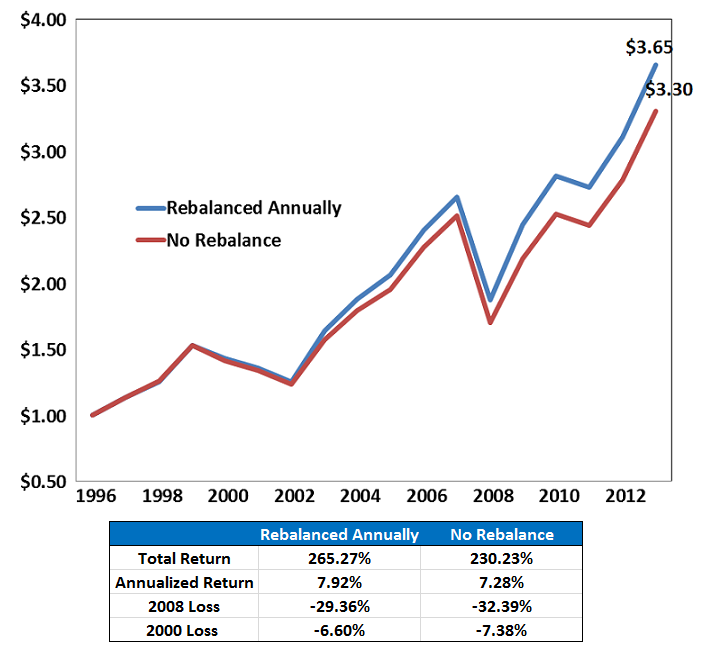
Rebalancing sounds boring until you remember what happens when you do not do it. A portfolio built to be balanced can drift surprisingly far over time. Stocks rally for years, bonds lag, international funds fall behind domestic funds, or one tiny satellite sleeve suddenly starts acting like the star of the show. Without rebalancing, your risk profile changes even if your goals have not.
The 5/25 Rule exists to solve three common problems.
1. It controls portfolio drift
If you started with a 60/40 portfolio and now it is effectively 70/30, you are not holding the same risk profile anymore. You may still call it your “balanced portfolio,” but the math has quietly filed an objection.
2. It helps you buy low and sell high
Rebalancing forces a simple discipline: trim what has become overweight and add to what has become underweight. No crystal ball required. No dramatic CNBC soundtrack necessary. Just a rule.
3. It avoids excessive trading
One danger of constant monitoring is that investors start trading every time the market sneezes. The 5/25 Rule sets meaningful tolerance bands, so you are not rearranging furniture every afternoon because one chair moved half an inch.
How the Math Works
The easiest way to understand the Larry Swedroe 5/25 Rule is to split it into two camps: larger allocations and smaller allocations.
Large allocations: the 5% rule usually applies
Suppose your target portfolio includes:
- 60% stocks
- 40% bonds
For the 60% stock allocation, 25% of the target would be 15 percentage points. Since the rule says to use the lesser of 5 percentage points or 25% of the target, the trigger becomes 5 percentage points.
That means you would rebalance if stocks moved outside:
- 55% on the low end
- 65% on the high end
Likewise, the 40% bond sleeve would trigger rebalancing outside:
- 35%
- 45%
This works well for big building blocks because a 5-point move is already meaningful.
Small allocations: the 25% rule usually applies
Now let’s say you have a 10% allocation to small-cap value.
Twenty-five percent of 10% is 2.5 percentage points. Since 2.5 is less than 5, the relative threshold applies.
That means the rebalance band becomes:
- 7.5% on the low end
- 12.5% on the high end
Here is another example. If you allocate 5% to REITs, then 25% of 5% is 1.25 percentage points. Your band becomes:
- 3.75%
- 6.25%
This is one of the smartest parts of the rule. A flat 5-point rule would make tiny allocations almost impossible to manage properly. A 5% sleeve could practically disappear before a plain 5-point trigger noticed anything was wrong. The relative threshold fixes that problem.
The 20% Breakpoint: Why It Matters
A useful shortcut is this: when an asset class is 20% or more of the portfolio, the 5-point threshold usually applies. When it is below 20%, the 25%-of-target threshold usually applies.
Why? Because 25% of 20% equals 5 percentage points. That is the crossover point.
So if your portfolio has:
- 30% international stocks, use a 5-point band
- 10% emerging markets, use a 25%-of-target band
- 5% gold or commodities, definitely use the relative band
This makes the rule elegant. Bigger allocations get a fixed tolerance, while smaller slices get a proportional one.
How to Apply the 5/25 Rule in Real Life
The rule sounds mathematical, but the actual process is very manageable.
Step 1: Set target allocations
You need a target portfolio before you can measure drift. That could be simple, like 70% stocks and 30% bonds, or more detailed, like:
- 40% U.S. total stock market
- 20% international developed markets
- 10% emerging markets
- 20% bonds
- 10% REITs
If the targets are fuzzy, the rebalancing rule will be fuzzy too. And fuzzy portfolio management has a habit of turning into “I’ll deal with it later.”
Step 2: Calculate the bands
For each asset class, determine the rebalancing threshold using the lesser of 5 percentage points or 25% of the target.
For the example above:
- 40% U.S. stocks: rebalance outside 35% to 45%
- 20% international developed: rebalance outside 15% to 25%
- 10% emerging markets: rebalance outside 7.5% to 12.5%
- 20% bonds: rebalance outside 15% to 25%
- 10% REITs: rebalance outside 7.5% to 12.5%
Step 3: Review the portfolio periodically
The 5/25 Rule is threshold-based, but that does not mean you need to watch your portfolio like a hawk guarding a spreadsheet. Many investors check quarterly, semiannually, or annually. The key is consistency. The trigger determines whether you trade; your review schedule determines when you notice.
Step 4: Rebalance intelligently
When a band is breached, rebalance back toward your target. Often the most tax-efficient method is to:
- direct new contributions to underweight assets,
- use dividends or interest instead of automatically reinvesting everywhere,
- rebalance inside tax-advantaged accounts first, and
- avoid realizing taxable gains unless necessary.
That last point matters. A technically perfect rebalance can still be a practical mess if it creates an ugly tax bill.
5/25 Rule vs. Calendar Rebalancing
Investors generally fall into two rebalancing camps: calendar-based and threshold-based.
Calendar-based rebalancing
This means you rebalance on a schedule, such as once a year. It is simple, easy to automate, and great for investors who prefer a maintenance calendar over constant measurement.
Threshold-based rebalancing
This means you rebalance only when portfolio weights drift past pre-set bands. The 5/25 Rule is a classic threshold-based method.
So which is better? In practice, many investors combine both approaches. They check the portfolio on a regular schedule, but they only trade if the drift has crossed the 5/25 thresholds. That hybrid approach gives you discipline without turning investing into a hobby you accidentally work overtime on.
Advantages of the Larry Swedroe 5/25 Rule
It is clear and objective
Good investing rules reduce the number of emotional decisions you have to make. The 5/25 Rule tells you what to do before markets get weird.
It respects portfolio structure
Small allocations do not behave like large ones. This rule understands that and adjusts accordingly.
It reduces overtrading
Small market moves do not automatically trigger action. That can save on transaction costs, taxes, and unnecessary second-guessing.
It reinforces risk management
One of the main jobs of rebalancing is not to squeeze out magic returns. It is to keep your portfolio aligned with the risk you actually intended to take.
Potential Drawbacks
It still requires monitoring
This is not a set-it-and-forget-it rule. It is more like set-it-and-check-it-before-it-turns-into-a-chaos-goblin.
It can create taxes in taxable accounts
If rebalancing requires selling appreciated assets in a taxable brokerage account, you may realize capital gains. That is why many investors prefer to rebalance with new money or inside retirement accounts when possible.
It is not a return cheat code
The 5/25 Rule can improve discipline and maintain risk. It is not a guarantee of higher returns. Sometimes rebalancing will feel brilliant. Sometimes it will feel like you sold the winner too early. Welcome to long-term investing.
Common Mistakes Investors Make
Confusing allocation drift with price changes
The rule is about portfolio weight, not raw investment performance. An asset can rise 30% and still remain within its allocation band if other assets rose too.
Applying the rule to random individual stocks
The 5/25 Rule works best with diversified asset classes or sleeves inside an asset allocation plan. It is not really designed for a portfolio that looks like a group chat of hot takes.
Ignoring contributions and withdrawals
Cash flows can do a lot of the rebalancing work for you. New money can top up lagging assets. Withdrawals can come from overweight assets. That can reduce the need for taxable sales.
Rebalancing without revisiting goals
If your financial goals, time horizon, or risk tolerance have changed, it may be time to revisit the target allocation itself. Rebalancing back to an outdated plan is still following the wrong map.
A Full Example of the Larry Swedroe 5/25 Rule
Let’s build a sample portfolio:
- 50% U.S. stocks
- 20% international stocks
- 20% bonds
- 10% small-cap value
The bands would look like this:
- 50% U.S. stocks: 45% to 55%
- 20% international stocks: 15% to 25%
- 20% bonds: 15% to 25%
- 10% small-cap value: 7.5% to 12.5%
Now imagine a few years pass and the portfolio drifts to:
- 56% U.S. stocks
- 18% international stocks
- 17% bonds
- 9% small-cap value
Only one allocation has clearly breached its band: U.S. stocks at 56%. That is above the 55% upper threshold. In that case, the portfolio is due for a rebalance. You might trim U.S. stocks and redirect the proceeds to the sleeves that are below target, especially bonds and international stocks.
Notice what the rule does here. It keeps you from rebalancing every small deviation, but it also stops the largest position from quietly taking over the entire portfolio.
Who Should Consider Using the 5/25 Rule?
This rule is a strong fit for investors who:
- have a written asset allocation plan,
- use diversified funds or ETFs,
- want a rules-based rebalancing process,
- prefer threshold-based discipline over constant tinkering, and
- care about keeping risk aligned with long-term goals.
It may be especially useful for DIY investors who want more sophistication than “rebalance every New Year’s Day,” but less complexity than building a fully custom institutional process.
Final Thoughts
The Larry Swedroe 5/25 Rule is popular for a reason: it is practical, intuitive, and built for real portfolios. It recognizes that a 40% bond allocation and a 5% REIT slice should not be treated the same way. It also recognizes that discipline matters more than drama.
At a deeper level, the rule is not really about chasing returns. It is about preserving the investment plan you chose in the first place. That can sound almost too simple, but simplicity is often exactly what investors need when markets get loud.
If you want a rebalancing framework that is smarter than pure calendar timing, more flexible than one-size-fits-all bands, and easier to follow than some advisor jargon tornado, the 5/25 Rule is worth serious attention. It gives your portfolio boundaries, gives your decisions structure, and gives your emotions fewer opportunities to start redecorating the place.
Experiences and Practical Lessons Related to the Larry Swedroe 5/25 Rule
One of the most common real-world experiences investors describe with the Larry Swedroe 5/25 Rule is relief. Not excitement. Not fireworks. Relief. That might not sound glamorous, but it is a real benefit. A lot of investors spend years wondering whether they should rebalance because stocks have surged, bonds have slumped, or one international sleeve has been dragged through the mud. The 5/25 Rule removes a surprising amount of mental clutter. Instead of debating every market move, investors can simply ask, “Did the allocation drift past the band?” If the answer is no, they move on. If the answer is yes, they act. That simplicity can be emotionally powerful.
Another experience many long-term investors report is that the rule often leads to fewer trades than expected. On paper, threshold-based rebalancing sounds active. In reality, investors who are still accumulating wealth can often handle a lot of the work with new contributions. If one sleeve is underweight, they simply direct fresh cash there. That means the 5/25 Rule is not always a sell-sell-sell process. In many cases, it becomes a calm “send the next contribution to the lagging fund” process. For younger investors, that can make the rule feel surprisingly low-maintenance.
Retirees and near-retirees often experience the rule differently. For them, withdrawals matter just as much as contributions once did. A practical lesson is that distributions can come from overweight asset classes first. If stocks have run well and bonds are light, a retiree may fund spending from the appreciated stock sleeve and leave the bond allocation alone, or even top it back up. In that sense, the 5/25 Rule can serve as a withdrawal guide as well as a rebalancing guide. It adds logic to the question of what to sell first.
There is also a psychological challenge that shows up again and again: rebalancing rarely feels comfortable in the moment. When an asset class is underweight, there is usually a reason. It may have just had a terrible run. Buying more of it can feel unnatural. Likewise, trimming an overweight winner can feel like interrupting a great party. Investors who stick with the rule often say the hardest part is not the math. It is trusting the plan when the plan feels slightly annoying. That is exactly why rules matter.
Perhaps the biggest practical takeaway is this: the 5/25 Rule works best when paired with a written investment policy, a reasonable review schedule, and tax awareness. Investors who use it casually tend to drift into inconsistency. Investors who define their targets, calculate their bands, and decide in advance how to rebalance usually find the process far smoother. In real life, the rule is less about being clever and more about being consistent. And in investing, consistency is often where the quiet wins live.