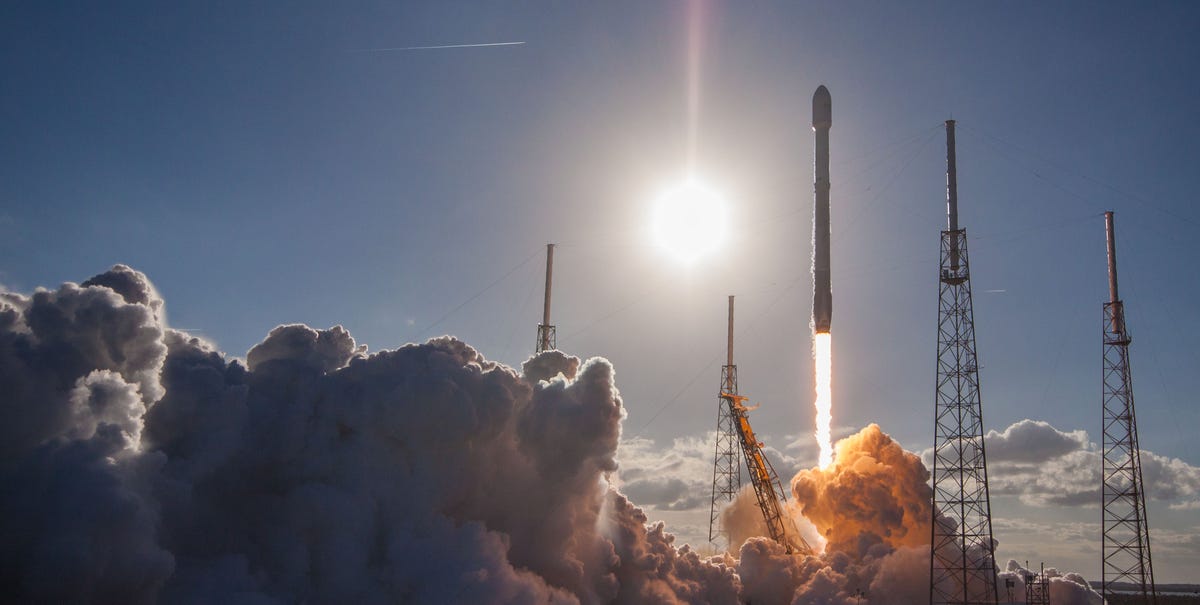
On April 18, 2018, SpaceX successfully launched NASA’s Transiting Exoplanet Survey Satellite, better known as TESS, from Space Launch Complex 40 at Cape Canaveral Air Force Station in Florida. The mission sounded simple enough: send a compact space telescope into orbit and ask it to stare at the sky until it spots tiny dips in starlight. In reality, TESS was built to help answer one of humanity’s biggest questions: how many worlds are out there?
The answer, as TESS keeps proving, is “a lot.” Possibly “please sit down before opening the spreadsheet” levels of a lot. After riding a Falcon 9 rocket into space, TESS began a planet-hunting mission designed to scan bright, nearby stars for exoplanets, which are planets orbiting stars beyond our solar system. Instead of taking postcard-style photos of alien beaches, TESS searches for the brief dimming that happens when a planet crosses in front of its star from our point of view. This is called the transit method, and it is basically cosmic hide-and-seek with better math.
Years after launch, the mission has moved far beyond “successful liftoff.” TESS completed its two-year primary mission, continued through extended mission phases, and became one of the most productive exoplanet discovery tools ever placed in space. Its observations have helped scientists identify hundreds of confirmed planets and thousands of planet candidates, while also supporting studies of stars, supernovae, asteroids, black holes, and other objects that apparently did not want planets to get all the attention.
Why the TESS Launch Mattered
The SpaceX TESS launch was not just another rocket launch with dramatic fire, smoke, and engineers calmly wearing headsets while everyone else held their breath. It marked a major step in NASA’s transition from discovering that exoplanets exist to studying worlds around nearby, bright stars in detail. Earlier missions, especially Kepler, proved that planets are common across the galaxy. TESS was designed to find targets closer to Earth and easier for powerful observatories to follow up.
That difference matters. A planet orbiting a bright nearby star is far easier to study than one circling a faint star thousands of light-years away. When TESS detects a promising candidate, astronomers can use ground-based telescopes, the Hubble Space Telescope, the James Webb Space Telescope, and other observatories to investigate the planet’s size, mass, orbit, and sometimes even clues about its atmosphere. TESS does not work alone; it is more like the talent scout of the exoplanet world, pointing the big instruments toward the most interesting auditions.
The Launch: Falcon 9 Delivers TESS to Space
TESS launched aboard a SpaceX Falcon 9 rocket on April 18, 2018. The rocket lifted off from Cape Canaveral and carried the spacecraft toward a highly elliptical orbit around Earth. After the upper stage completed its planned burns, TESS separated from Falcon 9 and began flying on its own, officially starting the journey toward its science mission.
SpaceX also successfully landed the Falcon 9 first stage on the drone ship “Of Course I Still Love You” in the Atlantic Ocean. Yes, that is the actual name. Spaceflight is full of precision engineering, orbital mechanics, and occasionally a sense of humor that sounds like it escaped from a science-fiction bookshelf.
The landing mattered because reusable rocket technology has become a major part of modern spaceflight. By recovering first-stage boosters, SpaceX demonstrated a model that could reduce launch costs and increase launch frequency. For science missions like TESS, that matters because the less money spent simply reaching space, the more ambitious future missions can become. Rockets are still not cheap, but reusable boosters help make space exploration feel a little less like throwing a luxury apartment building into the ocean after one use.
What TESS Was Designed to Do
TESS stands for Transiting Exoplanet Survey Satellite. Its main job is to watch large sections of the sky and measure the brightness of stars with extreme precision. When a planet passes in front of its host star, it blocks a tiny amount of light. That tiny dip can reveal the presence of a planet, especially when the dimming repeats on a regular schedule.
The spacecraft uses four wide-field cameras to monitor huge patches of sky. During its primary mission, TESS surveyed both the southern and northern skies, observing one sector at a time for about 27 days. This approach allowed it to cover a much broader area than earlier missions focused on smaller regions of space.
TESS was built to search hundreds of thousands of nearby bright stars. These stars are valuable because they are easier to observe again from Earth or with other space telescopes. If Kepler taught us that planets are everywhere, TESS helps scientists find the ones close enough for deeper investigation.
How the Transit Method Works
Imagine someone walking in front of a lamp. The room gets slightly dimmer for a moment. Now imagine that lamp is a star, the person is a planet, and the room is a telescope millions of miles away trying very hard not to blink. That is the basic idea behind the transit method.
When a planet crosses, or transits, in front of its star, the star’s brightness dips by a small but measurable amount. The size of the dip can help scientists estimate the planet’s size. The timing between repeated dips reveals the planet’s orbital period. With follow-up observations, researchers can sometimes determine the planet’s mass, density, and whether it is likely rocky, gaseous, or somewhere in between.
This method works best when the planet’s orbit lines up with our viewpoint. Not every planet transits from Earth’s perspective, which means TESS is only seeing part of the galactic neighborhood. Even so, the number of discoveries has been enormous. Space, it turns out, is not shy about making planets.
TESS After Launch: From First Survey to Extended Missions
After launch, TESS went through commissioning and calibration before beginning regular science observations. Its primary mission lasted two years and imaged a large majority of the sky. During that time, TESS transformed from a newly launched spacecraft into a steady discovery machine.
NASA later extended the mission, allowing TESS to keep observing the sky and revisit regions it had already scanned. This is important because repeated observations can reveal planets with longer orbital periods, improve the quality of earlier detections, and help scientists understand variable stars and other changing objects.
By the end of its second extended mission, TESS had helped identify thousands of confirmed and candidate exoplanets. Recent mission updates show that TESS data continues to fuel new research, including large-scale searches using machine learning and citizen science projects. In other words, the telescope is still doing its job, and researchers are still finding new ways to squeeze discoveries from its data like cosmic lemonade.
What Has TESS Found?
TESS has discovered a wide variety of worlds. Some are hot Jupiters, massive gas giants orbiting close to their stars. Others are super-Earths, planets larger than Earth but smaller than Neptune. Some are mini-Neptunes, mysterious worlds that do not have a close match in our own solar system. TESS has also found planets around small red dwarf stars, young stars, binary stars, and other systems that help astronomers understand how planets form and evolve.
One reason TESS is so valuable is that it does not only produce headline-grabbing planets. It produces patterns. The more planets scientists find, the better they can estimate how common different types of planets are. Are small rocky planets common? How often do planets form around cool stars? How many systems have multiple planets packed close together? TESS helps turn those questions from speculation into statistics.
TESS and the Search for Habitable Worlds
Whenever people hear “planet-hunting telescope,” one question immediately jumps into the room wearing moon boots: did it find another Earth? TESS was not designed to prove that a planet is habitable on its own. Its job is to find candidates, especially around nearby bright stars. Whether a planet could support life requires much more information, including its atmosphere, temperature, star type, radiation environment, and orbital conditions.
Still, TESS is an essential part of the search for potentially habitable worlds. A small planet orbiting in the habitable zone of a nearby star becomes a strong target for follow-up research. The habitable zone is the region where liquid water could exist on a planet’s surface under the right conditions. It is not a guarantee of palm trees, oceans, or friendly space dolphins. It simply means the planet is worth studying more closely.
The James Webb Space Telescope and future observatories can examine some TESS-discovered planets in more detail. For certain planets, scientists may be able to study atmospheric signatures, cloud properties, or chemical hints that reveal what kind of world they are dealing with. TESS opens the door; other observatories walk in with a clipboard and a very serious expression.
Why SpaceX Was Important to the Mission
The success of the SpaceX TESS launch highlighted the growing relationship between NASA science missions and commercial launch providers. Falcon 9 delivered the spacecraft efficiently, and the successful booster landing showed how reusable rockets were becoming routine rather than experimental.
For NASA, reliable commercial launch services help support a wide range of missions, from Earth observation and planetary science to astrophysics and crewed spaceflight. For SpaceX, missions like TESS demonstrated that Falcon 9 could serve not only communications companies and cargo missions but also high-value scientific spacecraft. That combination helped shape the modern launch market.
It also made the launch memorable for the public. Watching a rocket send a planet-hunting telescope into space is already exciting. Watching the first stage return and land on a floating platform afterward adds a second act. It is like seeing a delivery truck drop off a telescope in orbit and then parallel park in the ocean.
TESS Data Is a Treasure Chest
One of the most powerful things about TESS is that its data is useful long after the spacecraft collects it. Astronomers around the world can study TESS light curves to search for planets, analyze stars, identify unusual events, and test new detection methods. The mission’s public data has become a rich archive for professional scientists, students, and citizen scientists.
Recent research has shown that advanced data analysis, including machine learning, can uncover additional planet candidates hidden in earlier TESS observations. This means the mission’s discovery count can continue growing even from data already collected. TESS is not just a telescope; it is also a long-term scientific library, except the books are written in brightness measurements and the librarian is very picky about noise.
Citizen Science and the Human Side of Discovery
TESS has also helped bring everyday space fans into real scientific work. Citizen science programs allow volunteers to examine light curves and help identify possible planet signals. Human eyes can sometimes notice patterns that automated systems miss, especially when data is messy or unusual.
This collaboration between professional astronomers, algorithms, and public volunteers is one of the most exciting parts of modern astronomy. The next interesting planet candidate may be spotted by a researcher at a major institution, a machine learning model, or a curious person at home with a laptop and a suspicious amount of coffee. Science has become a team sport, and TESS keeps passing the ball.
The Bigger Picture: From Launch Pad to Galactic Census
The successful SpaceX launch of TESS was a beginning, not the whole story. Since 2018, the mission has helped expand humanity’s understanding of how common planets are and how diverse planetary systems can be. It has contributed to the growing catalog of confirmed exoplanets and given scientists thousands of targets for future study.
Before the 1990s, no planets beyond our solar system had been confirmed. Today, thousands are known, and TESS has played a major role in pushing that number higher. This shift is one of the most dramatic changes in modern astronomy. We have gone from wondering whether planets are rare to realizing that the galaxy may be packed with them. The night sky is no longer just a field of stars; it is a map of possible worlds.
Updated Perspective: Why TESS Still Matters Today
The “updated” part of the TESS story is that the mission remains scientifically important years after launch. TESS continues to provide valuable observations, and its archive continues to support new discoveries. The mission has also become a bridge between past, present, and future exoplanet science.
Kepler gave astronomers a revolutionary statistical view of planet abundance. TESS focuses on nearby bright stars that are ideal for follow-up. Webb and future telescopes can study selected planets in greater detail. Together, these missions form a pipeline: discover, confirm, characterize, and eventually search for signs that may point to habitability.
That pipeline is still developing, but TESS has secured its place in it. Its launch on a SpaceX Falcon 9 was the moment a small spacecraft began a very large job: helping humanity find its neighbors in the galaxy.
Experiences and Reflections: Watching the TESS Story Unfold
Following the TESS mission from launch to long-term discovery feels a bit like watching a quiet student become the class overachiever. At first, the public excitement focused on the launch itself. The rocket rose from Florida, the booster landed, and headlines celebrated another successful SpaceX mission. But the deeper story unfolded slowly, sector by sector, star by star, dip by dip.
One of the most interesting experiences related to TESS is realizing how patient space science can be. A rocket launch is loud, fast, and dramatic. Planet discovery is almost the opposite. It requires careful observation, repeated measurements, statistical confidence, and follow-up work. A promising signal might be a planet, but it might also be a stellar companion, an eclipsing binary, instrument noise, or some other cosmic prank. Astronomy is full of “maybe,” and TESS turns many of those maybes into testable targets.
For anyone interested in space, TESS is a great reminder that discovery does not always look like a dramatic movie scene. Sometimes it looks like a graph with a tiny dip in it. That dip may represent a planet hundreds of light-years away crossing in front of its star. It is not flashy at first glance, but once you understand what it means, the graph becomes thrilling. Somewhere out there, a world moved across a star, and a spacecraft near Earth noticed.
The mission also changes how we look at the night sky. Most people see stars as distant points of light. TESS encourages us to imagine those points as suns with systems of their own. Some may host scorching gas giants. Some may have compact systems of rocky planets. Some may have worlds unlike anything in our solar system. Once you absorb that idea, the sky feels less empty and more crowded, like a neighborhood where everyone forgot to turn on the porch lights.
Another meaningful experience is seeing how many groups contribute to one mission. NASA, MIT, SpaceX, observatories, data scientists, citizen scientists, and international researchers all play different roles. The launch provider gets the spacecraft into space. Engineers keep it healthy. Scientists design surveys and analyze results. Volunteers help inspect data. Other telescopes confirm and characterize candidates. No single group “owns” the wonder. It is shared work, and that is part of what makes it inspiring.
TESS is also a powerful educational topic because it connects big ideas with understandable methods. Students can grasp the transit method with a flashlight and a ball. Writers can explain it without needing to wrestle quantum mechanics into a chair. Readers can understand why a small change in brightness matters. That accessibility gives the mission public appeal. It makes exoplanet science feel less like a locked laboratory and more like an invitation.
Perhaps the best takeaway from the TESS launch and mission is that space exploration is cumulative. The launch lasted minutes. The mission has lasted years. The data may remain useful for decades. Future scientists may use TESS observations in ways that were not obvious when the spacecraft first left Earth. That is the beauty of a well-designed science mission: it keeps giving.
SpaceX successfully launching TESS was a milestone, but TESS successfully changing how we search for planets is the real headline. The rocket opened the door. The telescope looked through it. And on the other side, the universe was full of worlds.
Conclusion
The successful SpaceX launch of NASA’s TESS space telescope marked a major moment in the modern search for exoplanets. Launched aboard Falcon 9 in 2018, TESS was designed to survey nearby bright stars and identify planets using the transit method. Since then, it has completed its primary mission, continued through extended science operations, and helped build one of the richest catalogs of planet candidates in astronomy.
TESS matters because it finds worlds that other telescopes can study more deeply. It connects rocket innovation, space-based observation, data science, and public participation into one powerful mission. From a launch pad in Florida to a growing map of distant worlds, TESS has turned a successful liftoff into a long-running discovery story. Not bad for a spacecraft whose main hobby is watching stars blink.