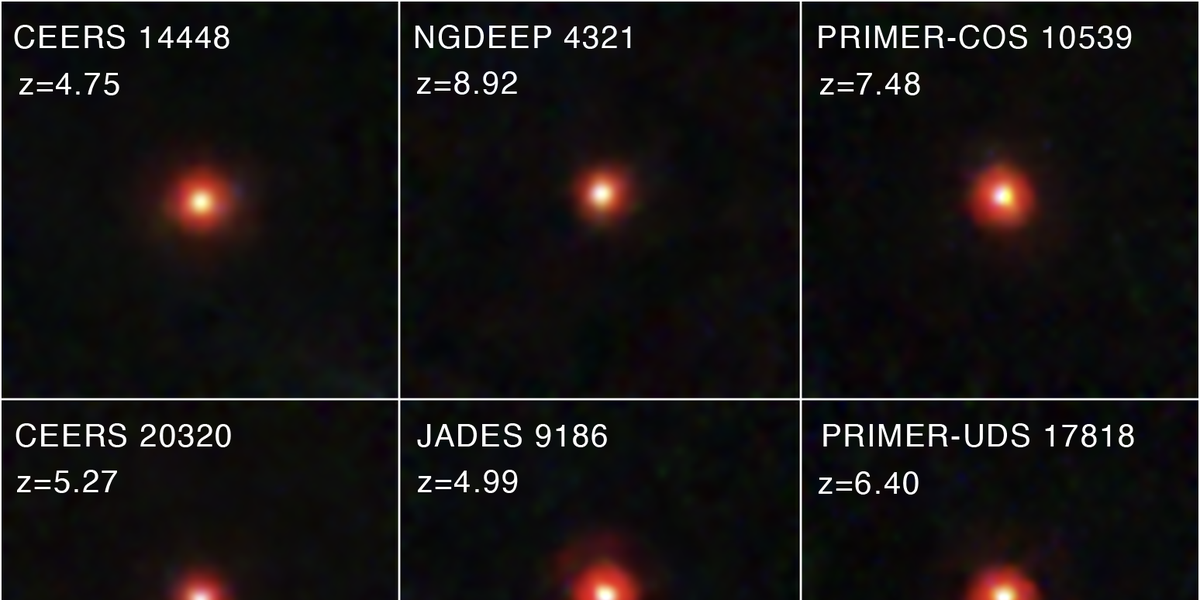
For a brief and wonderfully dramatic moment, some of the universe’s tiniest-looking objects seemed ready to kick over the furniture of modern cosmology. In early images from the James Webb Space Telescope, astronomers spotted compact, reddish specks from the young universe. They were nicknamed “little red dots,” which sounds like something a preschooler might name during art class. In reality, these objects became one of the most serious early-universe puzzles JWST has delivered.
The problem was simple to state and hard to solve: if these little red dots were galaxies powered mostly by stars, then many appeared too massive, too bright, and too numerous for their age. Some seemed to come from a time only hundreds of millions to about 1.5 billion years after the Big Bang. That is cosmic infancy. Finding huge mature galaxies there would be like opening a baby album and seeing a toddler with a mortgage, a 401(k), and strong opinions about kitchen countertops.
But science is not a panic button. It is more like a suspicious detective with a notebook. After more observations, especially JWST spectroscopy, researchers now think many little red dots may not be impossible star-packed galaxies after all. A large share of their light may come from accreting black holes, dense gas cocoons, hot dust, or strange short-lived stellar structures. Cosmology may not be broken. It may simply have found a new drawer full of weird socks.
What Are “Little Red Dots”?
Little red dots, often shortened to LRDs, are compact, red, distant sources discovered in large numbers in JWST deep-field observations. They are not red because someone turned up the saturation slider. Their redness is partly caused by cosmic redshift: as the universe expands, light traveling across billions of years is stretched toward longer, redder wavelengths.
JWST was built to see this kind of ancient infrared light. Older telescopes such as Hubble were excellent, but they were not designed to study the earliest, most heavily redshifted galaxies with the same sensitivity. Webb’s infrared eyes changed the game. Suddenly, astronomers were seeing faint objects that had been hiding in plain cosmic darkness.
LRDs tend to be small in appearance, unusually red in their rest-frame optical light, and often point-like or extremely compact. Many show features that suggest active galactic nuclei, or AGN: bright central regions powered by matter falling into supermassive black holes. Others could involve very dense star formation, dust, gas, or even supermassive stars. The frustrating part is that several explanations can imitate one another, because the early universe apparently enjoys wearing disguises.
Why Did They Seem to “Break Cosmology”?
Modern cosmology does a good job explaining the large-scale history of the universe. After the Big Bang, matter cooled, gravity gathered gas into dark matter halos, stars formed, galaxies assembled, and black holes grew. This process takes time. Massive galaxies do not usually pop into existence fully assembled like furniture in a suspiciously optimistic instruction manual.
Early JWST observations suggested that some LRDs might contain enormous stellar masses. If true, those galaxies would have converted gas into stars with shocking efficiency. In some cases, they seemed too big too early for standard models of galaxy formation. That raised the dramatic question: did JWST find evidence that our cosmic timeline was wrong?
The phrase “broke cosmology” made headlines because it was catchy, but the real scientific situation was more careful. Astronomers were not throwing the Big Bang model into a recycling bin. They were asking whether the light had been interpreted correctly. A galaxy’s brightness does not automatically equal starlight. Other power sources can cheat on the cosmic exam.
The Black Hole Explanation: Less Galaxy, More Engine
One leading explanation is that many little red dots are not massive star cities but galaxies with active black holes at their centers. When gas falls toward a black hole, it heats up and shines intensely. This accretion-powered light can make a small galaxy look far brighter than its stars alone would allow.
That matters because stellar mass estimates depend on interpreting the light. If astronomers assume most of the glow comes from stars, they may infer a huge galaxy. But if a hidden black hole is doing much of the work, the actual galaxy can be smaller and easier to fit into standard cosmological models.
Recent studies of hundreds of LRD candidates have found evidence that many are faint, red AGN at high redshift. Some show broad hydrogen emission lines, which are often associated with gas moving rapidly near a black hole. A large sample spanning multiple JWST legacy fields found LRDs across a wide redshift range and reported that AGN emission likely dominates much of their rest-optical light, while host galaxies contribute more strongly in the ultraviolet.
In plain English: the little red dots may not be overgrown galaxies. They may be compact young galaxies with extremely energetic central engines. That is still fascinating, but it is less likely to send cosmologists sprinting into the street with chalkboards.
Black Hole Stars, Quasi-Stars, and Other Cosmic Oddballs
One especially intriguing idea is the “black hole star” or quasi-star model. In this scenario, a growing black hole is buried inside a thick envelope of gas. The object can look red, compact, and strangely bright because the gas reprocesses the black hole’s energy before the light escapes.
NASA’s Webb reporting on GLIMPSE-17775, a little red dot magnified by the galaxy cluster Abell S1063, highlighted evidence consistent with this kind of dense gas cocoon. Researchers found spectral features that may point to electron scattering, helium absorption, fluorescence, and complex iron signatures. The object sits roughly 1.8 billion years after the Big Bang, late enough to be studied in rich detail but early enough to tell us something important about black hole growth.
This model helps explain several awkward features. LRDs are bright but often weak in X-rays, which is odd for ordinary AGN. If the central black hole is wrapped in dense gas, X-rays may be absorbed or hidden. Their compact appearance also makes sense if the power source is centralized. Their short-lived visibility could mean they are passing through a temporary evolutionary phase before clearing their cocoons and becoming more familiar active galaxies.
Are They Dusty, Gassy, or Something Stranger?
Another major question is what makes little red dots red. Dust is the classic culprit. Dust absorbs shorter-wavelength light and re-emits energy at longer infrared wavelengths. Astronomers have seen dusty galaxies before, so dust was an obvious suspect.
But LRDs refuse to be obvious. Some models suggest that their redness may come not mainly from dust, but from dense gas heated by accretion. In this view, gas around a black hole produces thermal emission and unusual absorption features. JWST proposals and new observing programs are targeting this exact problem, using instruments such as MIRI to study rest-frame near-infrared and mid-infrared light.
There is also evidence that hot dust heated by AGN may be present in at least some LRD populations. Stacked observations using JWST and other facilities have pointed to mid-infrared behavior consistent with AGN-heated dust. Yet even this does not solve everything. Some objects may need hybrid models involving black holes, gas, dust, and stars all contributing at once. The universe, as usual, has declined to keep the recipe simple.
The Supermassive Star Possibility
A different idea argues that some little red dots may be powered by supermassive stars. These would not be normal stars with slightly better gym memberships. We are talking about theoretical stellar objects that may reach hundreds of thousands or even about a million solar masses, surrounded by extended envelopes and shining with distinctive spectra.
Such stars could appear cool and red at the surface while being extremely luminous overall. They could also represent a stage just before the formation of heavy black hole seeds. That matters because one of the biggest mysteries in astronomy is how supermassive black holes grew so large so early. If the first black holes began as heavy seeds rather than small stellar remnants, the timeline becomes much less stressful.
The supermassive-star model does not necessarily replace the black hole interpretation. It may connect to it. A giant short-lived star could collapse into a black hole, feeding the early growth of the enormous black holes found in young galaxies and quasars. In other words, some little red dots may be snapshots of black holes being born, while others may show black holes already feeding.
What the Large Surveys Are Telling Us
One reason the little red dot mystery has advanced quickly is that JWST is not finding just one or two examples. Surveys such as CEERS, JADES, PRIMER, UNCOVER, and NGDEEP have built larger samples across different regions of the sky. A major study presented a sample of 341 LRDs, giving astronomers enough objects to compare patterns rather than argue over a single cosmic troublemaker.
Those surveys suggest that LRDs are relatively common in the early universe but do not remain common forever. They seem especially visible at high redshifts and then decline. That pattern hints that they may represent a short phase in early galaxy and black hole evolution.
If LRDs are mostly AGN-driven, they may reveal how black holes grew rapidly before galaxies reached their later, calmer forms. If some are dense star-forming systems, they may reveal extreme stellar environments unlike anything common nearby. If they are mixed populations, astronomers will need to separate them like a cosmic bag of trail mix: black holes here, dust there, supermassive stars in the corner, and a few raisins of confusion throughout.
Why This Does Not Mean Cosmology Was Wrong
The most important lesson is that surprising data do not automatically destroy a theory. Good theories survive by being tested, refined, and corrected. JWST did challenge simple assumptions about the early universe. It showed that massive black holes, compact galaxies, and energetic sources may have formed earlier and more efficiently than expected.
But the newer interpretations reduce the need for impossible stellar masses. If black holes or dense gas contribute much of the light, LRDs no longer require huge mature galaxies to exist too soon. The universe can keep its basic timeline while still adding new chapters about rapid black hole growth.
This is how science usually works. A new telescope opens a window. The first view looks bizarre. Headlines get excited. Researchers collect spectra, compare models, argue politely in conference rooms, and eventually discover that the universe is not broken. It is just more creative than our first draft.
Why Little Red Dots Still Matter
Even if little red dots do not break cosmology, they may reshape important parts of astrophysics. They could explain how supermassive black holes reached millions or billions of solar masses so early. They could show that the first galaxies were more compact, more efficient, or more black-hole-dominated than expected. They could reveal rare low-spin dark matter halos, strange gas envelopes, or short-lived stellar giants.
They also remind us that luminosity is not identity. A bright object in the early universe might be a starburst, a hidden black hole, hot dust, dense gas, or a blended system. JWST is powerful, but even Webb needs careful interpretation. A telescope gives us photons. Scientists still have to translate them into physics.
Experiences and Reflections: What the Little Red Dots Teach Us About Discovery
Following the little red dot story feels like watching science do its best work in public. At first, the reaction was astonishment. Astronomers had waited decades for JWST, expecting it to reveal the earliest galaxies. It did exactly that, but it also handed them a puzzle with several missing edge pieces and one piece that looked suspiciously like it belonged to a different box.
For anyone who enjoys astronomy, this is the fun part. Space science is often presented as a parade of clean answers: this is a galaxy, that is a black hole, here is a neat diagram with arrows. But real discovery is messier. Researchers stare at spectra, test models, reject easy explanations, and sometimes admit, “We are not sure yet.” That uncertainty is not weakness. It is the engine of progress.
The little red dots also show why better tools create better questions. Before JWST, many of these objects were invisible or poorly understood. Webb did not simply confirm old expectations; it expanded the list of things worth arguing about. That is what great instruments do. Galileo’s telescope revealed moons around Jupiter. Hubble revealed an expanding universe and deep fields full of galaxies. JWST is now showing that the early universe had more compact, red, energetic objects than astronomers expected.
There is a useful everyday lesson here too. The first interpretation of a surprising result is not always the final one. At first glance, LRDs looked like giant galaxies that formed too quickly. With more data, the story became subtler: hidden black holes, dense gas, dust, compact galaxies, and possibly supermassive stars. In normal life, we do this all the time. We see a situation, make a quick judgment, then learn more and revise it. The universe is simply doing this on a scale that requires a $10 billion telescope and a lot of coffee.
Another experience connected to this topic is the emotional roller coaster of science communication. “JWST broke cosmology” is an irresistible headline because it sounds dramatic. But the more accurate story is better: JWST found objects that exposed gaps in our understanding of early galaxy and black hole growth. That may not sound like a movie trailer, but it is more meaningful. Science rarely advances by smashing everything. It advances by finding the loose screw nobody noticed.
For students, writers, and curious readers, little red dots are a perfect example of why astronomy is never just about distant things. These objects force us to think about time, evidence, humility, and imagination. Their light began traveling when the universe was young. It crossed expanding space for billions of years, landed in Webb’s mirror, passed through human-built instruments, and became data on a screen. Then humans argued about it, as humans do, but with equations.
The best part is that the mystery is not over. Future JWST observations, deeper spectroscopy, X-ray studies, ALMA measurements, and comparisons with local analogs may reveal whether LRDs are one class of object or several. Some may be black-hole stars. Some may be dusty AGN. Some may be compact starbursts. Some may be transitional objects showing how black holes and galaxies grew together.
So, did little red dots break cosmology? Probably not. Did they break the boredom? Absolutely. They gave astronomers a new population of early-universe objects, forced models to improve, and reminded everyone that the cosmos still has excellent comedic timing. Just when scientists thought they had a fairly tidy picture of early galaxy formation, the universe leaned into the frame wearing a tiny red hat and said, “Explain this.”
Conclusion
The story of little red dots is not a tale of cosmology collapsing. It is a tale of astronomy getting sharper. JWST revealed compact red objects that initially seemed too bright and too massive for the young universe. Follow-up studies now suggest that many may be powered by accreting black holes, dense gas cocoons, hot dust, supermassive stars, or combinations of these processes. That means the early universe may be less broken than busy.
The mystery remains important because it touches some of the biggest questions in science: how the first galaxies formed, how supermassive black holes grew so quickly, and how matter organized itself after the Big Bang. The little red dots may be small in images, but their implications are enormous. Cosmology survived the scare, but it did not walk away unchanged. It learned something new, which is exactly what good science is supposed to do.