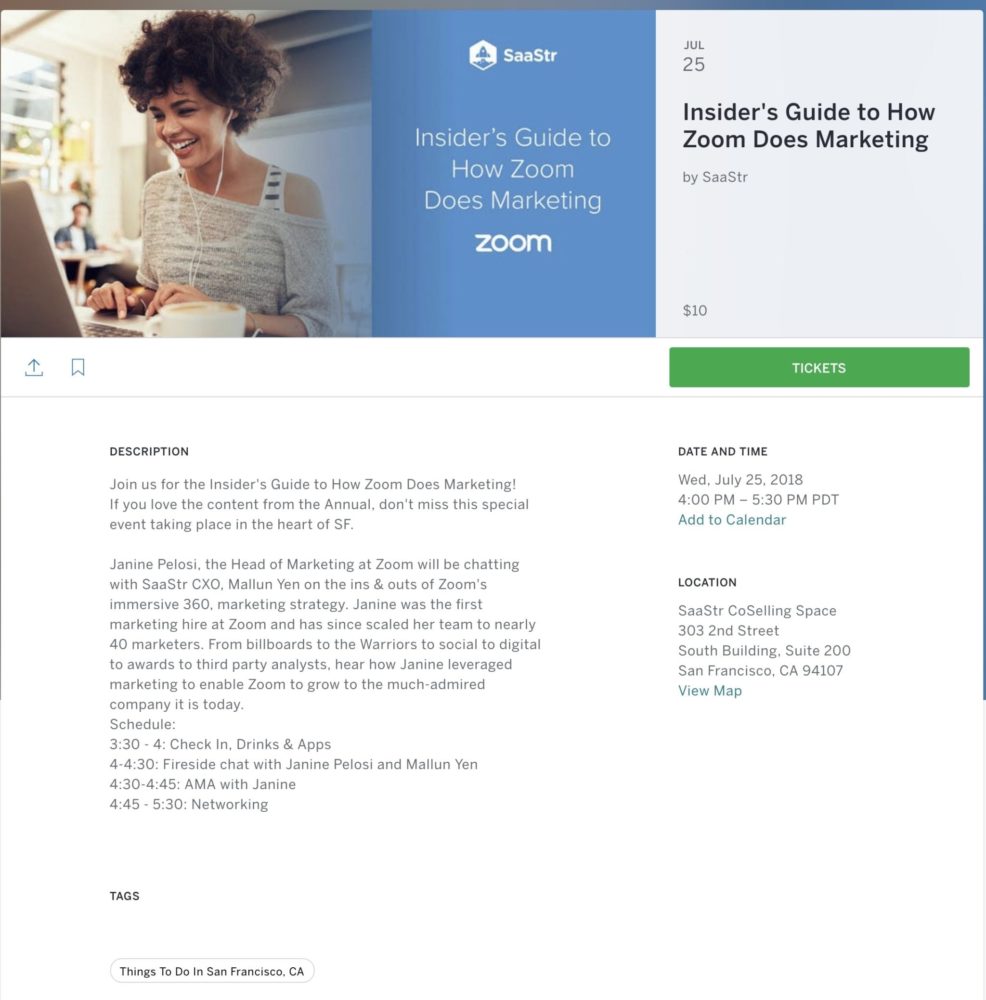
Some meetup titles sound like polite networking bait. This one sounds like somebody finally promised to open the vault. SaaStr CSS Meet-Up on Wed July 25: Come Learn How Zoom (Really) Does Marketing is the kind of title that makes founders, growth leaders, and over-caffeinated demand gen teams lean forward in their chairs. Why? Because Zoom did not become a household name by slapping a logo on a tote bag and calling it “brand awareness.” It built a marketing engine that looked simple from the outside and remarkably disciplined underneath.
That is what makes this topic so useful today. Zoom’s rise has often been framed as a product story, and to be fair, the product did plenty of the heavy lifting. But strong products do not market themselves in some magical unicorn forest. They need positioning, timing, category trust, user education, events, customer proof, and a go-to-market model that turns curiosity into revenue. Zoom managed to combine all of those pieces without sounding like it had swallowed a corporate thesaurus.
This article breaks down what a session like this meetup really represents: not just a calendar event, but a master class in Zoom marketing, SaaS marketing strategy, product-led growth, freemium conversion, and B2B brand building. If you want to understand how Zoom really does marketing, the short version is this: it lets the product open the door, then sends smart marketing in right behind it with a clipboard, a webinar, and suspiciously clean messaging.
Why This SaaStr Meet-Up Mattered
The appeal of a SaaStr CSS Meet-Up centered on Zoom was obvious. Zoom had become one of the most interesting examples in modern SaaS because it did not follow the old enterprise software script exactly. Instead of relying only on top-down sales motions, it grew through user love, easy adoption, and a practical marketing team that understood how to amplify what was already working.
That matters because many SaaS teams still create a false choice between product-led growth and marketing-led growth. Zoom’s real lesson is that the best companies do not treat those as rivals. They let the product generate trust and usage, then use marketing to create brand preference, educate the market, support the sales team, and help the business move upmarket. In other words, the product says, “Hello,” and marketing says, “Great, now let’s turn this into a repeatable engine.”
For founders and operators, the real attraction of this meetup topic is not celebrity startup gossip. It is pattern recognition. Zoom’s playbook offers clues about how a business can scale from individual users to enterprise accounts without becoming weirdly complicated, painfully expensive, or allergic to clarity.
How Zoom Really Does Marketing
1. It starts with product-led demand, not marketing theater
Zoom’s early momentum came from users trying the product, liking it, and bringing it into more conversations. That sounds obvious, but in SaaS, obvious things are often the least practiced. Too many companies pour energy into ad copy while the product experience still feels like a haunted escape room. Zoom benefited from a smoother user experience and a freemium path that lowered friction.
The company’s broader story shows how important that model became. Rather than forcing every prospect into a long, expensive buying journey, Zoom let free usage create familiarity. Once the product spread inside teams and organizations, sales and marketing could build on existing trust. That is one of the smartest forms of customer acquisition in B2B software because it reduces the classic “Who are you and why are you in my inbox?” problem.
In practical terms, this meant Zoom marketing was never just about lead generation. It was about creating the conditions for adoption, then helping that adoption expand. For SaaS brands, that is a crucial distinction. Marketing works better when it amplifies usage instead of trying to compensate for a weak product with expensive optimism.
2. It keeps messaging simple enough to survive contact with real humans
One of the most useful lessons from Zoom’s marketing approach is how relentlessly simple it has been. Not simplistic. Simple. That is a major difference. Simple messaging respects the buyer’s time. Simplistic messaging insults it.
Zoom’s appeal was never built on paragraphs of jargon about “synergistic collaboration ecosystems.” Thank goodness. Its marketing stayed close to practical value: easier meetings, better communication, less friction, reliable collaboration, faster connection. In SaaS, simple language is not a lack of sophistication. It is often a sign that the company actually understands what problem it solves.
This simplicity also created consistency across channels. Paid ads, events, webinars, sales support, brand campaigns, analyst conversations, and customer stories all worked better because the core promise was clear. When a company says one thing in ads, another in demos, and a third in the product itself, buyers notice. Usually with the kind of silence that ruins pipeline forecasts.
3. It uses freemium as a strategic bridge, not a charity program
The phrase freemium model sometimes makes executives nervous, mostly because “free” sounds suspiciously like “not revenue.” But in SaaS, freemium can be a very sharp strategic tool when paired with strong activation and natural upgrade paths. Zoom is one of the better-known examples of that logic in action.
Its growth showed that free usage can do more than fill the top of the funnel. It can create product familiarity inside large organizations, build internal advocates, and reduce the cost of proving value. Instead of asking enterprise buyers to take a blind leap, Zoom let teams experience the platform first. That kind of hands-on proof is powerful, especially when buyers prefer to test before they commit.
For marketers, the lesson is not “make everything free and hope for the best.” It is to design a user journey where the free experience builds trust, demonstrates value, and naturally leads to paid expansion. Free is not the business model. Free is the handshake.
4. It invests in webinars, live events, and education that move prospects forward
Another revealing part of the Zoom playbook is the role of webinars and events. These were not side hobbies. They were core marketing functions because they let prospects see the product, understand use cases, and move from vague awareness to real interest.
That matters even more in B2B software, where buyers often need a blend of self-service exploration and guided education. A strong webinar can shorten the path between “I’ve heard of this” and “I think this could work for our team.” It also gives marketing a way to support sales without resorting to lazy handoffs or random MQL confetti.
The clever part is that webinars also reinforce brand trust. They make a company visible, useful, and credible at the same time. A prospect may forget a display ad by lunchtime, but a good event or product session can stick because it solves a problem in real time. That is why Zoom’s use of educational programming feels less like promotion and more like conversion with better manners.
5. It builds brand preference, not just demand capture
One of the most underrated ideas in B2B marketing is brand preference. A lot of teams obsess over capturing existing demand while underinvesting in the long-term work that makes buyers prefer them in the first place. Zoom’s marketing story suggests the company understood that brand matters even when product adoption is already strong.
Brand preference is what helps a business grow beyond pure utility. It gives buyers confidence, makes pricing more resilient, and supports expansion into larger accounts. It also helps explain why two tools with similar feature lists do not perform equally in the market. Buyers are not robots, despite what some procurement processes might suggest. Trust, familiarity, and perceived reliability all shape decision-making.
Zoom’s marketing balanced performance channels with broader brand-building activities. That blend matters. Performance marketing is great for harvesting intent. Brand building helps create more of it. When the two work together, the business does not have to choose between short-term pipeline and long-term strength.
6. It treats analyst relations and third-party validation like growth assets
For many startups, analyst relations sound like something to think about after the office has nicer chairs. Zoom took a more mature approach. Early engagement with analysts and other forms of third-party validation helped the company look credible to bigger buyers, especially in the enterprise.
That is a smart move because larger organizations often want reassurance before they standardize on a platform. They want evidence, references, rankings, and proof that they will not be the first penguin off the iceberg. Marketing teams that understand this do not rely only on self-praise. They create ecosystems of validation through customer stories, analyst conversations, reviews, and category recognition.
Today, that strategy feels even more relevant. Enterprise buyers move across multiple channels before making decisions. They read reviews, compare vendors, talk internally, consult analysts, and look for signals of market trust. Zoom’s marketing approach fits that reality well: build the proof points, then make them easy to find.
7. It supports the move from SMB and mid-market into enterprise
Zoom’s growth is often associated with everyday users and smaller teams, but its marketing evolution also supported a move upmarket. That transition is where many SaaS companies wobble. The messaging gets bloated, the sales cycle gets longer, and the brand suddenly forgets how to sound human. Zoom handled that transition more gracefully than most.
Part of the reason is that its enterprise motion did not reject the product-led foundation. It built on it. Freemium adoption, user familiarity, and internal advocacy created a foothold. Marketing then reinforced that foothold with enterprise programs, account-based efforts, customer proof, and market education. That combination helped the company reach bigger accounts without losing the ease-of-use story that made it attractive in the first place.
This is the real power of a blended B2B marketing strategy. It allows the company to scale from individual users to complex buying committees without acting like it changed species halfway through.
8. It keeps evolving the story as the product portfolio expands
Another reason Zoom remains a useful case study is that it did not stop at meetings. Over time, the company expanded into a broader collaboration and communications platform with products tied to phone, contact center, AI, and workplace productivity. That expansion changed the marketing challenge. The question was no longer just “Why Zoom Meetings?” but “Why Zoom as a platform?”
That requires a different layer of marketing sophistication. A company has to preserve brand clarity while introducing new categories, new buyers, and new reasons to buy. Zoom’s recent positioning around AI, workplace productivity, and customer experience suggests a brand that is trying to grow without abandoning the trust it built around reliability and ease of use.
For SaaS marketers, this is a valuable lesson in narrative scaling. Early-stage messaging often focuses on one pain point. Later-stage messaging has to connect multiple solutions under one coherent promise. Do that poorly and the brand feels fragmented. Do it well and the market sees a platform instead of a pile of features wearing the same logo.
What SaaS Marketers Can Learn from Zoom’s Playbook
Product-led growth still needs grown-up marketing
If there is one myth worth throwing into the nearest recycling bin, it is the idea that product-led growth eliminates the need for marketing. It does not. It changes marketing’s job. Instead of forcing demand out of thin air, marketing helps users discover value faster, helps brands earn trust earlier, and helps sales teams convert usage into revenue more efficiently.
Zoom’s example shows how the product and the marketing engine can reinforce each other. The product creates love. Marketing turns that love into preference, expansion, and category strength. That is a much better partnership than the old model where marketing yells into the void while product quietly files bug tickets.
Simple wins, especially when the market gets noisy
Modern SaaS buyers are drowning in claims. Every company is “AI-powered,” “customer-centric,” and “redefining the future of work.” At this point, half the market sounds like it was written by a blender. Zoom’s more practical messaging reminds us that clarity is a competitive advantage.
Simple positioning does not mean shallow thinking. It means disciplined thinking. It means choosing a message the buyer can remember, repeat, and believe. In a crowded market, that alone can lift conversion performance, improve brand recall, and make every downstream channel work harder.
Events are still valuable when they create real learning
The title of this meetup itself proves a useful point: people still show up for events when the promise is specific and practical. “Come learn how Zoom really does marketing” is compelling because it offers insight, not empty inspiration. That is how the best events work. They give people something usable.
Too many event strategies chase volume instead of relevance. Zoom’s marketing story suggests a better approach: teach, demonstrate, build trust, and create the next conversation naturally. If an event feels like a glorified brochure, buyers tune out. If it feels like clarity, they lean in.
Experience and Takeaways from a Meet-Up Like This
A session built around a title like SaaStr CSS Meet-Up on Wed July 25: Come Learn How Zoom (Really) Does Marketing usually lands differently than a generic startup panel. People walk in expecting secrets. What they often leave with is something more useful: a realistic picture of how effective SaaS marketing actually works. And that experience matters.
First, there is usually a sense of relief in the room. Relief because the best operators rarely describe growth as a magic trick. They talk about testing, timing, channel mix, user behavior, tight execution, and discipline. Founders hear that and realize they do not need a viral stunt or a 97-slide brand manifesto. They need a product people like, a message people understand, and programs that help buyers move forward. It is less glamorous than startup mythology, but much more profitable.
Second, these meetups often change how marketers think about attribution. In theory, everyone wants clean reporting. In reality, brand, product usage, webinars, analyst mentions, sales conversations, and customer references all work together. A practical discussion about Zoom marketing reminds teams that not every meaningful marketing impact arrives with a neat little label attached. Sometimes a buyer converts because the free product worked, then a webinar clarified use cases, then a trusted review site reduced risk, then a sales rep closed the deal. Welcome to the real world. It has fewer neat funnels and more overlapping influence.
Third, the experience usually pushes teams to rethink what “good marketing” looks like. Many people come in expecting clever campaigns. What they hear instead is that good marketing often looks boring from the outside: simple messaging, careful spend, repeatable events, cross-functional alignment, customer proof, and consistent follow-up. Boring, in this case, is a compliment. Boring is what scales. Flashy is what gets screenshots in Slack and then quietly misses quota.
There is also a confidence shift that happens after hearing a case like Zoom’s. Early-stage founders start to see how they can punch above their weight without pretending to be bigger than they are. Growth teams realize they can start small, test hard, and double down on what gains traction. Sales leaders hear that marketing can do more than toss leads over the fence like a stressed-out raccoon. It can help create better buyers before the first sales call ever happens.
And maybe the most useful takeaway is emotional, not tactical. A meetup like this tends to remind operators that strong SaaS growth is built by people who stay practical. They do not confuse complexity with intelligence. They do not mistake noise for momentum. They do not pour money into channels just because those channels sound fashionable at dinner. They pay attention to what the buyer needs, what the product proves, and what the market rewards.
That is probably why a topic like this remains relevant long after the chairs are folded and the name badges are gone. It is not really about one evening on July 25. It is about a durable truth in SaaS marketing: the companies that win are often the ones that make buying feel easier, trusting feel safer, and learning feel faster. Zoom’s story shows that marketing does not have to be loud to be powerful. Sometimes the smartest growth engine in the room is the one speaking clearly while everyone else is still trying to sound impressive.
Conclusion
The real value of SaaStr CSS Meet-Up on Wed July 25: Come Learn How Zoom (Really) Does Marketing is that it points to a broader truth about modern software growth. Zoom did not rely on one miracle channel. It built a layered system: a product people wanted to use, a freemium path that reduced friction, simple messaging that buyers could understand, webinars and events that educated the market, brand work that built preference, and enterprise programs that supported expansion.
That combination is what makes Zoom such a compelling marketing case study. It proves that the best SaaS marketing is not fluff sprayed over product. It is the operating system that helps demand form, trust compound, and growth become repeatable. For founders and marketers chasing durable scale, that is the lesson worth stealing politely.