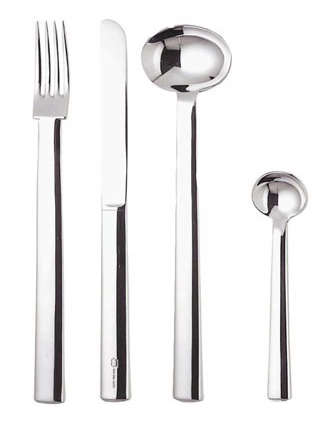
The Rundes Modell Flatware Collection by Josef Hoffman is the rare kind of tableware that makes a dinner fork feel like a design manifesto. Officially associated with Austrian architect and designer Josef Hoffmannoften misspelled as Josef Hoffmanthe collection was created in 1906 for the Wiener Werkstätte, the legendary Vienna Workshop that believed everyday objects deserved the same artistic care as buildings, paintings, and furniture.
At first glance, Rundes Modell looks simple: long handles, clean lines, circular spoon bowls, and very little ornament. But that simplicity is doing serious work. This flatware collection captures a turning point in modern design, when European decorative arts began stepping away from heavy historical decoration and moving toward geometry, function, craftsmanship, and restraint. In other words, it is not just something to eat soup with. It is a small, polished argument for modern living.
Today, Rundes Modell remains admired by collectors, museums, design historians, and homeowners who enjoy a table setting with a little architectural attitude. Alessi has reissued the collection in 18/10 stainless steel, making a once-elite Wiener Werkstätte design available to contemporary users who want their dining table to whisper, “Yes, I have taste,” without shouting across the room.
What Is the Rundes Modell Flatware Collection?
Rundes Modell translates roughly to “Round Model,” a name that points directly to the collection’s most memorable feature: its rounded forms, especially the circular bowl of the tablespoon. Designed by Josef Hoffmann in 1906, the flatware was originally produced for the Wiener Werkstätte, a design collective founded in Vienna in 1903 by Hoffmann, Koloman Moser, and patron Fritz Waerndorfer.
The collection included pieces such as table forks, table knives, tablespoons, teaspoons, dessert forks, fish knives, butter knives, serving pieces, and specialty utensils. Historic examples were made in materials such as silver, silver-plated alpaca, alpaca silver, and stainless steel blades. Modern reissues by Alessi are typically made in polished 18/10 stainless steel, a durable and food-safe material suited for everyday use.
What makes Rundes Modell special is not extravagance. There are no floral flourishes, no scrollwork, no theatrical handles trying to audition for a palace banquet. Instead, Hoffmann relied on proportion, rhythm, balance, and a very strict sense of form. The result is flatware that looks both antique and futuristic, depending on the room you put it in.
Who Was Josef Hoffmann?
Josef Hoffmann was born in 1870 in what is now the Czech Republic and became one of the most influential Austrian designers and architects of the early twentieth century. He was closely connected to the Vienna Secession and helped shape the visual language of Viennese modernism. His work covered architecture, furniture, interiors, glassware, metalwork, textiles, tableware, and decorative objects.
Hoffmann was a designer who believed that beauty should not be locked away in museums. It should live in chairs, lamps, spoons, coffee cups, walls, handles, and breakfast tables. This philosophy aligned perfectly with the Wiener Werkstätte, which sought to unify art and craft in daily life. The goal was not cheap mass production. The goal was a refined, well-made object that turned ordinary rituals into aesthetic experiences.
Hoffmann is often remembered for geometric clarity. He loved squares, grids, repeated patterns, and strong architectural forms. Yet Rundes Modell shows another side of him: his ability to soften geometry through rounded shapes and elegant usability. The collection proves that minimal design does not have to feel cold. It can feel deliberate, graceful, and quietly luxurious.
The Wiener Werkstätte Connection
The Wiener Werkstätte, or Vienna Workshop, was one of the most important design organizations of the modern era. Founded in 1903, it brought together artists, designers, architects, and craftspeople who wanted to elevate everyday objects. Their work included furniture, jewelry, textiles, ceramics, glass, metalwork, and interiors.
The group was deeply influenced by the Arts and Crafts movement, especially the belief that craftsmanship mattered. But the Wiener Werkstätte developed its own visual identity: cleaner, more geometric, more refined, and often more luxurious. It rejected imitation historical styles and focused on what was simple, appropriate, elegant, and beautifully made.
Rundes Modell fits that philosophy perfectly. It is useful, but not merely utilitarian. It is decorative, but not fussy. It is formal, but not stiff. The collection belongs to the idea of the Gesamtkunstwerk, or total work of art, where architecture, furniture, table linens, glassware, and flatware could all work together as one harmonious environment.
Design Features That Make Rundes Modell Stand Out
1. Circular Spoon Bowls
The most famous feature of the Rundes Modell collection is the rounded tablespoon. Unlike a conventional oval spoon, Hoffmann’s circular spoon bowl makes the object feel almost abstract. Some historic critics reportedly found this unusual shape a little too clinical or severe, as if dinner had wandered into an operating room. But users and collectors have long appreciated its originality.
2. Long, Slim Handles
The handles are elongated and elegant, giving each piece a strong visual line. This detail helps the flatware feel architectural. A fork is no longer just a fork; it becomes a tiny structure with balance, proportion, and direction.
3. Minimal Ornament
Rundes Modell avoids applied decoration. Its beauty comes from shape and proportion rather than surface embellishment. This is why it still feels modern more than a century after its creation. Trends come and go, but a well-resolved silhouette tends to age better than decorative drama.
4. Strong Craftsmanship
Historic Rundes Modell pieces were produced with the exacting standards associated with the Wiener Werkstätte. Marks on surviving examples may include the Wiener Werkstätte monogram, Hoffmann’s cypher, maker’s marks, and Austrian hallmarks. For collectors, these details matter because they help identify period pieces and distinguish them from later reproductions.
Original Rundes Modell vs. Modern Alessi Reissue
Original Rundes Modell flatware is highly collectible. Museum examples and auction lots show the range of the service, from individual spoons and forks to extensive multi-piece sets. Some historic examples were made in silver or silver-plated alpaca, while large services can include dinner forks, luncheon forks, fish knives, butter knives, dessert utensils, ladles, sugar spoons, mocha spoons, and other specialized pieces.
The modern Alessi version brings the design into everyday life. Produced in 18/10 stainless steel, it is more practical for contemporary kitchens while preserving the essential character of Hoffmann’s design. The Alessi reissue is especially appealing for people who want historically important flatware without needing to call an auction house, hire a conservator, or whisper nervously every time someone drops a teaspoon.
For everyday users, the Alessi Rundes Modell collection offers a balance of heritage and durability. It can work in a minimalist apartment, a mid-century dining room, a modern farmhouse kitchen, or a formal table setting. Its clean lines make it versatile, while its history gives it depth.
Why Collectors Love Rundes Modell Flatware
Collectors are drawn to Rundes Modell because it combines rarity, design importance, and visual identity. Many historic flatware patterns are beautiful, but not all of them changed the conversation around modern design. Rundes Modell did.
It represents a moment when artists were rethinking the entire domestic environment. Instead of seeing flatware as an afterthought, Hoffmann treated it as part of a complete visual world. A spoon could relate to a tablecloth. A fork could echo a chair. A knife could sit within a larger architectural language.
Auction records also show that significant Rundes Modell services can attract serious attention. Large sets produced by the Wiener Werkstätte, especially those with original marks and varied serving pieces, are valued not only as tableware but as design history. They belong in the same conversation as Viennese silver, Secessionist furniture, and early modern decorative arts.
How Rundes Modell Fits Modern Interior Design
One reason Rundes Modell still works today is that modern interiors have finally caught up with it. The collection looks comfortable beside marble countertops, matte ceramics, linen napkins, sculptural glassware, and simple white plates. It also pairs beautifully with darker table settings, where its polished surface can add contrast and brightness.
For a minimalist table, use Rundes Modell with plain porcelain, clear glass, and natural linen. For a warmer look, combine it with handmade ceramics, wood chargers, and soft neutral textiles. For a more dramatic setting, try black stoneware, smoky glass, and a single sculptural floral arrangement. The flatware is quiet enough to adapt, but distinctive enough to hold attention.
The trick is not to overcrowd the table. Rundes Modell looks best when it has room to breathe. Think of it like good architecture: the negative space matters.
Practical Buying Tips
Check the Name and Spelling
Many people search for “Josef Hoffman,” but the historically correct spelling is Josef Hoffmann, with two n’s. If you are researching museum pieces, auction records, or authentic vintage examples, use both spellings so you do not miss relevant results.
Know What You Are Buying
A modern Alessi set is different from an original Wiener Werkstätte piece. Both can be desirable, but they belong to different categories. The Alessi version is excellent for daily use and design-forward dining. Original pieces are collectible historic objects and should be evaluated for material, marks, condition, provenance, and completeness.
Consider Place Settings Carefully
Modern sets may include basic pieces such as table forks, knives, tablespoons, and teaspoons. If you entertain often, you may want dessert forks, fish knives, serving spoons, or additional teaspoons. Yes, teaspoons disappear. It is one of the universe’s least discussed design mysteries.
Think About Maintenance
Stainless steel reissues are easier to care for than silver or silver-plated antique pieces. For modern stainless steel, wash promptly, avoid harsh abrasives, and dry well to preserve the shine. For historic silver or alpaca pieces, consult proper conservation advice before polishing aggressively. A century-old spoon deserves better than a panic scrub with the rough side of a sponge.
Why Rundes Modell Still Feels Fresh
The staying power of Rundes Modell comes from its restraint. It does not rely on fashion. It does not need a logo. It does not beg for attention. It simply sits on the table with the confidence of an object whose designer understood proportion.
Many modern products look outdated within a decade because they are too tied to trend. Rundes Modell, by contrast, is rooted in principles: clarity, usefulness, craftsmanship, and form. Those ideas travel well across time. A spoon designed in 1906 can still look right beside a laptop, a ceramic espresso cup, and a very modern habit of photographing dinner before eating it.
Experience: Living With Rundes Modell Flatware
Using the Rundes Modell Flatware Collection is a little like inviting a design historian to dinner, except this one does not interrupt the conversation to explain the Vienna Secession every five minutes. The first thing most people notice is the feel. The pieces are long, balanced, and visually precise. They do not feel overly decorative or overly casual. They occupy that satisfying middle ground between museum object and useful tool.
At breakfast, the teaspoons feel especially charming. Their clean shape makes even a simple cup of coffee feel more intentional. Stirring sugar becomes a tiny ceremony. The spoon does not make your coffee better, of course, but it may make you sit up straighter while drinking it. That is the quiet psychological power of good design.
At dinner, the forks and knives create a formal rhythm on the table. They pair well with white plates, but they are not limited to formal porcelain. In fact, one of the most enjoyable ways to use Rundes Modell is with relaxed, handmade tableware. The contrast between Hoffmann’s disciplined geometry and the irregularity of ceramic plates creates a table that feels curated but not uptight.
The rounded spoon bowl is the conversation starter. Some guests may love it immediately. Others may tilt their heads and ask, “Is this spoon supposed to be like that?” That question is part of the fun. Rundes Modell has enough personality to invite curiosity, but not so much personality that it steals the meal’s spotlight. It is distinctive without being needy.
For hosts, the collection offers a practical advantage: it elevates simple food. A bowl of soup, a green salad, roasted vegetables, or a slice of cake looks more composed when served with flatware that has such strong lines. You do not need a twelve-course tasting menu. Even takeout can look thoughtful if the table setting is handled with care. Design cannot rescue bad soup, but it can give decent soup a very persuasive introduction.
There is also an emotional pleasure in using a design with history. Rundes Modell connects the modern table to Vienna in the early 1900s, to the Wiener Werkstätte, to the idea that everyday objects deserve artistic attention. That makes the flatware feel less disposable. It encourages slower meals, better table habits, and a little more appreciation for the objects we touch every day.
The collection is best for people who enjoy subtle design rather than decorative spectacle. If your dream flatware is covered in vines, crests, shells, and royal flourishes, Rundes Modell may feel too restrained. But if you love clean silhouettes, historical depth, and objects that reward a second look, it is deeply satisfying.
In daily use, the modern stainless steel version is the most practical choice. It carries the spirit of Hoffmann’s original design while fitting contemporary routines. You can use it for weeknight dinners, weekend brunches, holidays, and small gatherings without treating every fork like a museum loan. That balanceheritage without fragilityis one of the reasons the collection continues to attract design lovers today.
Conclusion
The Rundes Modell Flatware Collection by Josef Hoffman is more than a beautiful set of knives, forks, and spoons. It is a compact lesson in modern design, Wiener Werkstätte craftsmanship, and the power of restraint. Created by Josef Hoffmann in 1906, the collection transformed ordinary tableware into a carefully considered design statement.
Its circular spoon bowls, long handles, minimal ornament, and architectural clarity make it one of the most recognizable flatware designs of the early twentieth century. Whether viewed in a museum, collected as a historic Wiener Werkstätte object, or used through Alessi’s stainless steel reissue, Rundes Modell continues to prove that functional objects can carry elegance, intelligence, and personality.
For design enthusiasts, collectors, and anyone who believes dinner deserves better than forgettable utensils, Rundes Modell remains a timeless choice. It is practical, poetic, and just unusual enough to make the table more interesting. Not bad for a spoon that first raised eyebrows more than a century ago.