Note: This ranking weighs influence, joke quality, chemistry, longevity, cultural impact, and one crucial intangible: whether the anchor could look perfectly calm while the segment turned into absolute nonsense.
Few debates in comedy are more dependable than arguing over the best SNL Weekend Update anchors. The desk has launched careers, swallowed careers, produced catchphrases, generated annual holiday traditions, and somehow made fake news feel like one of television’s most durable art forms. For nearly the entire run of Saturday Night Live, Weekend Update has functioned as the show’s pressure valve: a place where topical jokes, sharp writing, and performer charisma have to work without the costume changes, elaborate sets, or cowbell assistance.
That is exactly why ranking these anchors is so much fun. The format looks simple, but it is brutally revealing. A great anchor has to deliver jokes cleanly, react to correspondents, build a point of view, and make the audience trust them enough to follow a punchline into weird territory. The best Update eras do more than read jokes. They define what the show sounds like in their moment.
So this is a power ranking of the best SNL Weekend Update anchors, focused on anchor runs rather than overall fame. In other words, this is not a ranking of who became the biggest celebrity after leaving Studio 8H. It is a ranking of who owned the desk, bent the format to their style, and left the strongest comedy footprint once the cue cards stopped flipping.
What Makes a Great Weekend Update Anchor?
Before we count down the best of the best, it helps to define the job. A top-tier Weekend Update anchor usually nails five things:
1. They sound like they belong at the desk
Some anchors feel born to sit behind a fake-news desk. Others feel like talented performers who wandered into the newsroom because their sketch was running late.
2. They have a comic point of view
The desk is always a character. Dennis Miller made it arch and caffeinated. Norm Macdonald made it sly and dangerous. Seth Meyers made it polished and politically literate. The best anchors tell you who they are within two punchlines.
3. They can play with correspondents
Weekend Update is not just about headlines. It is also about surviving a visit from Stefon, Drunk Uncle, Opera Man, or some emotional support animal with opinions on zoning laws.
4. They shape the era
The truly elite anchors do not just fit the format. They alter the feel of it. They become the measuring stick for everyone who follows.
5. They stay funny on rewatch
Topical comedy can age like milk left in a taxi. Great Update anchors still work years later because their rhythm, persona, and comic instincts remain funny even after the original headlines fade.
The Power Ranking
10. Kevin Nealon
Kevin Nealon does not always get enough credit in the SNL Weekend Update ranking conversation, which is a shame because he was a sturdy, sneaky-good anchor. He had the most traditional “newsman” face of the bunch, which made the jokes land with a useful dryness. Nealon was rarely flashy, but he understood the utility of the desk: set up the bit, keep the rhythm moving, and let the weirdos shine. That last part mattered. His era became a landing spot for memorable visitors, and he handled the chaos with an ease that now looks underrated. He may not have the mythmaking of the top tier, but he kept the machine humming.
9. Jimmy Fallon and Tina Fey
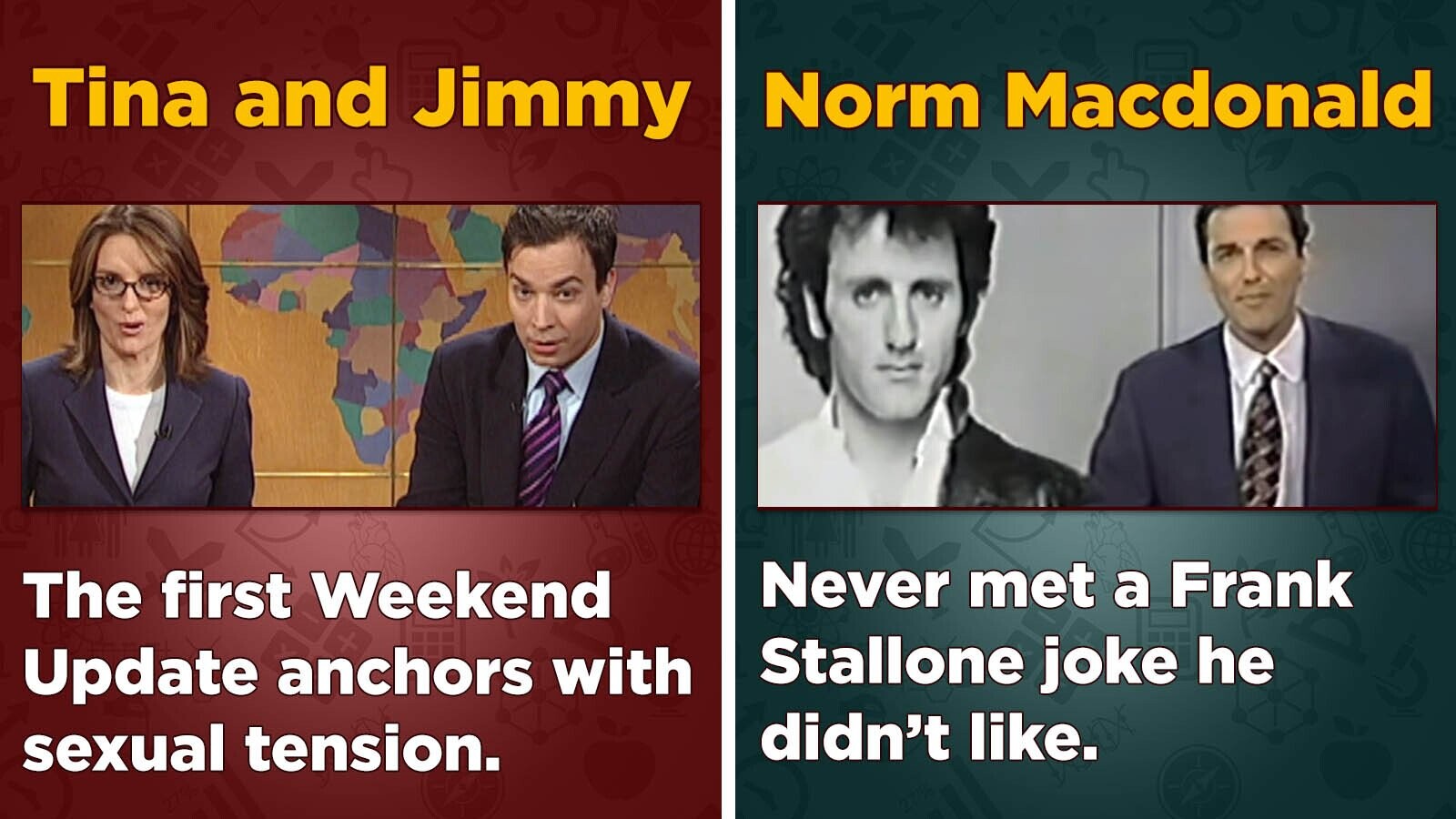
This duo was a tonal balancing act. Tina Fey brought bite, structure, and actual satirical muscle. Jimmy Fallon brought boyish energy, occasional looseness, and the sense that the desk might start grinning back at the audience. On paper, that should have been messy. In practice, it was charmingly effective. Fey gave the segment backbone; Fallon gave it bounce. They helped usher Weekend Update into a more modern, pop-culture-friendly groove for the early 2000s. Were they the tightest pair ever? No. Were they deeply watchable? Absolutely. Also, any era that helps bridge old-school Update into the millennium deserves a respectful tip of the fake-news teleprompter.
8. Amy Poehler and Seth Meyers
If this were a ranking based purely on chemistry per minute, Amy Poehler and Seth Meyers would be threatening the top five. Their run was shorter than fans sometimes remember, but it packed a lot into a brief window. “Really?!?” was one of the sharpest recurring bits the desk ever produced, letting both anchors weaponize exasperation in a way that felt modern without sounding smug. Poehler’s spark and Meyers’s composure made for a terrific blend. She could detonate a joke; he could catch the shrapnel and keep smiling. They felt like friends trading disbelief about the state of humanity, which, to be fair, is the secret sauce of many excellent Weekend Updates.
7. Colin Jost and Michael Che
This placement may annoy both traditionalists and recent-era loyalists, which usually means it is in the right neighborhood. Early on, Colin Jost and Michael Che could feel like a pairing still figuring out its exact temperature. Over time, though, they turned that tension into their identity. Jost’s clean-cut prep-school energy and Che’s looser, needling style created a dynamic built on contrast, not polish. Their annual joke-swap segments became instant holiday appointment viewing because they weaponized live discomfort better than almost anyone at the desk. They are also now part of the format’s long-history conversation, not just its current chapter. Longevity matters. So does surviving modern internet discourse while reading punchlines that half the audience loves and the other half screenshots for battle.
6. Jane Curtin with Dan Aykroyd and Bill Murray
Jane Curtin deserves more flowers than she usually gets in broad pop-culture rankings. She brought calm, intelligence, and the kind of straight-faced control that made absurdity even funnier. Her solo work was strong, but her partnerships are what made her historically essential. With Dan Aykroyd, she helped create the famous Point/Counterpoint dynamic that gave the segment one of its earliest truly iconic rhythms. With Bill Murray, she remained the stabilizing force while the tone around her got looser. Curtin did something foundational: she proved that Update did not need a wink-heavy showboat to work. Sometimes the funniest person at the desk is the one least interested in looking impressed by her own joke.
5. Chevy Chase
Putting Chevy Chase outside the top four might sound blasphemous to first-generation SNL purists, but this is where influence and actual desk dominance start arm-wrestling. Chase was the original blueprint. That matters enormously. He established the posture, the cadence, the smug little bite that would inform countless fake-news anchors afterward. A lot of what later made Weekend Update feel intuitive on television exists because Chase showed how the format could work. But founding something is not always the same as perfecting it. His run was brief, and later anchors deepened the segment in ways that went beyond the initial template. Still, no serious ranking leaves him out of the top tier. He built the house; others added the more comfortable furniture.
4. Dennis Miller
Dennis Miller made Weekend Update feel faster, smarter, and more caffeinated. He was not just delivering punchlines; he was coming at the desk with attitude, verbal precision, and a sense that every news item had personally offended him. His style was intensely specific to its time, but it also expanded the role. Miller helped make the anchor a comic personality rather than simply a host for jokes. He could sound polished and irritated at once, which is not easy unless you are either an exceptional comedian or trapped in an airport customer-service line. His six-year run gave the segment a durable post-reinvention identity, and later solo anchors owed a lot to the lane he carved out.
3. Seth Meyers
Seth Meyers was the professional’s professional at the desk. If Norm Macdonald represented danger and Tina Fey represented wit with swagger, Meyers represented mastery. He understood politics, structure, pacing, and the value of a crisp reaction shot when a correspondent was spiraling into lunacy. His solo years especially showed how strong he really was. Meyers could deliver a sharp political joke, pivot to a ridiculous desk piece, then play the perfect straight man for Stefon without making any of it feel disconnected. That is high-wire work disguised as effortless television. He made Weekend Update feel dependable in the best possible way, and for a live comedy show, dependable is often the difference between “good sketch” and “clip everyone rewatches forever.”
2. Tina Fey and Amy Poehler
If you want the most purely delightful duo in Weekend Update history, Tina Fey and Amy Poehler have a powerful claim to the crown. Their chemistry was immediate and enormous, the kind that can make a decent joke pop and a great joke take flight. Fey brought razor-sharp framing and writerly control. Poehler brought kinetic force and a grin that could turn a simple line reading into a mini-event. Together, they changed the energy of the desk. They did not just succeed as the first all-female co-anchor team. They made that fact feel secondary to the far more important truth that they were simply excellent. The segment became warmer, faster, and more alive when they shared it. If your personal ranking has them at number one, no argument here gets to act shocked.
1. Norm Macdonald
Norm Macdonald sits at number one because he did the hardest thing an Update anchor can do: he made the desk feel dangerous without ever losing the joke. Norm had the deadpan, the pause, the shrug, and the uncanny ability to make a punchline feel both obvious and unhinged at the same time. His “fake news” framing was not just a catchphrase; it was a comic mission statement. He could make tabloid stupidity sound like a philosophical indictment of the human race. He also had the rare gift of sounding amused by the joke before the audience caught up, which somehow made the laugh hit harder. Plenty of anchors were sharper on paper or smoother in delivery. None felt more singular. When people talk about the best SNL Weekend Update anchor, Norm is usually the name that ends the room’s argument.
Why the Top of This Ranking Looks the Way It Does
There is a pattern here. The very best Weekend Update anchors did not just read strong material. They defined a comic attitude. Norm Macdonald weaponized deadpan irreverence. Tina Fey and Amy Poehler made the desk feel electric and communal. Seth Meyers gave the format a modern political polish without sanding off its silliness. Dennis Miller supercharged the solo-anchor model. Chevy Chase created the original grammar of the whole operation.
And then there is the tricky part: how much should longevity count? It should count, but not enough to overpower peak performance. That is why Colin Jost and Michael Che land in the upper half without cracking the medal stand. Their run has been historically long, and their joke swaps are already embedded in the show’s modern mythology. But the best Weekend Update anchors are not just consistent. They shift the center of gravity of the segment. The top three did that more decisively.
Final Verdict
If you are looking for the definitive winner of this power ranking of the best SNL Weekend Update anchors, it is Norm Macdonald by a smirk. If you are looking for the most lovable duo, Tina Fey and Amy Poehler might be your champions. If you value structure, topical sharpness, and pure desk management, Seth Meyers has a case that will never go away. And if your first Weekend Update anchor was somebody else, congratulations: you now understand why these rankings always turn into comedy-family arguments at the speed of a live cue card flip.
That is the beauty of Weekend Update. Every great anchor reflects the era around them, but the best ones also outlive it. The headlines change. The jokes date themselves. The desk remains. And somewhere, right now, someone is still arguing that their favorite anchor was robbed.
The Viewing Experience: Why Weekend Update Rankings Feel So Personal
The reason fans get so emotionally invested in ranking SNL Weekend Update anchors is simple: the desk often becomes your personal entry point into Saturday Night Live. A lot of viewers do not remember the first cold open they loved, or the first host monologue that made them laugh, but they absolutely remember the first anchor who made Weekend Update feel like an event. That memory matters. It becomes your default setting for what the segment is “supposed” to be.
If you grew up on Norm Macdonald, you probably expect the desk to have a little danger in it. You want jokes that sound almost too dry, too strange, too fearless to be read on network television. If you came in during the Tina Fey and Amy Poehler years, you may think Weekend Update should sparkle with chemistry and feel like two brilliant friends tagging in and out. If Seth Meyers was your guy, then maybe the ideal desk is crisp, controlled, and built for immaculate reactions to characters who have clearly escaped from another sketch. And if Colin Jost and Michael Che were your first weekly anchors, the segment may feel incomplete without a little mutual sabotage and at least one joke designed to make the other guy visibly regret his career choices.
That is what makes the viewer experience around Weekend Update so fascinating. It is not just a comedy segment. It is a generational marker. Each era teaches its audience what “fake news” comedy should sound like. The older runs often feel more purely joke-driven on rewatch. The middle eras become master classes in desk chemistry. The modern era adds internet virality, rapid-response politics, and a constant awareness that a single punchline can ricochet across social media before the applause has even died down. The desk has always been live-wire television, but now it is live-wire television with screenshots.
There is also the strange pleasure of rewatching Weekend Update years later and discovering that your opinions have changed. An anchor you once thought was merely solid can seem stronger once you realize how hard the format actually is. A pairing you loved as a kid may reveal cracks when viewed next to sharper writers or better straight-man instincts. On the flip side, a performer you overlooked can suddenly click because you are no longer watching for celebrity; you are watching for timing, control, and how they steer the room. Weekend Update rewards rewatching because the desk strips comedy down to its essential tools. No costume can save a weak rhythm. No giant set piece can distract from a bad read.
And then there is the live experience itself, which remains part of the magic. Weekend Update often feels like the moment an SNL episode either settles in or reveals its limitations. A shaky episode can be rescued by a killer Update. A strong episode can become great if the desk catches fire. When a correspondent bit lands, the audience becomes part of the rhythm. When an anchor breaks just enough to show delight without losing control, it creates that special live-comedy feeling: the sense that everybody in the room knows they are watching something temporary and repeatable at the same time.
That may be the real reason fans care so much about ranking the anchors. Weekend Update is not just a segment people watch. It is a segment people live with. They quote it, revisit it, compare eras, and use it as a shorthand for what kind of comedy they value most. Some want precision. Some want chaos. Some want warmth. Some want a deadpan assassin. The desk has made room for all of them, which is why this argument never really ends. Honestly, thank goodness for that. Television needs more stupidly passionate debates about fake newsreaders.