Some artists need a stretched canvas, a quiet studio, and a perfectly sharpened pencil. Others need a mirror, a steady hand, a pile of pigments, and the courage to turn their own skin into a living gallery. That is the magic behind the viral world of body painting makeup, where artists use the human body not as a background, but as the main event.
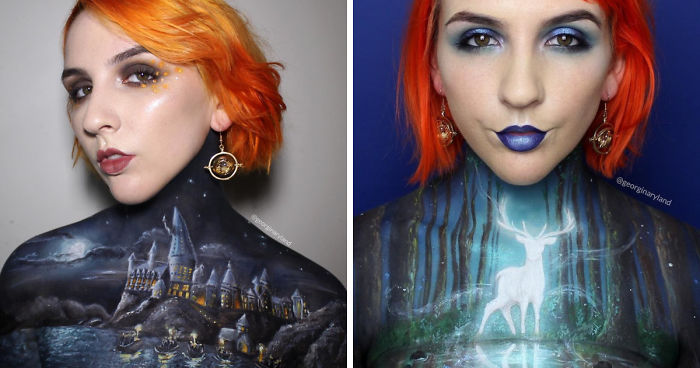
One of the most fascinating names in this space is Georgina Ryland, a Brisbane-based makeup artist and body painter known for painting detailed scenes across her own body. Her work has included pop-culture references, fantasy worlds, famous paintings, movie scenes, and tiny visual stories that look as if they wandered out of a museum, got lost at Comic-Con, and decided to live happily on someone’s shoulder. The result is part beauty, part illusion, part performance art, and part “how did she do that without sneezing?”
Body canvas art has exploded online because it gives viewers two surprises at once. First, you notice the drawing. Then, a second later, your brain whispers, “Wait. That’s skin.” In a world full of filters, fast edits, and AI-generated visuals, makeup artists who paint directly on themselves offer something refreshingly human: slow craftsmanship, imperfect patience, and a face-to-face relationship with the art.
The Rise of Body Painting Makeup as Modern Visual Art
Body painting is not new. Cultures around the world have used pigments on skin for ritual, identity, celebration, storytelling, theater, and ceremony for centuries. What feels new is the way social media has turned the practice into a highly visible form of contemporary art. A finished body painting can now reach millions of viewers in a single post, especially when the artwork blends realism, fantasy, and optical illusion.
Artists like Georgina Ryland show how makeup can move far beyond everyday beauty. Instead of focusing only on complexion, lashes, lips, or contour, she treats the body as a three-dimensional surface. The collarbone becomes a horizon line. A shoulder becomes a cliff edge. The upper chest becomes a stage for castles, galaxies, oceans, animated characters, or dreamlike landscapes. The body is no longer merely wearing makeup; it is hosting a full production.
This is why the phrase “makeup artist creates incredible drawings using her own body as canvas” works so well as a headline. It captures the curiosity of the process and the shock of the result. Most people have tried eyeliner and discovered that drawing a straight line on skin is basically a trust fall with gravity. These artists are painting entire worlds on curved, moving, breathing anatomy. That deserves applause, hydration, and probably a very good makeup remover.
Who Is Georgina Ryland?
Georgina Ryland is an Australian makeup artist and body painter recognized for intricate, colorful designs created directly on her own skin. Her work has been shared widely because it combines technical skill with instantly recognizable cultural references. Instead of presenting makeup as a simple finishing touch, she uses it as a storytelling tool.
Her body paintings often draw inspiration from movies, television, fantasy, animation, video games, and classic art. That variety is a major reason her work is so engaging. A viewer might see a dramatic fantasy scene one day and a delicate homage to a famous painting the next. Her portfolio feels like a tiny streaming service for the eyeballs, except every episode is painted by hand.
What makes Ryland’s process even more impressive is that she frequently paints on herself. That means she has to deal with reversed angles in the mirror, body curves, limited reach, lighting changes, and the practical problem of keeping the design clean while still moving enough to create it. Paper stays politely flat. Skin has opinions.
Why Painting on the Body Is So Difficult
Painting on skin is not the same as painting on canvas. Skin has texture, warmth, oil, movement, pores, and natural curves. The artist must understand anatomy and perspective. A straight line across the chest may appear curved in a photograph. A shadow painted too heavily can make the design look muddy. A highlight placed in the wrong spot can flatten the entire illusion.
Body painting also requires patience because each layer must be controlled. Colors need to be blended without becoming dull. Edges must stay crisp. Fine details have to survive the natural movement of breathing. And because the artist is often photographing the final look, the design must work not only in real life but also on camera. A piece can look impressive in the mirror and still need adjustments once seen through a lens.
In Ryland’s case, the strongest works succeed because they respect the body’s shape instead of fighting it. Her paintings do not simply sit on the surface; they use the surface. The angle of the shoulder can become depth. The slope of the chest can become a landscape. The curve of the neck can guide the viewer’s eye into the design. That is the difference between decoration and full body canvas art.
Body as Canvas: Why the Internet Can’t Look Away
Body painting makeup is extremely shareable because it creates a moment of visual confusion. The viewer pauses. The brain recalculates. Then the comments begin: “Is this edited?” “Is this real?” “How many hours did this take?” “Why can’t I even match my left eyebrow to my right eyebrow?”
That reaction is part of the art. Great body painting forces people to slow down. In a feed where most images are consumed in half a second, an illusion makeup look can make someone stop, zoom in, and study the details. The artwork rewards attention. Every brushstroke says, “Yes, look closer. I dare you.”
Another reason this art form resonates is that it feels personal. The artist is not hiding behind a canvas across the room. The artwork is on the artist’s own body. That creates intimacy and vulnerability. The skin becomes both medium and message. When done thoughtfully, the result can feel playful, emotional, cinematic, or surreal.
The Power of Pop Culture References
Ryland’s work often connects with viewers through familiar stories. Movie scenes, fantasy worlds, animated icons, and beloved characters already carry emotional weight. When those images are recreated on the body, they gain a new kind of energy. A castle painted across the upper body is not just a castle; it is a reminder of childhood imagination, fandom, and the thrill of seeing something familiar in an unexpected place.
Pop culture body painting also gives the audience an easy entry point. You do not need an art history degree to appreciate a detailed tribute to a famous film or fantasy universe. You only need eyes and a willingness to say, “Okay, that is ridiculously cool.” From there, viewers may begin noticing the technique: the shading, linework, composition, and control that make the image believable.
Optical Illusion Makeup and the New Beauty Frontier
Georgina Ryland is part of a broader movement of makeup artists who use cosmetics to bend perception. Artists such as Mimi Choi and Dain Yoon have become known for surreal makeup illusions that make faces appear sliced, multiplied, warped, or transformed into living puzzles. These works share a common belief: makeup is not limited to enhancing features. It can also question what a feature is.
Optical illusion makeup relies on highlights, shadows, symmetry, false edges, and photographic angles. In traditional beauty makeup, contour may subtly define the cheekbones. In illusion makeup, contour can create a fake eye socket, a folded face, a floating mouth, or a painted object that appears three-dimensional. The same basic tools are used, but the ambition changes completely.
This is one reason body painting artists are so valuable to the beauty world. They stretch the definition of makeup. They remind people that cosmetics can be playful, strange, intellectual, theatrical, and deeply artistic. A lipstick can be a lipstick, yes. But in the right hands, it can also be a dragon scale, a sunset, a shadow line, or a tiny doorway into another universe.
Makeup Without Photoshop
One of the biggest appeals of body canvas art is the question of authenticity. Viewers often assume the final image must be digitally altered because the illusion appears too clean to be real. Many artists answer that doubt by sharing time-lapse videos, close-up process shots, and removal clips. These behind-the-scenes moments prove that the work exists on skin, not just on a screen.
That transparency strengthens the audience’s appreciation. A finished photo is impressive, but watching the design come together is even better. The viewer sees the sketch lines, the base colors, the mistakes corrected, the shadows deepened, and the final highlights added. Suddenly the artwork becomes not only beautiful, but believable.
The Tools Behind Incredible Body Drawings
Professional body painting usually involves more than regular foundation and eyeshadow. Artists may use water-activated paints, cream colors, cosmetic-grade pigments, setting powders, fine art brushes, sponges, liners, and sealers. The exact kit depends on the design, the artist’s style, and the skin area being painted.
For detailed drawings, brush control matters enormously. A large sponge can block in color quickly, but fine lines require tiny brushes and a very steady hand. Artists often use multiple brush sizes the way traditional painters do. A broad brush may create a background wash; a detail brush may add eyelashes, stars, scales, windows, vines, or tiny architectural lines.
Layering is also essential. A strong body painting rarely starts with the final detail. The artist builds from a sketch to base colors, then adds midtones, shadows, highlights, outlines, and final accents. Each stage matters. Skip the structure, and the finished piece may look flat. Overwork the details, and the design can lose clarity. The sweet spot is controlled chaos with a makeup wipe nearby.
Why Skin-Safe Products Matter
Because body painting uses skin as the surface, safety is not optional. Cosmetic products can cause irritation or allergic reactions in some people, especially when used for long sessions or over large areas. Fragrances, preservatives, dyes, metals, and latex-related ingredients are among the common categories that may trigger reactions in sensitive users.
Artists should choose cosmetic-grade products intended for skin, avoid craft paints, follow product directions, and remove makeup gently. Anyone trying body painting at home should patch test new products, especially if they have sensitive skin or a history of irritation. If redness, itching, swelling, burning, or a rash appears, the product should be removed and avoided. Art is fun; angry skin is less fun and much less photogenic.
Removal is another underrated part of the craft. A design may take hours to paint and only minutes to photograph, but taking it off properly protects the skin barrier. Gentle cleansers, patience, and moisturizer can make the difference between “that was amazing” and “why does my shoulder feel like sandpaper?”
What Makes a Body Painting Go Viral?
A viral body painting usually has three qualities: instant impact, technical depth, and emotional familiarity. The first glance must stop the viewer. The second glance must reveal skill. The third glance should offer a reason to care.
Instant impact might come from a famous character, a dramatic illusion, or a scene that appears impossible to paint on skin. Technical depth comes from clean execution: realistic shading, sharp edges, smart use of anatomy, and a clear composition. Emotional familiarity comes from the subject matter. A viewer may share the piece because it reminds them of a favorite movie, a childhood story, a game, a painting, or a mood they recognize.
Georgina Ryland’s work fits this formula beautifully. Her body paintings are not random decorations. They are recognizable, detailed, and designed for the camera. They reward fans of beauty, art, film, fantasy, and visual puzzles all at once. That wide appeal helps explain why body canvas makeup performs so well on platforms built for quick visual discovery.
The Role of Time-Lapse Videos
Time-lapse videos are perfect for this art form because they compress hours of labor into seconds. A blank patch of skin becomes a sketch. The sketch becomes color. The color becomes depth. The depth becomes a finished scene. Viewers get the satisfaction of watching something appear almost magically while still understanding that the magic is made of work.
These videos also help artists build trust. In an era when edited images are everywhere, process content proves the artist’s hand. It shows that the final look is not a filter pretending to be skill. It is skill that happens to look impossible.
Body Painting as Performance, Not Just Makeup
Body painting is often described as makeup, but it also belongs to performance art. The artist must pose, photograph, light, and present the work. The body is not a passive surface. It participates. A slight turn of the shoulder can change the illusion. A tilted chin can improve the composition. A poorly chosen pose can hide the best part of the design.
This makes body painting unusually demanding. The artist is painter, model, photographer, director, editor, and sometimes contortionist. When the same person is creating and wearing the artwork, the process becomes even more complex. Imagine painting a miniature landscape on a moving hill while looking at it backward in a mirror. Now add deadlines, lighting, and the need not to smudge anything. Fun? Yes. Easy? Absolutely not.
That effort is part of the appeal. People respond to visible dedication. A body painting that takes several hours carries the energy of persistence. It says the artist cared enough to sit with one idea until it became real. In a fast-content world, that kind of patience feels rare and valuable.
of Experience: What Body Canvas Art Teaches Creators
Anyone who has experimented with creative makeup, face painting, or body painting quickly learns that the first lesson is humility. The idea in your head arrives wearing a cape. The first sketch on skin arrives wearing mismatched socks. That is normal. Skin is a living surface, and it does not behave like paper. It stretches, absorbs, reflects light differently in each area, and reminds you that elbows and shoulders were not designed for perfect geometry.
A beginner’s experience often starts with excitement and a design that is far too ambitious. Maybe you decide to paint a galaxy on your arm. Easy, right? A little blue, a little purple, a few stars. Thirty minutes later, the “galaxy” looks like a bruise that studied astronomy. This is where body painting teaches patience. You learn to build slowly, test colors, use reference images, and step back often. The best artists are not the ones who never make mistakes. They are the ones who notice mistakes early and know how to turn them into shadows, clouds, rocks, or “intentional texture.”
The second lesson is planning. A good body painting starts before the brush touches skin. You need to think about where the design will sit, how the body will move, what angle will be photographed, and which parts need the sharpest detail. If the artwork is meant for a front-facing photo, the design must be planned for that view. If it wraps around the shoulder or arm, the composition must still make sense from the main camera angle. This is where many beginners discover that body painting is part illustration and part stage design.
The third lesson is product control. Too much water can make paint run. Too little water can make it patchy. Cream products may blend beautifully but transfer easily. Powders can soften edges but may dull bright colors. Every product has a personality. Some are cooperative little angels. Others behave like they were raised by raccoons. Testing products on a small area before beginning a large design can save time, skin, and emotional stability.
The fourth lesson is comfort. Long painting sessions can be tiring, especially when painting on yourself. Good lighting, a comfortable chair, breaks, water, snacks, and a mirror setup can make a huge difference. Artists who create detailed work on their own bodies are not just talented; they are physically disciplined. Holding a pose, reaching awkward angles, and concentrating for hours takes stamina.
The final lesson is that body painting changes how you see makeup. After trying it, even simple beauty routines feel more artistic. Eyeliner becomes linework. Blush becomes color theory. Highlight becomes light placement. Contour becomes structure. You begin to understand that makeup is not only about looking polished. It can be about storytelling, play, identity, humor, fantasy, and expression. That is the real charm of artists like Georgina Ryland. They remind us that the body can be a canvas, makeup can be a paintbox, and creativity can turn an ordinary mirror into a studio.
Conclusion: A Living Canvas With a Sense of Wonder
“Makeup Artist Creates Incredible Drawings Using Her Own Body As Canvas” is more than a catchy headline. It describes a creative movement where beauty, painting, fandom, photography, and performance collide. Georgina Ryland’s work shows how the body can become a place for miniature worlds, visual jokes, dramatic scenes, and technical mastery. Her art is impressive not only because it looks beautiful, but because it is difficult, temporary, and deeply personal.
That temporary quality may be the most poetic part. A body painting can take hours to create, gather thousands of reactions, and then disappear down the drain with soap and water. But the image remains. The process remains. The reminder remains: art does not always need a frame. Sometimes it needs skin, courage, patience, and a brush small enough to paint a tiny window on a collarbone.
For viewers, body canvas makeup offers wonder. For creators, it offers a challenge. For the beauty industry, it offers proof that makeup is not just a product category. It is a language. And when artists use that language boldly, the human body becomes something extraordinary: not an object to correct, but a surface through which imagination can speak.
Note: This article is written as original, publication-ready web content based on real public information about body painting makeup, illusion makeup artists, and cosmetic safety practices.