Opening a “can of worms” usually means you touched one tiny problem andcongratulationsyou’ve now adopted fourteen more.
A kan of worms, on the other hand, is what happens when that chaos gets illustrated, labeled, and sold back to your brain as a novelty product you
didn’t know you needed (but suddenly want in aisle five, next to the emotional-support cereal).
Kan Of Worms Toons are punchy, colorful, single-panel-style cartoons presented like playful packagingbold titles, goofy “ingredients,” and
tiny truths hidden in plain sight. The vibe is: “Life is complicated; here’s a sticker for your forehead that says same.”
What Are Kan Of Worms Toons?
At their core, Kan Of Worms Toons are humor cartoons built around a simple (and sneaky) idea: treat modern feelings like consumer products.
The cartoons often resemble a labeled canbrand name up top, the “product” in the middle, and an overconfident promise somewhere in the design.
That promise is almost always a lie… which is why it’s funny.
The creator, credited as MVANNP and associated with the ChatterWhackys universe, leans into quick-hit jokes:
typos that haunt you at 2 a.m., outrage that comes “assorted,” and social media that offers “24-hour relief” for grumpy people (the way a commercial would,
if commercials were emotionally honest for once).
If you like gag cartoons, doodle humor, and that specific kind of internet wit where the joke is “our brains are doing their best, please clap,”
this is your snack-sized comedy.
Why “Kan” Works So Well
“Can of worms” is one of those phrases that instantly sets a mood. It’s not a cozy mood. It’s a “you clicked the wrong email attachment” mood.
The original idiom is about creating a complicated situation where solving one problem triggers many more. Turning it into Kan is a neat trick:
it keeps the meaning, adds a brand-like look, and signals that what you’re about to see is intentionally messybut in a controlled, comedic way.
In other words: it’s the chaos of real life, repackaged into something you can laugh at instead of arguing with in the shower three days later.
The Kan Of Worms Style Formula
1) Product parody
The “canned” framing isn’t just a visual gimmickit’s a joke engine. The moment a feeling becomes a product, the cartoon gets to satirize marketing language:
“extra strength,” “single dose,” “relieves mild cases of frowns,” and other beautiful nonsense that sounds like a label because it is a label.
2) Tiny truths disguised as silliness
Many cartoons land because they take something weirdly universal (like the dread after posting a typo) and treat it like a public health crisis.
And honestly? Sometimes it is.
3) Big, readable lettering
These are built to be instantly understoodlike a sign you’d read in traffic, except the sign is telling you that your “shadow put on weight after winter.”
The humor is fast, but the observation sticks.
4) A friendly, oddball cast
Birds, beasts, aliens, snack foods, and little mascot-like characters show up to deliver the punchline. It’s a light touch:
the characters are silly, but the jokes don’t feel mean.
Kan Of Worms Toons (13 Pics): The Gallery Tour
Below are 13 “pics” presented as a guided tourwhat’s happening, what the joke is, and why it works. (Images are described for accessibility and
so you can appreciate the humor even without the visual in front of you.)
Pic #1: “GMR Grumpy Mood Remover”

This one looks like an over-the-counter spray for your personality. It promises “24-hour relief,” “as seen on social media,” and lists what it “relieves,”
including mild frowns and that specific spiritual injury of stepping in dog poop.
Why it lands: because the label language is hilarious and painfully believable. We’ve all seen ads that promise to cure something complex
with something simple. This cartoon just says the quiet part out loud: you’re not buying a product, you’re buying a mood.
Pic #2: “Sharky’s Click-Bait: Gullibles Formula”

The cartoon turns clickbait into a product, complete with “juicy headlines.” Little characters stare up like they’re about to bite a hook.
If you’ve ever opened a tab “for one second” and resurfaced forty-five minutes later watching a video about a raccoon with hobbieshello, this is for you.
Why it lands: it’s not scolding. It’s playful. It doesn’t call you dumb; it calls the system “Sharky,” which somehow feels both nicer
and more accurate.
Pic #3: “Typo-Eze: Instantly Erase That Dread”

It’s the emotional hangover in a can: that moment you notice a typo after you hit “post,” and your brain quietly schedules a decade-long cringe montage.
The cartoon sells a “single dose” solution, as if a typo is a rash you can treat with a dab of ointment.
Why it lands: everyone has felt this. Even people who pretend they haven’t. Especially those people.
Pic #4: “Blame-Game League: Assorted Idealism”

“Pointing fingers with petty heroic outrage” is the kind of phrase that sounds like a joke until you remember it describes half the internet on a Tuesday.
The character on the side insists they’re just drinking coffee and minding their business, which is also what people say right before they quote-tweet
someone into the sun.
Why it lands: it skewers the behavior, not a specific side. The target is the habitthat reflex to assign blame before
understanding the situation.
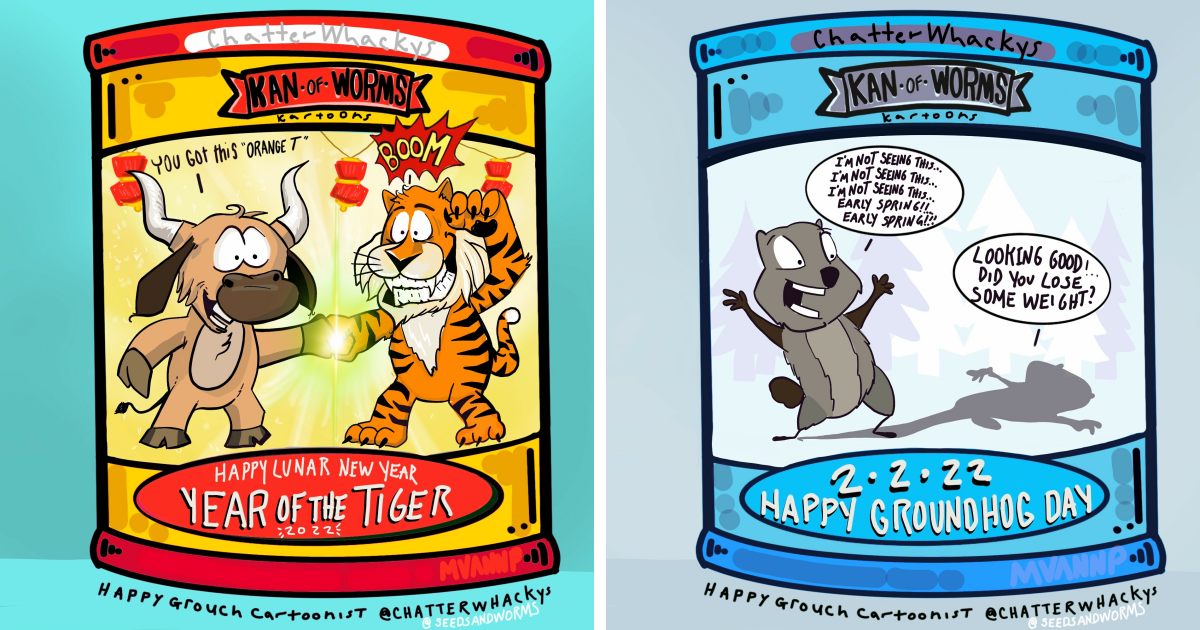
Pic #5: “Happy Lunar New Year: Year of the Tiger”

This one leans celebratory. A tiger shows up with big “let’s do this” energy, and the scene feels like a pep talk that accidentally turns into slapstick.
It’s festive, bright, and built like a seasonal specialsame universe, new occasion.
Why it lands: it shows the format isn’t limited to cynicism. The “kan” is flexible: it can hold joy, too.
Pic #6: “Happy Groundhog Day: The Shadow Glow-Up”

The groundhog chants “early spring” like it’s summoning hope, and thenboomthe shadow gets a compliment that is also accidentally insulting.
It’s a perfect snapshot of how humans can turn a wholesome moment into a weird comment in under three seconds.
Why it lands: the joke is gentle but sharp: we’re desperate for good news, and we’re also weirdly bad at delivering it.
Pic #7: “Survey???: What Do the Earthlings Think?”

This cartoon leans into the modern obsession with surveys and takes. Everyone wants feedback; nobody wants consequences.
The line “what can go in a kan-of-worms?” is meta and sillylike the cartoon is asking you to help write the rules for the chaos.
Why it lands: it pokes fun at the idea that public opinion is always the best compass.
Sometimes it’s just a weather vane doing interpretive dance.
Pic #8: “Bob the Boarder”

This feels like a logo you’d see on a sticker, a tee, or the side of a questionable energy drink.
A character on a skateboard becomes a brand markpart cartoon, part badge.
Why it lands: it expands the universe. Not every “pic” needs a full punchline; some build the world.
Pic #9: “Crossed Fingers (Tiny Dog Edition)”

It’s the universal symbol for “I want this to work out and I’m willing to negotiate with reality.”
The design is simple, which makes it feel like an iconalmost like a button you’d press before sending a risky email.
Why it lands: it’s short, visual, and instantly readable. Like the best modern jokes, it could fit on a hoodie.
Pic #10: “Meat Brain on My Shoulders”

Calling your brain a “meat brain” is funny because it’s technically true and emotionally disrespectfultoward yourself.
This pic turns that thought into branding, as if your skull came with a warranty card.
Why it lands: it’s the kind of joke that makes you laugh and then immediately drink water.
(Not because you’re enlightenedbecause you forgot to hydrate. Meat brain.)
Pic #11: “Yellow Balloon Taped to a Kan-of-Worms”

It’s an art-world wink: an everyday object, taped up, presented like a masterpiece. The joke is that the “masterpiece” is basically nonsense
but also that nonsense gets attention, which is kind of the point.
Why it lands: it’s absurd without trying too hard. It just says, “Look at this. Yep. That’s the joke.”
Somehow, that works.
Pic #12: “Cure the Monday Blues With Some Fun News”

This one feels like a mini news segment. It suggests that the cure for Monday blues is… “fun news,” like a Martian visitors center.
It’s the kind of cheery nonsense you’d hear from a coworker who brings donuts after a disaster and says, “Well! We’re alive!”
Why it lands: it recognizes that sometimes the best way through Monday is not realismit’s a small, ridiculous story that interrupts
the dread.
Pic #13: “Lucky Cheeseburgers: The Power Burger”

The burger is basically a mascot for comfort. The side character admits that simply saying “cheeseburger” makes them laughwhich is honestly relatable.
Some words are funny. Some foods are funny. Some days you take what you can get.
Why it lands: it’s pure lightness. Not every cartoon has to be a grand statement.
Sometimes it’s just: “Hey, your brain deserves a snack.”
Why These Cartoons Land (Even When Life Doesn’t)
They’re “gag cartoons” with a social-media brain
The best single-panel jokes behave like good street signs: you get it fast, you remember it later.
That’s the gag-cartoon traditiontight concept, minimal setup, one clean hit. The Kan format adds modern packaging:
big typography, bright color, and share-friendly composition.
They use marketing language as comedy
“Extra strength.” “Single dose.” “24-hour relief.” Those phrases are funny because they’re familiar, and because they’re often nonsense in real life.
The cartoons turn that nonsense into the punchline.
They aim at habits, not people
A lot of humor online feels like it’s trying to win a fight. These toons feel like they’re trying to win a smile.
They poke at habits we all havedoomscrolling, blame reflexes, typo panicso the joke lands as recognition, not attack.
They’re weirdly comforting
There’s something soothing about seeing your internal chaos turned into a labeled product. It creates distance.
You’re not “a mess”you’re just dealing with a temporary case of Irksomes. Apply Vanilla-Orange-Mint as needed.
How to Create Kan-Style Cartoons Without Copying
If these cartoons make you want to draw, that’s a great sign. Here are a few ways to capture the spiritquick, readable humorwithout borrowing anyone’s
exact format or characters.
Start with a feeling that acts like a product
- Feeling: the dread of “Reply All.” Product twist: a “Reply-All Repellent.”
- Feeling: meeting that should’ve been an email. Product twist: “Agenda-Flavored Air.”
- Feeling: late-night overthinking. Product twist: “Brain Tabs: Opens 37 at once.”
Write the label like a real label
Real packaging uses confident, slightly vague promises. Make yours overly specific in the funniest way possible:
“Relieves the urge to reorganize your whole life at 11:47 p.m.”
Keep the punchline visible at phone size
A strong single-panel cartoon respects the scroll. Use big text, simple shapes, and one main idea.
If you need three paragraphs to explain the joke, you didn’t make a cartoonyou made a lecture, and nobody asked for homework.
Use digital tools like a shortcut, not a crutch
Digital drawing can make iteration easiermove text, test colors, clean up lineswithout redoing the whole piece.
If you’re new, the goal is speed and clarity: sketch, adjust, simplify, publish.
Quick FAQs
Are Kan Of Worms Toons a comic strip?
They read more like single-panel “gag cartoons” than a continuing strip with a long storyline. The “kan” presentation makes them feel like a collectible
series, even when each joke stands on its own.
What kind of humor is it?
Observational, playful, and modernwork stress, social media habits, seasonal moods, and the absurd little moments that make you laugh because the alternative
is screaming into a pillow.
Why do so many pics look like product labels?
Because consumer packaging is a universal language. You don’t need context to understand what “extra strength” meansyou just need a pulse and a checkout
line.
Is it family-friendly?
Generally, the humor leans silly and mild. The jokes are more “life is weird” than “shock comedy.”
Conclusion
Kan Of Worms Toons (13 Pics) are a compact reminder that humor doesn’t have to be complicated to be smart.
A single panel can do a lot: parody marketing, roast modern habits, and still feel warm instead of harsh.
The “kan” format is the perfect containerbright, bold, and just ridiculous enough to make real life feel a little lighter.
If you’re the kind of person who laughs at the word “cheeseburger,” cringes at typos like they’re historical events, and believes “Monday blues”
should come with a warning label, you’re in the right aisle.
Bonus: Real-World Experiences Inspired by Kan Of Worms (500+ Words)
One of the most recognizable “experiences” around Kan Of Worms–style humor is the immediate self-identification effect.
You see a label like “Typo-Eze” and your brain doesn’t just understand the jokeit pulls up a full internal documentary:
the moment you posted something, the second you spotted the typo, the tiny panic, the edit, the refresh, the “did anyone notice?” spiral.
It’s funny because it’s specific… and it’s also funny because it’s everyone.
Another common experience is what you might call the break-room bouncethe way a small cartoon can interrupt a heavy day.
People share single-panel jokes the way they share snacks: you don’t need a big reason, you just need a moment.
A “Cure the Monday Blues with Some Fun News” gag feels like that coworker who tries to raise morale with something harmlessly absurd.
Even if the day is still Monday, the brain gets a quick vacation from taking everything personally.
Then there’s the scroll-stumble laugh: you’re moving through your feed on autopilot, and a bright “kan” pops up like a neon sign.
The format is designed to stop the thumbbig text, bold colors, one clear ideaso the experience is almost physical.
You pause. You read. You smirk. And for a second you’re not a person managing a calendar; you’re just a human reacting to something silly on purpose.
That’s a rare feeling online, where so much content demands a reaction instead of offering a laugh.
Kan-style cartoons also trigger a very modern experience: the “this is literally a product now” realization.
When a “Grumpy Mood Remover” is presented like a spray, it mirrors how often real life tries to monetize emotions:
buy calm, buy confidence, buy energy, buy focus, buy sleep. The cartoon exaggerates that truth until it becomes a joke,
and the experience for many readers is a mix of laughter and a quick, low-stakes “wow… yeah.”
It’s not heavy-handed; it’s more like a wink from the art saying, “We see what’s happening.”
A different kind of experience comes from the collectible vibe. Because each piece looks like a labeled item, readers often treat them like
a seteven if the jokes aren’t sequential. It’s similar to how people collect stickers or save memes: the pleasure isn’t only the punchline,
it’s the feeling of, “This belongs in my personal library of tiny truths.”
The “Bob the Boarder” design, for example, reads like merch on purposeless a joke, more a mascotso it taps into that collector instinct.
Finally, there’s the best experience: the share-without-explaining moment. Some humor is hard to share because it needs context,
background, and a ten-minute apology. Kan Of Worms–style humor is the opposite. You can send it to a friend with no caption.
It becomes a shorthand: “I’m tired,” “I’m trying,” “I’m laughing so I don’t scream,” “I need a burger and a nap,” all communicated with one image.
That’s why these cartoons fit the internet so wellthey’re not long. They’re not loud. They’re just instantly human.