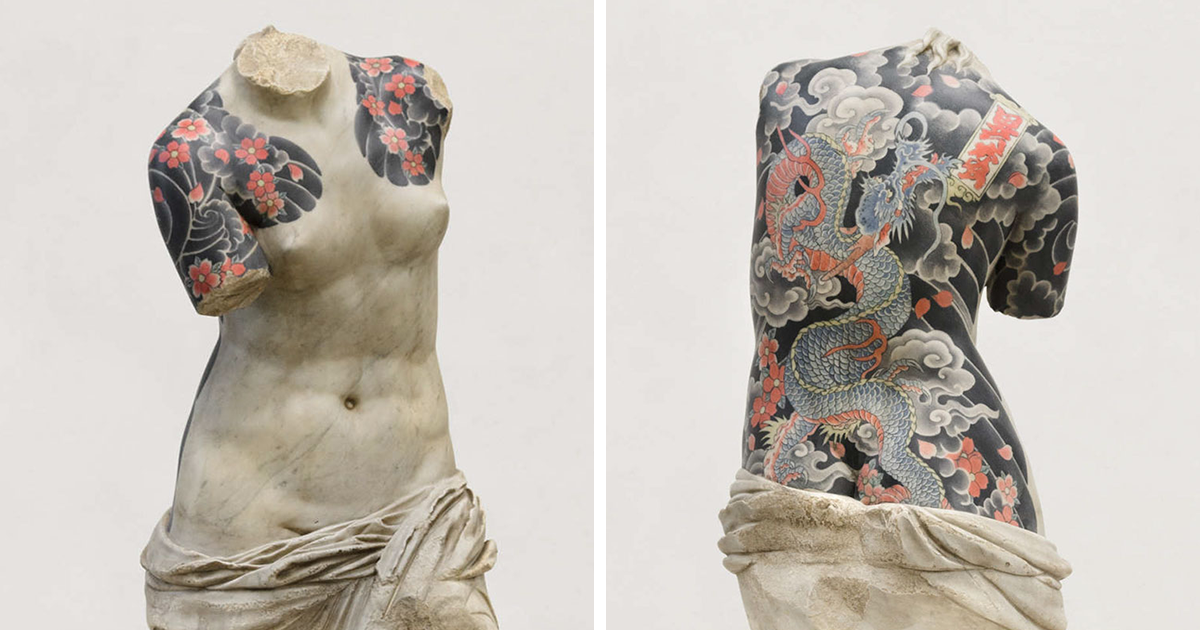
Some artworks ask you to admire them from a safe, respectful distance. Fabio Viale’s tattooed marble sculptures do the exact opposite. They march right up to your classical-art expectations, flick them on the forehead, and ask, “So… you thought ancient beauty had to stay clean, pale, and untouchable?”
That is the delicious tension at the center of Viale’s work. He takes forms we associate with museum reverence, marble gods, goddesses, heroes, and other intimidatingly perfect bodies, and covers them with imagery borrowed from tattoo culture, especially motifs linked to Japanese body art and the harsh visual language of criminal tattoos. The result is weird, bold, funny, confrontational, and strangely elegant. It is like watching a marble masterpiece leave the academy, get streetwise, and come back hotter than ever.
And here is the twist that makes the whole thing even smarter: these works do not just shock for the sake of shock. They also expose a myth many people still carry around without realizing it, namely that classical sculpture was always meant to be pure white, colorless, and spiritually above the messiness of everyday life. Viale’s statues feel rebellious, yes, but they also feel like art history getting its collar yanked.
Who Is the Artist Behind These Tattooed Marble Rebels?
Fabio Viale is not some internet prankster with a paintbrush and a chaotic streak. He is a serious Italian sculptor with deep technical control over marble, a material that has historically been treated like the tuxedo of fine art. Marble is luxurious, unforgiving, and very good at exposing frauds. You cannot bluff your way through it. If your hand slips, your idea collapses. If your concept is weak, the stone will not save you.
That is partly why Viale’s work lands so hard. Before the tattoos even enter the picture, the sculptures themselves already show extraordinary command. He has built a career around making marble do things it should not seem able to do, from recreating everyday objects to producing classical figures with startling physical presence. So when he turns to ancient sculpture, he is not borrowing prestige. He is wrestling with it.
His tattooed sculptures work because the craftsmanship is never the joke. The joke, if there is one, is on us, on the viewers who still carry a neat little hierarchy in our heads: marble equals refinement, tattooing equals rebellion, criminal iconography equals danger, museums equals purity. Viale throws all of that into a blender and serves it back in a form that is both gorgeous and mildly unsettling.
Why the “Criminal Tattoo” Angle Feels So Electric
The headline-making tension in these works comes from the collision of two visual systems that are usually kept far apart. On one side, you have classical sculpture: ideal bodies, harmony, permanence, cultural authority, the whole marble-and-meaning package. On the other, you have tattoo traditions associated with identity, code, subculture, resistance, status, and sometimes intimidation. One language says “civilization.” The other says “I have lived.”
That clash is what makes the sculptures look so unapologetically badass. A tattoo on a living person already changes how we read the body. It can suggest belonging, memory, pain, protection, loyalty, grief, swagger, or warning. When that same visual logic appears on a marble Venus or a classical male torso, the body suddenly stops being a distant ideal and starts feeling inhabited. It acquires biography. It becomes less like an icon and more like a character with stories nobody wrote down.
And that matters because classical sculpture has often been presented as if it floated above ordinary human mess. Viale drags it back to earth, but in a brilliant way. He does not destroy the beauty of the original forms. He complicates it. The statues remain elegant, but now they are also coded, risky, and contemporary. They feel less like relics and more like people you might not want to underestimate in a dark alley, assuming that dark alley has excellent gallery lighting.
These Sculptures Shock Us Because We Still Believe a Big Marble Lie
One of the smartest things about Viale’s work is that it sneaks into a long-running art-historical debate through the back door. Many viewers still assume ancient Greek and Roman sculptures were meant to be pristine white. That image has been repeated so often in museums, textbooks, design culture, and luxury branding that it feels natural. But it is not the whole truth.
Ancient sculpture was frequently painted, gilded, or otherwise embellished. In other words, the all-white marble ideal that modern audiences worship is partly a later fantasy, helped along by time, burial, pigment loss, Renaissance taste, and later theories about beauty. Once you understand that, Viale’s sculptures stop looking like random acts of visual disrespect and start looking like a contemporary continuation of an older reality: sculpture and color have always had a more intimate relationship than the museum gift shop version of history likes to admit.
That is why the tattoos do more than decorate. They expose the gap between what ancient sculpture was and what modern culture decided it should stand for. Viale understands that the white marble body is not just an aesthetic object. It is also an ideology. It has been tied to ideas of purity, timelessness, nobility, and cultural superiority. Putting tattoos on it is therefore not just stylish, it is disruptive in the most intelligent way. It says: maybe this body was never as innocent as you imagined.
Why Classical Figures Are the Perfect Canvas
There is also a clever historical irony in Viale’s choice to work with famous classical forms. Many of the ancient statues people know best today survive as Roman marble copies of earlier Greek works. So even the “original” classical tradition is full of replication, adaptation, and reinterpretation. That makes Viale’s project feel oddly faithful to history. He is not violating a pure lineage. He is joining a chain of remixing that has been going on for centuries.
Take a familiar form like the Venus de Milo or Laocoön. These are not just sculptures; they are visual celebrities. They come with baggage. Viewers already bring assumptions about beauty, civilization, mythology, and museum importance. When Viale tattoos those forms, he is not starting from zero. He is hijacking loaded cultural symbols and rewriting them in a language that feels both contemporary and taboo.
That is part of what makes the work instantly shareable online. You do not need an art history degree to get the basic drama. You see an ancient-looking marble figure with tattoos and your brain immediately does a double take. But if you stay with the work longer, the experience gets richer. The sculpture becomes a conversation about heritage, surface, masculinity, femininity, status, violence, identity, and how culture decides what counts as respectable beauty.
Technique Matters: This Is Not a Cheap Visual Gimmick
A weaker artist could have made this concept feel like a novelty poster in a tattoo shop waiting room. Viale avoids that trap because of his process. He does not simply splash paint on the surface and call it radical. The color is worked into the stone in a way that gives the tattoos a more embodied, skin-like presence. That matters enormously.
The tattoos do not sit on the sculptures like stickers. They feel absorbed, almost metabolized. The marble starts behaving less like a cold monument and more like a body that has actually undergone marking. That is why these works are so visually convincing. The stone still reads as stone, but it also starts mimicking flesh, history, and social identity all at once.
This technical seriousness is what gives the work staying power. Once the initial shock wears off, there is still plenty to admire: the anatomy, the balance of form and pattern, the intelligent use of iconography, and the uncanny way the tattoos seem to alter the emotional temperature of the figure. A classical torso can look heroic when left bare. Add the right tattoo field, and suddenly it looks defiant, dangerous, erotic, mournful, or menacing. Same marble. Entirely different psychological weather.
Sacred Meets Profane, and Neither One Leaves Unchanged
Viale’s sculptures are often discussed in terms of the sacred and the profane, and for good reason. Classical statuary still carries a whiff of the sacred in Western culture, even when the subject is mythological rather than religious. We are trained to approach it respectfully. Tattoos, especially criminal or prison-coded tattoos, can signal the opposite end of the cultural spectrum: the body as archive, warning, transgression, survival.
When those two worlds collide, the sculpture becomes unstable in the best way. It no longer belongs neatly to the temple or the street. It sits between them. That in-between state is where the excitement lives. You are not just looking at an object; you are watching two systems of value argue in public.
And the argument is wonderfully productive. The tattoos do not merely “dirty” the statues. They humanize them, historicize them, and in some cases make them more emotionally accessible. At the same time, the marble elevates the tattoo imagery, forcing viewers who might dismiss body art as low culture to take its visual power seriously. Each side changes the other. That is the real magic trick.
Why the Internet Cannot Resist These Sculptures
Let’s be honest: Viale’s work is extremely online in the best possible sense. It delivers immediate impact without becoming shallow. In a single image, you get an art-history reference, a subculture reference, a technical flex, and a mini identity crisis. That is catnip for contemporary audiences.
But the sculptures last because they are not just viral bait. They tap into big modern obsessions: remix culture, reappropriation, the politics of beauty, the clash between elite and popular art, and the desire to see old forms reactivated instead of embalmed. We live in a moment when people are tired of being told that heritage must remain untouched to be respected. Viale’s marble figures speak directly to that mood.
They also carry a deeper emotional charge. Tattoos often mark turning points: pain endured, loyalty declared, identity chosen, memory preserved. When classical sculpture absorbs that logic, it stops feeling like frozen perfection and starts feeling like lived experience. The statues become less “Look at this ideal body” and more “Look at what a body can carry.” That is a much more contemporary question, and a much more human one.
What These Works Ultimately Say About Beauty
At the heart of Viale’s project is a stubborn refusal to let beauty stay polite. His sculptures suggest that beauty does not need to be untouched to remain powerful. In fact, it may become more compelling once it has been marked, challenged, or complicated.
That is a message with real cultural bite. For centuries, classical beauty has been framed as calm, balanced, and above contamination. Viale proposes something far more interesting: beauty can be coded, scarred, hybrid, subcultural, and confrontational. It can wear the marks of conflict and still command awe. Maybe even because of them.
And that is why these sculptures feel so memorable. They are not merely clever mash-ups of old art and new ink. They are arguments in stone. They ask whether the body must remain pure to remain beautiful, whether tradition must stay frozen to stay meaningful, and whether so-called high culture is brave enough to survive a tattoo gun, metaphorically speaking.
Experience: What It Feels Like to Encounter Tattooed Marble in Real Life
Looking at photos of Viale’s work online is one thing. Standing in front of tattooed marble, or even imagining that encounter seriously, is something else entirely. The first sensation is usually disbelief. Your eyes want to sort the sculpture into a familiar category. Classical statue. Museum object. Marble body. Case closed. But then the tattoos pull the rug out from under that neat little filing system.
You start moving closer. The body still has the authority of stone, but the surface begins behaving like skin in your imagination. That is a strange and thrilling sensation. Marble is supposed to feel distant, cold, untouchable. Tattoos are intimate. They belong to pain, memory, ritual, tribe, rebellion. When the two fuse, your brain does a hard reset.
There is also a weird emotional split that happens. Part of you wants to laugh because the idea is so audacious. A classical sculpture with criminal tattoos? That sounds like a pitch dreamed up at 2 a.m. by an art director who had too much espresso. But the longer you look, the less it feels like a joke. The humor gives way to tension, then curiosity, then admiration. You realize the work is not mocking the past. It is waking it up.
Another striking part of the experience is how the tattoos shift the figure’s personality. A marble Venus can read as serene, idealized, and remote. Add dense, dark imagery and suddenly she feels tougher, more enigmatic, maybe even defiant. A male torso that once seemed heroic can start to look dangerous, seasoned, almost cinematic. The forms do not change, but the character does. It is like watching the same actor play a completely different role without changing costumes, because the “costume” is now under the skin.
There is also a bodily reaction. Tattooed marble makes you more aware of your own skin. You begin thinking about what bodies record over time, scars, ink, labor, grief, fashion, aging, identity. The sculpture is no longer just an object from the past. It becomes a mirror, though a very dramatic one, probably with better abs than most of us will ever manage.
Most of all, the experience leaves you with the sense that culture is not fixed. That may sound lofty, but Viale’s sculptures make the point with a wonderfully blunt visual language. The classics are not sealed in amber. They can be argued with. They can be dressed differently. They can absorb new meanings without losing their old power. In fact, that may be how they stay alive.
So the lasting experience is not just “Wow, cool tattooed statue.” It is the realization that beauty, history, and identity are all more negotiable than we pretend. And that realization is exhilarating. Because once marble can change, maybe everything else can too.
Conclusion
Fabio Viale’s tattooed classical sculptures are unforgettable because they do several things at once. They dazzle as feats of marble technique. They provoke as cultural mash-ups. They challenge the myth of untouched white antiquity. And they turn ancient forms into vividly contemporary bodies loaded with identity, symbolism, and attitude.
Most importantly, they prove that classical art does not have to stay frozen in reverence to remain meaningful. Sometimes the boldest way to honor tradition is to argue with it, mark it up, and send it back into the world looking sharper, stranger, and more alive. In Viale’s hands, marble does not lose dignity when it gets tattooed. It gains a pulse.