Imagine opening Adobe Photoshop, dragging in a perfectly normal photo of a cat, and watching the software whisper, “Nice. But what if the cat were judging a corporate board meeting from inside a cereal bowl?” That, dear reader, is the spirit of Photoshop humor: the glorious intersection of skill, mischief, surrealism, and the tiny voice inside every designer’s head that says, “This is probably too weird… so let’s add a tiny cowboy hat.”
Photoshop has spent decades helping photographers polish portraits, designers build campaigns, artists create digital worlds, and internet users turn everyday images into jokes that live rent-free in our brains. Since its public release in 1990, Photoshop has become more than an image-editing program. It is a cultural verb, a creative laboratory, a meme machine, and sometimes the reason your aunt believes a shark was actually swimming down a flooded highway.
If Photoshop had its own sense of humor, it would not tell knock-knock jokes. It would place a door in the middle of the ocean, put a confused giraffe behind it, add cinematic lighting, and label the file “final_final_reallyfinal_v8.psd.” Its comedy would be visual, absurd, technically impressive, and just strange enough to make you zoom in twice.
What Makes Photoshop Humor So Addictive?
Great visual comedy usually begins with surprise. Psychologists often describe humor through incongruity: the funny spark that happens when two incompatible ideas collide. Photoshop is basically an incongruity factory with layers, masks, selection tools, blending modes, and enough adjustment sliders to make a raccoon look like it runs a luxury skincare brand.
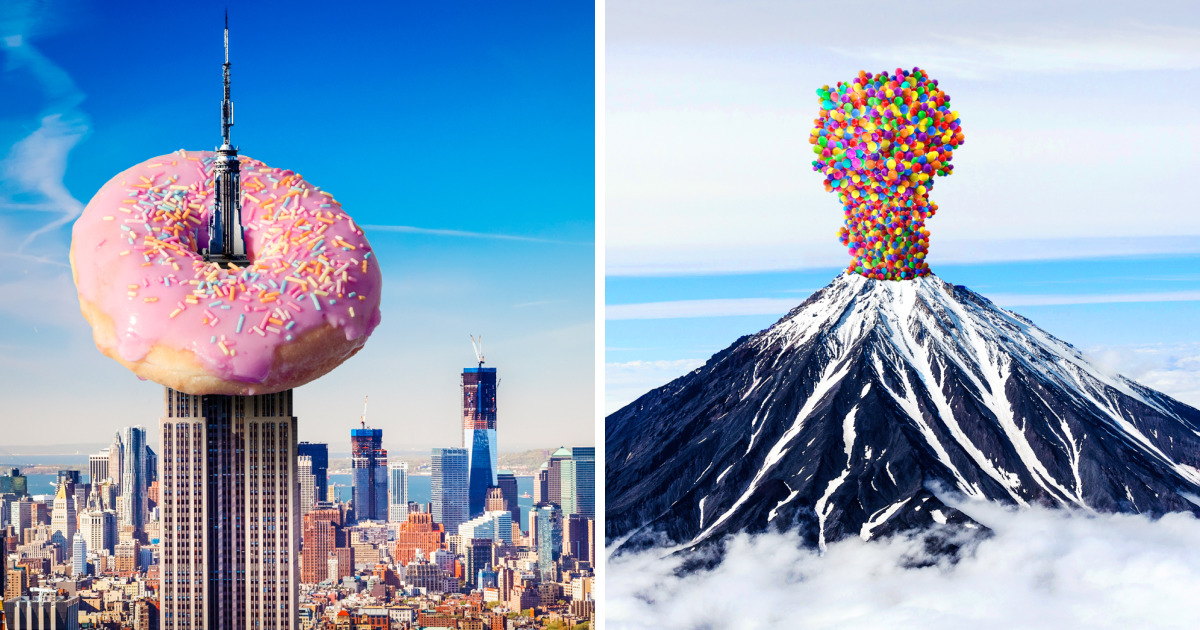
The best funny Photoshop edits work because they take something familiar and quietly break reality. A dog at the dinner table is cute. A dog at the dinner table reviewing quarterly earnings while wearing bifocals is comedy. A mountain landscape is beautiful. A mountain landscape where the peak has been replaced by a sleeping pug is the kind of digital nonsense the internet was clearly built to preserve.
The Three Ingredients of a Funny Photoshop Edit
First, there is recognition. The viewer needs to understand the original world: a wedding photo, a celebrity portrait, a vacation snapshot, a product ad, or a stock image of a man smiling at salad for reasons science still cannot explain.
Second, there is disruption. Something enters the scene that should not be there: a dinosaur in a grocery store, a Renaissance baby holding a smartphone, or a heroic squirrel photoshopped into a movie poster.
Third, there is commitment. The joke works best when the editing is polished enough to make the absurd idea feel temporarily believable. Bad Photoshop can be funny, too, but great Photoshop humor makes your brain say, “This is impossible,” while your eyes respond, “Counterpoint: it has shadows.”
From Serious Tool to Internet Mischief Engine
Photoshop was originally designed as a powerful image-editing tool for photographers, publishers, and creative professionals. Over time, its features expanded into layers, masks, advanced selections, retouching tools, compositing, object removal, nondestructive edits, and now generative AI features that can add, remove, or expand visual content with text prompts.
That professional power is exactly why it became so funny. Humor loves contrast. A tool capable of producing museum-quality digital art is also capable of giving Abraham Lincoln sunglasses, putting a pizza slice in orbit, or transforming a family holiday card into a fake album cover for a band called “Grandma and the Leftovers.” Photoshop humor is hilarious because it uses serious craft for unserious purposes.
This is not new. Art history is full of serious technique used for playful disruption. Surrealists loved unexpected combinations: ordinary objects turned strange, dream logic replacing common sense, and familiar scenes behaving badly. Photoshop simply gave that impulse a digital interface. Instead of a paintbrush and canvas, modern creators use cutouts, masks, shadows, blending, and a healthy disrespect for gravity.
If Photoshop Were a Comedian, What Kind Would It Be?
Photoshop would be the friend who says very little at dinner, then sends the group chat an image of everyone as medieval oil paintings by midnight. It would not explain the joke. It would simply export it at 300 DPI.
1. The Surrealist Prankster
This version of Photoshop loves dream logic. It would create a goldfish commuting on the subway, a toaster worshipped like an ancient monument, or a business meeting where everyone is a flamingo except the intern, who is a confused cactus.
Surreal Photoshop humor works because it treats nonsense with total seriousness. Lighting, shadows, perspective, and texture make the joke land. The more realistic the impossible scene looks, the funnier it becomes. A floating banana is mildly amusing. A floating banana casting a perfect shadow over Times Square while pedestrians ignore it? That is comedy wearing a tiny crown.
2. The Meme Mechanic
Memes thrive on repetition, remixing, and community participation. The Library of Congress has treated web culture, memes, GIFs, image macros, and online vernacular as meaningful forms of digital folklore. That makes Photoshop one of the unofficial toolboxes of modern folk humor.
In meme culture, an image is rarely finished. It mutates. Someone captions it. Someone edits the caption. Someone replaces the person in the image with a raccoon. Someone else adds laser eyes. Then a brand tries to use it three weeks too late, and the meme immediately retires out of embarrassment.
If Photoshop had a sense of humor, it would understand that memes are not just pictures. They are social shorthand. A funny edit can say “Monday morning,” “group project disaster,” or “me pretending I know what an NFT is” faster than a paragraph ever could.
3. The Accidentally Funny Intern
Not all Photoshop humor is intentional. Sometimes the funniest images are Photoshop fails: missing limbs, duplicate hands, warped backgrounds, floating products, shadows pointing in different directions, and models whose elbows appear to have signed a separate contract.
These mistakes are funny because they reveal the invisible labor behind polished media. Retouching is supposed to disappear. When it fails, the curtain swings open, and suddenly we are all staring at a luxury handbag ad where the model has three knees and the couch is bending like it owes money.
The Rise of AI Image Editing: Photoshop Learns New Tricks
Modern Photoshop is not just about manual retouching. Adobe’s newer generative AI tools, including Generative Fill, Generative Expand, and AI-assisted object removal, make it easier to add, replace, or extend parts of an image using text prompts. Firefly-powered editing can help creators move faster, test ideas, and produce variations without rebuilding everything from scratch.
For comedy, this is rocket fuel. A creator can start with a photo of a beach and ask for “a dramatic courtroom full of seagulls,” “a tiny alien lifeguard,” or “a suspiciously elegant raccoon reading a weather report.” The results still need taste, direction, and often plenty of cleanup, but the brainstorming process becomes faster and more experimental.
However, AI image editing also raises an important point: funny is best when it is honest. A harmless surreal joke is one thing; deceptive manipulation is another. As synthetic content becomes more realistic, transparency tools such as Content Credentials and provenance standards matter because they help audiences understand how an image was created or edited. The funniest Photoshop creations should make people laugh, not mislead them into believing a mayor actually rode a giant hamster into a press conference.
Funny Photoshop Ideas That Feel Like the Software Developed a Personality
If Photoshop could wake up, drink an espresso, ignore seventeen update notifications, and start making jokes, here is what it might create.
A Cat as a Renaissance Noble
The internet already treats cats like royalty, so this edit simply tells the truth with velvet sleeves. Imagine a tabby posed in a dramatic oil-painting composition, wearing a ruffled collar, one paw resting on a globe, staring into the distance like it just conquered the treat drawer.
A Businessman Giving a Presentation to Ducks
This image works because the body language is familiar. We all recognize corporate presentation anxiety. Replace the audience with ducks, and suddenly the quarterly sales report becomes a pond-based TED Talk. Bonus points if one duck looks skeptical.
A Baby Operating Heavy Machinery
Obviously, not in real life. In Photoshop comedy, however, a baby in a hard hat sitting inside a bulldozer with a serious expression creates instant absurdity. The joke comes from confidence. Babies are not known for project management, but the right edit can make one look like the foreman of a very sticky construction site.
A Shark in a Public Library
A shark swimming through a library aisle is the perfect “wait, what?” visual. The contrast between danger and quiet reading etiquette is delicious. Add a tiny sign that says “Please Keep Voices Down,” and the image becomes sophisticated nonsense.
A Haunted Printer
Every office already believes the printer is haunted. Photoshop would simply document the truth: paper floating in a supernatural spiral, toner smoke rising like a curse, and a tiny ghost emerging from the tray holding a jammed invoice.
Why We Love Digital Absurdity
Funny Photoshop edits give people a break from ordinary reality without requiring them to leave it completely. They use familiar images as a doorway into absurdity. That is why surreal photo manipulation, meme edits, and visual jokes spread so easily online: they are quick to understand, easy to share, and emotionally lightweight.
They also let creators participate in a larger conversation. A single edited image can respond to a trend, parody a movie poster, mock a common workplace frustration, or turn a boring product photo into something memorable. In digital culture, humor is often collaborative. One person makes the original edit, another remixes it, another captions it, and before long the joke has grown legs, put on roller skates, and crashed into a comments section.
How to Create Photoshop Humor Without Making a Visual Mess
Photoshop humor may look chaotic, but the best examples are built on craft. The sillier the concept, the more important the execution becomes.
Match the Lighting
If a raccoon is giving a presidential speech, it still needs believable lighting. Shadows, highlights, and color temperature make the edit feel intentional instead of pasted together during a caffeine emergency.
Respect Perspective
A giant rubber duck in downtown traffic must match the camera angle. If the perspective is off, the joke turns into a visual ransom note. If the perspective is right, viewers accept the duck as part of the morning commute.
Use Details as Punchlines
Tiny details reward viewers who look closely. A name tag, a background character, a fake warning label, or a hidden expression can turn a funny image into a rewatchable joke. Photoshop humor is often funniest on the second glance.
Keep the Concept Simple
A strong funny Photoshop idea can usually be explained in one sentence: “A raccoon runs a spa,” “a dog becomes a judge,” “the moon is a cookie.” If the concept requires a paragraph and a family tree, the punchline may need a nap.
When Photoshop Humor Goes Wrong
There is a difference between playful manipulation and irresponsible deception. Satire, parody, and obvious absurdity can be delightful. But realistic edits involving real people, public events, disasters, health claims, or political situations need care. The more believable an edited image becomes, the more responsibility the creator has.
That does not mean humor must become boring. It means creators should use context, captions, labels, and ethical judgment. A fake movie poster starring your dog as an astronaut is charming. A realistic fake news image is not a joke; it is a problem wearing a clown nose.
Experiences Related to Photoshop Humor: What Happens When Creativity Gets Mischievous
Anyone who has spent time around designers, meme makers, content creators, or bored office workers knows that Photoshop humor often begins with one dangerous sentence: “I made a version.” That version is never normal. It starts as a harmless tweak, then someone adds sunglasses, someone else requests flames, and fifteen minutes later the company mascot is riding a dragon through a spreadsheet.
One of the most common experiences with funny Photoshop edits is the group-chat explosion. Someone shares a simple photo: a friend standing awkwardly at a picnic, a pet making a strange face, a coworker caught mid-blink during a video call. Then the edits begin. The picnic friend becomes a movie villain. The pet becomes a royal advisor. The coworker becomes a motivational poster reading, “Leadership Is Mostly Buffering.” What makes these edits memorable is not just the image itself, but the shared laughter around it.
Photoshop humor also teaches an unexpected lesson about observation. To make a visual joke work, you have to notice small things: facial expressions, posture, background objects, lighting direction, empty space, and the emotional tone of an image. A great editor sees a boring hallway and imagines a red carpet. They see a coffee mug and imagine a spaceship. They see a stock photo meeting and think, “This needs one confused goat.”
There is also a strangely joyful tension between skill and stupidity. A creator might spend forty minutes perfecting the shadow under a floating taco. That is objectively ridiculous, but it is also the secret charm of the craft. Comedy often improves when the artist takes the dumb idea seriously. The more carefully rendered the nonsense, the funnier it gets. A sloppy floating taco is just a mistake. A beautifully lit, perfectly masked floating taco with cinematic depth of field becomes art. Possibly not museum art, but definitely “send this to everyone named Kevin” art.
For beginners, the first funny Photoshop project often involves replacing someone’s face, cutting out an animal, or adding an object where it clearly does not belong. The early results may have crunchy edges and shadows that behave like they were raised by wolves. But that is part of the experience. Every skilled digital artist has probably created at least one cursed image that should be locked in a folder called “learning process.”
For professionals, Photoshop humor can be a creative warm-up. Designers who spend their workdays building polished brand assets may use silly edits to loosen up. It is like stretching before a run, except the stretch involves putting a raccoon in a luxury perfume campaign. These playful experiments can lead to better ideas because they lower the pressure. When the goal is laughter, creators take risks they might avoid in formal work.
Photoshop humor also builds community. Online challenges where users edit the same image show how many different punchlines can emerge from one source photo. One person turns a man pointing at the sky into a superhero poster. Another places him in a Renaissance fresco. Another makes him point at a giant sandwich descending from the heavens. The original image becomes a stage, and everyone brings their own joke.
Perhaps the best experience related to Photoshop humor is the tiny moment of disbelief it creates. You look at an image, understand it, reject it, accept it, and laughall in about two seconds. It is a magic trick with pixels. The rabbit was never in the hat. The hat was never in the ocean. The ocean was actually a stock texture. Still, for one brief second, the impossible made perfect sense.
Conclusion: Photoshop’s Joke Is Reality, Lightly Rearranged
If Photoshop had its own sense of humor, it would be clever, chaotic, visually sharp, and slightly too proud of its layer organization. It would understand that comedy often lives in the gap between what we expect and what we see. A normal image tells us what happened. A funny Photoshop edit asks, “Yes, but what if it happened with ducks?”
From surreal photo manipulation to meme culture, from polished parody to hilarious Photoshop fails, digital image humor remains one of the internet’s most flexible creative languages. It lets ordinary people remix reality, exaggerate everyday frustrations, and turn boring pictures into tiny visual punchlines. The best edits do not just show technical skill. They show timing, taste, imagination, and the courage to ask whether a toaster would look funnier wearing cowboy boots.
So if Photoshop ever develops a personality, let’s hope it has a good laugh. And let’s hope it saves the file before crashing.
Note: This article is written in original American English for web publishing, based on synthesized research about Photoshop history, image-editing features, surrealism, meme culture, humor theory, AI image editing, and digital content transparency.