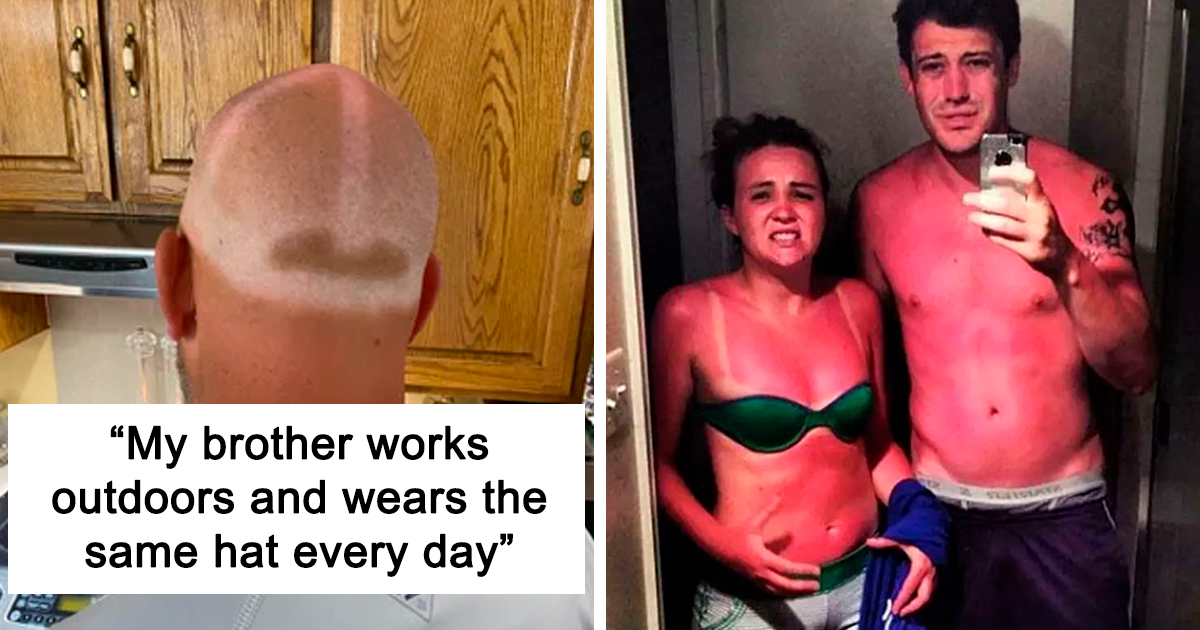
There is a special kind of confidence that appears five minutes after arriving at the beach. Someone pulls out a bottle of sunscreen, and another person waves it away like a medieval king rejecting peasant medicine.
“I never burn.”
“It’s cloudy.”
“I’m only going outside for an hour.”
Then evening arrives, the shower water feels like boiling soup, and the formerly confident sun worshipper discovers a bright red outline of sunglasses, sandals, suspenders, or one tragically misplaced handprint.
The following 50 sunscreen fails are humorous composite scenarios based on common sunburn patterns and outdoor experiences, not claims about identifiable individuals. Laugh at the unfortunate tan lines, but remember that sunburn is real skin damagenot merely a temporary fashion disaster.
Why Skipping Sunscreen Produces Such Spectacular Results
Sunburn is an inflammatory reaction caused by excessive ultraviolet radiation. UVB rays are strongly associated with burning, while UVA rays penetrate more deeply and contribute to premature skin aging. Both can damage skin cells and increase the risk of skin cancer. Sunburn may appear within hours, although the full redness, tenderness, swelling, or blistering can become more noticeable later.
People sometimes assume that clouds, darker skin, a base tan, cold weather, or a beach umbrella make sunscreen unnecessary. Unfortunately, UV radiation does not negotiate with confidence. It can reach skin on cloudy days, affect people of every skin tone, pass through loosely woven clothing, and reflect from water, sand, snow, glass, and concrete.
Dermatologists generally recommend a broad-spectrum, water-resistant sunscreen with SPF 30 or higher for exposed skin. It should be applied generously and reapplied approximately every two hours, as well as after swimming, heavy sweating, or toweling off. Sunscreen works best as part of a larger strategy that includes shade, protective clothing, sunglasses, and a wide-brimmed hat.
50 People Who Said “I Don’t Need Sunscreen”
Beach Decisions That Aged Poorly
- The Sunglasses Raccoon: He removed his sunglasses at dinner and discovered two pale circles surrounded by a face the color of tomato bisque.
- The Backward-Cap Graduate: His forehead survived beautifully. The backward semicircle burned into his neck suggested he had been branded by a baseball team.
- The Sand Napper: She fell asleep with one arm across her stomach and woke up wearing a permanent-looking diagonal sash made of unburned skin.
- The Forgotten Feet: He protected his face, shoulders, and chest but ignored his feet. Shoes became medieval torture devices for the next several days.
- The Flip-Flop Artist: Two crisp white sandal straps remained on otherwise red feet, creating footwear that could not be removed because it was technically skin.
- The Towel Shadow: A folded towel covered half his leg. That evening, one thigh looked vacation-ready while the other looked recently introduced to a furnace.
- The Book-Shaped Belly: She read for hours with a paperback resting on her abdomen. The resulting pale rectangle resembled an advertisement for literature-based sun protection.
- The Seashell Collector: Hours spent bending forward protected his stomach but roasted his back, turning him into a human warning label for poor posture.
- The Umbrella Optimist: He stayed beneath an umbrella and assumed he was invincible, forgetting that reflected UV radiation can still reach skin from sand and water.
- The “Just Ten Minutes” Swimmer: Ten minutes became ninety. His shoulders later matched the red pool floats he had spent the afternoon mocking.
Fashion Choices That Became Sunburn Stencils
- The Crocs Constellation: Circular ventilation holes created a dotted pattern across both feet, proving that practical footwear can also produce avant-garde skin art.
- The Mesh-Shirt Visionary: He expected airflow. He received hundreds of tiny burned diamonds arranged across his torso like an angry picnic tablecloth.
- The Suspender Situation: Two pale vertical stripes remained on a bright red back, making him resemble an irritated slice of bacon wearing road markings.
- The Cutout Swimsuit Gamble: The suit looked sophisticated at noon. By sunset, its geometric openings had created a skin puzzle no clothing could completely conceal.
- The One-Sleeve Wonder: A long car ride with one arm beside an open window left him with two arms that appeared to belong to different people.
- The Anklet Outline: Her delicate ankle jewelry left a pale chain-shaped mark surrounded by red skinan elegant accessory upgraded into a temporary tattoo.
- The Watch Collector: Removing his smartwatch revealed a ghostly white rectangle so precise that friends could identify the model without seeing the device.
- The Bucket-Hat Betrayal: The hat protected the top of his head but abandoned his ears, which spent the evening looking like two glowing emergency signals.
- The Necklace Negative: A large pendant preserved one pale circle on her chest, creating the appearance that she had been attacked by a very selective spotlight.
- The Torn-Jeans Experiment: Each fashionable rip produced a separate red patch. His knees looked as though they had lost several tiny arguments.
Outdoor Sports and Festival Fails
- The Marathon Minimalist: He applied sunscreen at sunrise and never reapplied. Sweat and hours outdoors transformed his race bib into a rectangular tan-line souvenir.
- The Golfer’s Glove: One hand remained pale beneath a glove while the other darkened dramatically, creating the illusion of a poorly coordinated body transplant.
- The Cyclist’s Helmet: Ventilation slots produced striped scalp burns that made his head resemble a carefully grilled panini.
- The Soccer Spectator: She protected the children but forgot herself. By the final whistle, her folding-chair straps had created a complicated shoulder diagram.
- The Music-Festival Glitter Trap: Decorative stickers blocked small pieces of sunlight, leaving stars, moons, and hearts surrounded by skin that felt anything but festive.
- The Kayaker’s Knees: He covered his face and arms but ignored the knees pointing directly at the sky. They later became two painful red headlights.
- The Baseball Doubleheader: A two-hour game became five hours in the stands. His team lost, and his forearms celebrated by turning the opponent’s uniform color.
- The Fishing Enthusiast: Reflected sunlight from the water helped cook the underside of his chin, an area he had confidently declared “physically impossible to burn.”
- The Tennis Sock Legacy: High socks protected his ankles while his calves burned, leaving him with permanent-looking white boots whenever he wore shorts.
- The Rooftop Yoga Philosopher: She found inner peace but lost track of time. Her mat straps left two pale lines that looked like punctuation marks.
Work, Travel, and Everyday Miscalculations
- The Convertible Commuter: He drove with the roof down and arrived looking normal. Several hours later, his forehead submitted a bright red complaint.
- The Window-Seat Sleeper: She dozed beside an airplane window and woke with one side of her face noticeably more sun-exposed than the other.
- The Backyard Mechanic: He worked beneath a car with only his lower legs exposed. His shins paid the full price for the rest of his body’s shade.
- The Gardening Minimalist: A tank top, crossed apron straps, and hours of weeding produced a back pattern that resembled an unfinished highway interchange.
- The Roofer Who Knew Better: Years of outdoor work encouraged overconfidence. One forgotten neck application was enough to make his collar intolerable.
- The Road-Trip Passenger: Her arm rested near the window for six hours, creating a sharp sleeve line without requiring her to leave the vehicle.
- The Outdoor-Wedding Guest: He dressed formally but skipped sunscreen. His bow tie remained elegant while his ears slowly became the reception’s brightest decorations.
- The Cruise-Deck Reader: A cool ocean breeze disguised the intensity of the sun until his skin delivered the unpleasant update later that evening.
- The Snow-Day Skeptic: Cold temperatures convinced him that sunburn was impossible. Reflected UV from the snow responded with a painful correction.
- The Sidewalk-Café Regular: She sat at the same sunny table repeatedly, developing one darker arm that appeared to have enjoyed a separate vacation.
Application Mistakes That Defeated the Entire Purpose
- The Tiny-Dab Technician: He stretched a pea-sized amount across his entire body, apparently believing sunscreen had the coverage powers of industrial house paint.
- The Spray-and-Pray Expert: A quick mist floated mostly into the breeze. Random protected streaks appeared among large areas of thoroughly unprotected skin.
- The Shoulder-Blade Quitter: She reached most of her back but missed two symmetrical patches, creating red islands located precisely where she could not apply moisturizer.
- The Expired-Bottle Archaeologist: He found sunscreen in an old beach bag and treated its mysterious texture as evidence that it had become “extra powerful.”
- The Morning-Only Believer: One application before breakfast was expected to survive swimming, sweating, toweling, lunch, volleyball, and several hours of direct sunlight.
- The SPF-100 Superhero: He assumed a high SPF granted unlimited outdoor time. No sunscreen blocks every UV ray or eliminates the need for reapplication.
- The Cloudy-Day Gambler: She saw gray skies and left the sunscreen at home. The clouds did not sign any agreement to block all UV radiation.
- The Base-Tan Defender: He claimed his existing tan was “natural armor.” By evening, the armor had upgraded itself into another layer of visible damage.
- The Dark-Skin Myth Subscriber: She believed her skin tone made sun protection unnecessary. Although visible redness can differ, every skin tone can experience UV damage.
- The Helpful Handprint: A friend applied sunscreen to the center of his back but missed everything around it. The surviving pale handprint looked like evidence from a slapstick crime scene.
The Funniest Tan Lines Come From Predictable Mistakes
Most sunscreen disasters involve one of four errors: applying too little, missing exposed areas, forgetting to reapply, or treating sunscreen as the only necessary form of protection. Frequently neglected spots include the ears, lips, scalp, hairline, neck, hands, feet, backs of the knees, and skin near swimsuit edges.
SPF is also widely misunderstood. SPF 30 filters about 97% of UVB rays when applied correctly, while higher SPF products filter slightly more. That does not mean SPF 100 lasts all day, provides complete protection, or permits someone to remain outdoors indefinitely. Sunscreen wears away, rubs off, and becomes less effective after swimming or sweating.
A More Reliable Sun-Protection Routine
- Choose broad-spectrum sunscreen that protects against UVA and UVB rays.
- Use SPF 30 or higher on exposed skin.
- Apply it before prolonged outdoor exposure rather than waiting until skin feels hot.
- Use enough product to create an even, generous layer.
- Reapply about every two hours and after swimming, sweating, or toweling off.
- Use lip balm with SPF and remember the ears, scalp, hands, neck, and feet.
- Combine sunscreen with shade, protective clothing, sunglasses, and a wide-brimmed hat.
- Check the local UV Index before outdoor activities.
The EPA’s UV Index uses a scale from 1 to 11 or higher to forecast the expected intensity of ultraviolet radiation. As the number rises, unprotected skin can be damaged more quickly, making additional protection and reduced midday exposure increasingly important.
What to Do When the Joke Has Already Turned Red
A mild sunburn can often be managed with cool baths or showers, gentle moisturizer, additional fluids, and complete protection from further sun exposure while the skin recovers. Aloe vera or soy-containing moisturizers may feel soothing. Avoid placing ice directly on the skin, and do not intentionally peel flaking skin or break blisters.
Medical help may be necessary when sunburn is severe, covers a large area, causes significant blistering, or appears alongside fever, confusion, faintness, dehydration, worsening pain, vomiting, or signs of infection. Babies and young children may require professional advice sooner.
Most importantly, do not treat the fading of redness as proof that nothing happened. The uncomfortable color may disappear, but ultraviolet exposure can cause lasting cellular damage. Repeated burns and accumulated exposure contribute to premature aging and skin-cancer risk.
Experiences That Turn Sunscreen Skeptics Into Sunscreen Evangelists
Nearly every committed sunscreen user seems to have an origin story. It is rarely glamorous. Nobody announces, “I carefully reviewed dermatology guidance and optimized my long-term photoprotection strategy.” More often, the story begins with a cheap beach chair, an overcast sky, and the sentence, “I’ll be fine.”
Consider the familiar first-day-of-vacation experience. A traveler arrives at a resort before the room is ready and decides to spend “a little while” beside the pool. The sunscreen is buried in a suitcase, but retrieving it feels inconvenient. The breeze is cool, the drinks are colder, and there is no immediate discomfort. By dinner, however, the traveler cannot comfortably lean against a chair. For the rest of the vacation, every photograph includes a loose shirt, a shaded seat, and the facial expression of someone negotiating with their own shoulders.
Outdoor festivals create another classic lesson. People remember water, sunglasses, portable chargers, and complicated outfits, but sunscreen is treated as optional luggage. After hours of standing in an open field, decorative straps and jewelry become stencils. The resulting sunburn does not merely hurt; it conflicts with every outfit planned for the following week. Nothing develops respect for broad-spectrum SPF quite like attending an important meeting with the pale outline of a lightning bolt across your forehead.
Road trips produce quieter but equally convincing experiences. Because passengers remain inside a vehicle, they may not consider themselves “out in the sun.” Yet an arm resting near a bright window for several hours can accumulate substantial exposure. The difference may not be obvious until later, when one forearm appears darker or feels tender. From then on, sunscreen enters the glove compartment beside the registration papers and emergency snacks.
Sports offer their own unpleasant education. Runners, cyclists, golfers, anglers, and spectators often begin early, when temperatures are mild. As the day progresses, sweat removes product, clothing shifts, and exposed areas change. Someone who applied sunscreen carefully at 7 a.m. may assume the job is finished. By afternoon, a race number, watch, helmet strap, glove, or pair of high socks has created a sharply defined souvenir. The lesson is not that sunscreen failed; the lesson is that reapplication was treated like an optional software update.
Parents frequently describe a particularly ironic version of the experience. They carefully coat their children from head to toe, add hats, organize shade, and issue repeated warnings. Meanwhile, they forget their own shoulders and neck. That evening, the children are comfortable while the parent stands in front of a fan looking like an exhausted lobster. The episode usually ends with a family sunscreen station near the door so that protecting the adults becomes part of the routine too.
People with deeper skin tones may have a different experience because redness can be less obvious, but tenderness, heat, irritation, darkening, peeling, and other effects of excessive exposure can still occur. The myth that naturally darker skin eliminates the need for protection can delay recognition of UV damage. Sunscreen should not be marketed as belonging to one complexion, climate, or type of vacation. Sun safety is for human skin.
The best lesson from these stories is not that careless people deserve embarrassment. It is that humans are poor at responding to hazards they cannot immediately see or feel. UV radiation is invisible, and sunburn often announces itself after the damaging exposure has already occurred. A reliable routine removes the need to make a fresh decision every time the sun appears.
Keep sunscreen where it will actually be used: beside the door, in a work bag, with sports equipment, or near travel toiletries. Choose a formula that feels comfortable enough to apply generously. Set a reapplication reminder during long outdoor days. Add a hat and protective clothing when possible. These small habits are far easier than spending three nights sleeping like a rotisserie chicken because every normal position hurts.
Conclusion: Confidence Is Not an SPF
The sun does not care whether someone “never burns,” dislikes the texture of sunscreen, has a base tan, or plans to remain outside for only twenty minutes. It also has an impressive talent for turning ordinary objects into ridiculous tan-line templates.
The 50 mishaps above may be funny, but the underlying message is serious. Sunburn is preventable skin damage. Broad-spectrum sunscreen, sensible reapplication, shade, clothing, hats, sunglasses, and attention to the UV Index can help people enjoy the outdoors without becoming the next sunglasses raccoon, Crocs constellation, or human mesh pattern.
Bring the sunscreen. Use enough. Reapply it. Your future skinand your vacation photoswill be grateful.