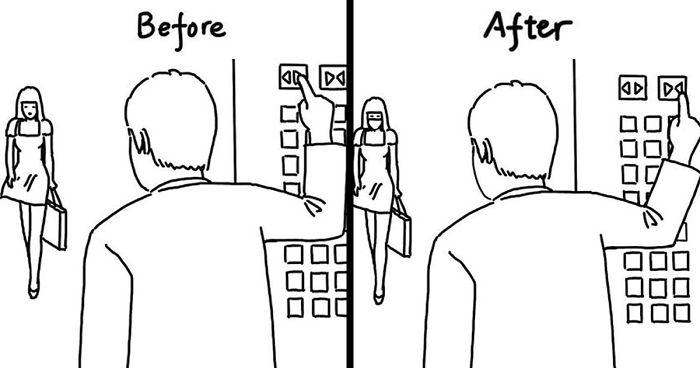
Some comics need a paragraph of dialogue, a subplot, a dramatic sound effect, and perhaps a small explosion. Tango Gao often needs a cat, a shadow, and a line so thin it looks as though it skipped breakfast. That restraint is exactly why his clever comics work so well.
Known for minimalist, mostly wordless illustrations, Tango Gao turns familiar objects, animals, and everyday frustrations into visual puzzles with a punchline hiding in plain sight. A shoe can become a joke about eyesight. A cloud can develop an attitude. A shadow can tell a completely different story from the thing casting it. His work makes readers pause, smile, and occasionally wonder whether the household objects around them have been quietly plotting something.
This collection of 35 clever comics by Tango Gao is not simply about funny drawings. It is about the pleasure of seeing ordinary life from an unexpected angle. The jokes are clean, quick, and often surprisingly thoughtfulproof that a comic does not need a speech bubble to have something smart to say.
Who Is Tango Gao?
Tango Gao, also known as Gao Youjun and sometimes called Shanghai Tango, is a Shanghai-born artist, illustrator, and cartoonist whose work has gained an international following for its visual wit. He began posting frequent drawings online in 2010, building a daily creative practice that transformed ordinary observations into compact visual jokes.
His background helps explain why his comics feel so neatly constructed. Gao studied mathematics before pursuing art and later worked in advertising, two worlds that reward different kinds of problem-solving. In his illustrations, that logic shows up as a visual equation: introduce a familiar thing, bend one assumption, and arrive at a conclusion that feels inevitable only after you see it.
That is the magic trick. Tango Gao does not bury the reader under complicated details. Instead, he leaves enough white space for the brain to participate. The audience is not merely looking at a joke; it is completing one.
Why Tango Gao’s Clever Comics Are So Easy to Love
Minimalism Does the Heavy Lifting
Many artists use detail to build a world. Tango Gao often uses detail sparingly so that one visual switch can carry the entire comic. A clean black outline, a mostly white background, and a single unexpected transformation make the reader focus on the idea instead of the decoration.
That simplicity gives the work impressive speed. You understand the setup in seconds, then the punchline arrives like a banana peel placed by a very polite philosopher. The comic does not shout, “Look how clever I am!” It simply waits for you to notice.
His Humor Crosses Language Barriers
Because many of Tango Gao’s illustrations use little or no text, they travel easily between cultures. A joke about a cat, a pair of glasses, a cloud, a moon, or a stubborn object does not require a long translation note or a dictionary the size of a toaster.
Wordless comics also allow readers to bring their own interpretation. One person may see a silly animal gag; another may see a comment on routine, vanity, loneliness, pressure, or modern habits. The drawing stays simple, but the reaction can be surprisingly personal.
Everyday Objects Become Tiny Characters
One of Gao’s strongest habits is treating normal objects as though they have opinions, moods, and secret lives. A household item may become anxious. A piece of weather may become petty. An animal may expose a human absurdity without saying a word. Suddenly, the world feels less like a collection of objects and more like an office full of coworkers who have all been waiting to complain.
35 Clever Details That Make Tango Gao’s Comics Stand Out
Each illustration in this type of collection works as a small visual surprise. The following ideas capture the techniques and recurring pleasures that make Tango Gao’s comic style so memorable.
- Unexpected shadows: A shadow may reveal what a character wishes to be rather than what it actually is.
- Object transformations: A familiar tool can suddenly double as something completely different.
- Animal intelligence: Cats, dogs, birds, and other creatures often appear smarter than the humans nearby.
- Simple visual reversals: The joke flips the expected relationship between two objects.
- Perspective tricks: A small change in viewpoint creates an entirely new meaning.
- Playful scale: Something tiny becomes enormous, or something enormous becomes strangely manageable.
- Cloud personalities: Weather is not always neutral in Gao’s universe; sometimes it has a grudge.
- Quiet absurdity: The funniest moment may be presented with absolutely no dramatic reaction.
- Visual puns: A shape becomes the joke before the reader has time to expect one.
- Animal behavior twists: A creature behaves in a way that is ridiculous but oddly logical.
- Human vanity: Tiny acts of pride receive gentle, cartoon-sized consequences.
- Modern-life satire: Technology, routine, work, and social habits get nudged with a very sharp pencil.
- Clean linework: The simple drawing style keeps the idea in control.
- White space: Empty space becomes part of the timing, much like a comedian’s pause.
- Ordinary settings: A room, sidewalk, chair, or table can become the stage for a surreal moment.
- Instant recognition: The setup feels familiar before the punchline makes it strange.
- Visual logic: Even when the joke is absurd, it usually follows its own internal rules.
- Small emotional shifts: A character can go from confident to confused in one panel.
- Relatable frustration: The comics understand that daily life is often mildly ridiculous.
- Zero wasted dialogue: The reader is trusted to understand without a caption explaining the obvious.
- Soft satire: The jokes tease human behavior without becoming cruel.
- Unusual pairings: Two unrelated objects suddenly make perfect comic partners.
- Shape-based humor: Circles, curves, and silhouettes become punchlines.
- Simple setups: The first image is often so clear that the twist lands immediately.
- Layered meaning: A joke can be silly at first glance and thoughtful on a second look.
- Comic timing without words: Panel order and spacing do the work of a spoken punchline.
- Visual misdirection: Your eyes assume one thing before the comic reveals another.
- Gentle weirdness: The art feels strange enough to surprise but familiar enough to comfort.
- Everyday imagination: Gao finds humor in the things people usually walk past without noticing.
- Animal expressions: Even a small face can carry the entire joke.
- Unexpected endings: The final panel often changes how you understand the first.
- Playful pessimism: Some jokes acknowledge life’s nonsense while still making it fun.
- Dreamlike logic: The illustrations feel like thoughts you might have just before falling asleep.
- Rewatchable humor: A second look often reveals a visual clue missed the first time.
- Big ideas in small spaces: The comics prove that a few lines can carry a surprising amount of personality.
How Tango Gao Turns Simple Drawings Into Smart Visual Comedy
The best Tango Gao comics work because they respect the reader’s intelligence. Instead of explaining the joke, they create a small gap between what you expect and what you see. Your brain rushes in to close that gap, and the laugh arrives at the exact moment the connection clicks.
Think of it as visual origami. The paper looks flat until one fold changes everything. A seemingly ordinary scene becomes a pun, a tiny piece of satire, or a comment on how people behave when no one is watching. The setup is calm. The twist is sharp. The result is often funnier because it never seems desperate for attention.
That approach also makes the art highly shareable. Readers do not need to explain a long backstory before sending a Tango Gao comic to a friend. They can simply send it with a message like, “This is us,” “This is my cat,” or “Why is this painfully accurate?”
The Experience of Reading 35 Clever Comics By Tango Gao
Reading a collection of Tango Gao comics feels a little like walking through a familiar neighborhood after someone has secretly rearranged reality. The streets are recognizable. The chairs, animals, clouds, shoes, cups, and people all seem normal at first. Then one detail shifts, and suddenly the whole scene has developed a personality problem.
The experience is refreshing because the comics demand almost nothing from the reader. There is no complicated cast list to memorize. No epic timeline. No need to remember what happened in issue number 247 after a three-year publishing break and a multiverse reboot involving seven different versions of a talking refrigerator. You simply look, notice, and react.
That does not mean the work is shallow. In fact, the lack of dialogue can make the humor feel more intimate. Without words telling you what to think, you have room to discover the joke on your own. You may pause at a drawing for two seconds, then suddenly understand it and feel the tiny satisfaction of solving a puzzle. It is a laugh, but it is also a small victory for your brain.
There is something calming about the clean, uncluttered style as well. Modern life tends to arrive with notifications, tabs, meetings, messages, advertisements, and at least one email marked “urgent” that turns out to be about a webinar. Tango Gao’s comics cut through that noise. They offer a brief, quiet moment where one visual idea gets the full spotlight.
The humor also feels generous. Even when the comic pokes fun at people, it rarely comes across as smug. The jokes recognize that everyone is occasionally foolish, confused, vain, distracted, lazy, overconfident, or defeated by a very small inconvenience. In other words, everyone is human, and humans are excellent material for comedy.
Readers may also notice how often the comics encourage a second glance. The first glance gives you the scene. The second explains the trick. The third may reveal that the artist planted a small clue at the edge of the image, quietly setting up the punchline. That repeat value is one reason minimalist comics can stay memorable long after a reader scrolls past them.
A collection of 35 clever comics creates a rhythm of discovery. One image makes you laugh. The next makes you tilt your head. Another lands like a visual pun. Then comes a comic that is oddly sweet, followed by one that makes a household object seem suspiciously judgmental. The variety keeps the experience lively because every drawing has its own tiny rulebook.
Ultimately, Tango Gao’s comics remind readers that humor does not always need to be loud. Sometimes the funniest idea is hiding in a shadow, a shape, a small misunderstanding, or the way an animal looks at a human who clearly has no idea what is going on. Those quiet surprises make the collection easy to enjoy, easy to revisit, and difficult to forget.
Final Thoughts
These 35 clever comics by Tango Gao show why visual humor can be so powerful. With minimal lines, little or no dialogue, and a talent for turning ordinary life sideways, Gao creates jokes that feel immediate and surprisingly smart. His comics are proof that imagination does not need a huge stage. Sometimes it only needs a blank page, a good idea, and the confidence to let a cat outthink everyone in the room.
Whether you enjoy funny comics, minimalist illustrations, visual puns, or simply the strange comfort of realizing that your daily routine is more absurd than you thought, Tango Gao’s work delivers a quick dose of wit with plenty of room for a second look.