A diary is supposed to be private, but notebooks have one inconvenient design flaw: they can be opened. A curious sibling, roommate, classmate, or visiting cousin with absolutely no respect for boundaries can turn your peaceful journal into unauthorized bedtime reading.
Writing your diary in secret code adds an extra layer of privacy while making journaling feel like a spy mission. You do not need advanced mathematics, a computer science degree, or a dramatic trench coat. All you need is a coding system, a key you can remember, and enough practice to write without stopping every three words to decode your own thoughts.
Journaling can provide a private space for organizing thoughts, reflecting on experiences, tracking emotions, and reducing mental clutter. Research and educational resources from American universities and health organizations also associate expressive writing with stress management, emotional reflection, and improved focus.
This guide explains how to write in your diary in secret code in three practical steps. You will learn how to design a personal cipher, create a secure but usable key, practice your system, and avoid the mistakes that make coded journals frustrating rather than fun.
Why Write a Diary in Secret Code?
Most people use secret writing for one simple reason: privacy. You may want to describe a crush, record an argument, explore an embarrassing idea, or complain about somebody who is sitting three feet away pretending not to watch you write.
A secret diary code can make you feel more comfortable expressing yourself honestly. It may also turn journaling into a creative hobby. Instead of merely recording, “Today was strange,” you get to transform the sentence into mysterious symbols that look as though they contain the coordinates of buried treasure.
However, homemade codes should be understood realistically. A substitution alphabet or Caesar shift can discourage casual snooping, but it is not equivalent to modern digital encryption. Simple ciphers preserve recognizable patterns and may be solved through guessing or letter-frequency analysis. Educational resources commonly present Caesar, Pigpen, substitution, and Vigenère ciphers as useful ways to learn cryptography, not as appropriate protection for highly sensitive information.
For ordinary diary privacy, though, a personal code can be perfectly useful. The objective is usually not to defeat a team of professional cryptanalysts. It is to make your notebook too confusing for someone who was planning to peek for thirty seconds.
Step 1: Choose and Build Your Secret Code
Your first task is to choose a system that is difficult enough to discourage readers but simple enough for you to use regularly. If writing one sentence takes twenty minutes, your exciting secret diary will soon become an exciting secret paperweight.
Option A: Create a Symbol Substitution Alphabet
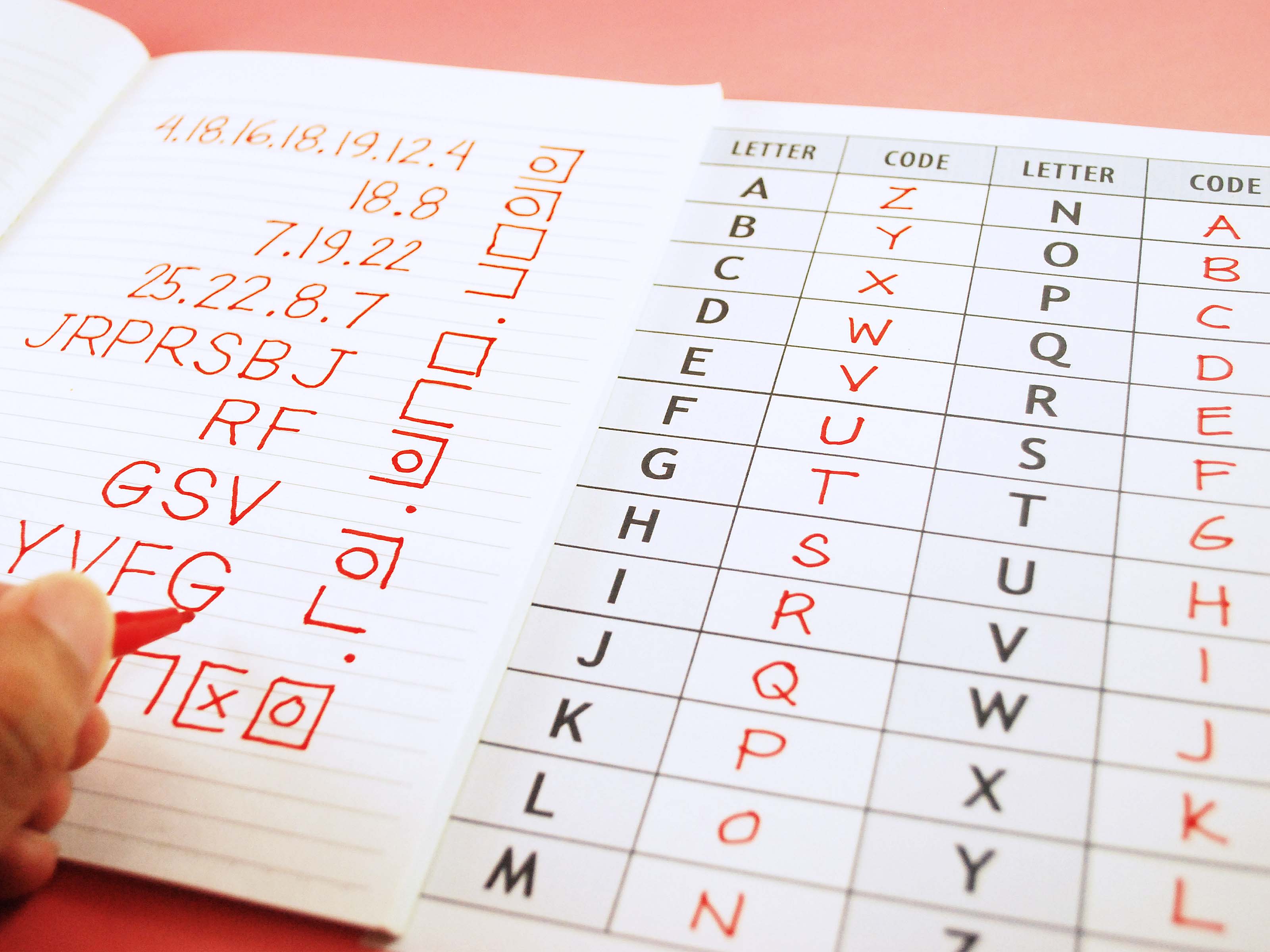
A substitution alphabet replaces each letter with another letter, number, shape, or symbol. For example, you might represent A with a triangle, B with a circle, C with two vertical lines, and D with a small star.
You can also combine symbols and ordinary characters:
- A = 4
- B = β
- C = <
- D = ∂
- E = 3
- F = #
Continue until all 26 letters have a unique replacement. Include symbols for common punctuation if you want your entries to remain expressive. A coded diary without question marks or exclamation points can make even your most dramatic day look strangely calm.
A symbol alphabet is visually distinctive and can be customized endlessly. The weakness is that the same plaintext letter always creates the same coded symbol. Common letters such as E, T, A, O, I, and N may appear frequently, giving a determined reader clues.
Option B: Use a Caesar Shift
A Caesar cipher moves every letter forward by a fixed number of positions in the alphabet. With a shift of three, A becomes D, B becomes E, and C becomes F. Letters near the end wrap back to the beginning, so X becomes A, Y becomes B, and Z becomes C.
Using a shift of three, the sentence:
I LIKE SAM
becomes:
L OLNH VDP
This system is fast to learn because you only need to remember one number. Unfortunately, it is also easy to test because there are relatively few possible shifts. It works best for discouraging quick glances rather than protecting serious secrets.
Option C: Design a Personal Keyword Code
A keyword system changes letters according to a word that only you know. Choose a memorable word such as MOONLIGHT, BLUEBERRY, or TACO. Avoid using your name, birthday, school mascot, pet’s name, or anything written repeatedly in the diary.
One beginner-friendly method is to assign each letter of the keyword a number based on its alphabet position. For example:
- T = 20
- A = 1
- C = 3
- O = 15
Repeat those shifts across the message. The first letter moves by 20 positions, the second by 1, the third by 3, the fourth by 15, and then the sequence begins again. Because the shift changes throughout the sentence, repeated letters do not always produce identical results.
This approach takes longer to learn, but it hides patterns better than a single Caesar shift. You can simplify it by using a shorter keyword or by limiting the system to names and especially private sentences.
Option D: Replace Important Words Instead of Every Letter
You do not have to encode an entire entry. Another strategy is to invent code names for people, places, feelings, and events.
- Your crush becomes “Orion.”
- Your school becomes “The Castle.”
- An argument becomes “a thunderstorm.”
- A secret meeting becomes “buying lemons.”
- Feeling anxious becomes “the radio is buzzing.”
You could write, “Orion smiled at me near the Castle library, and the radio immediately started buzzing.” To everybody else, it sounds like unusual fantasy fiction. To you, it records a recognizable moment.
Word replacement is fast and natural, but context can reveal meanings over time. Make your substitutions imaginative, rotate them occasionally, and avoid choosing words that are obviously connected to the real person or event.
Step 2: Make a Key and Establish Consistent Rules
Once you have selected a code, create a key that explains exactly how it works. Consistency matters. If a star represents S on Monday and R on Thursday, your future self will read your diary and wonder whether your past self was sending a message or experiencing keyboard turbulence.
Write a Complete Coding Key
Your key might contain:
- The coded version of every letter
- Symbols for numbers and punctuation
- Your shift number or keyword
- Code names for important people
- Rules for spaces, capital letters, and paragraph breaks
- Special shortcuts for common words
Create abbreviations for words you use frequently. For example, you could represent “because” with a spiral, “today” with a square containing a dot, and “I feel” with two connected lines. Shortcuts make your system faster while introducing patterns that are unique to you.
Do Not Store the Key in an Obvious Place
Writing “SUPER SECRET CODE KEY” on the first page of your diary defeats the general spirit of the project. Keep the key somewhere separate from the journal.
You might store it inside an unrelated notebook, in a sealed envelope, or as a disguised chart among ordinary study notes. You can also memorize the main system after practicing and destroy the original key. Before doing that, test yourself. Confidence is wonderful, but staring helplessly at twelve pages of your own unreadable symbols is less wonderful.
Use More Than One Privacy Layer
A code should not be your only defense. Keep the diary in a private location, use a locking box if appropriate, or choose a journal with a small physical lock. If you use a digital diary, select an application that supports a strong password and reputable encryption.
Layering methods is more effective than relying on one clever trick. A hidden journal written in code requires someone to find it and decipher it. That creates two separate obstacles, which is usually enough to defeat ordinary curiosity.
Avoid Recording Extremely Sensitive Information
Do not write passwords, banking details, identification numbers, home security codes, or other critical information in a homemade cipher. Classical codes are puzzles, not professional security systems.
Also remember that diary privacy should never prevent you from getting help. If you are in danger, experiencing abuse, considering self-harm, or dealing with a serious emergency, tell a trusted adult, qualified professional, or emergency service rather than hiding the situation exclusively in coded writing.
Step 3: Practice Until the Code Feels Natural
Your code becomes useful only when you can write and read it without turning every entry into a two-hour final exam. Begin with short, ordinary sentences before encoding complicated emotional reflections.
Start With a Daily Practice Sentence
Write one coded sentence every day, such as:
- “I ate pancakes for breakfast.”
- “The weather was cold today.”
- “I finished my science assignment.”
- “My cat knocked over a plant again.”
After writing the sentence, decode it immediately. Check for mistakes and adjust any symbols that are too similar. A dot, a tiny circle, and a slightly larger tiny circle may appear perfectly distinct when you design them. At 11:45 p.m., they all become mysterious potatoes.
Move From Partial Coding to Full Entries
You can gradually increase the amount of coded content:
- Encode only names and private words.
- Encode one important sentence per entry.
- Encode one complete paragraph.
- Write an entire diary entry in code.
This method lets you build speed without abandoning your journaling habit. It also allows you to choose different privacy levels. A description of lunch may remain in ordinary English, while a paragraph about a personal conversation can be coded.
Test Whether You Can Read Older Entries
After one week, return to your first coded entry and decode it without checking the key immediately. Then repeat the test after a month.
If you cannot read your old writing, simplify the system. If you can decode it instantly, consider whether it needs another layer. The best diary code sits between “obvious to everyone” and “apparently written by an exhausted alien.”
Change the Code Carefully
You may want to update your secret code occasionally, especially if somebody has seen your key or guessed several symbols. Record the date on which the new system begins so you know which key applies to which entries.
Do not change every rule at once unless necessary. You could rotate five symbols, choose a new shift, or replace several important code names. Small changes protect your privacy without making your diary impossible to maintain.
Example of a Simple Diary Coding System
Imagine that you choose the following rules:
- Apply a Caesar shift of five to ordinary letters.
- Replace your best friend’s name with “Comet.”
- Replace your crush’s name with “Atlas.”
- Use
99to mean “I am worried.” - Write dates backward.
Your original diary sentence might be:
July 18: I talked to Maya about Alex after class. I am worried she knows I like him.
Your mixed-code version could begin:
81 Ylwj: N yfqpjI yt Htrjy fgtzy Fyqfx fkyjw hqfxx. 99 xmj pstbx N qnpj mnr.
This is not unbreakable, but it combines a shifted alphabet, code names, a numeric phrase, and a disguised date. A casual reader would need time, patience, and far too much interest in somebody else’s afternoon.
Common Secret Diary Code Mistakes
Making the System Too Complicated
A code involving six alphabets, four rotating keys, moon phases, and the current price of orange juice may sound impressive. It will also make you avoid writing. Choose a method that protects privacy without interrupting honest expression.
Using Predictable Clues
Do not use a shift based on your age or a keyword based on your pet’s name. Avoid labeling coded people with obvious initials. If your crush is named Benjamin, changing the name to “Blue-Eyed B” is not exactly an intelligence-agency-level disguise.
Leaving Too Many Words Uncoded
A reader may infer coded sections from surrounding sentences. For example, “I cannot believe [coded name] asked me to the dance” reveals quite a lot. Encode the full sensitive sentence instead of hiding only one word.
Forgetting Your Own Rules
Use a temporary practice key until the system becomes familiar. Review it regularly and keep the rules stable. A readable personal code is more valuable than a sophisticated system you cannot remember.
Assuming a Code Guarantees Privacy
Homemade ciphers create resistance, not certainty. Someone with enough coded material may identify repeated patterns, guess common words, or compare entries with known events. Combine coding with sensible physical or digital storage.
Experiences From Keeping a Diary in Secret Code
The first experience most people have with coded journaling is excitement. A blank notebook stops looking like stationery and starts looking like classified evidence. Even an entry about losing a sock feels important when it is written in triangles, dots, and backwards letters.
The second experience is usually slower and less glamorous: realizing that writing in code takes practice. During the first few entries, you may spend more time examining your key than thinking about your day. You might forget whether a diamond means M or N, accidentally write half a word in English, or discover that three of your symbols look identical when written quickly.
This awkward stage is normal. After several days, your hand begins to remember common symbols. Frequently used words become automatic. You may even develop shortcuts that were not part of the original plan. A quick curl becomes “because,” two dots become “very,” and a lightning bolt represents the person who creates ninety percent of the drama in your diary.
Another interesting experience is that coding can change how you think about an event. Translating a sentence forces you to slow down. Instead of immediately writing, “That was the worst conversation ever,” you pause while converting each word. During that pause, you may notice more specific feelings: embarrassment, disappointment, anger, jealousy, or relief.
That extra reflection can improve the entry. You begin writing what happened rather than only recording the first emotional reaction. The secret code becomes more than a privacy device; it becomes a small speed bump between the event and your interpretation of it.
There can also be a humorous side. When you decode an old entry, your dramatic coded sentence may turn out to say, “Jordan looked in my direction twice, so this is obviously destiny.” Time has a special talent for turning yesterday’s emergency into today’s comedy.
Using code names creates its own memories. You may forget why a teacher was called “Captain Waffle” or why your soccer team became “The Department of Questionable Decisions.” These names give the journal personality and can make rereading it years later more entertaining.
Some people discover that fully coded entries feel emotionally distant. Converting every word may interrupt the natural flow of writing, especially during stressful moments. A mixed system often works better: write ordinary observations normally and encode only the paragraphs you most want to protect.
For example, you might describe school, work, weather, or daily routines in regular English. When you reach a private conversation or uncomfortable feeling, switch to your cipher. This keeps the diary readable while marking the sections that mattered most.
The greatest challenge appears when you change systems. A new alphabet may seem stronger, but older habits remain in your hand. You may accidentally combine two versions and create a code that nobodyincluding youcan interpret. Dating each key and practicing the new symbols separately helps prevent this problem.
Over time, the most successful secret codes become simpler rather than more complicated. You learn which symbols are comfortable to write, which words need abbreviations, and which details genuinely require protection. The final system may not look like something from a spy movie, but it works because you actually use it.
The most rewarding experience comes months or years later when you reopen the diary and successfully decode a forgotten entry. The symbols transform back into a moment, a worry, an achievement, or a joke that once mattered enough to preserve. You are not merely cracking a cipher. You are meeting an earlier version of yourself who trusted that future you would still have the key.
Conclusion
Learning how to write in your diary in secret code does not require an elaborate encryption machine. Start by choosing a manageable system, create a consistent key, and practice until coded writing feels comfortable. Symbol alphabets, Caesar shifts, keyword ciphers, code names, and personal abbreviations can all make a journal more private and enjoyable.
Remember that the best diary code is not necessarily the most complicated one. It is the system you can use consistently, remember later, and combine with responsible storage. Keep your key separate, avoid recording critical security information, and update the code when necessary.
Your diary should remain a place where you can write honestly. The code is simply the lock on the doorand perhaps an excuse to draw suspicious-looking spirals while pretending to be a secret agent.