Few things feel more ridiculous than paying two dollars for air. Not premium air. Not air wearing a tuxedo. Just regular compressed air, the same basic stuff your tires have been craving since the dashboard tire pressure light started glowing like a tiny orange guilt trip. The good news is that you can often refill your tires for free if you know where to look, what to ask for, and how to use the pump without accidentally turning your tire into a sad rubber pancake.
Keeping your tires properly inflated is not just a “car person” habit. It affects safety, gas mileage, tire life, braking, steering, and how confidently your vehicle handles the road. Underinflated tires can wear faster, run hotter, and make your car work harder than it needs to. Overinflated tires are not ideal either, because they can reduce ride comfort and lead to uneven wear. In plain English: your tires want the right PSI, not your best guess and definitely not “whatever number is printed on the sidewall.”
This guide explains how to refill your tires for free, where to find free air, how to check the correct tire pressure, and how to avoid common mistakes at gas station air pumps. Whether you are preparing for a road trip, dealing with cold-weather tire pressure loss, or simply trying not to donate another handful of quarters to a grumpy machine, here is how to air up smartly.
Why Tire Pressure Matters More Than Most Drivers Think
Tire pressure is measured in PSI, or pounds per square inch. Your vehicle manufacturer sets a recommended cold tire pressure because your tires, suspension, braking system, and load capacity are designed around that number. When the pressure is too low, more of the tire touches the road. That creates extra heat, drag, and wear. When the pressure is too high, the tire may ride more harshly and wear unevenly in the center.
Proper inflation can help your tires last longer, improve fuel efficiency, and keep your vehicle handling the way it was designed to handle. It also gives your tire tread a better chance of doing its job in rain, sudden stops, and everyday driving. Think of tire pressure as the handshake between your car and the road. Too soft, too stiff, or wildly inconsistent, and things get awkward fast.
Where To Find the Correct Tire Pressure for Your Car
Before you refill your tires, find the correct PSI. Do not use the maximum PSI printed on the tire sidewall as your normal inflation target. That number is the tire’s maximum pressure limit, not the recommended pressure for your specific vehicle.
The correct tire pressure is usually listed on a sticker inside the driver’s side door jamb. Open the driver’s door and look along the frame. You may also find it in the owner’s manual. Many passenger vehicles fall somewhere around the low-to-mid 30 PSI range, but front and rear tires can differ, and trucks, SUVs, EVs, and vehicles carrying heavier loads may require different pressures.
Check the sticker carefully. Some vehicles list separate PSI values for front tires, rear tires, spare tires, and loaded driving conditions. If your vehicle has a compact spare, it may require much higher pressure than your regular tires. Yes, the spare tire has feelings too. Mostly abandonment issues.
Check Tires When They Are Cold
For the most accurate reading, check tire pressure when the tires are cold. “Cold” usually means the vehicle has been parked for at least three hours or has been driven less than about a mile at moderate speed. Tires heat up as you drive, and heat increases pressure. That means a warm tire can show a higher PSI than it actually has when cold.
If your low tire pressure light comes on after a chilly night, do not panic. Tire pressure commonly drops as temperatures fall. A rough rule many drivers use is that tires can lose about 1 PSI for every 10-degree Fahrenheit drop in temperature. That is why the tire pressure warning light loves to make dramatic appearances in fall and winter, usually when you are already late and holding coffee.
How To Refill Your Tires for Free: The Smartest Options
Free tire air is still available in many parts of the United States. You just need to know which places commonly offer it and which states require it under certain conditions.
1. Use Free Air at Tire Shops
Tire shops are often the easiest and most reliable places to get free air. Many locations offer free tire pressure checks even if you did not buy your tires there. Discount Tire, for example, advertises free tire air pressure checks at its locations, with no appointment needed. You typically pull into the marked air check lane, stay in your vehicle, and a technician checks and adjusts your tire pressure to the vehicle-recommended PSI.
This is one of the best options for drivers who feel unsure about using a gas station pump. A tire shop employee can also spot obvious issues such as low tread, visible sidewall damage, or a tire that keeps losing air. If one tire is always low while the other three are fine, that is not “tire personality.” It may be a leak, nail, valve stem problem, or bead issue.
2. Try Warehouse Clubs With Tire Centers
Warehouse clubs with tire centers may offer inflation services or self-serve tire inflation stations, depending on location and membership policies. Costco Tire Centers, for example, are known for nitrogen inflation services connected with tire purchases and maintenance. Some locations also have self-serve nitrogen stations for members.
Nitrogen is not magic, but it can help tires maintain pressure slightly better over time because it is less affected by moisture and may seep out more slowly than ordinary compressed air. For everyday drivers, regular air is perfectly acceptable as long as the tires are inflated to the correct PSI. The key is not whether the tire is filled with air or nitrogen. The key is whether it is filled correctly.
3. Look for Convenience Stores Known for Free Air
Some convenience store and gas station chains are known in many regions for free air pumps. Wawa and Sheetz are commonly associated with free air in areas where they operate, and many drivers also report finding free air at QuikTrip, QuickChek, GetGo, and similar regional chains. Availability can vary by location, and pumps can be out of service, so it is smart to have a backup plan.
Modern free air pumps often let you set the target PSI on a digital screen. You attach the hose to the valve stem, the machine inflates or releases air as needed, and it beeps when the tire reaches the target. It is basically a tiny robot butler for your wheels, minus the accent.
4. Know the Free-Air Laws in California and Connecticut
Some states have rules that help drivers access free tire air. In California, service stations are generally required to provide free air, water, and a pressure gauge to customers who purchase motor vehicle fuel. If the machine asks for payment after you bought gas, you may need to ask the attendant to turn on the air.
Connecticut also requires licensed fuel retailers to provide an air compressor for free public use during business hours. The details can vary by state and situation, so read posted signs and ask politely. The magic phrase is not complicated: “Hi, could you please turn on the air for my tires?” This works better than glaring at the coin slot like it owes you rent.
5. Ask Local Repair Shops or Auto Parts Stores
Many local repair shops, quick-lube shops, and some auto parts stores may check or top off tire pressure for free, especially if they are not slammed with customers. This is not guaranteed everywhere, but it is worth asking. Be polite, choose a non-busy time, and do not expect a full inspection unless the shop offers one.
A simple air top-off takes only a few minutes, and businesses often see it as good customer service. You might remember the shop later when you need tires, brakes, or an oil change. Free air is tiny marketing with a tire gauge attached.
Step-by-Step: How To Refill Your Tires at a Free Air Pump
Step 1: Find Your Recommended PSI
Check the driver’s side door jamb sticker or owner’s manual. Write down the PSI for front and rear tires if they are different. Do not inflate to the tire sidewall maximum unless your vehicle manual specifically tells you to, which is uncommon for normal driving.
Step 2: Park Close Enough for the Hose To Reach
Pull up carefully so the air hose can reach all four tires. This sounds obvious until you watch someone perform a five-point parking ballet next to an air pump. Leave room for other drivers and avoid blocking traffic in the lot.
Step 3: Remove the Valve Cap
Unscrew the small cap from the valve stem on the tire. Put it in your pocket or cup holder so it does not roll away into the mysterious dimension where missing socks and 10mm sockets live.
Step 4: Check the Current Pressure
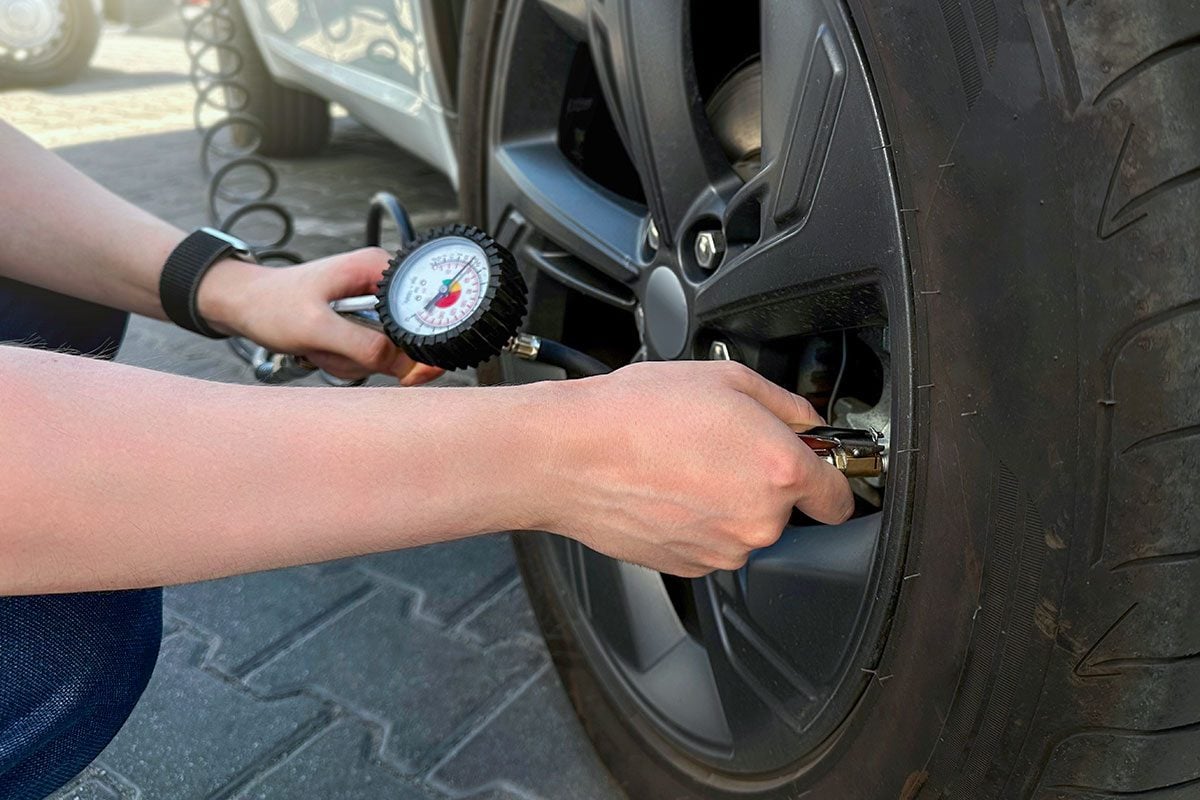
If the pump has a built-in gauge, use it. If not, use your own tire pressure gauge. Press the gauge firmly onto the valve stem until the hissing stops and you get a clear reading. A quick hiss is normal. A long hiss means the gauge is not seated correctly.
Step 5: Add Air in Short Bursts
If the tire is low, attach the air chuck firmly to the valve stem. Add air in short bursts if using a manual pump, then recheck the pressure. If using a digital pump, set the target PSI and let the machine do its work. Many digital pumps beep when finished.
Step 6: Recheck and Adjust
If you overfill slightly, press the small pin inside the valve stem to release a little air, then check again. Do not obsess over a fraction of a PSI, but try to get close to the recommended number. Accuracy matters; perfectionism can stay home and alphabetize the glove box.
Step 7: Replace the Valve Cap
Put the valve cap back on snugly. Valve caps help keep dirt and moisture out of the valve stem. They are small, cheap, and surprisingly important for something that looks like it came free in a cereal box.
What To Do If the Tire Pressure Light Stays On
After refilling your tires, the TPMS light may turn off immediately, or it may take a few minutes of driving. Some vehicles require a reset procedure, which may be listed in the owner’s manual. If the light keeps returning, check all four tires again, including the spare if your vehicle monitors it.
If one tire repeatedly loses pressure, have it inspected. A slow leak can come from a tiny puncture, damaged valve stem, cracked wheel, corrosion around the bead, or a previous repair that failed. Repeatedly refilling a leaking tire is like repeatedly mopping a floor while the sink is still overflowing. Technically active, not exactly solving the problem.
Free Air vs. Paid Air: Is There Any Difference?
In most everyday situations, free compressed air and paid compressed air do the same job: they inflate the tire. The difference is usually convenience, location, and equipment quality. Some paid machines are well-maintained and accurate. Some free machines are excellent. Some machines, free or paid, look like they survived a small meteor strike.
The best approach is to keep an inexpensive tire pressure gauge in your glove box. That way, you are not fully dependent on the pump’s gauge. Digital gauges are easy to read, while pencil-style gauges are cheap and durable. Either one is better than kicking the tire and declaring, “Seems fine.” That method belongs in the Museum of Questionable Automotive Confidence.
Common Mistakes To Avoid When Refilling Tires
Using the PSI on the Tire Sidewall
The sidewall number is the tire’s maximum pressure, not your vehicle’s recommended pressure. Always use the door jamb sticker or owner’s manual.
Checking Pressure After a Long Drive
Hot tires show higher pressure. For the most accurate reading, check when the tires are cold. If you must add air while tires are warm, recheck them later when cold.
Ignoring the Spare Tire
Many drivers forget the spare until they need it. Check it periodically. A flat spare tire is just a heavy decoration with trust issues.
Not Replacing Valve Caps
Valve caps help protect the valve stem from debris and moisture. Replace missing caps when you can.
Assuming the Pump Is Accurate
Public air pumps can be worn, damaged, or poorly calibrated. Use your own gauge when possible.
How Often Should You Check Tire Pressure?
A good rule is to check tire pressure at least once a month and before long road trips. Also check when seasons change, especially when temperatures drop. If your vehicle carries heavy cargo, passengers, or towing weight, review the owner’s manual for load-specific recommendations.
Make tire pressure part of a simple monthly routine: check the oil level if applicable, look at the tread, glance at the sidewalls, refill washer fluid, and confirm the tires are properly inflated. It takes less time than scrolling through three videos about someone restoring a rusty lawn mower you will never own.
How To Find Free Air Near You
Start with tire shops. Search for nearby tire stores and look for free air check lanes. Next, check warehouse clubs where you have a membership. Then look at regional convenience stores known for free air. If you are in California or Connecticut, understand your state’s free-air rules and ask the attendant if the machine requires activation.
You can also use map apps and search phrases like “free air for tires near me,” “free tire pressure check,” “Discount Tire air check,” “gas station free air,” or “free air pump.” Read recent reviews because air pumps break often. A review from last week is more useful than a glowing comment from 2016 written by someone named TireWizard89.
Is It Worth Buying a Portable Tire Inflator?
Even though this guide focuses on free tire air, a portable 12-volt or cordless tire inflator can be a great backup. It will not technically refill your tires for free because you bought the device, but after that, you can top off at home without hunting for a pump. This is especially helpful in winter, during road trips, or if you live far from reliable free air stations.
Look for an inflator with an automatic shutoff, built-in gauge, long power cord or battery compatibility, and enough pressure capacity for your vehicle. Keep in mind that small inflators are designed for topping off tires, not rescuing a completely flat tire with sidewall damage. If a tire is severely flat, damaged, or unsafe, stop driving and get help.
Real-World Experiences: Lessons From the Free-Air Hunt
After using free air pumps in different places, one lesson becomes clear quickly: the best free air is the one that actually works when you need it. That sounds obvious, but anyone who has driven to a gas station with a low tire light knows the emotional journey. First, hope. Then, a handwritten “out of order” sign. Then, mild betrayal. Then, another gas station three blocks away where the hose exists but the nozzle looks like it fought a raccoon and lost.
The easiest experiences usually happen at tire shops. Pulling into a dedicated air check lane is simple, especially for drivers who do not want to wrestle with a public pump. You stay in the car, the technician checks each tire, and you leave with the correct PSI. The only downside is timing. During cold snaps, lines can form because everyone’s tire pressure light wakes up at once. It is like a seasonal migration, except instead of birds, it is compact SUVs with dashboard warnings.
Digital gas station pumps are convenient when they work. The best ones let you set the exact PSI, connect the hose, and wait for a beep. These are great for beginners because you do not have to guess how long to hold the trigger. The tricky part is getting a good seal on the valve stem. If you hear constant hissing, reposition the hose. Do not panic. The tire is not judging you. Probably.
Older pumps with manual gauges can be faster, but they require more attention. Add air briefly, check the pressure, repeat, and avoid overfilling. This is where having your own gauge helps. Public gauges live rough lives. They get dropped, stepped on, rained on, and occasionally treated like medieval tools by frustrated drivers. A small personal gauge removes a lot of uncertainty.
Another real-world tip: refill your tires before you are desperate. If the tire is only a few PSI low, the process is quick and relaxed. If it is dangerously low, you may be dealing with a leak or damage, and driving around searching for free air can make the situation worse. When one tire is much lower than the others, treat it as a warning sign, not a personality quirk. Get it inspected before it becomes a roadside problem with hazard lights and a ruined afternoon.
Timing matters too. Early mornings are best for accurate cold readings and shorter lines. After work, during winter temperature drops, and before holiday travel, free air stations can get busy. Keep your valve caps loose enough to remove by hand, store a tire gauge in the car, and know two or three nearby free-air options. That tiny bit of planning can save money, reduce stress, and keep you from feeding another machine quarters while muttering things unsuitable for a family parking lot.
Conclusion
Refilling your tires for free is absolutely possible if you know where to go and how to ask. Tire shops, some warehouse clubs, many regional convenience stores, and certain states’ free-air rules can all help you avoid paying for something your tires need regularly. The real win is not just saving a dollar or two. It is keeping your vehicle safer, improving tire life, and making sure your car handles properly when the road gets wet, cold, crowded, or full of drivers who consider turn signals optional.
Check your recommended PSI, measure pressure when tires are cold, use a reliable gauge, and top off your tires before they become seriously low. Free air is helpful, but good tire habits are even better. Your tires are the only parts of your vehicle touching the road, so give them the correct pressure and a little attention. They will repay you with better performance, longer life, and fewer dashboard warning lights trying to ruin your morning.