Finding the vertex of a quadratic equation may sound like a tiny math errand, but it is actually one of the most useful skills in algebra. The vertex tells you where a parabola reaches its lowest point or highest point. In other words, it is the turning pointthe place where the graph says, “Nope, I’m going the other direction now.”
Whether you are graphing a quadratic function, solving a word problem about maximum profit, or figuring out the peak height of a ball tossed into the air, the vertex is your mathematical VIP. The good news is that you do not need a wizard hat, a graphing calculator, or a mysterious chant involving “x squared.” You only need to recognize the form of the quadratic equation and follow a clear process.
In this guide, you will learn how to find the vertex of a quadratic equation in 10 practical steps. We will cover standard form, vertex form, completing the square, axis of symmetry, common mistakes, and examples that make the process feel less like algebra fog and more like a well-lit sidewalk.
What Is the Vertex of a Quadratic Equation?
The vertex of a quadratic equation is the highest or lowest point on the graph of a parabola. A quadratic function usually has the form y = ax² + bx + c, where a, b, and c are numbers and a cannot be zero. If a is positive, the parabola opens upward and the vertex is the minimum point. If a is negative, the parabola opens downward and the vertex is the maximum point.
The vertex is written as an ordered pair: (h, k). The h value is the x-coordinate, and the k value is the y-coordinate. In plain English, h tells you where to move left or right, and k tells you how high or low the vertex sits.
Why the Vertex Matters
The vertex is not just a dot on a graph. It helps you understand the behavior of the entire quadratic function. If you know the vertex, you can quickly identify the axis of symmetry, graph the parabola more accurately, and solve many real-world optimization problems.
For example, if a business models profit with a quadratic equation, the vertex may show the price that produces maximum profit. If a physics problem models the height of a thrown object, the vertex may show the object’s highest point. If your homework asks you to graph a parabola, the vertex is usually the best place to start. Think of it as the parabola’s home address.
Step 1: Identify the Form of the Quadratic Equation
Before doing any calculations, look at the equation and identify its form. The two most common forms are:
- Standard form: y = ax² + bx + c
- Vertex form: y = a(x – h)² + k
If the equation is already in vertex form, congratulations. The vertex is practically waving at you. If the equation is in standard form, you will need to use a formula or convert it into vertex form.
Step 2: Know the Vertex Formula for Standard Form
For a quadratic equation in standard form, y = ax² + bx + c, the x-coordinate of the vertex is found with this formula:
x = -b / 2a
This formula gives you the axis of symmetry, which is the vertical line that passes through the vertex. Once you have the x-coordinate, you plug that value back into the original equation to find the y-coordinate. Simple? Mostly. The formula is simple; the arithmetic is where students sometimes invite chaos to the party.
Step 3: Identify a, b, and c Correctly
In the equation y = ax² + bx + c, the coefficient a is the number in front of x², b is the number in front of x, and c is the constant.
For example, in y = 2x² – 8x + 3:
- a = 2
- b = -8
- c = 3
Notice that b is negative. This matters. A lot. Ignoring a negative sign in a quadratic equation is like ignoring a “wet paint” sign. You can do it, but there will be consequences.
Step 4: Find the x-Coordinate of the Vertex
Now use the formula x = -b / 2a. Using the example y = 2x² – 8x + 3, substitute a = 2 and b = -8:
x = -(-8) / 2(2)
x = 8 / 4
x = 2
So the x-coordinate of the vertex is 2. This also means the axis of symmetry is the vertical line x = 2.
Step 5: Substitute the x-Value Back Into the Equation
To find the y-coordinate, plug the x-value into the original quadratic equation. Do not plug it into a different equation, your calculator history, or a random expression from last Tuesday.
Using y = 2x² – 8x + 3 and x = 2:
y = 2(2)² – 8(2) + 3
y = 2(4) – 16 + 3
y = 8 – 16 + 3
y = -5
The vertex is (2, -5).
Step 6: Interpret the Vertex
The vertex (2, -5) means the parabola turns at the point where x equals 2 and y equals -5. Since a = 2 is positive, the parabola opens upward. Therefore, the vertex is the minimum point of the function.
If the equation were something like y = -2x² + 8x + 3, the parabola would open downward because a is negative. In that case, the vertex would be a maximum point. This is especially important in word problems that ask for the greatest height, largest area, or maximum revenue.
Step 7: Find the Vertex Directly From Vertex Form
If your equation is written as y = a(x – h)² + k, the vertex is (h, k). No formula is needed.
For example, in y = 3(x – 4)² + 7, the vertex is (4, 7).
Be careful with signs. In y = 3(x – 4)² + 7, the x-coordinate is positive 4 because the form is (x – h). If the equation is y = 2(x + 5)² – 1, rewrite the inside as x – (-5). The vertex is (-5, -1).
Step 8: Convert Standard Form to Vertex Form When Needed
Sometimes you may be asked to rewrite a quadratic equation in vertex form. This is useful because vertex form reveals the vertex immediately.
Take the equation y = x² + 6x + 5. To complete the square:
- Group the x terms: y = (x² + 6x) + 5
- Take half of 6 and square it: (6 / 2)² = 9
- Add and subtract 9 inside the expression: y = (x² + 6x + 9) + 5 – 9
- Rewrite the perfect square: y = (x + 3)² – 4
Now the vertex is easy to see: (-3, -4).
Step 9: Check Your Answer With the Axis of Symmetry
The axis of symmetry is a vertical line that cuts the parabola into two matching halves. It always passes through the vertex. For standard form, the axis of symmetry is:
x = -b / 2a
If you found the vertex (2, -5), then the axis of symmetry should be x = 2. You can use this as a quick check. Points on either side of the axis should have matching y-values when they are the same distance from the axis.
For example, if the axis is x = 2, then x-values 1 and 3 are equally far from 2. Their y-values should match. This is a helpful way to catch arithmetic mistakes before they sneak into your final answer wearing a fake mustache.
Step 10: Practice With a Full Example
Let’s find the vertex of y = -x² + 6x – 2.
Identify a, b, and c
- a = -1
- b = 6
- c = -2
Find the x-coordinate
x = -b / 2a
x = -6 / 2(-1)
x = -6 / -2
x = 3
Find the y-coordinate
y = -(3)² + 6(3) – 2
y = -9 + 18 – 2
y = 7
The vertex is (3, 7). Since a is negative, the parabola opens downward, so the vertex is a maximum point.
Common Mistakes When Finding the Vertex
Forgetting the Negative Sign in -b
The formula is x = -b / 2a, not b / 2a. If b is already negative, then -b becomes positive. This is one of the most common mistakes, and it can completely change the answer.
Using the Wrong Value for a
The value of a is the coefficient of x². If the equation is y = -x² + 4x + 1, then a = -1, not 1. The invisible 1 is still there, and so is the negative sign.
Stopping After Finding x
The vertex is an ordered pair, not just an x-value. After finding the x-coordinate, always plug it back into the equation to find the y-coordinate.
Misreading Vertex Form
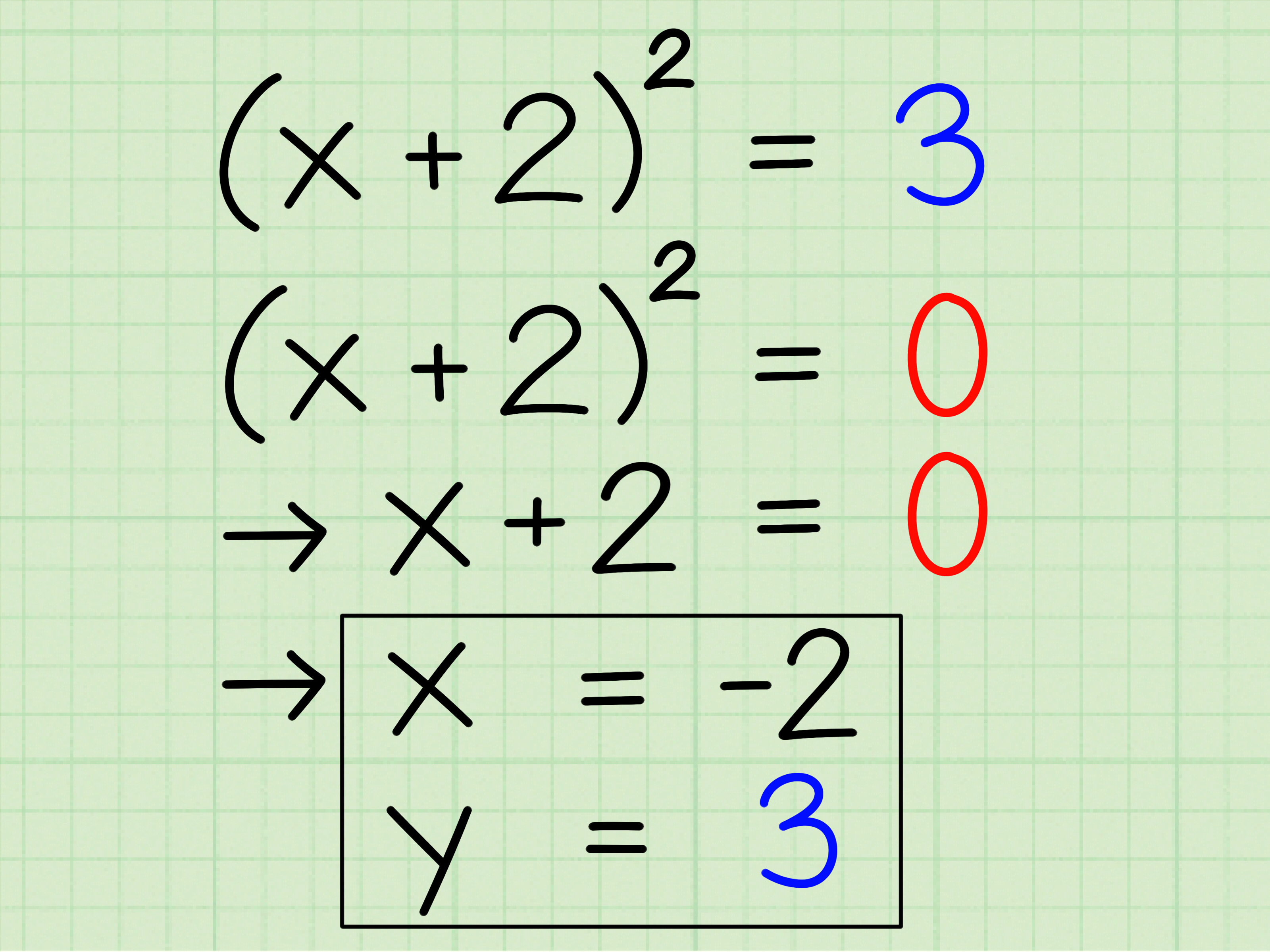
In y = a(x – h)² + k, the vertex is (h, k). If the equation says (x + 2)², the x-coordinate is -2, not 2. The sign inside the parentheses often tries to trick people. Do not let it win.
Real-World Uses of the Vertex
The vertex of a quadratic equation appears in many real-world situations. In physics, it can represent the maximum height of a projectile. In business, it can show maximum profit or minimum cost. In engineering and design, it can help model arches, bridges, and curved paths. In sports, it can describe the path of a basketball, soccer ball, or golf shot.
For example, suppose the height of a ball is modeled by h(t) = -16t² + 64t + 5, where t is time in seconds. The vertex tells you when the ball reaches its maximum height. Here, a = -16 and b = 64.
t = -64 / 2(-16) = 2
The ball reaches its highest point after 2 seconds. To find the height, substitute t = 2 into the equation:
h(2) = -16(2)² + 64(2) + 5 = -64 + 128 + 5 = 69
The maximum height is 69 feet. Not bad for one little formula.
Experience-Based Tips for Learning How to Find the Vertex
One of the most helpful experiences when learning how to find the vertex of a quadratic equation is realizing that the process is more pattern recognition than memorization. At first, many students try to treat every quadratic like a brand-new creature hiding in the bushes. But after practicing a few examples, the structure becomes familiar. Standard form asks for the formula. Vertex form gives the answer directly. Completing the square is the bridge between the two.
A useful habit is to pause before calculating and ask, “What form am I looking at?” This one question saves time and prevents unnecessary work. If the equation is y = 4(x – 1)² + 6, there is no need to expand it into standard form just to use -b / 2a. The vertex is already visible: (1, 6). Expanding it would be like taking apart a sandwich to confirm it contains bread. Technically possible, emotionally unnecessary.
Another experience-based tip is to write down a, b, and c before using the formula. This may feel like an extra step, but it dramatically reduces mistakes. Students often lose points not because they do not understand the concept, but because they copy a sign incorrectly. Writing a = -3, b = 12, and c = 8 creates a small safety checkpoint before the arithmetic begins.
It also helps to connect the formula to the graph. The x-coordinate of the vertex is not a random number floating in algebra space. It is the center line of the parabola. When students understand that x = -b / 2a gives the axis of symmetry, the formula becomes more meaningful. You are not just calculating; you are locating the middle of the curve.
When practicing, choose examples with different signs. Try one where a is positive, one where a is negative, one where b is negative, and one already written in vertex form. This variety trains your brain to handle the most common traps. A worksheet full of nearly identical problems may build speed, but mixed practice builds judgment.
Graphing a few examples by hand can also make the vertex easier to remember. Plot the vertex first, draw the axis of symmetry, then choose matching x-values on both sides. For example, if the vertex has x-coordinate 3, test x-values 2 and 4 or 1 and 5. When the matching points line up, the symmetry becomes visible. Algebra suddenly looks less like a pile of symbols and more like a shape with a personality.
Finally, do not rush the substitution step. Many errors happen after the correct x-coordinate has already been found. Use parentheses when plugging in numbers, especially negative numbers. If x = -2, write (-2)², not -2². Those parentheses can be the difference between the right answer and a math gremlin.
The vertex method becomes easier with repetition. After enough practice, finding the vertex feels like following a recipe: identify the form, choose the method, calculate carefully, and interpret the result. No panic required. Maybe a pencil. Maybe coffee. Definitely parentheses.
Conclusion
Finding the vertex of a quadratic equation is one of the most important skills in algebra because it reveals the turning point of a parabola. If the equation is in standard form, use x = -b / 2a to find the x-coordinate, then substitute that value back into the equation to find the y-coordinate. If the equation is in vertex form, read the vertex directly from y = a(x – h)² + k.
The vertex helps you graph quadratic functions, identify maximum and minimum values, solve real-world problems, and understand the shape of a parabola. Once you learn to recognize the form of the equation and handle signs carefully, the process becomes straightforward. The vertex may be the turning point of the graph, but for many students, it is also the turning point where quadratic equations finally start to make sense.
Note: This article is written in original American English for web publication and is based on widely accepted algebra concepts taught by reputable educational resources.