Wavelength sounds like one of those words that belongs in a laboratory where everyone wears goggles and says “fascinating” a lot. But the truth is much friendlier: wavelength is simply the distance from one matching point on a wave to the next. That could mean crest to crest, trough to trough, or any repeating point in the wave pattern. Whether you are studying light, sound, radio signals, ocean waves, or a slinky that has seen better days, wavelength helps explain how waves move, behave, and interact with the world.
The good news? Calculating wavelength is not wizardry. Most of the time, you only need one equation: wavelength = wave speed ÷ frequency. In symbols, that is λ = v / f. For light and other electromagnetic waves in a vacuum, the speed is the speed of light, commonly written as c = 299,792,458 meters per second. For sound, water waves, or waves on a string, the speed depends on the medium.
This guide breaks down how to calculate wavelength in 11 clear steps, with practical examples, common mistakes, and real-world tips. By the end, you will know how to solve wavelength problems without staring at your calculator like it personally betrayed you.
What Is Wavelength?
Wavelength is the length of one complete wave cycle. Imagine a row of hills. The distance from the top of one hill to the top of the next hill is one wavelength. In physics, wavelength is usually represented by the Greek letter lambda: λ.
Wavelength is commonly measured in meters, but depending on the type of wave, you may also see centimeters, millimeters, micrometers, nanometers, or kilometers. Visible light, for example, has extremely tiny wavelengths, typically measured in nanometers. Radio waves can have wavelengths from centimeters to many meters, while ocean waves may stretch across several meters or more.
The Main Formula for Wavelength
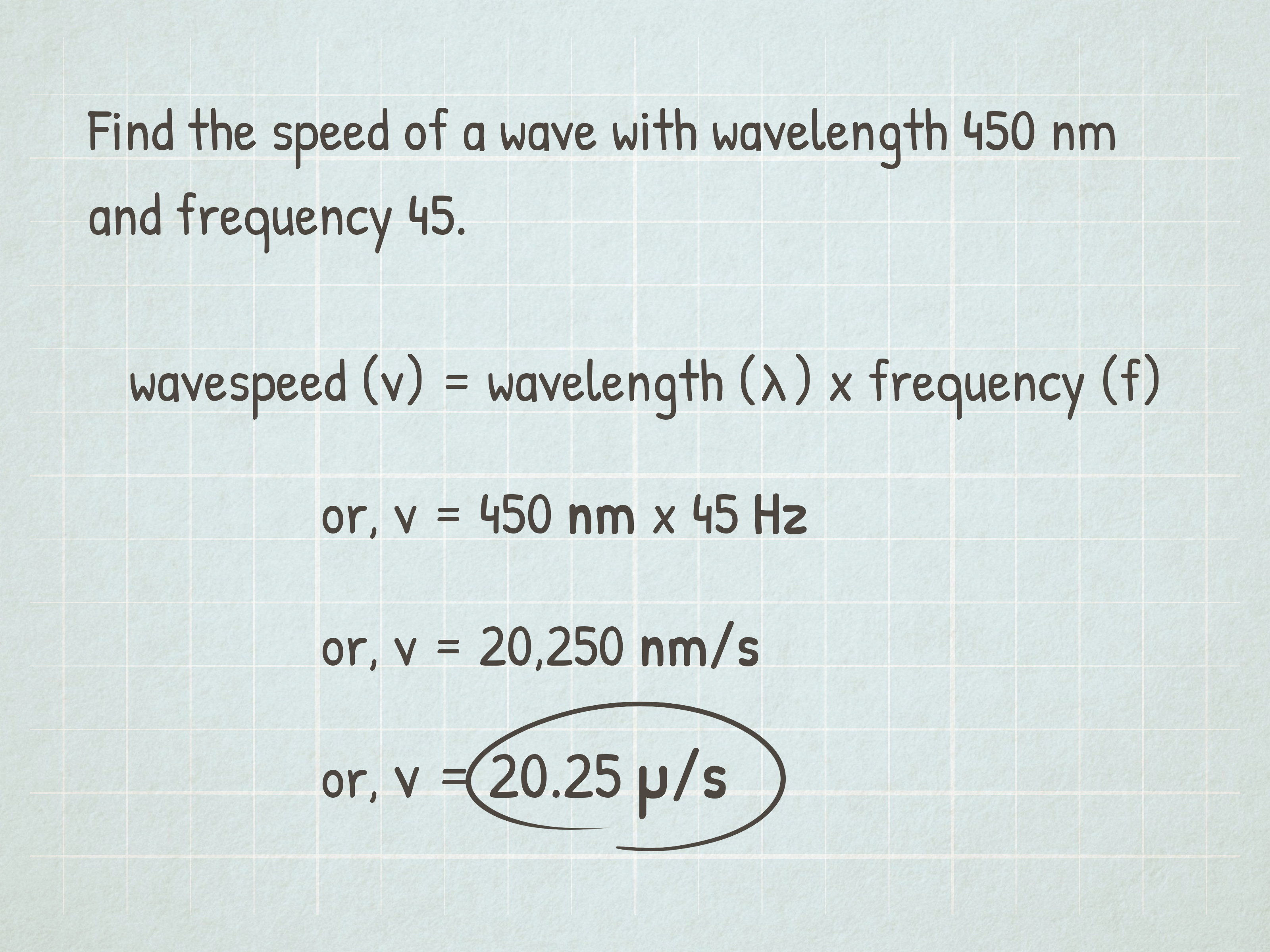
The most important wave equation is:
v = fλ
Where:
- v = wave speed, usually in meters per second (m/s)
- f = frequency, measured in hertz (Hz)
- λ = wavelength, measured in meters (m)
To calculate wavelength, rearrange the formula:
λ = v / f
This formula means wavelength gets shorter when frequency increases, assuming the wave speed stays the same. In plain English: if waves are arriving more often, they have to pack closer together. Physics: the original space-saving hack.
How to Calculate Wavelength: 11 Steps
Step 1: Identify the Type of Wave
Before touching the formula, ask: what kind of wave are you working with? Is it light, sound, a water wave, a radio wave, or a wave traveling through a string?
This matters because different waves travel at different speeds. Light in a vacuum travels at the speed of light. Sound in air travels much slower. Waves on a rope depend on the rope’s tension and mass. If you use the wrong speed, your answer may look impressive but be completely wrongthe physics version of confidently walking into the wrong classroom.
Step 2: Write Down the Known Values
Most wavelength problems give you frequency and wave speed. Write them clearly before solving. For example:
- Frequency = 600 Hz
- Wave speed = 340 m/s
- Wavelength = unknown
Listing your values helps prevent mistakes, especially when units are mixed. It also makes your work easier to check later.
Step 3: Choose the Correct Formula
If you know wave speed and frequency, use:
λ = v / f
If you are calculating the wavelength of light or another electromagnetic wave in a vacuum, use:
λ = c / f
Here, c is the speed of light. For most school problems, using 3.00 × 10⁸ m/s is acceptable unless your teacher or assignment asks for the exact value.
Step 4: Convert Frequency to Hertz
Frequency must be in hertz if speed is in meters per second. One hertz means one cycle per second. Sometimes frequency is given in kilohertz, megahertz, gigahertz, or terahertz. Convert before calculating.
- 1 kHz = 1,000 Hz
- 1 MHz = 1,000,000 Hz
- 1 GHz = 1,000,000,000 Hz
- 1 THz = 1,000,000,000,000 Hz
For example, 95.5 MHz becomes 95,500,000 Hz. That looks like a big number, but do not panic. Your calculator has seen worse.
Step 5: Convert Wave Speed to Meters per Second
To keep your units clean, use meters per second for speed. If speed is given in kilometers per second, multiply by 1,000. If it is given in centimeters per second, divide by 100.
For example, light travels about 300,000 kilometers per second. In meters per second, that becomes:
300,000 km/s × 1,000 = 300,000,000 m/s
That is why scientific notation is so useful. Writing 3.00 × 10⁸ m/s is much cleaner than writing a long parade of zeros.
Step 6: Substitute Values into the Formula
Now place your numbers into the equation. Suppose a sound wave travels through air at 343 m/s and has a frequency of 686 Hz.
λ = v / f
λ = 343 / 686
λ = 0.5 m
The wavelength is 0.5 meters. That means one complete wave cycle is half a meter long.
Step 7: Divide Carefully
This step sounds obvious, but small calculator errors can cause big answer errors. Make sure you divide speed by frequency, not frequency by speed. The formula is λ = v / f, not f / v.
Here is a quick mental check: higher frequency should usually mean a shorter wavelength when speed is constant. If your answer gets larger after frequency increases, check your math.
Step 8: Add the Correct Unit
A wavelength answer without a unit is like a recipe that says “add 4.” Four what? Eggs? Cups of flour? Emotionally unavailable teaspoons?
If speed is in meters per second and frequency is in hertz, wavelength will be in meters. For tiny wavelengths, you may convert meters to nanometers or micrometers.
Useful conversions include:
- 1 meter = 100 centimeters
- 1 meter = 1,000 millimeters
- 1 meter = 1,000,000 micrometers
- 1 meter = 1,000,000,000 nanometers
Step 9: Round Your Answer Appropriately
In many physics and chemistry problems, your final answer should match the significant figures of the given data. If frequency is given as 5.0 × 10¹⁴ Hz and speed is given as 3.00 × 10⁸ m/s, your answer should usually have two significant figures because the frequency has two.
Do not over-round in the middle of the problem. Keep extra digits while calculating, then round at the end. Your future self will thank you, probably while holding a calculator and a snack.
Step 10: Check Whether the Answer Makes Physical Sense
A reasonable answer depends on the wave type. Visible light wavelengths are usually around hundreds of nanometers. Sound waves in air often have wavelengths from centimeters to meters, depending on pitch. Radio waves can be much longer.
For example, if you calculate visible light and get a wavelength of 12 meters, something has gone very wrong. That would be more like a radio wave, not light your eyes can see. Checking the size of your answer helps catch unit errors quickly.
Step 11: Practice with Different Wave Problems
The best way to get comfortable is to solve several examples. Try light waves, sound waves, and radio waves. Each one uses the same basic relationship, but the numbers feel different because the speeds and frequencies vary widely.
Once you understand the formula, wavelength calculations become predictable. You identify the wave speed, convert frequency to hertz, divide, and label the unit. That is the whole game plan.
Example 1: Calculating the Wavelength of Light
Problem: A light wave has a frequency of 6.00 × 10¹⁴ Hz. What is its wavelength in a vacuum?
Given:
- c = 3.00 × 10⁸ m/s
- f = 6.00 × 10¹⁴ Hz
Formula:
λ = c / f
Calculation:
λ = (3.00 × 10⁸) / (6.00 × 10¹⁴)
λ = 5.00 × 10⁻⁷ m
To convert meters to nanometers:
5.00 × 10-7 m × 109 = 500 nm
Answer: The wavelength is 5.00 × 10⁻⁷ meters, or 500 nanometers. This falls in the visible light range.
Example 2: Calculating the Wavelength of Sound
Problem: A sound wave has a frequency of 440 Hz. If the speed of sound in air is about 343 m/s, what is the wavelength?
Formula:
λ = v / f
Calculation:
λ = 343 / 440
λ = 0.7795 m
Answer: The wavelength is about 0.78 meters.
This frequency is the musical note A above middle C, often used for tuning instruments. So yes, wavelength is secretly hanging out inside music. Physics has range.
Example 3: Calculating the Wavelength of a Radio Wave
Problem: An FM radio station broadcasts at 100 MHz. What is the wavelength of the radio signal?
Step 1: Convert MHz to Hz.
100 MHz = 100,000,000 Hz = 1.00 × 10⁸ Hz
Step 2: Use the speed of light for radio waves.
c = 3.00 × 10⁸ m/s
Step 3: Calculate.
λ = c / f
λ = (3.00 × 10⁸) / (1.00 × 10⁸)
λ = 3.00 m
Answer: The wavelength is about 3 meters.
How Wavelength Relates to Frequency and Energy
Wavelength and frequency have an inverse relationship when wave speed stays constant. Higher frequency means shorter wavelength. Lower frequency means longer wavelength. Think of people walking through a doorway: if more people pass every second, they must be closer together. Waves work in a similar rhythm-based way.
For electromagnetic radiation, wavelength is also related to energy. Shorter wavelengths, such as ultraviolet light and X-rays, have higher frequencies and higher photon energies. Longer wavelengths, such as radio waves, have lower frequencies and lower photon energies. This is why different parts of the electromagnetic spectrum behave so differently, even though they are all electromagnetic waves.
Common Mistakes When Calculating Wavelength
Using the Wrong Wave Speed
Do not automatically use the speed of light for every wavelength problem. Use c only for electromagnetic waves in a vacuum or when the problem tells you to approximate that way. Sound waves, water waves, and mechanical waves have different speeds.
Forgetting Unit Conversions
This is the classic trap. If frequency is given in MHz and you plug in 100 instead of 100,000,000, your answer will be wildly wrong. Always convert to hertz first.
Confusing Frequency with Period
Frequency is cycles per second. Period is the time for one cycle. They are related, but they are not the same. If you are given period instead of frequency, use:
f = 1 / T
Then calculate wavelength using λ = v / f. You can also use λ = vT, since one full wave travels one wavelength during one period.
Leaving the Answer in Awkward Units
A wavelength of 0.00000065 meters is correct, but 650 nanometers is easier to read when discussing visible light. Choose units that fit the context.
Wavelength Formula Cheat Sheet
| Situation | Formula | Use When |
|---|---|---|
| General wave | λ = v / f | You know wave speed and frequency |
| Electromagnetic wave | λ = c / f | The wave is light, radio, microwave, UV, X-ray, or gamma radiation |
| Using period | λ = vT | You know wave speed and period |
| Finding frequency | f = v / λ | You know wave speed and wavelength |
Real-Life Uses of Wavelength Calculations
Wavelength is not just a classroom concept. Engineers, scientists, musicians, medical technicians, astronomers, and communication specialists use wavelength every day.
In radio communication, wavelength helps design antennas. In music and acoustics, wavelength explains pitch, resonance, and room sound. In medicine, different wavelengths are used in imaging technologies and treatments. In astronomy, wavelengths reveal the temperature, movement, and composition of stars and galaxies. Even your microwave oven relies on electromagnetic waves, though it is mostly interested in heating leftovers, not winning a physics fair.
Experience-Based Tips for Learning How to Calculate Wavelength
When students first learn how to calculate wavelength, the hardest part is usually not the formula. The formula is short, friendly, and surprisingly well-behaved. The real challenge is knowing which numbers to use and how to handle units. In practice, wavelength problems become much easier when you slow down and treat every problem like a small checklist.
One helpful habit is to write the equation before adding numbers. Start with λ = v / f. Then write the known values underneath it. This simple step keeps your brain from juggling too much at once. It also helps you avoid the very common mistake of dividing frequency by speed. If you are working during a test, this written setup can also earn partial credit even if your final arithmetic takes a wrong turn.
Another practical tip is to pay close attention to prefixes. Many students lose points because they forget that MHz means millions of hertz, not just “a slightly fancier Hz.” For radio waves, Wi-Fi, cell signals, and visible light, frequencies are often huge. Scientific notation is your friend here. Instead of writing 600,000,000,000,000 Hz, write 6.00 × 10¹⁴ Hz. It looks cleaner and reduces the chance of losing a zero in the mathematical wilderness.
It also helps to memorize a few “sanity check” ranges. Visible light is roughly hundreds of nanometers. Sound in air often has wavelengths that people can imagine physically, such as centimeters or meters. Radio waves can be meters long or longer. If your answer says green light has a wavelength of 2 kilometers, do not simply move on with confidence. That is your calculator waving a tiny red flag.
In tutoring situations, a great way to make wavelength feel real is to connect it to sound. Play a low note and a high note. The low note has a lower frequency and a longer wavelength. The high note has a higher frequency and a shorter wavelength. Suddenly the formula is not just symbolsit is something you can hear. The same idea applies to light: red light has a longer wavelength than blue or violet light, which is why color, frequency, and wavelength are connected.
Another experience-based trick is to keep units attached throughout the calculation. Write m/s for speed and Hz for frequency. Since Hz means 1/s, dividing meters per second by cycles per second leaves meters. That is a nice built-in confirmation that the formula is working. When the units come out correctly, your calculation is probably on the right track.
Finally, practice with mixed examples. Do not only calculate visible light wavelengths. Try sound, radio waves, water waves, and string waves. This builds flexibility and prevents the common habit of using 3.00 × 10⁸ m/s for everything. The speed of light is famous, but it is not invited to every wave problem.
Conclusion
Calculating wavelength is one of the most useful skills in wave physics because it connects speed, frequency, and the physical size of a wave. The core formula is simple: λ = v / f. For electromagnetic waves in a vacuum, use λ = c / f. The key is choosing the correct wave speed, converting frequency to hertz, dividing carefully, and labeling your answer with the right unit.
Once you understand wavelength, many science topics become easier: sound, light, radio signals, color, resonance, astronomy, and even antenna design. It is a small formula with a huge résumé. Learn the steps, practice the examples, and wavelength calculations will go from “physics panic” to “I’ve got this.”