After hours at a desk, a long drive, or an ambitious attempt to carry every grocery bag in one trip, your lower back may feel as though it needs a reset button. A gentle twist produces a satisfying pop, and suddenly you feel looser. Naturally, the next thought is: “How can I do that again without accidentally folding myself into a lawn chair?”
The important truth is that you do not actually need to crack your lower back. The popping sound is usually a harmless side effect of joint movement, not proof that a bone has been pushed back into place. Gentle mobility exercises may reduce stiffness and sometimes produce a pop, but forcing your spine to crack can irritate joints, strain muscles, or aggravate an existing condition.
This guide explains why your back pops, how to crack your lower back using eight controlled movements, what not to do, and when stiffness or pain deserves professional attention.
Why Does Your Lower Back Crack?
Your lower spine contains small joints called facet joints. Like many movable joints, they are surrounded by a capsule containing lubricating fluid and dissolved gases. When a joint moves and the pressure inside its capsule changes, a gas cavity may form or shift, producing a popping sound. This process is often described as joint cavitation.
Other noises may come from tendons, ligaments, or other soft tissues moving over nearby structures. Either way, the sound does not usually mean that vertebrae were “out of alignment” and have snapped back into their proper parking spaces.
The temporary relief people feel after cracking their backs may come largely from stretching muscles, changing joint position, and reducing the sensation of stiffness. A louder crack does not mean a better result. Your spine is not microwave popcorn; more popping is not the goal.
Before You Try to Crack Your Lower Back
Warm up first
Cold, tight muscles are less cooperative. Walk around for five to ten minutes, take a warm shower, or perform a few slow pelvic movements before attempting a deeper stretch. The warm-up should feel easy and comfortable.
Use slow, controlled pressure
Move only until you feel mild tension. Do not bounce, jerk, or twist as far as physically possible. A stretch should feel like a gentle pullnot an electrical shock, stabbing sensation, or audition for an action movie.
Do not chase the sound
Your back may pop during one of these movements, or it may remain completely silent. Both outcomes are normal. The useful result is improved comfort and mobility, not the noise.
How to Crack Your Lower Back: 8 Gentle Methods
1. Single Knee-to-Chest Stretch
This beginner-friendly stretch gently flexes the lower spine while relaxing the muscles around the hips and buttocks.
- Lie on your back on a firm but comfortable surface.
- Bend both knees and place your feet flat on the floor.
- Bring your right knee toward your chest.
- Hold behind the thigh or just below the knee. Avoid pulling directly on the kneecap.
- Gently draw the leg closer until you feel a mild stretch in your lower back or buttock.
- Hold for 15 to 30 seconds while breathing normally.
- Lower the leg and repeat on the left side.
You may feel a small release as the hip and lower-back muscles relax. Repeat two or three times per side. Do not force the knee against your chest if that position causes pinching in the hip.
2. Double Knee-to-Chest Stretch
The double-knee version creates slightly more lower-back flexion and may feel especially good after prolonged standing.
- Lie on your back with both knees bent.
- Lift one leg and then the other toward your chest.
- Hold behind both thighs or wrap your arms lightly around your shins.
- Draw your knees inward until you feel a comfortable stretch.
- Hold for 15 to 30 seconds.
- Release one leg at a time and return your feet to the floor.
A very small side-to-side rocking motion may feel comfortable, but keep it gentle. Avoid large, fast rocking movements that turn a stretch into an uncontrolled spinal roll.
3. Supine Lower-Back Rotation
This movementsometimes called a lower-trunk rotationgently rotates the lumbar spine without requiring you to support your body weight.
- Lie on your back with your knees bent and feet together.
- Extend your arms to the sides for support.
- Keep your shoulders relaxed against the floor.
- Slowly lower both knees toward the right.
- Stop when you feel a mild stretch through the lower back or outer hip.
- Hold for 10 to 20 seconds.
- Return to the center and repeat on the left.
Your knees do not need to touch the floor. A pop may occur as you rotate, but do not press your knees down with your hand to manufacture one. Perform two to four repetitions on each side.
4. Figure-Four Glute Stretch
Tight gluteal and hip muscles can make the lower back feel stiff. This stretch targets those neighboring tissues and may reduce the urge to twist aggressively.
- Lie on your back with your knees bent.
- Place your right ankle across your left thigh, just above the knee.
- Thread your hands behind the left thigh.
- Gently pull the left leg toward your chest.
- Keep your head and shoulders relaxed.
- Hold for 20 to 30 seconds.
- Switch sides.
You should feel the stretch mostly in the buttock and outer hip of the crossed leg. If you feel knee pain, reduce the range or skip the movement.
5. Cat-Cow Mobility Exercise
Cat-cow moves the spine through gentle flexion and extension. It is particularly useful after sitting because it mobilizes several parts of the back without requiring a forceful twist.
- Begin on your hands and knees.
- Place your hands beneath your shoulders and your knees beneath your hips.
- Exhale as you gently tighten your abdomen and round your back toward the ceiling.
- Let your head lower naturally without forcing your chin toward your chest.
- Inhale as you slowly tilt your pelvis, lower your abdomen slightly, and lift your chest.
- Keep the movement comfortable rather than collapsing deeply into your lower back.
- Repeat six to ten times.
Move with your breathing instead of racing through repetitions. If kneeling bothers your knees, place a folded towel beneath them.
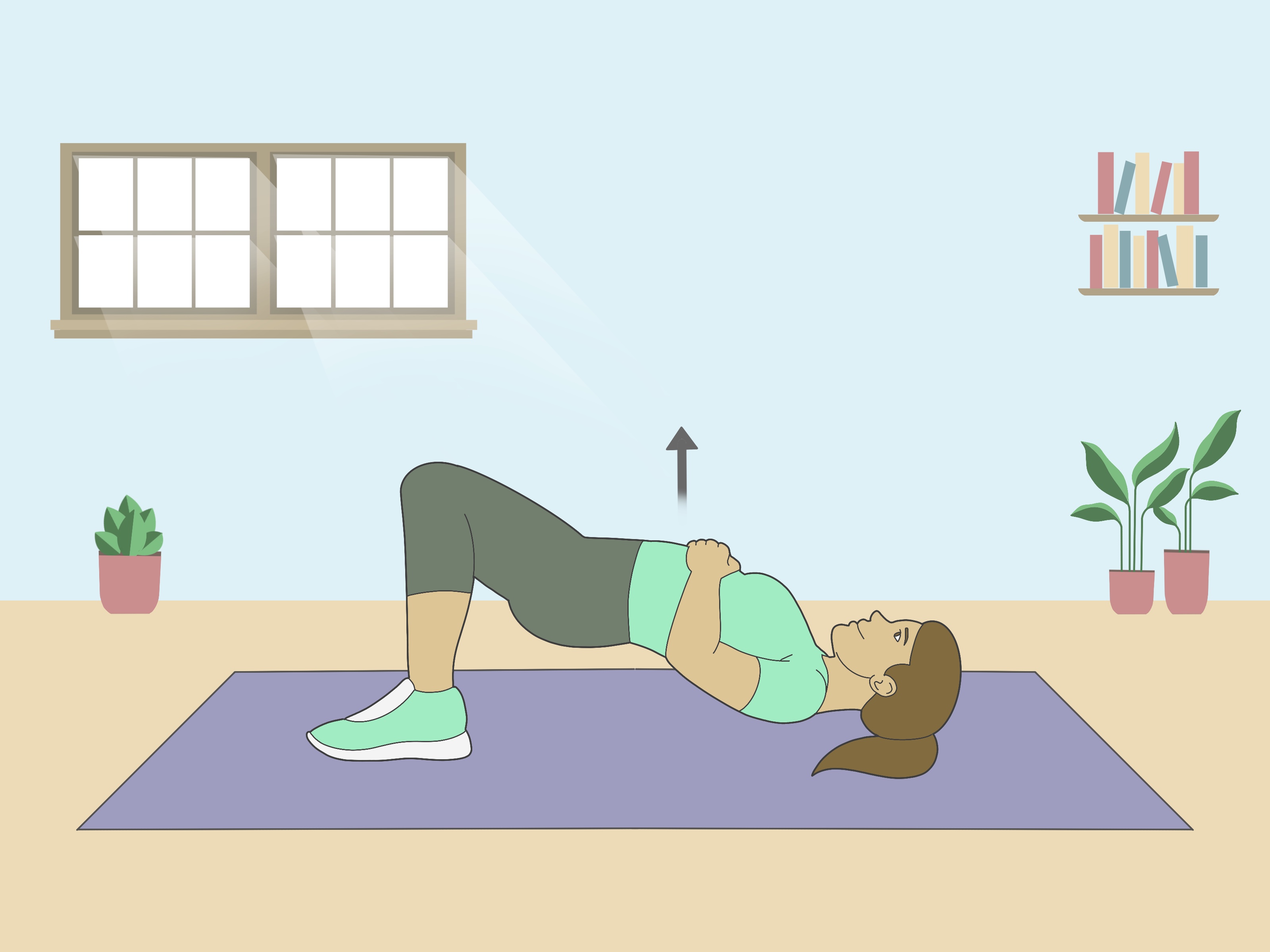
6. Pelvic Tilts
Pelvic tilts provide a small, controlled lumbar movement that can reduce stiffness without demanding much flexibility. They are a good choice when larger twists feel too intense.
- Lie on your back with your knees bent and feet hip-width apart.
- Rest your arms beside your body.
- Gently tighten your abdominal muscles.
- Tilt your pelvis so your lower back moves slightly closer to the floor.
- Hold for three to five seconds.
- Relax and allow your spine to return to its natural position.
- Repeat eight to fifteen times.
The movement should be subtle. You are not trying to lift your hips into a bridge or flatten your back with maximum force. Think “smooth adjustment,” not “hydraulic press.”
7. Seated Chair Rotation
A seated twist can be useful at work, but it should be performed on a stable, armless chairnot a rolling office chair with dreams of escape.
- Sit upright with both feet flat on the floor.
- Place your right hand on the outside of your left thigh.
- Place your left hand lightly behind you or on the side of the chair.
- Lengthen your spine before beginning the rotation.
- Slowly turn your chest toward the left.
- Keep your hips facing forward.
- Hold for approximately 10 seconds.
- Return to the center and repeat on the opposite side.
Use your hands for light guidance rather than leverage. Pulling hard on the chair can create more force than your lower back needs.
8. Supported Standing Back Extension
This gentle extension can counter the rounded posture created by prolonged sitting. However, it may not suit people whose symptoms worsen when bending backward.
- Stand with your feet approximately hip-width apart.
- Place your hands on your hips or the back of your pelvis.
- Gently tighten your abdominal muscles for support.
- Lift your chest and lean backward a small amount.
- Keep your knees soft and avoid throwing your head backward.
- Pause for one or two seconds.
- Return to neutral.
- Repeat three to five times.
Stop if this movement causes leg symptoms, pinching, dizziness, or increased back pain. Bigger is not better; a few degrees of movement may be plenty.
What Not to Do When Cracking Your Back
Some social-media back-cracking tricks look dramatic because drama gets clicks. Your lumbar spine, unfortunately, does not accept payment in likes.
- Do not ask someone to step, kneel, or jump on your back. Uncontrolled pressure can injure muscles, ribs, joints, or vulnerable spinal structures.
- Do not use fast, forceful twisting. Momentum may carry the spine beyond a comfortable range before you can react.
- Do not repeatedly crack the same area. Once a joint has moved, repeatedly forcing it may irritate surrounding tissues without producing meaningful relief.
- Do not use a foam roller directly under the lower spine to create extreme extension. The lumbar area lacks the protective rib-cage support found in the upper back.
- Do not continue through sharp pain. Pain is not evidence that a technique is “working deeply.” It is a reason to stop.
Is It Bad to Crack Your Lower Back Every Day?
Occasional painless popping during normal movement is generally not automatically concerning. However, needing to forcefully crack your back several times a day may indicate that you are treating a recurring sensation rather than its cause.
Frequent stiffness can be associated with long periods of sitting, poor workstation setup, limited hip mobility, inadequate physical activity, muscle fatigue, or an exercise routine that lacks balanced strength. Instead of repeatedly twisting for a few seconds of relief, consider taking movement breaks, walking regularly, adjusting your chair, and strengthening your abdominal, hip, and back muscles.
A physical therapist can evaluate how your hips, pelvis, and spine move together. This is especially useful when one side always feels tight, the urge to crack returns immediately, or discomfort affects sleep and everyday activities.
When Should You Avoid These Methods?
Do not attempt to crack or manipulate your lower back without medical guidance if you have:
- A recent fall, collision, sports injury, or lifting injury
- Known osteoporosis or a history of compression fractures
- Recent back, abdominal, or pelvic surgery
- A diagnosed spinal fracture, tumor, infection, or instability
- Severe arthritis or an inflammatory spinal condition
- New pain during pregnancy or pregnancy-related complications
- Back pain accompanied by unexplained fever or weight loss
- Leg weakness, numbness, or worsening balance problems
People with a diagnosed disc problem, spinal stenosis, spondylolisthesis, or persistent sciatica should ask a clinician which movements are appropriate. A stretch that helps one condition may aggravate another.
Lower-Back Warning Signs That Need Medical Attention
Seek urgent medical care if back pain follows significant trauma or occurs with loss of bladder or bowel control, numbness around the groin or inner thighs, rapidly worsening leg weakness, or difficulty urinating. These symptoms may indicate serious nerve compression.
You should also contact a healthcare professional when pain:
- Is severe or progressively worsening
- Radiates below the knee or causes persistent tingling
- Is accompanied by fever, chills, or unexplained weight loss
- Consistently wakes you from sleep
- Does not improve after several weeks of appropriate self-care
- Interferes with walking, working, sleeping, or other normal activities
How to Reduce the Urge to Crack Your Back
Take frequent movement breaks
Stand, walk, or change positions at least once every hour. Even a brief trip to refill your water can interrupt the stiffness caused by prolonged sitting.
Strengthen your core and hips
Exercises such as modified bridges, bird dogs, side steps, and other clinician-approved movements may improve spinal support. Strength work should be gradual and should not reproduce sharp pain.
Improve your workstation
Place your feet on the floor, support your lower back, and position your screen so you are not continually bending forward. The “perfect posture” is less important than changing positions regularly.
Walk regularly
Walking is an accessible, low-impact activity that promotes general movement and helps many people manage routine back stiffness. Start with a comfortable duration and increase it gradually.
Use heat for muscular stiffness
A warm shower or heating pad may relax tight muscles before gentle movement. Protect your skin, limit the duration, and avoid sleeping on a heating pad.
Experiences and Practical Lessons From Lower-Back Cracking
People often describe lower-back cracking as an instant “pressure release.” After sitting through a long meeting or driving for several hours, a slow twist may produce a pop and make standing upright feel easier. That experience is real, but it is easy to misinterpret. The sound can become the star of the show even though the helpful part was probably the movement, stretching, and change of position.
Consider the typical office worker who feels stiff at 3 p.m. At first, that person may twist sharply in the chair until the lower back cracks. The relief lasts ten minutes, so the process gets repeated several times. Eventually, the twisting becomes a habit. A more useful experiment is to replace the forceful crack with a two-minute routine: stand up, walk down the hallway, perform several pelvic tilts, and complete a gentle seated rotation. Many people find that the broader movement break provides longer-lasting comfort than a single aggressive twist.
Another common experience happens after exercise. Someone finishes squats, running, or yardwork and notices that one side of the lower back feels “stuck.” Pulling both knees toward the chest may create a pop, but a figure-four stretch reveals that the real tightness is concentrated in the hip and buttock. Once those areas relax, the back feels better even when no additional cracking occurs. This is a useful reminder that lower-back stiffness does not always originate in the exact spot where it is felt.
Morning stiffness provides a third lesson. Rolling directly into a deep spinal twist immediately after waking may feel too intense. Starting with a brief walk around the room, a warm shower, or several slow cat-cow repetitions often makes later stretches more comfortable. The body usually responds better to an invitation than an ambush.
There is also a psychological side to cracking. A pop offers immediate sensory feedback, so it can feel as though something important has been corrected. When no pop occurs, people may keep twisting farther, add hand pressure, or ask a friend to help. That is where a harmless habit can become risky. Silence does not mean failure. A gentle movement can improve mobility without producing any sound at all.
People who experience recurring pain often learn the most after working with a physical therapist. Instead of focusing only on the painful segment, the therapist may identify limited hip movement, reduced trunk endurance, an uneven lifting technique, or a workstation that keeps the body in one position for hours. Addressing those factors may reduce both the discomfort and the constant urge to crack the back.
The best practical rule is to judge a method by how your body feels during the next several hoursnot by how loud the pop was. A useful movement should leave you feeling the same or better. If soreness, leg pain, tingling, or reduced mobility follows, discontinue the technique and seek professional guidance.
Conclusion
The safest way to crack your lower back is not to force it. Gentle knee-to-chest stretches, controlled rotations, pelvic tilts, cat-cow movements, hip stretches, and supported extensions may ease stiffness and occasionally produce a natural pop. That sound is optional, not a certificate of success.
Warm up, move slowly, and stop before mild tension turns into pain. Avoid partner-assisted pressure, aggressive twisting, and repeated attempts to make the same joint crack. When stiffness keeps returning, your time is usually better spent improving movement habits, hip mobility, core strength, and workstation ergonomics.
Most importantly, do not use back cracking to cover up progressive pain or neurological symptoms. Your back may occasionally be noisy, but it should not be ignored when it is sending a genuine alarm.
SEO Tags
Note: This article provides general educational information and is not a diagnosis or a substitute for individualized medical care. Its safety guidance is based on information from major U.S. health and medical organizations, including the National Institutes of Health, NIAMS, NCCIH, MedlinePlus, Mayo Clinic, Cleveland Clinic, the American Academy of Orthopaedic Surgeons, Hospital for Special Surgery, Johns Hopkins Medicine, Duke Health, Harvard Health Publishing, and academic physical-therapy resources.