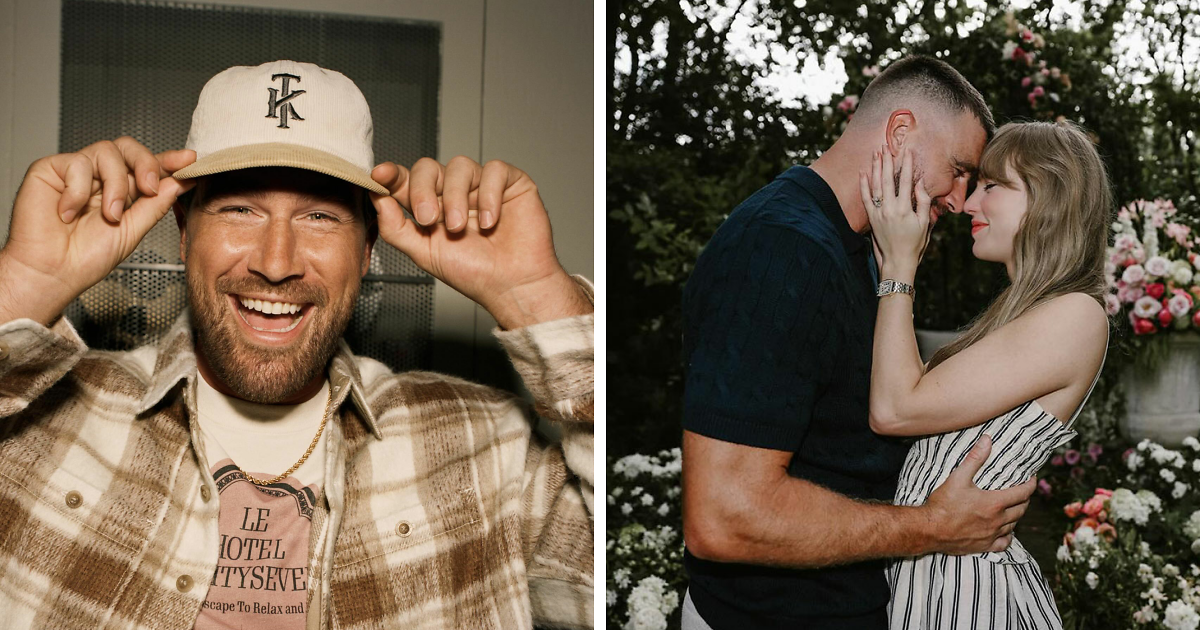
Taylor Swift and Travis Kelce’s engagement should have been the internet’s collective rom-com finale: flowers, a ring, a football star on one knee, and enough heart emojis to power a small suburb. Instead, the celebration quickly became something very 2025: a love story, a fashion campaign, a brand strategy debate, and a social media courtroom all at once.
Shortly after Swift and Kelce announced their engagement, Kelce’s new American Eagle collaboration with his lifestyle brand Tru Kolors hit the spotlight. The timing was so neat that some fans immediately raised an eyebrow. Was it just a happy coincidence? A perfectly scheduled business rollout? Or, as some online users dramatically claimed, a “marketing stunt” wrapped in roses and varsity jackets?
The truth is probably less scandalous and more modern: when two of the most famous people in entertainment and sports get engaged, every nearby brand, campaign, and social media manager suddenly starts sprinting like it is the fourth quarter. Swift and Kelce are not merely celebrities; they are cultural weather systems. When they move, everyone checks the forecast.
The Engagement That Broke The Internet All Over Again
Swift and Kelce announced their engagement in August 2025 through a joint Instagram post featuring a garden proposal, a large diamond ring, and the now-famous caption about an “English teacher” and a “gym teacher” getting married. It was sweet, self-aware, and designed with the kind of soft-focus polish that makes the internet pause mid-scroll.
For fans who had followed the couple since their relationship became public in 2023, the news felt like the next chapter in a story that had already blended pop music, NFL Sundays, sold-out stadiums, and podcast lore. Kelce’s early attempt to give Swift a friendship bracelet with his number on it had already become part of modern celebrity mythology. Swift cheering at Chiefs games, Kelce appearing at Eras Tour stops, and the pair slowly becoming more public made the engagement feel both surprising and inevitable.
But celebrity romance in the social media era rarely stays in one lane. Within minutes, congratulations were joined by analysis. Within hours, analysis was joined by conspiracy theories. And within a day, the arrival of Kelce’s American Eagle ad gave skeptics something shiny to point at.
Why Travis Kelce’s American Eagle Ad Fueled The “Marketing Stunt” Claims
The campaign in question was AE x Tru Kolors by Travis Kelce, a limited-edition fashion collaboration between American Eagle and Kelce’s own lifestyle brand. The line included more than 90 pieces, from tees and varsity jackets to rugby polos, cricket sweaters, cashmere sets, and casual statement pieces. The campaign also featured athletes such as Suni Lee, Azzi Fudd, Drew Allar, Jeremiah Smith, Kiyan Anthony, and Anna Frey.
On its own, the collaboration made sense. Kelce has long been known for bold tunnel outfits, playful tailoring, and a personal style that says, “Yes, I did check the mirror, and yes, I enjoyed what I saw.” American Eagle also had every reason to pursue a high-profile sports-meets-pop-culture partnership. Kelce is an NFL star, a podcast personality, a fashion risk-taker, and half of one of the most watched celebrity couples in the world.
The issue was timing. The engagement announcement came first. The campaign arrived almost immediately afterward. To casual observers, it looked like a marketing calendar had been sprinkled with fairy dust. To skeptical fans, it looked suspiciously convenient.
Online reactions ranged from amused to cynical. Some users joked that the engagement had turned into a shopping event before anyone could even ask about wedding colors. Others accused the couple, the NFL, American Eagle, and every brand within a five-mile radius of monetizing romance. A few fans defended the pair, pointing out that major fashion collaborations are planned months, sometimes more than a year, in advance. Kelce himself had said the project had been kept quiet for nearly a year, which strongly suggests this was not something thrown together overnight after a proposal photo went viral.
Coincidence Or Strategy? The Modern Celebrity Calendar Is Complicated
Calling the engagement a “marketing stunt” may be catchy, but it is also a big claim. A more careful reading is this: the engagement, the fashion collaboration, Swift’s album cycle, Kelce’s NFL season, and brand social media reactions all collided in the same attention economy.
Swift’s career has always involved precise storytelling. Album eras, visual clues, lyric references, surprise announcements, and carefully chosen public moments are part of her professional language. Kelce, meanwhile, has expanded beyond football into podcasting, entertainment, and fashion. Together, their public lives naturally create overlap between personal milestones and commercial opportunities.
That does not automatically make the relationship fake. It does mean their romance exists inside a world where every public detail becomes content. A proposal photo is not just a proposal photo when millions of people analyze the flowers, the caption, the ring, the timing, the outfit, the background song, and whether a cardigan is about to sell out.
In the past, celebrity engagement news lived mostly in magazines and entertainment shows. Today, it instantly becomes a multi-platform event. TikTok creators decode it. X users debate it. Instagram brands meme it. News outlets recap it. Fashion sites identify the clothes. Marketing analysts evaluate the business impact. Somewhere in the middle, two people may actually just be happy.
Brands Went Wild After The Engagement
American Eagle was not the only brand to benefit from the Swift-Kelce news cycle. After the engagement, several companies jumped into the conversation with jokes, promotions, and congratulatory posts. Food brands, fashion retailers, streaming platforms, and snack companies all treated the announcement like the Super Bowl of social media engagement.
Krispy Kreme celebrated with a limited free doughnut promotion. Other brands riffed on the “English teacher” and “gym teacher” caption. Some recreated outfits. Some inserted their products into the conversation. Some posts were clever. Some were charming. Some felt like a marketing intern had three minutes, one iced coffee, and a desperate need to meet the moment.
This is what happens when a celebrity couple becomes a shared cultural reference. Brands want proximity to attention. Swift and Kelce generate attention at a scale that few people can match. Even a playful post can bring huge reach when it connects to a topic everyone is discussing.
However, the brand pile-on also contributed to the backlash. When too many companies rush into a personal milestone, the moment can start to feel less like romance and more like a seasonal sale. Fans who were already wary of celebrity commercialization saw the ad campaign and brand reactions as proof that the engagement had been absorbed into a promotional machine.
Why Fans Are So Divided
The split in fan reaction comes down to trust, timing, and celebrity fatigue.
1. Some fans trust the love story
Many Swifties and NFL fans see the relationship as genuine because it has unfolded over time. They point to the couple’s public support for each other, the family connections, the podcast moments, and the way both stars appear comfortable being publicly silly, proud, and affectionate. For these fans, the marketing-stunt theory feels overly cynical.
2. Some fans distrust anything too polished
Other fans are skeptical because the announcement looked almost too perfect. A garden proposal, a viral caption, a ring close-up, a fashion campaign the next day, and album promotion nearby created a sequence that felt scripted to them. In an era when celebrity branding can be extremely strategic, people are quick to assume choreography.
3. Some people simply enjoy the drama
Let’s be honest: the internet likes a conspiracy theory the way a cat likes knocking a glass off the table. It may not be productive, but it gets attention. Calling something a “PR stunt” is an easy way to sound like you see behind the curtain, even when the curtain is mostly just a normal curtain with very good lighting.
The Business Side: Why Kelce’s Brand Benefits Either Way
Whether fans loved or questioned the timing, the American Eagle collaboration got exactly what every campaign wants: visibility. Kelce’s fashion line was suddenly discussed not only by sports outlets and style publications, but also by entertainment sites, pop-culture accounts, Swift fan pages, and casual observers who might not normally care about a football player’s clothing drop.
That is the power of association. Kelce’s name already carried value as a Chiefs star and Super Bowl champion. His relationship with Swift magnified his cultural reach. Add an engagement announcement, and the audience becomes even wider. People who may never watch a full NFL game now recognize Kelce. People who may never follow menswear accounts now know he has a fashion collaboration.
From a branding standpoint, this is gold. The collaboration connects sports, Gen Z fashion, celebrity romance, social media conversation, and the kind of public curiosity that cannot be purchased through ordinary ads alone. Even backlash can drive awareness, as long as it does not overwhelm the product itself.
But Does Good Timing Mean It Was Planned?
Good timing does not automatically equal manipulation. Major retail collaborations require design, manufacturing, campaign shoots, athlete coordination, media planning, inventory, and launch schedules. A collection with more than 90 pieces and multiple campaign faces is not created in a single afternoon because someone proposed in a flower garden.
What is more likely is that several planned events happened close together, and the internet connected them with a neon marker. The campaign had reportedly been in development for months. Swift’s album promotion had its own timeline. The NFL season was approaching. The engagement, according to family comments reported at the time, had taken place before the announcement was posted publicly.
In celebrity culture, announcements are rarely random. Public figures often choose when to share private news. That does not make the private news fake. It means the public release of the news may be timed with care. There is a difference between “strategically announced” and “not real.”
The Bigger Story: Love, Branding, And The Attention Economy
The Swift-Kelce engagement controversy says less about one couple and more about how audiences now experience fame. We no longer consume celebrity news as simple updates. We inspect it like a spreadsheet. We ask who benefits, what is being sold, what platform wins, and whether the emotional moment has a product tie-in hiding nearby.
That skepticism is understandable. Modern celebrity branding can be intense. Musicians sell albums, vinyl variants, films, merchandise, and experiences. Athletes sell apparel, podcasts, endorsements, and media appearances. Brands use pop culture to gain relevance. Fans have learned that attention is money, and famous people know it too.
Still, there is a danger in assuming every public joy is fake because it also has economic impact. A celebrity can be in love and profitable. A proposal can be sincere and photogenic. A campaign can be planned in advance and still benefit from lucky timing. Two truths can share the same stadium suite.
Specific Examples Of The Reaction Cycle
The reaction followed a familiar pattern. First came celebration: fans reposted the engagement photos, reacted to the ring, and praised the caption. Then came the brand wave: companies rushed to make jokes and promotions. Then came the skepticism: users questioned the timing of Kelce’s ad and Swift’s album rollout. Finally came the counterreaction: defenders argued that calling every celebrity milestone fake is exhausting, unfair, and impossible to prove.
This four-step cycle now happens constantly in pop culture. A celebrity announces news. Brands join. Critics accuse. Fans defend. The original event becomes less important than the debate around it. In this case, a proposal became a conversation about authenticity, consumerism, celebrity branding, NFL visibility, and whether romance can survive being turned into a trending topic.
Experience Section: What This Moment Teaches Anyone Watching From The Internet Sidelines
There is something oddly familiar about watching the Swift-Kelce engagement become a marketing debate. Most people are not global pop stars or NFL champions, but almost everyone knows what it feels like when a personal moment gets interpreted by other people. Post a vacation photo, and someone thinks you are showing off. Share good news, and someone wonders what you are not saying. Launch a project near a life event, and suddenly people become detectives with Wi-Fi.
The first lesson from this story is that timing changes perception. Even if two events are unrelated behind the scenes, their public closeness can make them feel connected. In everyday life, this happens all the time. A person announces a new relationship and then promotes a business. A creator shares a personal milestone and then releases merch. A company celebrates a cultural moment and then gets accused of chasing clout. The public does not see the months of planning; it sees the order of posts.
The second lesson is that audiences now expect transparency, but they also punish polish. If something looks messy, people call it careless. If it looks too polished, people call it fake. Swift and Kelce are caught in that impossible middle. Their engagement photos were beautiful, which made many fans happy and made some skeptics suspicious. Kelce’s ad looked professional, which is exactly what an ad is supposed to do, but the timing made it feel like part of a larger performance.
The third lesson is that online criticism often says as much about the audience as it does about the subject. Some fans have watched celebrity culture become increasingly commercial, so they bring that skepticism to every big moment. That does not make them irrational; it means they are reacting to an entertainment ecosystem where personal branding is everywhere. At the same time, constant suspicion can flatten human emotion. If every smile is strategy and every proposal is promotion, the internet becomes a very boring detective novel where the answer is always “PR.”
The fourth lesson is useful for brands. Jumping into a viral moment can work, but it requires taste. A clever post can feel like a wink. A lazy one can feel like a cash grab. The Swift-Kelce engagement gave companies a huge cultural wave to surf, but not every brand needed to grab a board. Sometimes the best marketing move is knowing when to say congratulations and step away before the comments section starts throwing tomatoes.
Finally, this moment shows why celebrity stories remain so powerful. People are not only reacting to Swift and Kelce. They are reacting to love, ambition, money, fame, sincerity, and the strange way all of those things mix online. The engagement became a mirror. Optimists saw romance. Skeptics saw strategy. Marketers saw opportunity. Fans saw a new era. And everyone else saw a reminder that in 2025, even a proposal can become a full-service content package before dinner.
Conclusion: A Real Engagement In A Very Branded World
Fans calling Taylor Swift’s engagement a “marketing stunt” after Travis Kelce’s American Eagle ad says a lot about modern celebrity culture. The timing was undeniably convenient. The brand response was loud. The fashion campaign gained huge attention. Swift’s album cycle and Kelce’s expanding business profile added even more fuel to the speculation.
But convenient timing is not proof of a fake relationship. What it proves is that Swift and Kelce live at the center of an attention economy where personal news, professional projects, fan emotion, and brand strategy constantly overlap. Their engagement may be romantic, marketable, and culturally enormous all at once. That is not a contradiction. That is modern fame.
So was the engagement a marketing stunt? Based on available public information, there is no solid evidence for that claim. What is clear is that the announcement became a marketing moment whether Swift and Kelce intended it or not. In today’s internet, love may be private for two people, but the second it goes public, the brands arrive wearing sneakers, holding doughnuts, and asking if anyone needs a caption.
Note: This article analyzes public reaction, entertainment coverage, and brand timing. It does not claim that Taylor Swift and Travis Kelce staged their engagement.