Note: This article is written for web publishing in clean HTML body format, based on real NASA mission information and current Mars exploration updates.
Introduction: Meet the Rover That Refused to Be Ordinary
NASA’s Perseverance Mars Rover is not your average remote-controlled science buggy. It is a six-wheeled robotic geologist, climate observer, sample collector, experimental oxygen maker, high-resolution photographer, and unofficial mayor of Jezero Crater. If Mars had a neighborhood watch, Perseverance would be rolling through it with a laser, a drill, and a very serious job description.
Launched on July 30, 2020, and landed on Mars on February 18, 2021, Perseverance is part of NASA’s Mars 2020 mission. Its main assignment sounds simple, but it is one of the biggest scientific questions humans have ever asked: Did Mars once support life? To answer that, the rover studies rocks, dust, weather, ancient lake deposits, and possible biosignaturesfeatures that may preserve signs of ancient microbial activity.
Perseverance landed in Jezero Crater, a location scientists selected because it once held a lake and river delta billions of years ago. On Earth, ancient river deltas can preserve evidence of life beautifully. On Mars, the same idea is much harder, dustier, colder, and about 140 million miles less convenient. That is why NASA sent a rover built like a laboratory on wheels.
What Is NASA’s Perseverance Mars Rover?
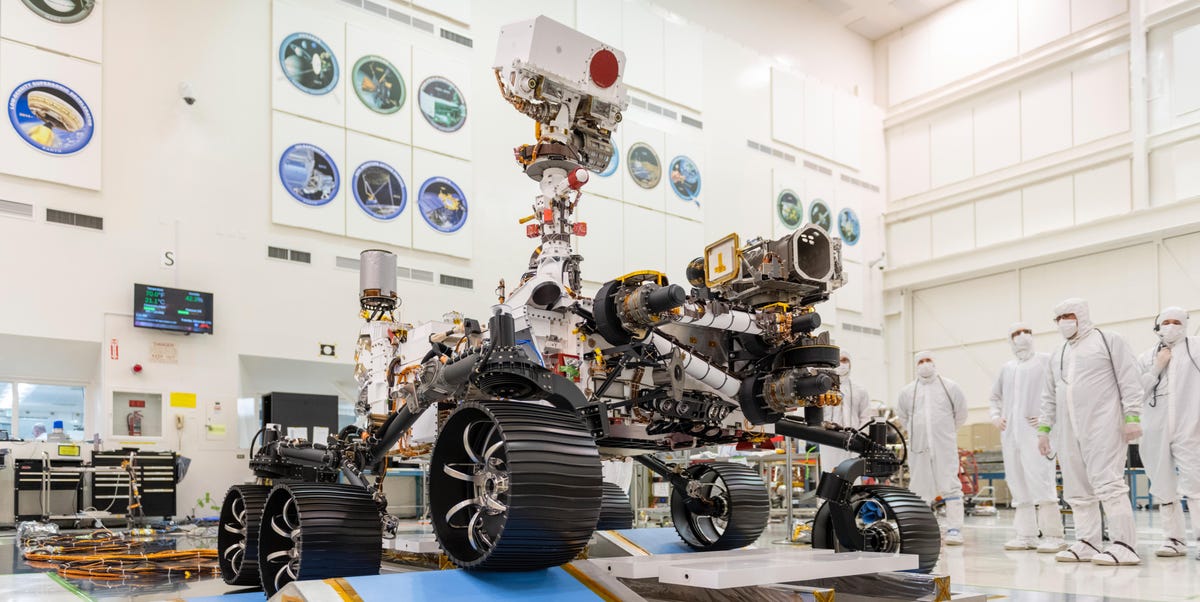
Perseverance is a car-sized robotic explorer designed to investigate the geology and astrobiological history of Mars. It is about the size of a small SUV, weighs roughly a metric ton, and travels on six rugged wheels built to handle rocky Martian terrain. It is powered by a radioisotope power system, allowing it to operate day and night without relying on solar panels.
The rover is operated by teams on Earth, but it cannot be driven like a toy car because radio signals take minutes to travel between Earth and Mars. Instead, mission engineers send commands, and Perseverance uses onboard navigation systems to plan safe routes, avoid hazards, and keep moving toward science targets. In other words, it has a better sense of direction than many people leaving a shopping mall parking lot.
Why Jezero Crater Matters
Jezero Crater is one of the most important destinations ever explored on Mars. Scientists believe it held water more than 3.5 billion years ago, including a lake, river channels, and a fan-shaped delta. Those features matter because water is one of the key ingredients associated with life as we know it.
The crater also contains a wide variety of rocks, including sedimentary deposits, igneous materials, and minerals altered by water. This makes Jezero a natural archive of Mars’ early history. By studying its rocks layer by layer, Perseverance helps scientists reconstruct what the environment may have been like when Mars was warmer, wetter, and possibly more welcoming to microbial life.
The Ancient Lake and Delta
One of the rover’s most exciting targets is the ancient river delta inside Jezero. Deltas on Earth often trap organic material, fine sediments, and chemical clues. If ancient Martian microbes ever existed in or near Jezero’s water system, delta rocks could be among the best places to look for preserved evidence.
Perseverance has also studied areas beyond the crater floor and delta, including the crater rim and nearby highlands. These older rocks may preserve records from a very early period in Martian history, offering clues about the planet’s formation, water activity, and habitability.
Main Goals of the Perseverance Mission
NASA designed Perseverance with four major science and exploration goals. First, the rover searches for signs of ancient life. Second, it characterizes Mars’ geology and climate. Third, it collects carefully selected rock and soil samples for possible return to Earth. Fourth, it tests technologies that could support future human missions to Mars.
Searching for Ancient Life
Perseverance is not looking for little green Martians waving from behind a boulder. It is searching for possible signs of ancient microbial life, such as chemical patterns, minerals, textures, or organic molecules that may have formed in life-friendly environments. Any promising discovery still requires careful confirmation because non-biological processes can sometimes create similar features.
Collecting Mars Samples
One of Perseverance’s most important jobs is sample caching. The rover drills cores from Martian rocks, seals them in titanium tubes, and stores them for possible future return to Earth. These samples could become some of the most valuable scientific materials ever collected, because laboratories on Earth can analyze them with instruments far more powerful than anything that can fit on a rover.
In 2023, Perseverance completed a backup sample depot on the Martian surface, carefully placing ten tubes in an organized pattern. The idea is wonderfully practical: if the rover cannot deliver samples directly to a future retrieval mission, scientists still have a backup collection waiting on the ground. Mars may be harsh, but NASA clearly believes in having a Plan B.
The Science Instruments on Perseverance
Perseverance carries seven primary science instruments, each with a specialized role. Together, they allow the rover to see, scan, drill, analyze, listen, measure weather, and peek below the surface. It is basically a science fair project that grew up, got a nuclear battery, and moved to another planet.
Mastcam-Z
Mastcam-Z is the rover’s advanced camera system. It captures color images, panoramas, 3D views, and zoomed-in details of distant rocks and landscapes. These images help scientists choose driving routes and identify geological targets worth investigating.
SuperCam
SuperCam studies rocks and soils from a distance using cameras, spectrometers, and a laser. Yes, the rover really can zap rocks with a laser. The laser vaporizes tiny amounts of material, and the instrument reads the light produced to determine chemical composition. It is science, not space vandalism.
PIXL
PIXL, short for Planetary Instrument for X-ray Lithochemistry, examines the fine-scale chemical makeup of rocks. It helps scientists understand how minerals formed and whether the environment may once have been suitable for life.
SHERLOC and WATSON
SHERLOC searches for organic compounds and minerals using ultraviolet light. WATSON, its close-up camera, takes detailed images of rock textures. Together, they help scientists inspect surfaces that may preserve chemical or structural clues about ancient Martian environments.
RIMFAX
RIMFAX is a ground-penetrating radar instrument. It lets Perseverance look below the Martian surface and study buried layers, which can reveal ancient geological structures, erosion patterns, and possible evidence of past water movement.
MEDA
MEDA, the Mars Environmental Dynamics Analyzer, measures weather conditions such as temperature, wind, pressure, humidity, and dust. Mars weather is not exactly beach weather, but understanding it is essential for science and future human exploration.
MOXIE
MOXIE was a technology demonstration that produced oxygen from carbon dioxide in the Martian atmosphere. It completed its mission after multiple successful oxygen-producing runs. This matters because future astronauts may need to make oxygen on Mars for breathing and rocket fuel instead of bringing every molecule from Earth.
Perseverance and Ingenuity: The Rover and the Little Helicopter That Could
Perseverance did not arrive alone. Attached beneath its belly was Ingenuity, a small experimental helicopter designed to test powered flight in the thin Martian atmosphere. Originally planned for only a handful of flights, Ingenuity wildly exceeded expectations by completing 72 flights before its mission ended in 2024.
Ingenuity proved that controlled flight on Mars was possible. It also helped scout terrain and inspired future aerial exploration concepts. Its success was one of those rare space moments where the engineering team probably deserved both a medal and a nap.
What Has Perseverance Discovered?
Perseverance has already reshaped our understanding of Mars. It has confirmed that Jezero Crater contains rocks shaped by water, documented ancient delta deposits, collected diverse samples, and observed minerals and textures that may be important for astrobiology.
One of the most discussed findings involves a rock nicknamed Cheyava Falls and a sample called Sapphire Canyon. Scientists reported that the rock contains features described as potential biosignatures, including distinctive spots and mineral patterns. However, NASA has been careful: this is not proof of life. It is an intriguing clue that requires more study, ideally in laboratories on Earth.
That caution is important. Science is not a game of shouting “aliens!” every time a rock looks interesting. The responsible approach is to test multiple explanations, compare the evidence, and avoid jumping to conclusions faster than a rover descending by sky crane.
The Mars Sample Return Connection
Perseverance’s samples are central to the broader goal of Mars Sample Return, a proposed campaign to bring selected Martian materials to Earth for detailed analysis. The plan has faced technical, budget, and scheduling challenges, but the scientific value of returning samples remains enormous.
On Earth, scientists could examine Martian rocks using powerful microscopes, chemical analyzers, isotope instruments, and biological screening tools. These tests could help determine whether Mars ever had conditions suitable for life and whether any preserved features are biological or purely geological.
How Perseverance Drives on Mars
Driving on Mars is slow, careful, and complicated. The rover must avoid sharp rocks, deep sand, steep slopes, and terrain that could damage its wheels or instruments. Perseverance uses cameras and autonomous navigation software to evaluate the ground ahead. Engineers on Earth plan routes, but the rover can make some decisions on its own.
This ability allows Perseverance to cover more ground than older rovers could manage under constant human direction. As of recent mission updates, the rover has continued traveling across and beyond Jezero Crater, approaching major distance milestones while still conducting science operations.
Why Perseverance Matters for Future Human Missions
Perseverance is not only studying Mars’ past. It is helping prepare for Mars’ future. MOXIE tested oxygen production. MEDA collects weather data useful for mission planning. Surface images help scientists understand terrain hazards. Dust observations, temperature readings, and atmospheric measurements all contribute to the practical knowledge humans will need before setting foot on the Red Planet.
Future astronauts will need to know where to land, how to operate equipment, how dust behaves, how cold nights become, and how to use local resources. Perseverance is helping answer those questions one sol at a time.
Why the Rover Is Named Perseverance
The name “Perseverance” was selected through a student naming contest, and it fits perfectly. Mars missions demand patience, resilience, and creativity. The rover survived launch, interplanetary cruise, atmospheric entry, sky-crane landing, dust, rocks, software updates, and years of exploration. That is perseverance in the most literal, six-wheeled sense.
The name also reflects human exploration itself. Space science is rarely quick or easy. Missions take years to design, build, launch, operate, and interpret. Every image from Mars represents the work of engineers, scientists, technicians, programmers, mission planners, and students who believed the question was worth the effort.
Common Questions About NASA’s Perseverance Mars Rover
Is Perseverance Still Working?
Yes. Perseverance continues to operate on Mars, exploring new terrain, collecting data, and supporting the long-term scientific goals of the Mars 2020 mission.
Did Perseverance Find Life on Mars?
No confirmed life has been found on Mars. Perseverance has discovered intriguing rocks and possible biosignature candidates, but scientists must rule out non-biological explanations before making any major claim.
Can Perseverance Come Back to Earth?
No. Perseverance is not designed to return to Earth. Its samples may be retrieved by a future mission, but the rover itself will remain on Mars.
How Long Will Perseverance Last?
The rover was designed for a prime mission of at least one Martian year, equal to about 687 Earth days. It has already far exceeded that goal and continues to provide valuable science.
Experience Section: What Perseverance Teaches Us About Curiosity, Patience, and Big Questions
Following the Perseverance mission feels a little like reading the slowest, smartest adventure story ever written. There are no daily explosions, no dramatic space battles, and no Martian traffic jams. Instead, the excitement comes from tiny victories: a successful drive, a clear panorama, a carefully drilled sample, a strange rock texture, a weather reading, or a new clue hiding in ancient stone.
One of the most powerful experiences connected to Perseverance is realizing how much patience real discovery requires. Online, we are used to instant answers. Ask a question, get a result, move on. Mars does not work that way. A single rock may take days or weeks to study. A sample collected today may not reveal its deepest secrets until years later, perhaps only after it reaches a laboratory on Earth. Perseverance reminds us that important answers often arrive slowly.
The mission also changes how we think about distance. Mars can look close in photographs, especially when Perseverance sends back crisp images of pebbles, dunes, and distant hills. Yet every image traveled across millions of miles of space. A dusty rock on your screen represents a chain of engineering so complex it almost sounds fictional: a rover on another planet, communicating with orbiters, sending data to Earth, interpreted by scientists who may be sitting at desks with coffee mugs and very full calendars.
There is also something emotionally powerful about seeing a human-made machine explore an empty landscape. Perseverance has no emotions, no homesickness, and no opinion about sunsets. Still, people naturally attach meaning to its journey. It becomes a symbol of curiosity. It is proof that humans can ask a question so big“Was there ever life beyond Earth?”that we build a robotic scientist and send it to another world to investigate.
For students, writers, science fans, and casual readers, Perseverance offers a useful lesson: exploration is not only about reaching a destination. It is about learning how to ask better questions. At first, the question may be broad: Was Mars once habitable? Then it becomes more precise: Which rocks formed in water? Which minerals suggest chemical energy? Which samples should be saved? Which features are interesting but explainable without biology?
That process is valuable far beyond Mars. Whether someone is studying science, building a business, learning a skill, or solving a personal challenge, the Perseverance approach applies: observe carefully, test patiently, keep records, adjust the plan, and do not confuse a clue with a conclusion. Also, when possible, bring a laser. Actually, maybe not that last part.
The rover’s journey is also a reminder that failure and adjustment are part of serious exploration. Not every sample attempt works perfectly. Not every route is simple. Ingenuity eventually ended its flight mission. Mars Sample Return has faced uncertainty. Yet none of that erases the achievement. It makes the achievement more human. Great missions are not smooth roads; they are long roads traveled carefully.
Perseverance gives us a front-row seat to a scientific mystery still unfolding. It has not delivered a final answer about life on Mars, and that is exactly what makes the story compelling. The rover is still gathering clues, one rock at a time, in a crater that once held water under an ancient sky. For now, the Red Planet is keeping some of its secrets. Perseverance, true to its name, keeps asking.
Conclusion: Why Perseverance Is One of NASA’s Most Important Mars Missions
NASA’s Perseverance Mars Rover is more than a machine on another planet. It is a mobile laboratory built to investigate Mars’ ancient habitability, collect priceless samples, test future exploration technologies, and deepen humanity’s understanding of the Red Planet. From Jezero Crater’s ancient delta to the rover’s carefully sealed sample tubes, every part of the mission points toward one of science’s greatest questions: did life ever exist beyond Earth?
Perseverance has already exceeded its original mission timeline, supported the first powered flights on another planet through Ingenuity, tested oxygen production with MOXIE, and collected samples that may one day transform planetary science. It has shown that Mars is not just a cold desert in the sky. It is a world with history, chemistry, landscapes, and clues waiting patiently in stone.
The story is still being written. And somewhere on Mars, a rover named Perseverance continues to roll forward, proving that curiosity has wheels.