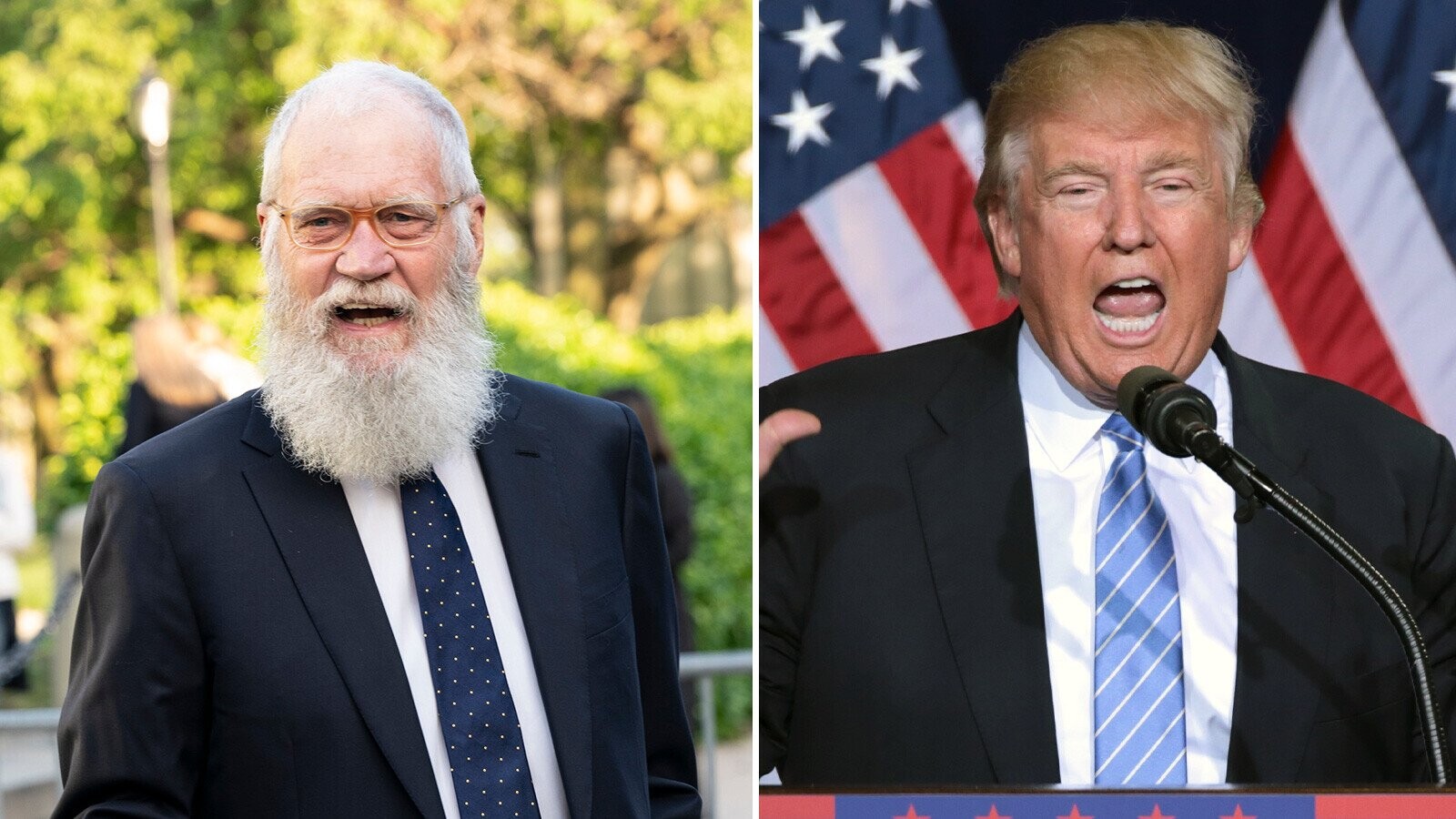
Donald Trump’s long-running battle with late-night television has added a familiar face to its cast: David Letterman. The retired host has been needling Trump for decades, but the latest clash was not sparked by a fresh monologue, a celebrity interview, or even one of Letterman’s famous Top Ten lists. It began when Letterman defended Jimmy Kimmel and criticized the political pressure surrounding ABC’s temporary suspension of Jimmy Kimmel Live! in September 2025.
Trump answered in the style he has made unmistakably his own. Rather than debating Letterman’s warning about media freedom, he attacked the comedian’s ratings, appearance, and relevance, calling him “highly overrated” and a “loser.” It was less a policy rebuttal than a digital heckle delivered from the presidential balcony. Letterman had questioned the use of political power around comedy; Trump responded with the verbal equivalent of throwing a tomato at the stage.
The exchange may look like another celebrity feud designed to feed the social-media furnace. Yet it raises a larger question: What happens when a president treats comedians, networks, and critical entertainment programs as political opponents rather than cultural irritants? That is why the Trump-David Letterman feud matters beyond two famous men trading insults.
Why Donald Trump Turned His Attention to David Letterman
Letterman Spoke Up for Jimmy Kimmel
The immediate trigger was ABC’s decision to suspend Jimmy Kimmel’s late-night show on September 17, 2025. Kimmel had drawn criticism for a monologue about the political response to the killing of conservative activist Charlie Kirk. The controversy intensified after Federal Communications Commission Chairman Brendan Carr criticized the remarks and discussed possible consequences for broadcasters. Major station groups, including Nexstar and Sinclair, also moved to preempt the program.
ABC described the removal as an indefinite suspension, although Kimmel returned to the air less than a week later. The short duration did not make the episode feel minor. To critics, the sequence looked alarming: a government regulator publicly condemned a comedian, large affiliate owners withdrew the show, and the network quickly pulled it. Supporters of the suspension argued that broadcasters and employers are entitled to respond when on-air comments are viewed as inaccurate, offensive, or irresponsible.
Letterman addressed the controversy at The Atlantic Festival. He said the situation resembled “managed media” and contrasted it with his own years of mocking presidents from both parties without pressure from federal agencies. His central argument was not that comedians are immune from criticism. It was that government power should not appear to hover over a network’s programming choices like a stern principal standing behind the school newspaper editor.
Trump Made the Disagreement Personal
Trump’s reply on Truth Social focused on Letterman rather than the substance of his complaint. He questioned Letterman’s old ratings, mocked his appearance, and praised him only for knowing when to retire. This response followed a recurring Trump formula: challenge the critic’s status, talent, audience size, looks, or business success, then frame the critic as a failed entertainer seeking attention.
The tactic is politically useful because it converts an institutional debate into a personality contest. “Should officials pressure broadcasters?” is a complicated question involving law, regulation, corporate incentives, and constitutional principles. “Who is the bigger loser?” fits comfortably on a phone screen before breakfast.
David Letterman Is Not a New Trump Critic
Trump and Letterman were not always enemies. Before Trump became a political figure, he was a recurring late-night guest: wealthy, boastful, camera-ready, and willing to play along. That made him ideal material for Letterman, whose comedy often relied on letting a public figure talk until the absurdity introduced itself.
In a 1987 appearance, Letterman pressed Trump about his net worth. Years later, old interview clips became historical artifacts from an era when Trump was treated mainly as a celebrity businessman. In 2012, Letterman challenged Trump over his criticism of China by pointing out that Trump-branded ties were manufactured there. The exchange captured the old relationship perfectly: Trump supplied the grand claim, and Letterman quietly pulled a loose thread until the suit started coming apart.
After Trump launched his presidential campaign in 2015, Letterman joked that retiring had been the biggest mistake of his life because he no longer had a nightly platform from which to cover the spectacle. He soon delivered a Trump-themed Top Ten list during a live appearance. By 2017, his criticism had become more serious. Letterman said Trump’s conduct was insulting to the presidency and argued that comedians had an obligation to keep mocking powerful figures.
That history explains why Trump’s 2025 attack felt both new and inevitable. Letterman was no longer merely the retired host who once interviewed him. He had become an elder statesman of late-night comedy publicly accusing the administration of creating a chilling atmosphere around political satire.
Why Letterman Is a Particularly Awkward Target
A current host answers to advertisers, affiliates, executives, contracts, and quarterly earnings calls. A retired David Letterman is harder to pressure. No station group can preempt his next episode because there is no next episode, and no nervous executive can move his monologue to 2:17 a.m.
Letterman also speaks with the credibility of someone who spent more than three decades inside network television. Trump’s insult may energize supporters, but it has little practical leverage over him. In fact, calling Letterman irrelevant placed him back in national headlinesa curious way to prove that nobody is listening.
The Real Dispute Is About Power, Not Punchlines
A Network Can Discipline a Host
The First Amendment does not require a private television network to employ any particular comedian. ABC can make programming decisions, affiliates can decline to air content, advertisers can leave, viewers can complain, and hosts can face consequences. That is part of the normal, sometimes messy relationship between speech and private institutions.
Government Pressure Changes the Equation
The constitutional concern becomes sharper when public officials appear to threaten regulatory consequences because they dislike protected commentary. Broadcast companies operate in a regulated environment, and station owners depend on FCC licenses. Even without a formal order, critics argue that public warnings from a powerful regulator can influence corporate behavior.
Carr later disputed claims that the FCC had threatened to revoke licenses unless Disney fired Kimmel. He argued that broadcasters have legal obligations distinct from cable channels and online platforms, and that affiliate owners were exercising their own judgment. Civil-liberties groups, entertainers, Democratic lawmakers, and one FCC commissioner reached a different conclusion, describing the episode as coercive and dangerous to free expression.
That disagreement deserves more than team-sports shouting. It is possible to believe Kimmel’s comments were poorly phrased while also worrying about political officials encouraging broadcasters to punish him. It is also possible to defend a company’s right to suspend an employee while questioning whether the company would have acted at the same speed without regulatory pressure. The uncomfortable part is the overlap.
Trump’s Broader War With Late-Night Television
Letterman joined a crowded list of Trump targets. Trump has repeatedly criticized Jimmy Kimmel, Stephen Colbert, Seth Meyers, and Jimmy Fallon, often citing ratings and talent while urging networks to remove hosts. The complaints are partly cultural. Most major late-night programs have leaned heavily into anti-Trump comedy, and their audiences often skew toward viewers who already dislike him.
But Trump does not treat the shows as harmless background noise. He responds to them as participants in political conflict. In his view, a critical monologue is not just a joke; it is hostile messaging distributed by a powerful media company. His critics counter that ridicule is one of the oldest tools used to challenge leaders and that presidents should tolerate mockery without invoking the machinery of government.
The tension is intensified by the shrinking economics of traditional late-night television. Streaming, podcasts, social clips, and changing viewing habits have weakened the old business model. Networks can therefore cite real financial pressures when reducing or canceling expensive programs, while skeptics can still wonder whether political controversy influenced the timing. Money and politics can occupy the same conference room, even when neither one signs the visitor log.
Why the Attack May Help Letterman
Letterman built his reputation by mocking authority, show-business vanity, and people who took themselves too seriously. Being insulted by a president for defending another comedian fits his brand almost too neatlythe late-career equivalent of a lifetime achievement award delivered in all caps.
The clash also reminds younger audiences why Letterman mattered. His skeptical interviews and institutional mischief helped establish late night as a place where carefully managed public images could be punctured. One festival appearance and one furious presidential post put him back in that familiar role.
What the Feud Reveals About Political Communication
Letterman offered a structural criticism about media control. Trump supplied a personal attack that was easier to quote, headline, and share. The insult traveled farther than the argument, which is exactly how the modern attention economy works.
Letterman understands that machinery because late-night television helped build an earlier version of it. A sharp joke once defined a politician for viewers the next morning. Today, the president, comedian, networks, activists, and algorithms occupy the same endless showand nobody can find the commercial break.
The Experience Behind the Headlines: What This Feud Feels Like in Practice
For viewers, the experience is strangely exhausting. A person turns on a comedy show hoping for ten minutes of jokes before bed and ends up in a constitutional argument involving broadcast licenses, affiliate ownership, political violence, corporate risk, and federal regulation. The entertainment is still there, but it arrives carrying a briefcase full of legal questions. Even people who dislike Kimmel or Letterman may feel uneasy when a comedy controversy starts sounding like a test of institutional independence.
For comedy writers, the atmosphere can create a new layer of calculation. Writers have always worried about standards, audience reaction, advertisers, and whether a joke is funny enough to survive rehearsal. Political pressure adds another question: Could this line trigger a campaign not merely against the joke, but against the network’s licenses, ownership deals, or executives? Nobody needs to issue a direct ban for caution to spread. Sometimes the possibility of retaliation is enough to make a room edit itself.
For network executives, the experience is less like defending a grand principle and more like standing in the middle of a kitchen fire while shareholders ask about dessert. They must weigh legal exposure, affiliate relations, audience anger, employee morale, regulatory interests, and revenue. A decision presented publicly as a matter of taste may also reflect business fears that cannot be neatly summarized in a press release. This is why outsiders often suspect hidden motives, even when executives insist the decision was editorial.
For Trump supporters, the episode can feel like long-delayed accountability for an entertainment industry that routinely mocks their preferred candidate and their values. They may see late-night hosts not as brave truth-tellers but as wealthy partisans protected by corporate platforms. From that perspective, complaints about censorship sound selective, especially when other employees have lost jobs over controversial speech without receiving celebrity support.
For Trump critics, the same sequence feels more ominous. They see a president celebrating the removal of a critic, a regulator publicly condemning protected speech, and corporations responding quickly. The fear is not that every comedian will disappear tomorrow. It is that repeated pressure teaches media companies to avoid trouble before trouble arrives. The result would not necessarily be official censorship with stamped documents and locked studio doors. It could be softer: fewer risky jokes, safer guests, vaguer monologues, and executives who decide that political comedy is no longer worth the headache.
Letterman’s role in this experience is important because he remembers a different norm. He mocked presidents for years and expected annoyance, not regulatory drama. His comments offered a before-and-after comparison from someone who lived inside the system. Whether one agrees with his politics or not, that institutional memory is valuable. It helps explain why the clash is bigger than an insult about ratings or facial hair. The real story is how quickly satire, corporate power, government influence, and partisan identity now collide.
Conclusion: Letterman Is the Target, but Late-Night Freedom Is the Story
Donald Trump’s attack on David Letterman was personal, theatrical, and perfectly designed for social media. Yet the dispute underneath it is serious. Letterman argued that political power should not be usedor appear to be usedto frighten media companies into disciplining comedians. Trump dismissed the messenger as overrated and irrelevant.
The irony is that Trump’s response proved Letterman’s relevance. A retired host made a brief argument about media pressure, and the president amplified it to the entire country. The resulting spectacle revived an old rivalry while exposing a newer anxiety: late-night television may be weaker as a business, but it remains powerful enough to anger presidents.
Letterman is unlikely to return to a nightly desk, and Trump is unlikely to stop answering critics with personal attacks. Their feud will probably continue in occasional burstspart political argument, part show-business grudge, and part reunion episode nobody ordered. The jokes may be familiar, but the stakes surrounding them have changed.
Editor’s note: This article analyzes events that began in September 2025 and includes subsequent context available through July 2026. Reporting was cross-checked against major U.S. news, entertainment, civil-liberties, and regulatory sources.